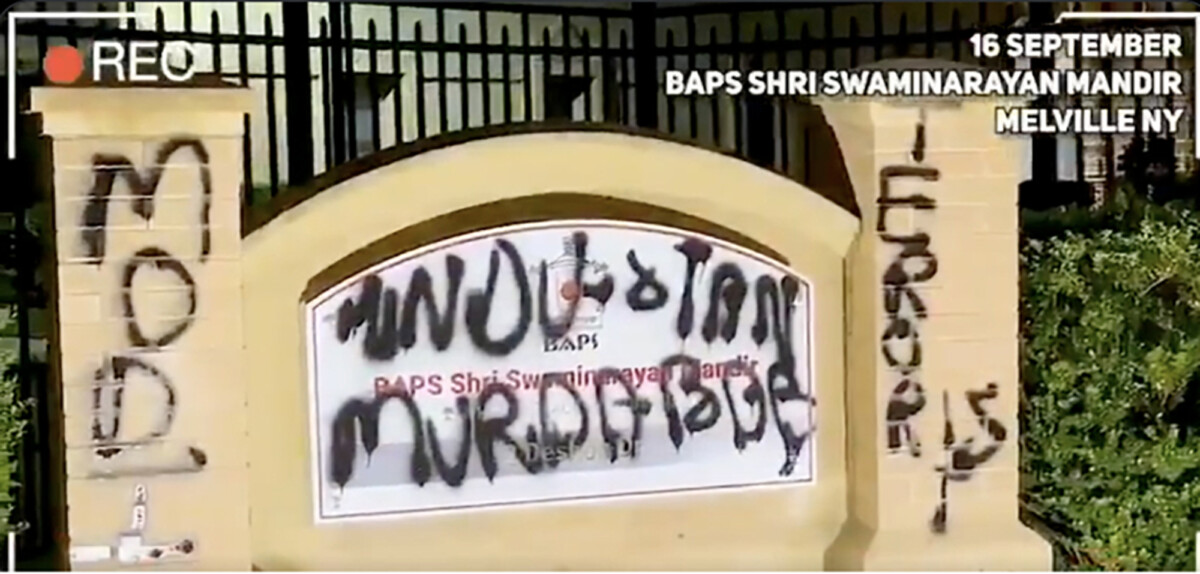
Recent incidents of vandalism against Hindu temples in the United States, including a BAPS mandir in Indiana, reveal a troubling pattern: spray-painted death threats aimed at Hindus, India, and public figures associated with India’s government. These nearly identical acts, repeated across multiple cities over the past year, constitute a serious hate-crime trend that demands a coordinated, informed, and unwavering response from the Hindu American community and allied dharmic traditions.
While geographically distant from the subcontinent, diaspora communities are increasingly confronted by imported political disputes and communal tensions. Mandirsspaces of worship, solace, service, and educationare being miscast as political proxies. This mischaracterization threatens religious freedom, community safety, and the dignity of peaceful congregants who seek only spiritual practice and cultural continuity.
Evidence suggests that fringe separatist networks associated with the Khalistan movementsome with alleged links to international organized crime and terrorism as reflected in publicly reported arrestsare attempting to intimidate community institutions by conflating temples with state power. Such narratives falsely presume that Hindus collectively embody a political stance. In reality, the vast majority of Sikhs in the United States and India firmly reject vandalism, separatist violence, and intimidation. Strengthening solidarity between Hindus, Sikhs, Jains, and Buddhists is essential to preventing extremist actors from sowing discord among dharmic communities.
The scope of this threat is broader than isolated graffiti. By credible counts, at least 20 incidents since 2022across the United States, Canada, and Australiahave targeted mandirs and even statues of Mahatma Gandhi outside temples, signaling a sustained campaign against visible symbols of Hindu heritage. These are not routine public nuisances; they are calculated attempts to normalize menace, erode confidence, and chill religious expression.
Historically, some institutions have quietly removed the graffiti, resumed programming, and hoped the problem would pass. Although motivated by a desire for calm, this approach underestimates the adaptive nature of organized intimidation. Failing to document, report, and publicly contextualize these crimes can unintentionally embolden repeat offenders and obscure the pattern for law enforcement and policymakers.
Effective prevention requires precision, unity, and due process. Communities can: (1) clearly describe the threat without stigmatizing any faith community; (2) engage law enforcement with incident timelines, imagery, and pattern analysis; (3) brief elected officials on risk indicators and community impacts; (4) build interfaith coalitionsespecially with Sikh, Jain, and Buddhist leadersto deliver a unified public message against hate; (5) conduct security audits, improve lighting and CCTV coverage, and standardize incident response protocols; (6) proactively brief local media to ensure accurate, non-sensational coverage; and (7) utilize civil rights and hate-crime reporting channels to pursue accountability under the law.
Community experiences underscore the human cost: elders hesitate to attend evening aarti, volunteers feel compelled to add new safety roles, and children ask why anyone would deface a place where families pray and serve. These moments reveal why mandirs must be protectednot simply as religious spaces but as hubs of charitable outreach, education, and interfaith engagement. Ensuring safety preserves the capacity to host food drives, youth classes, and dialogues that build resilient neighborhoods.
The path forward is neither silence nor retaliation, but principled couragenaming the problem, safeguarding sacred spaces, and standing together across dharmic traditions. When Hindus, Sikhs, Jains, and Buddhists present a united front, extremist narratives lose credibility and oxygen. With consistent documentation, community education, and law enforcement partnership, these criminal acts can be deterred, perpetrators brought to justice, and the sanctity of mandirs reaffirmed.
Temple vandalism in the US must not be normalized. A precise, lawful, and united responsegrounded in interfaith solidarity and community safetyoffers the proven strategy to confront hate and restore confidence.
Inspired by this post on Hindu America.