Life often unfolds in unexpected ways, connecting identities through the enduring questions “who am I” and “what else is out there?” For many first-generation Hindu Indian Americans, that exploration seeks coherence among multiple roles—professional, cultural, spiritual, and civic—while living fully within the American experience.
That search for coherence can be seen in the journey from engineering to Hindu advocacy, grounded in the lived reality of being a first-generation Hindu Indian American in the United States. These identities—Hindu, Indian, and American—are not contradictory; they are complementary, rooted in shared ideals of freedom, self-empowerment, and possibility. Yet the very spaces that model these ideals—Hindu temples, or mandirs—have increasingly come under attack.
On August 15, the 78th anniversary of India’s Independence Day, a complex mix of emotions emerges: pride and gratitude, but also worry, uncertainty, and dissonance. The tensions are not between being Hindu and being American; rather, they arise from witnessing vandalism directed at sacred spaces that represent both spiritual life and community contribution in America.
Since December 2024, exactly eight Hindu temples or mandirs across the United States have been vandalized, with most incidents occurring in California. Mandirs are more than places of worship; they function as community hubs for cultural diversity, service, education, and intergenerational support. They embody American values of pluralism and religious freedom. In this light, attacking a mandir—an institution nurtured by immigrant communities that strengthen the nation’s civic fabric—can be understood as an attack on the American ethos itself.
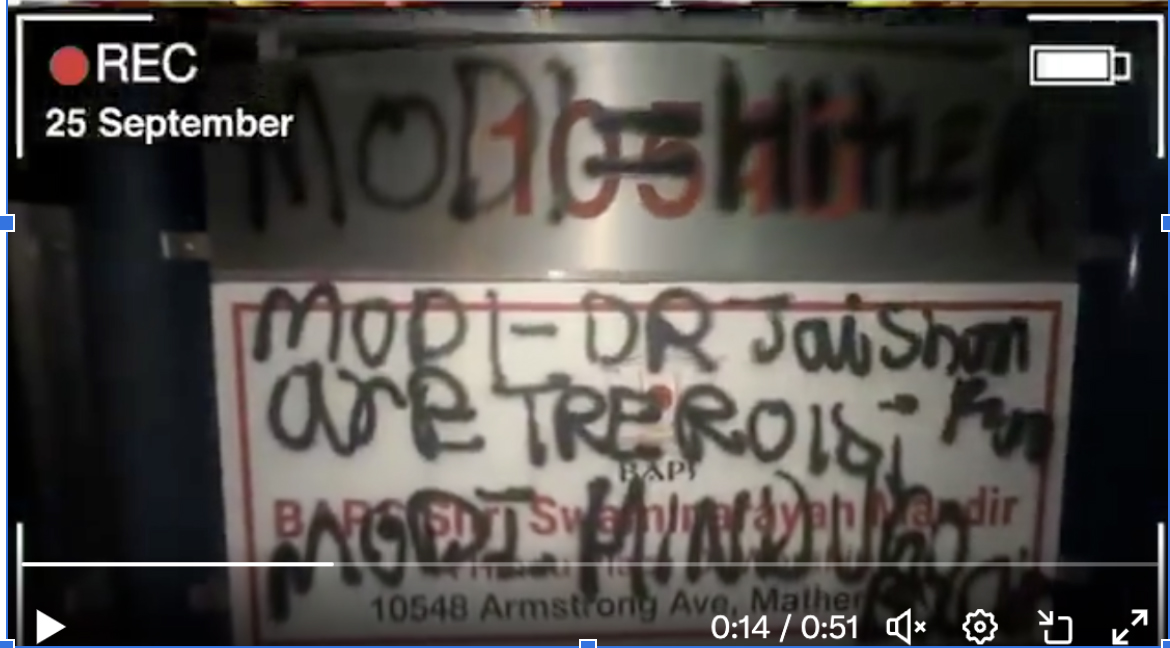
One incident on September 15, 2024, illustrates the human impact. The BAPS mandir in Mather, Sacramento, California, was vandalized. For many in the local community, this temple symbolizes renewal and belonging—especially after the COVID-19 pandemic, when Diwali celebrations revived shared joy through lights, rangolis, offerings like Raj Bhog, and greetings exchanged by devotees in traditional attire. That experience of homecoming underscores why the attack felt like a personal violation of home and sanctuary.
At a press interaction after the incident, graffiti reading “Go back, Hindus” confronted community members at the entrance. Messages such as “Hindustan Murdabad,” “Fuck Modi,” and “Hindu go back home” have appeared at multiple sites over recent months. Such language has provoked confusion, fear, and frustration—especially among immigrants who have long understood mandirs as safe, sacred connections to a spiritual homeland. In community conversations, difficult questions surfaced: Am I welcome here as a Hindu American? What does assimilation mean without erasing core identity? What does safety look like for our children and future generations?
Amid these questions, it is essential to separate communities from fringe extremist narratives. Reports have discussed a Khalistan-linked extremist element in several attacks, but the Sikh and Hindu communities across the diaspora are bound by shared family ties, common values, and a long history of celebrating each other’s holy days. Attempts by any extremist fringe to divide Hindus and Sikhs should be resisted unequivocally. The dharmic traditions—Hinduism, Sikhism, Jainism, and Buddhism—share commitments to compassion, service, and nonviolence; preserving unity among them is vital.
The August 11 vandalism at the BAPS mandir in Greenwood, Indiana—just days before the 78th anniversary of India’s Independence—reinforced concern about consistency in public responses to hate incidents. A principled, even-handed approach by law enforcement and elected leaders is crucial for all religious communities. Equally important, communities must respond with clarity, solidarity, and lawful civic action—refusing to normalize vandalism as part of religious life and ensuring that “harmless graffiti” is not dismissed as inconsequential.
Historical cases of extremist violence—including the bombing of a passenger plane and recent federal convictions in related cases—underscore the need for vigilance. A chain of attacks against houses of worship anywhere in the United States should concern the entire nation, not only those directly targeted. Hindu temples have been part of American life for more than a century, with nearly 1,000 mandirs across the country. One of the world’s largest Hindu temples is located in New Jersey and draws international visitors. These institutions are integral to American neighborhoods and civic life; protecting them protects everyone—children, families, and elders alike.
The response to such challenges can draw from dharmic teachings that emphasize duty, resilience, and ethical action. The Bhagavad Gita’s guidance on purposeful effort without attachment to outcomes offers a steady compass. On August 15, 2025, Krishna Janmashtami coincides with the celebration of India’s independence—a timely reminder that devotion, discipline, and collective responsibility can coexist with civic engagement. Constructive steps—including documenting and reporting hate crimes, strengthening temple safety practices, building interfaith partnerships, and advocating for equitable policy—advance both religious freedom and public safety.
Safeguarding mandirs is, in essence, safeguarding American pluralism. Rejecting divisive narratives, standing with Sikh, Jain, and Buddhist communities, and working with neighbors and institutions to ensure security represent a proven path to unity. When sacred spaces are protected, the nation’s commitment to liberty, diversity, and shared flourishing is strengthened for all.
Inspired by this post on Hindu America.