
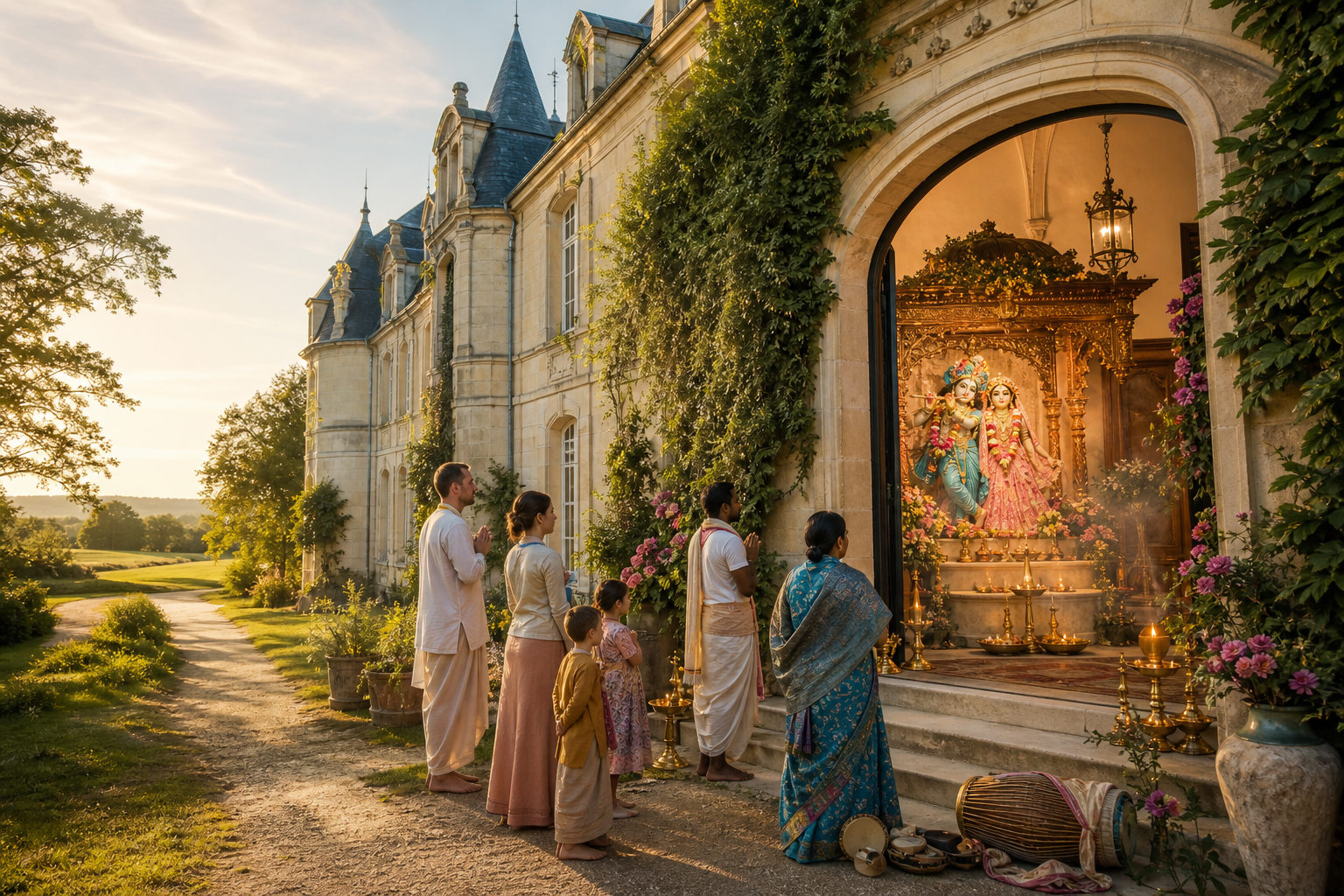
France Mein ISKCON New Mayapur Temple is more than a travel-vlog discovery or a quiet countryside stop near Luçay-le-Mâle. It is a significant example of how Hindu spiritual life, especially the Gaudiya Vaishnava tradition of Radha Krishna bhakti, has taken root in Europe without losing its core devotional grammar. Located at the Château d’Oublaise in the Indre department of central France, New Mayapur, also known as La Nouvelle Mayapura, brings together temple worship, rural retreat life, sacred sound, vegetarian prasadam, and the emotional immediacy of Radha Krishna Darshan in a setting that feels unexpectedly serene.
The phrase “Hidden Gem Near #familyvlog” captures one part of the experience, but the deeper significance lies in the meeting of place, practice, and memory. A French château, historically associated with aristocratic rural Europe, becomes a living dharmic space through daily worship, kirtan, seva, and community life. The result is not a museum-like display of Indian spirituality but a functioning temple ecosystem where visitors can observe how bhakti adapts to geography while preserving continuity with India’s sacred traditions.
ISKCON, the International Society for Krishna Consciousness, was founded in New York in 1966 by A. C. Bhaktivedanta Swami Prabhupada. Its theological foundation belongs to Gaudiya Vaishnavism, a devotional Hindu sampradaya shaped by the teachings of Sri Chaitanya Mahaprabhu and centered on loving service to Krishna. The movement gives particular emphasis to the Bhagavad Gita, Srimad Bhagavatam, nama-sankirtana, deity worship, prasadam, and a disciplined life of devotion. New Mayapur in France belongs to this wider global network, but its rural château setting gives it a distinct character within the history of Hindu temples abroad.
The name “New Mayapur” itself carries layered meaning. Mayapur in West Bengal is revered in Gaudiya Vaishnava tradition as the sacred land connected with Sri Chaitanya Mahaprabhu, whose teachings emphasized the chanting of the holy names and the accessibility of divine love. By naming a French spiritual community after Mayapur, devotees created a symbolic bridge between Bengal’s devotional geography and the European countryside. This does not replace the original Mayapur; rather, it extends its devotional memory into a new cultural landscape.
For many visitors, the first impression is architectural contrast. The approach to Château d’Oublaise does not resemble the urban density of many Indian temple neighborhoods. Instead, the journey passes through quiet roads, fields, trees, and open rural space. This transition matters. It prepares the mind for a different rhythm, one in which darshan is not rushed and spiritual attention is gently separated from the pace of ordinary travel. The temple experience becomes both visual and atmospheric: the sacred image, the sound of kirtan, the fragrance of incense, and the stillness of the countryside work together.
Radha Krishna Darshan at New Mayapur should be understood within the larger Hindu concept of darshan, which is not merely “seeing” an image. In temple culture, darshan is reciprocal: the devotee beholds the deity, and the deity is understood to graciously behold the devotee. This gives temple worship its emotional power. A family may arrive as tourists, but the encounter often becomes contemplative. Children notice color, music, lamps, and flowers; elders recognize the continuity of samskara; seekers encounter a form of devotion that is both disciplined and tender.
The Radha Krishna tradition emphasizes divine love as the highest spiritual principle. In Gaudiya Vaishnavism, Radha represents the supreme expression of devotion, and Krishna represents the all-attractive divine reality. Their worship is therefore not only theological but relational. The temple environment invites reflection on love purified of possession, service free from ego, and joy expressed through remembrance. This makes the darshan especially meaningful for families, because it frames devotion not as an isolated ritual but as a shared culture of reverence.
New Mayapur also illustrates the importance of bhakti yoga as a lived practice. Bhakti is not reduced to emotion alone; it is organized through daily habits. Chanting, hearing scripture, honoring prasadam, serving the temple, caring for guests, and maintaining sacred spaces all form part of the discipline. In this sense, the temple is technical in the traditional dharmic meaning of the word: it operates through carefully transmitted procedures, time-bound worship, ritual etiquette, culinary purity, music, language, and theology.
The use of sacred sound is central. The Hare Krishna maha-mantra, kirtan, and scriptural recitation are not ornamental additions to the temple; they are core devotional technologies. Sound structures attention. It gathers the community into a shared rhythm, reduces social distance, and allows people from different linguistic backgrounds to participate. In a European setting where visitors may speak French, Hindi, English, Bengali, Tamil, Gujarati, or other languages, kirtan becomes a unifying medium that does not depend entirely on ordinary conversation.
Prasadam is another important dimension of the experience. In Hindu temple traditions, food offered to the deity and then honored by devotees becomes a medium of grace, hospitality, and cultural continuity. At temples such as New Mayapur, vegetarian prasadam communicates several values at once: ahimsa, gratitude, simplicity, community, and sanctified nourishment. For families, this can be one of the most accessible forms of spiritual education, because children understand care through food before they understand philosophy through abstraction.
The rural character of New Mayapur also deserves attention. ISKCON’s European presence includes several countryside communities, and La Nouvelle Mayapura is often recognized among them. Such communities are not only temples but experiments in sacred rural life. They raise questions that remain relevant today: How can spirituality shape food practices? How can land become part of sadhana? How can a community maintain tradition while participating respectfully in European civic life? These questions make New Mayapur more than a devotional destination; it becomes a case study in cultural adaptation.
For the Indian diaspora in Europe, temples like New Mayapur provide a form of cultural anchoring. They offer more than festival gatherings. They preserve memory through ritual calendars, devotional music, Sanskrit and vernacular vocabulary, prasadam, deity worship, and intergenerational participation. A child growing up in France may not experience India in the same way as grandparents did, but a temple visit can make dharma visible, audible, and emotionally real. This is one reason Hindu temples abroad often function as cultural schools even when they are not formally organized as educational institutions.
At the same time, New Mayapur should not be seen only through an ethnic lens. ISKCON’s history in Europe includes many non-Indian practitioners who adopted Krishna bhakti through study, chanting, service, and community life. This creates a distinctive cultural exchange. Indian visitors may arrive expecting to find “their” tradition abroad, only to discover French, European, and international devotees preserving elements of Vaishnava practice with sincerity. Such encounters can be deeply moving because they reveal that dharma travels not merely through ancestry but through practice, discipline, and devotion.
This point is important for dharmic unity. Hinduism, Buddhism, Jainism, and Sikhism each contain distinct histories, scriptures, institutions, and philosophical frameworks, yet they also share civilizational concerns: ethical discipline, compassion, self-transformation, reverence for teachers, sacred sound, pilgrimage, community service, and liberation from ego-centered living. A place like New Mayapur can therefore be appreciated not as a sectarian marker but as one expression of the broader dharmic capacity to create sacred life in new lands.
The temple’s value also lies in its ability to slow down the visitor. Modern travel often turns sacred places into backdrops for quick images. A more thoughtful visit asks different questions. What does the space teach about devotion? How does the architecture change when used for worship? How do sounds, lamps, flowers, and food create religious meaning? How does a child respond to darshan without needing a formal lecture? These questions turn a family vlog moment into a meaningful cultural and spiritual observation.
There is also a useful academic lesson in the transformation of Château d’Oublaise. Religious communities often reinterpret built environments. A structure created in one historical context can acquire new sacred meaning through repeated ritual use. Over time, the building is no longer understood only as a château; it becomes a temple, a gathering place, a memory-site, and a symbol of Hindu presence in France. This process is common in diaspora religious history, where communities adapt available spaces and gradually sacralize them through practice.
In this sense, New Mayapur contributes to the study of Hindu temples abroad. It shows that a temple need not always begin with classical Indian architecture to become spiritually meaningful. While shikharas, gopurams, mandapas, and sculptural programs are vital parts of Hindu architectural heritage, diaspora communities sometimes begin with houses, warehouses, schools, converted churches, estates, or rural properties. Sacredness emerges through consecration, worship, community recognition, and continuity of practice.
The experience of Radha Krishna Darshan in France also expands the imagination of pilgrimage. Pilgrimage is not only movement toward ancient geography; it can also be movement toward living devotion. For some, the great tirthas of India remain the central aspiration. For others, especially families living abroad, a regional temple becomes the nearest point of sacred access. New Mayapur serves this role by offering a place where bhakti can be encountered without crossing continents.
The emotional force of such a visit often comes from recognition. The lamps may recall childhood temple evenings. The sound of kartals may recall festival processions. The sight of Radha and Krishna may evoke Janmashtami, Holi, or memories of Vrindavan and Mayapur. Yet the French countryside adds a new layer: dharma appears not as something confined to one nation but as a living tradition capable of finding form wherever sincere practice is sustained.
A balanced understanding should also recognize that ISKCON, like many modern religious institutions, has been discussed in scholarly, social, and public contexts from multiple perspectives. Academic and public debates around new religious movements, diaspora identity, and institutional governance are part of the broader history of religion in the modern world. However, a temple visit focused on New Mayapur’s devotional life can be assessed primarily through its visible practices: worship, hospitality, kirtan, prasadam, scriptural learning, and community formation.
For visitors planning a respectful experience, basic temple etiquette matters. Shoes are generally removed before entering sacred areas. Modest clothing is appropriate. Photography should be guided by local rules, especially during darshan and arati. Silence or soft speech helps maintain the atmosphere of worship. Prasadam should be received with gratitude. These practices are not merely formal rules; they cultivate humility and allow the visitor to participate in the space without turning it into a spectacle.
The family dimension is especially significant. A family visit to New Mayapur can become an informal lesson in Hindu culture, Vaishnava theology, vegetarian ethics, sacred music, and diaspora history. Children may remember the colors and sounds first, but those impressions often become the foundation for later understanding. In many dharmic traditions, learning begins through participation before it becomes intellectual. Temple spaces preserve that pedagogy naturally.
New Mayapur also invites comparison with other Hindu temples in France, including urban temples serving Tamil, North Indian, Gujarati, and broader Hindu communities. France’s Hindu landscape is diverse, shaped by migration, diaspora networks, spiritual movements, and regional histories. Within this landscape, the ISKCON New Mayapur Temple stands out because of its rural setting and its association with a château estate. It offers a different model of Hindu presence: contemplative, pastoral, and community-centered.
The broader cultural lesson is that dharma is both rooted and mobile. It remains rooted in scripture, lineage, ritual, and sacred memory, yet it is mobile through people, songs, food, festivals, and institutions. Radha Krishna worship in France is not a dilution of tradition when practiced with seriousness; it is an example of continuity under changed conditions. Such continuity is one of the strengths of Hindu civilization and of dharmic traditions more broadly.
For devotees, New Mayapur may be experienced as a place of seva and surrender. For scholars, it is a valuable example of religious transplantation and adaptation. For families, it is a peaceful destination where children can encounter living Hindu practice. For travelers, it is a hidden gem in France. For the dharmic world, it is a reminder that sacred culture survives not only through monuments but through daily worship, shared meals, songs, discipline, and the quiet labor of communities.
The most meaningful way to understand France Mein ISKCON New Mayapur Temple is therefore not as an exotic curiosity, but as a living bridge. It connects Mayapur and rural France, Radha Krishna bhakti and European cultural space, diaspora memory and local hospitality, personal devotion and collective identity. Its darshan offers a gentle but powerful insight: wherever sincere remembrance of the divine is cultivated, a place can become sacred.
Inspired by this post on Dandavats.
