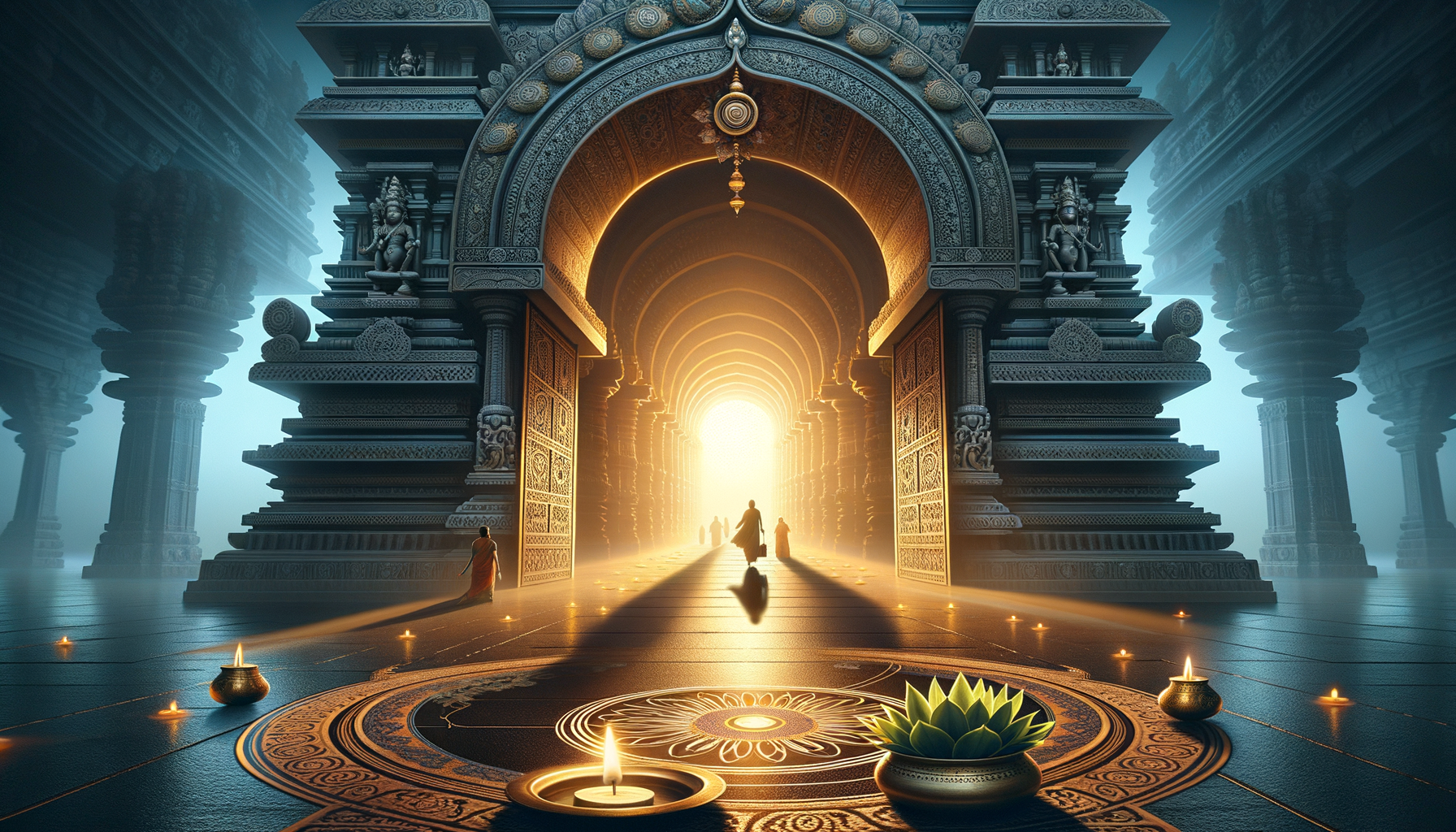
Vaikunta Ekadashi is widely regarded as distinct among the approximately twenty-five Ekadashi observances that occur in a lunar year. Revered as a symbolic “gateway to the divine,” it is celebrated in the Vaishnava tradition as the day when Lord Vishnu opens the Vaikuntha Dwaraman act understood as an invitation to inner awakening and liberation (moksha) for sincere devotees.
Across major Vaishnava templesmost notably Srirangam (Paramapada Vaasal) and Tirumala (Vaikunta Dwaram)ceremonial doorways are opened at dawn, and the faithful enter in solemn processions. This public ritual is not merely pageantry; it functions as a theological statement: crossing the threshold signifies moving from limitation to grace, and from habitual patterns to spiritual clarity, in line with Ekadashi fasting and vrata (vow).
Puranic narratives offer a broader backdrop to Ekadashi itself. Textual traditions recount the asura Muran, whose arrogance disturbed cosmic order; Vishnu’s triumphand the emergence of the Ekadashi vow in stories preserved in the Padma Puranahighlights vigilance, self-restraint, and the subduing of inner turbulence. While such episodes address the origin and spirit of Ekadashi generally, later practice elevates Vaikunta Ekadashi in particular as the auspicious day when Vaikuntha’s gates are symbolically opened for all who seek refuge in Vishnu’s compassion.
What sets Vaikunta Ekadashi apart from other Ekadashis is its explicit soteriological promise. Whereas each Ekadashi emphasizes purification, discipline, and devotion, this observance is uniquely linked with the imagery of entering Vaikunthasuggesting not only merit accumulation but a decisive reorientation toward liberation. For many, the practice intensifies during Dhanurmasa/Margashirsha, aligning food austerity, mantra-japa, and temple darshan with the day’s elevated spiritual potential.
Regional traditions deepen this experience. In Tamil Nadu, the rite is known as Sorgavasal Thirappu; in the Telugu-speaking regions, it is celebrated as Mukkoti Ekadashi. Devotees maintain Ekadashi fasting, keep vigil (jagarana), recite Vishnu Sahasranama, and engage in charity. The dawn crossing of the sanctum’s special doorway is often accompanied by a palpable stillnessdevotees commonly describe an inner quiet that lingers long after the ceremony ends.
Beyond ritual, the day invites a reflective ethic. Vaikunta Ekadashi underscores core dharmic values shared across India’s spiritual tapestry: self-restraint, compassion, and remembrance of the divine. These themes resonate with the spirit of uposatha-like observances in Buddhism (mindful discipline), vrata and upavasa in Jainism (austerity with non-violence), and the Sikh emphasis on simran and seva (remembrance and service). The unifying thread is clear: authentic practice turns inward discipline into outward harmony.
In family settings, observance often combines scriptural listening with simple actsoffering tulasi leaves, lighting a lamp, and preparing sattvic food after the fast concludes. Children and elders alike participate in darshan, cultivating continuity between generations. People frequently recall how standing before the Vaikunta Dwaram at sunrise evokes gratitude and a renewed commitment to dharma in daily life.
In comparative terms, all Ekadashis encourage clarity and devotion, yet Vaikunta Ekadashi concentrates their essence into a single, potent moment of crossinga lived metaphor in which the threshold becomes both a temple door and an inner passage. This is why, within Vaishnava temples and homes, the day is regarded as a hinge between effort and grace, discipline and deliverancean observance whose meaning is devotional, ethical, and profoundly transformative.
Inspired by this post on Hindu Blog.