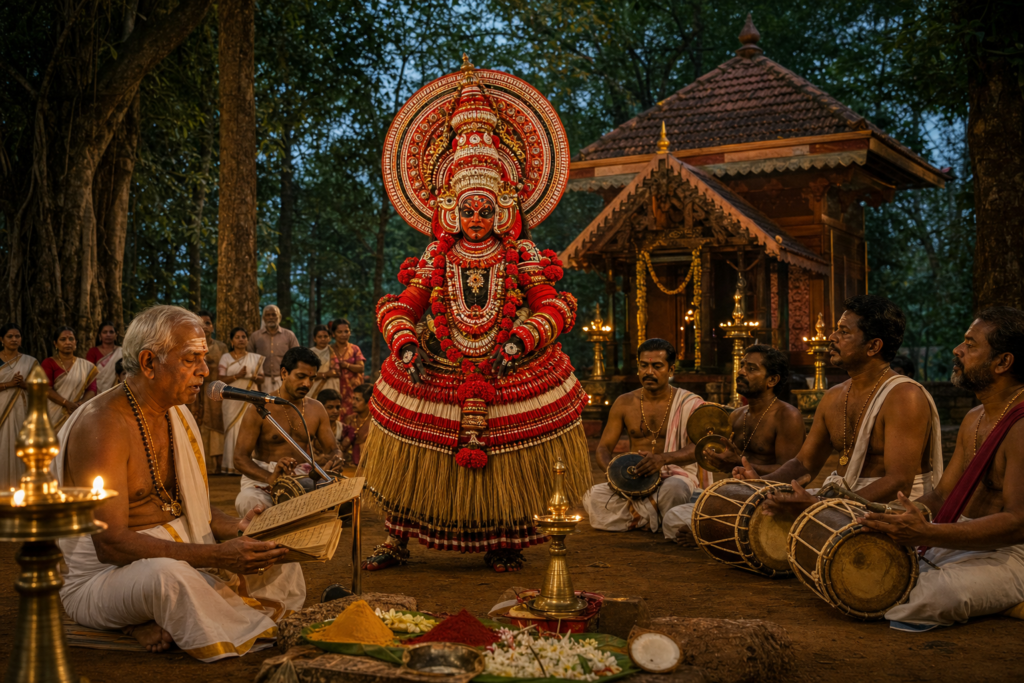
Like a beautiful palace with a closed door, the dhama requires a key to grant entrance: chanting the Holy Name with loving affection. Sri Bhaktivinoda Thakura states this principle with clarity, and it captures a central dynamic of the Bhakti Tradition in Hinduismsacred sound as the living gateway to sacred reality. Approached with humility and love, the Name reveals what intellect alone cannot access.
In Vaishnava theology, dhama refers not merely to a geographical site such as Vrindavan, Mayapur, or Puri, but to a living, spiritual environment perceptible according to consciousness. The dhama is described as ever-present, yet ordinarily veiled, because entry is calibrated not by physical proximity but by inner disposition. Loving remembrance expressed through chanting serves as the practical key that aligns perception with presence.
The effectiveness of this key rests on the ontology of the Name. In Gaudiya Vaishnava thought, the Name (nama) and the Named (nami) are non-different. This non-duality asserts that the Holy Name of Krsna is not a symbolic pointer but a direct presence. Consequently, chanting is not simply devotional speech; it is an encounter, and its quality depends on the chanter’s sincerity, ethical alignment, and affectionate intent.
Sri Bhaktivinoda Thakura emphasizes loving affection because the transformation intended by chanting cannot be reduced to technique. Mechanical recitation yields a preliminary clearing effect (often described as a dawning or nama-abhasa), but the mature, luminous stage (suddha-nama) arises when the heart turns toward service and gratitude. Ethical orientation matters: humility, truthfulness, compassion, and respect for all practitioners remove the inner obstructions traditionally framed as offenses to the Name.
Modes of practice are complementary. Japa denotes personal, often quiet or softly vocalized repetition, usually with a mala of 108 beads to anchor attention and intention. Kirtan brings sound into community, where rhythmic call-and-response, hand instruments, and shared devotion catalyze concentration and joy. Smarana (remembrance) weaves throughout, as the mind gently returns to the Holy Name between and within these practices.
Technical attention elevates practice from habit to craft. Clear pronunciation preserves the mantra’s phonetic integrity; steady rhythm stabilizes attention; a relaxed yet upright posture supports unforced breathing; and a consistent daily vow creates momentum. Many practitioners coordinate sound with the breath, allowing the out-breath to carry syllables while the in-breath resets awareness. In both japa and kirtan, the guiding principle remains affectionate mindfulness rather than volume or speed.
Contemporary research on mantra repetition and contemplative attention provides convergent insights. Repetitive sacred sound has been associated with reduced mind-wandering, improved attentional stability, and markers of parasympathetic activation that correlate with calm alertness. Practitioners frequently report greater emotional regulation, a softening of self-criticism, and renewed ethical sensitivityoutcomes long described in the Bhakti Tradition.
Cultivating loving affection naturally leads to supporting practices. Hearing sacred narratives, engaging in seva (service), and associating with sincere practitioners deepen the relational dimension that chanting signals. In Vaishnava terms, hearing, chanting, remembering, serving, and friendship with the Divine mutually reinforce each other; the Name is the thread that ties them into a single fabric of spiritual life.
Common obstacles tend to be consistent across contexts: distraction, dryness, mechanical repetition, irregularity, and interpersonal friction. Practical remedies include: setting a steady daily window for japa, approaching kirtan as an offering rather than a performance, reflecting on gratitude to rekindle warmth, and gently returning attention to the syllables whenever the mind strays. Ethical repairhonesty, reconciliation, and serviceremoves subtle resistance that otherwise blunts the potency of chanting.
This focus on sacred sound aligns closely with other dharmic traditions, underscoring unity in spiritual diversity. In Sikhism, Naam Simran and the recitation of Japji cultivate remembrance of the One through the Name. Buddhism upholds mantra recitation and mala-based practice to stabilize attention and awaken compassion. Jainism centers the Namokar (Navkar) Mantra to honor the qualities of liberated beings and purify intention. Across these paths, the shared insight is clear: mindful, heartfelt repetition of the sacred transforms perception, character, and community life.
Seen through this inclusive lens, chanting the Holy Name does not foster sectarianism; it builds bridges. Sacred sound disciplines speech, refines listening, and harmonizes the mind. It also awakens ethical responsibilityin everyday interactions, in ecological care, and in the cultivation of compassionthus embodying the dharmic ideal of mutual uplift. In this way, personal devotion fuels social harmony without erasing distinctive theologies or practices.
Field experiences in kirtan gatherings and pilgrimage contexts consistently reveal a pattern: when practitioners chant with warmth rather than worry about performance, a palpable quiet joy arises, and the sense of separation softens. Pilgrims often describe this as a gentle reassuranceKrsna’s forgiving presence felt as kindness more than doctrine. Over time, such moments aggregate into trust: the conviction that the Name truly shelters.
A practical roadmap is straightforward. Begin with a modest, daily japa commitment anchored to a specific time and place. Complement this with periodic kirtan to benefit from the collective uplift of community. Support both with study, service, and satsanga. Attend carefully to speech and conduct to avoid offenses that erode sincerity. Most of all, relate to the Holy Name as companionship, not merely as a taskallowing affection to do what technique alone cannot.
In summary, the dhama opens to loving remembrance expressed through chanting. The logic is simple yet profound: when the Name is approached as living presence, not performance, the heart recognizes shelter. For those drawn to Krsna, this shelter is gentle and forgiving; for those walking allied dharmic paths, sacred sound offers the same essential refugeclarity of mind, warmth of heart, and unity with the Highest. Thus, the key that turns in the door of the palace is within reach of all who chant with love.
Inspired by this post on Dandavats.