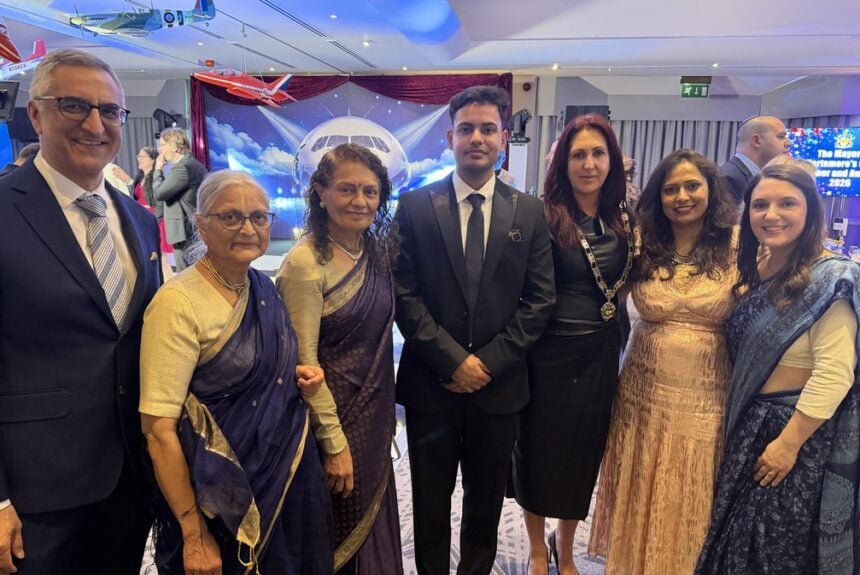
Bhaktivedanta Manor’s Devotee Care Office (DCO) received a Civic Award in the Community Care category at Hertsmere’s annual awards ceremony, held at the Hilton DoubleTree in Borehamwood. The award was accepted on behalf of the DCO by Krishna Purna Dasi, Dr Diviash Thakrar, Hemangi Radha Dasi, and Saraswati. This recognition strengthens the standing of faith-based community care within Hertsmere and affirms the contribution made by the Manor’s volunteer-led ecosystem.
In Hertsmere, Civic Awards highlight individuals and organizations that measurably enhance community well-being, social inclusion, and local resilience. Recognition in the Community Care category typically reflects consistent service delivery, reliable governance, and a demonstrable benefit to residents, including those from diverse cultural and linguistic backgrounds.
Within this landscape, the Devotee Care Office serves as a point of contact for practical and pastoral support at Bhaktivedanta Manor, an ISKCON (International Society For Krishna Consciousness) community hub. The DCO’s remit centers on the holistic care of congregants and neighborsaddressing spiritual, emotional, and social needs through responsive listening, structured signposting, and timely coordination with appropriate services.
The approach aligns with dharmic principles shared across Hinduism, Buddhism, Jainism, and Sikhismseva (selfless service), karuna (compassion), ahimsa (non-harm), and dana (generosity). These values foreground person-centered care, dignity, and mutual aid, offering a unifying ethical foundation for community service across dharmic traditions.
In practice, community care in such settings commonly spans befriending and companionship for the isolated, culturally sensitive support around life events, signposting to statutory and voluntary services, and coordination of volunteers for time-bound needs. Where appropriate, faith-informed encouragement is combined with respect for pluralism, ensuring that assistance remains inclusive and non-proselytizing.
Robust community care also depends on sound technical foundations. Good practice in the United Kingdom includes safeguarding policies proportionate to risk, clear confidentiality and data-protection procedures (GDPR compliance), equality, diversity and inclusion (EDI) awareness, risk assessment for activities, accessible complaints pathways, and basic training for volunteersfor example, boundaries, active listening, and knowing when to refer to professionals.
Volunteer management further benefits from role clarity, rota reliability, and debrief mechanisms that sustain volunteer well-being. These mechanisms help prevent burnout, maintain service quality, and nurture a culture of reflective improvementfeatures commonly associated with mature faith-based care programs.
Outcome-focused teams typically monitor simple indicators such as timely responses to queries, successful referrals, follow-up touchpoints, and feedback from service users. Qualitative narrativesstories of reduced isolation, improved confidence in navigating local services, and strengthened social tiescomplement quantitative measures to provide a rounded picture of impact.
By anchoring care in shared human values, the DCO illustrates how Interfaith Dialogue can move from conversation to collaborative effort. Visible civic recognition invites wider cooperation with local groupsdharmic and non-dharmic alikewhile reinforcing a borough-wide culture of respect, inclusion, and neighborliness.
The significance of such care is heightened amid contemporary pressures, including loneliness, cost-of-living challenges, and the lingering after-effects of public-health disruptions. Culturally responsive, volunteer-powered support acts as a trusted bridge between residents and formal services, reducing barriers linked to language, belief, or custom.
A practical blueprint for scalable, ethical community care in dharmic contexts can be summarized across six domains: access and outreach; safeguarding and ethics; volunteer development; partnership and signposting; cultural and linguistic competence; and outcomes and learning. Attention to these domains helps translate timeless principles into day-to-day practices that withstand real-world constraints.
The presence of Krishna Purna Dasi, Dr Diviash Thakrar, Hemangi Radha Dasi, and Saraswati at the ceremony symbolized a collective endeavor. Their acceptance acknowledged the steady labor of many volunteers, staff, and well-wishers whose reliable contributions make compassionate care possible.
Importantly, the ethos recognized in Hertsmere resonates across dharmic traditions: Sikh langar, Jain dana, Buddhist karuna, and Hindu seva converge on the same social horizonwelcoming, feeding, listening, and accompanying those in need. Opportunities for joint service projects, shared training, and knowledge exchange can deepen unity while multiplying community benefit.
Civic acknowledgment also encourages transparent governance and continuous learning. Sharing templates, training outlines, and evaluation tools with peer institutions strengthens sector capacity and ensures that community care remains accountable, person-centered, and adaptable.
Viewed in this light, the Hertsmere Civic Award for Community Care affirms more than a single office’s achievement; it recognizes a replicable model of compassionate, organized service rooted in dharmic values and open to all. It stands as an invitation to broaden collaboration and to sustain the everyday, practical kindness that underwrites resilient communities.
Inspired by this post on Dandavats.