
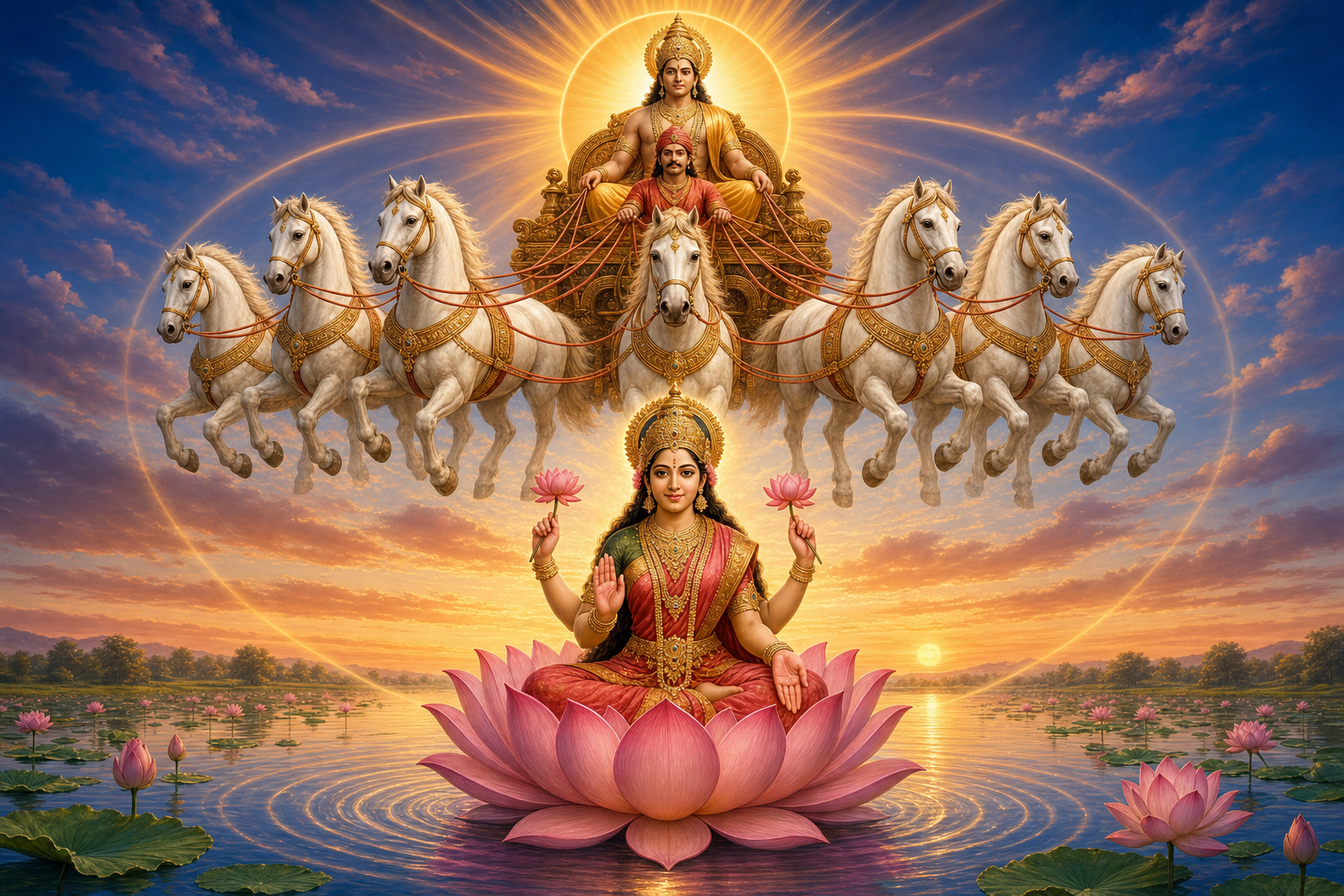
You can recognise Lakshmi on her lotus or Surya behind his crimson charioteer and still be unsure what the image asks of you. Recognition tells you who is present. Interpretation reveals how you should act.
If you are choosing an image for a home shrine, explaining a temple carving to a child, or trying to look beyond surface beauty, begin with the relationships inside the image. The lotus teaches purity without withdrawal. Aruna teaches power without excess. Together, they offer a practical way to read Dharmic iconography as ethical instruction.
Key takeaways for reading sacred imagery
- Purity does not require escape from the world. The lotus grows through mud and water yet opens above them unstained.
- Cosmic balance is not passive moderation. It is power placed under wise direction, as Aruna governs the movement and arrival of Surya’s radiance.
- No symbol should be read alone. Figure, posture, object, gesture, colour, companion, placement, and time form one visual sentence.
- Similar images across Hindu, Buddhist, Jain, and Sikh traditions can reveal shared Dharmic concerns without making their teachings interchangeable.
- A sacred image has been understood only partially until you can turn its pattern into a concrete decision or discipline.
The lotus defines purity as contact without capture

A shallow reading treats purity as separation: clean things belong far from muddy things. The lotus overturns that assumption. It takes root in mud, depends on water, and rises through both. Its beauty is not produced by avoiding difficult conditions but by transforming what those conditions provide.
Even the surface of the plant reinforces the lesson. Microscopic structures and waxy coatings make lotus leaves highly water-repellent, so droplets bead and roll away in what is known as the lotus effect. Dharmic thought turns this natural property into an ethical image: participate fully, but do not let possession, praise, resentment, or fear adhere to the mind.
This is why the Bhagavad Gita can liken disciplined action to water that does not cling to a lotus leaf. Nonattachment is not inactivity. The leaf remains in the pond, and the practitioner remains amid work, family, duty, and consequence. What changes is the tendency to build identity around the fruits of action.
Lakshmi’s lotus applies that principle directly to prosperity. As Śrī, she represents auspicious flourishing rather than money in isolation. Her lotus seat asks whether abundance has a clean foundation. The lotuses in her hands ask whether beauty and wellbeing continue to unfold after wealth has been acquired. Her boon-giving and fear-dispelling gestures show that prosperity becomes auspicious when it supports life rather than merely enlarging the possessor.
You can use that imagery as a three-part examination of any gain, whether it involves money, authority, education, reputation, or opportunity:
- Examine the root. How was the gain obtained? Deception, exploitation, or concealed injury cannot become Dharmic merely because some of the result is later donated.
- Examine what clings. Has the gain produced useful freedom, or has it intensified vanity, anxiety, rivalry, and the need for display?
- Examine the flowering. Who besides you is nourished? Look at effects on family, colleagues, community, the natural world, and those who will inherit the consequences.
The lotus therefore does not romanticise poverty or condemn material success. It distinguishes prosperity from accumulation. A larger account, house, title, or audience may be fortunate, but size alone cannot establish auspiciousness. The decisive questions concern origin, attachment, stewardship, and consequence.
Try the examination on one real part of your life. Choose a possession, responsibility, or stream of income that occupies your mind. Trace its root, name what has begun to cling, and decide how part of it can circulate through dāna, service, fair dealing, or responsible care. That is a more faithful response to Lakshmi’s lotus than treating it only as a charm for acquisition.
Cosmic balance means that power accepts guidance
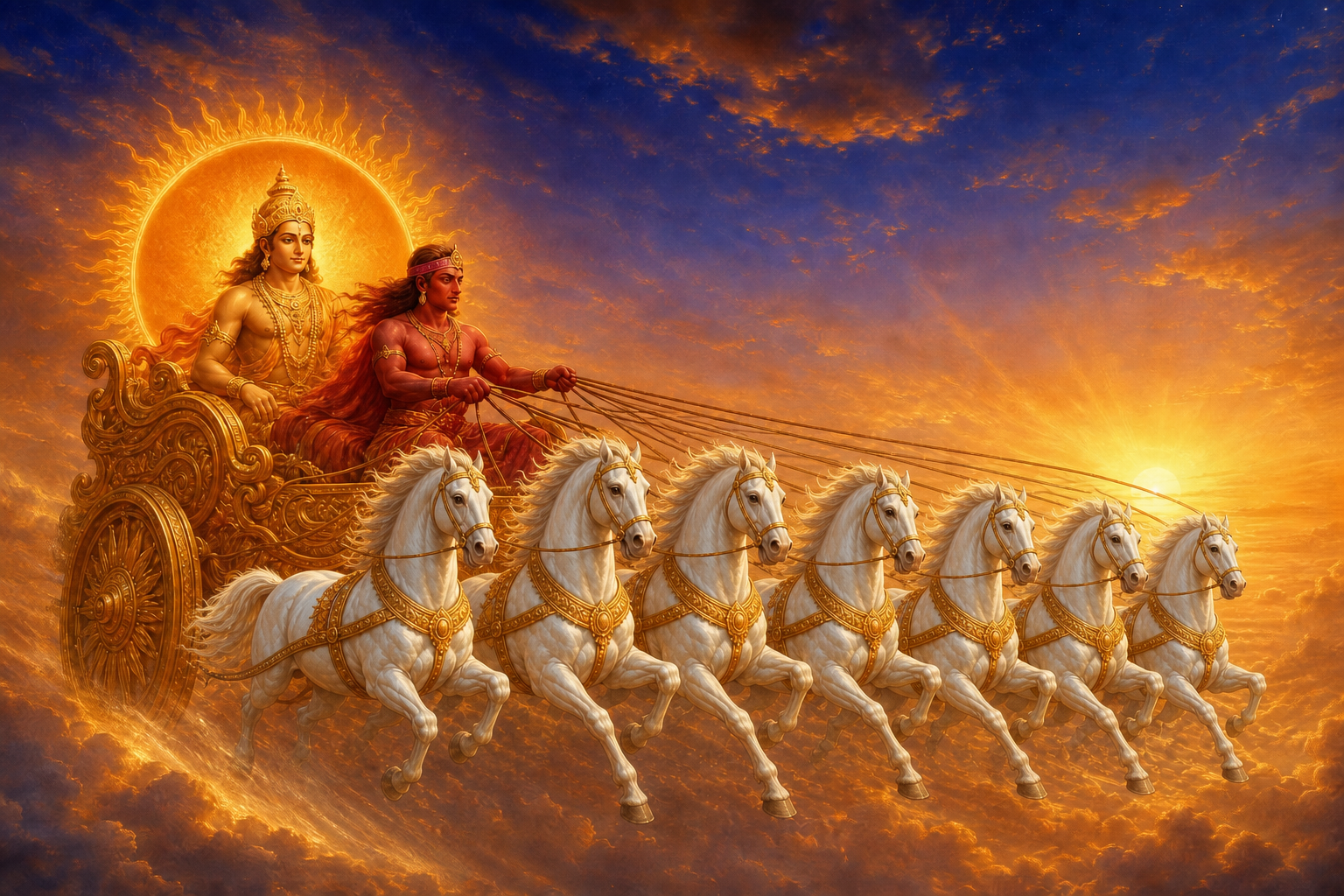
The image of Aruna riding before Surya addresses a different danger. The problem is not impurity but ungoverned intensity. Sunlight sustains life, yet limitless solar brilliance would overwhelm embodied beings. Aruna, the crimson presence of dawn and Surya’s charioteer, does not extinguish that brilliance. He regulates its arrival.
This is an important distinction. Balance is sometimes mistaken for weakening every force until nothing demanding remains. Aruna represents something more exact: retain the power, provide it with direction, sequence it properly, and deliver it in a form the world can receive. Restraint is not the opposite of strength here. It is what makes strength serviceable.
The dawn sky makes the symbolism visible. As the first rays travel through a longer atmospheric path, scattering produces the reddened light associated with arunodaya. Full daylight does not appear as a sudden white blaze. It comes through a crimson threshold, allowing forms to emerge gradually. Observation supplies the image; sacred narrative gives that image ethical meaning.
Aruna’s own origin sharpens the warning against bad timing. Vinata opened his egg prematurely, and he emerged before his development was complete. His eventual role at dawn transforms that history of untimely emergence into the governance of time and pace. The figure who once appeared too soon becomes the one who ensures that light arrives in season.
The structure of Surya’s chariot expands the same lesson. Its seven horses are often associated with the seven metres of Vedic verse. Its single wheel can signify the solar year, with twelve spokes corresponding to the months. Light is therefore imagined not as shapeless force but as cadence, recurrence, and measure. Aruna holds the reins of an ordered cosmos.
The Kaṭha Upaniṣad uses a related chariot pattern for human life: discriminative intelligence serves as charioteer, while the senses require reins and direction. The point is not that energy or perception is corrupt. Both are necessary. Trouble begins when movement has no governing intelligence.
You can apply the Aruna principle before exercising any strength you possess. This matters especially when telling a difficult truth, correcting another person, using institutional authority, or acting from justified anger. Ask four questions: Is it true? Is this the right time? Is the force proportionate to the need? Can the person or community receive it without preventable injury?
Those questions do not justify cowardice, concealment, or endless delay. Aruna still brings Surya. Wise mediation governs revelation; it does not cancel it. If your restraint protects a falsehood, it is no longer balance. If your directness serves only the pleasure of overpowering someone, it is not illumination. The image asks you to preserve both truth and the conditions under which truth can restore order.
A six-part method for reading a sacred image
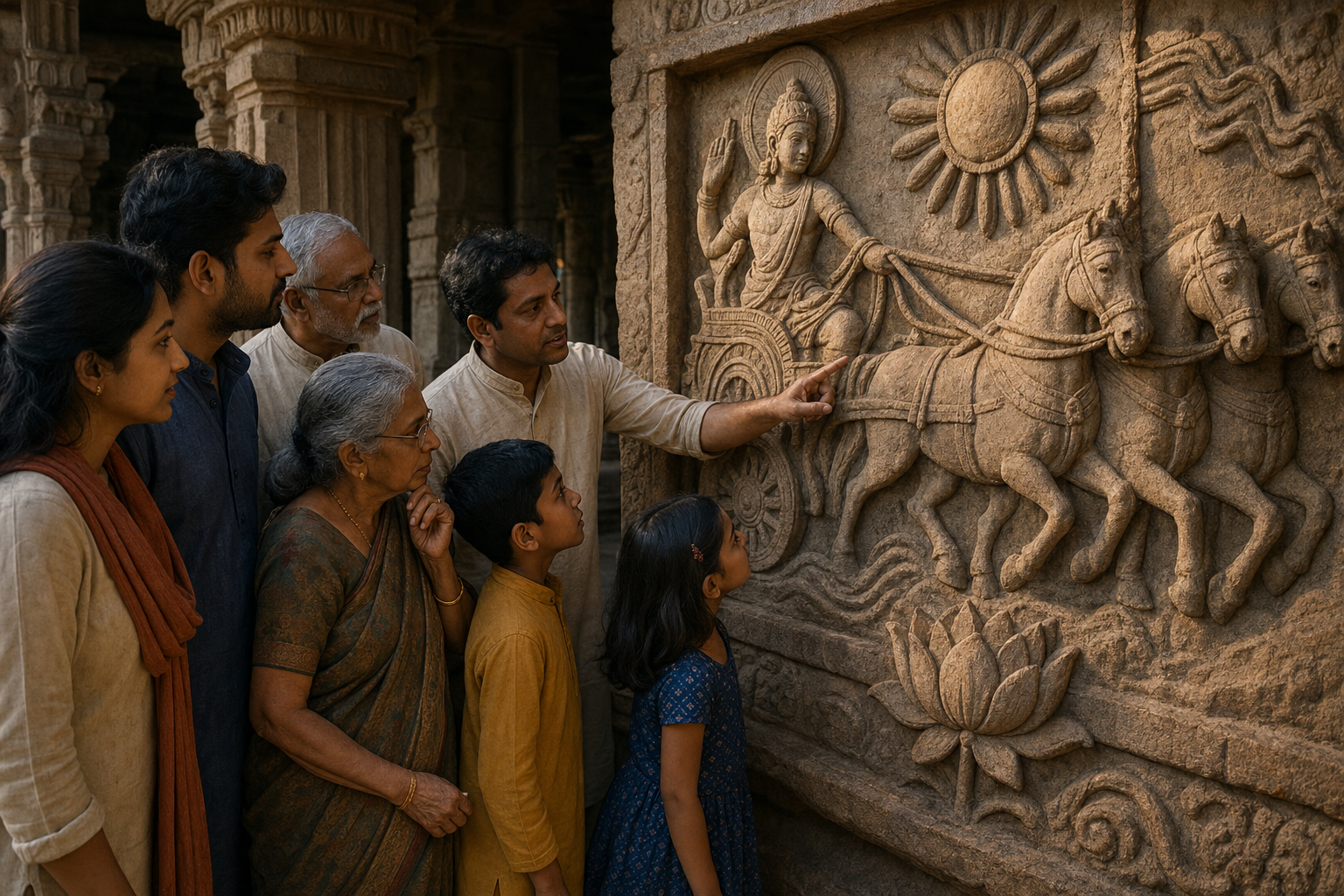
A deity’s name is the beginning of interpretation, not the end. Use the following sequence when you encounter a murti, painting, manuscript image, coin, doorway carving, or shrine motif. It prevents one familiar object from swallowing the meaning of the whole composition.
- Identify the central power. Ask what principle the main figure embodies in this setting: prosperity, preservation, illumination, knowledge, courage, or another mode of sacred agency. Lakshmi directs attention toward auspicious flourishing; Surya toward life-giving radiance and temporal order.
- Look beneath and around the figure. A throne, lotus, vehicle, wheel, water, or horizon establishes the conditions under which the central power operates. Lakshmi does not merely happen to sit near a flower. The lotus is the ethical ground of her prosperity.
- Separate held objects from gestures. Objects often indicate powers to be cultivated or exercised. Gestures show how the deity relates to the devotee. In a frequent four-armed form of Lakshmi, upper hands bear lotuses while lower hands offer varada, the boon-giving gesture, and abhaya, the gesture that dispels fear.
- Read colour through context. A pink or red lotus with Lakshmi can emphasise vital, worldly, and aesthetic flourishing. A white lotus can bring sattvic luminosity and balance to the foreground. Aruna’s crimson is the colour of transition before full solar brilliance. Colour refines the sentence; it rarely supplies the entire meaning by itself.
- Study relationships and sequence. Ask who guides, accompanies, bathes, protects, or precedes whom. Elephants performing abhiṣeka over Gaja-Lakshmi connect abundance with consecration, royal responsibility, rain, and communal flourishing. Aruna’s position ahead of Surya tells you that mediation must precede the full exercise of power.
- Notice placement and time. A Gaja-Lakshmi image on a lintel addresses what should enter and flourish within a space. Lotus medallions on temple pillars or ceilings extend auspicious order through the structure. An image or rite encountered at dawn carries the potency of a threshold between darkness and full activity.
Now combine the parts into one sentence. If Lakshmi sits upon an open lotus, holds two more lotuses, extends reassuring and giving hands, and receives an elephant abhiṣeka, you might read the ensemble this way: prosperity founded on purity should mature into generosity, freedom from fear, legitimate responsibility, and nourishment that reaches beyond one household.
If Aruna holds the reins before the seven-horsed chariot of Surya, the visual sentence changes: immense radiance enters the ordered world through discernment, rhythm, and timely mediation. In both cases, relationship carries more meaning than isolated inventory.
Regional, sectarian, and historical forms will not always contain every feature. Do not force a missing lotus, gesture, horse, or companion into an image. Read what is actually present, then consult the ritual and theological setting in which that form is worshipped. Iconography is a language, but it has dialects.
Shared Dharmic imagery should lead to practice, not flattening
The lotus moves across the Dharmic family because purity amid worldly entanglement is a widely shared concern. Buddhist images place Buddhas and bodhisattvas on lotus thrones to express awakening that is not stained by saṃsāra. The name Padmasambhava itself preserves lotus imagery. In Jain tradition, Padmaprabha is identified by a red lotus, while lotus forms in shrines and manuscripts support the ideal of spiritual impeccability. Sikh Gurbani evokes the kamal, the lotus of the heart, opening through the Guru’s Word while life continues in the world.
These resonances are real, but resemblance is not identity. A lotus beneath a Buddha should not simply be called Lakshmi’s symbol transferred to another figure. Each tradition gives the image distinct doctrinal work, ritual use, and devotional feeling. Shared civilisational vocabulary makes conversation possible; it does not erase the speaker’s particular voice.
The same care applies to dawn. Hindu sandhyā practice, Jain samayik and pratikraman, Buddhist early meditation vigils, and Sikh Amrit Vela all value quiet hours associated with clarity and renewal. Their purposes and disciplines remain distinct. What can be noticed across them is a common confidence that transitions deserve attention: the mind is easier to direct when a new cycle has begun but the day’s habits have not yet seized it.
When you explain a shared symbol, use three moves. Name its tradition-specific meaning first. Identify the genuine parallel second. Then state the ethical question both versions help you ask. This keeps unity from becoming vagueness and difference from becoming isolation.
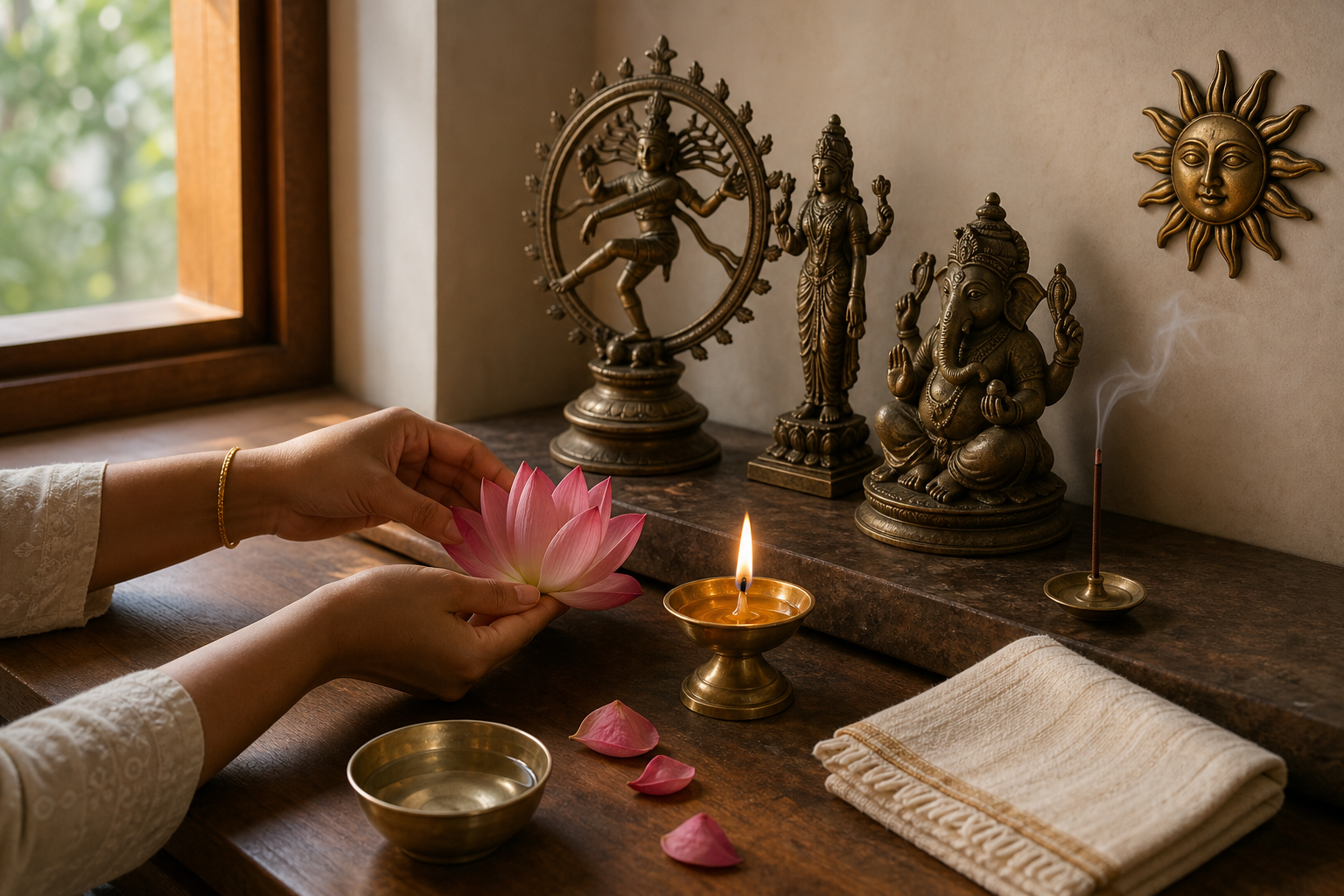
You can turn the method into a short contemplative practice at a shrine or temple:
- Pause before naming the image and observe its posture, foundation, hands, companions, colours, and direction of movement.
- Name the central power in plain language: abundance, light, preservation, awakening, or disciplined strength.
- Identify what makes that power auspicious. Look for a lotus, reins, a gesture, a companion, a threshold, or another governing relationship.
- Complete the sentence, “This power serves dharma when it is guided by…”
- Choose one action for the same day. Clean up the origin or use of one gain, practise one act of dāna, moderate the delivery of a difficult truth, or begin a responsibility gradually enough to sustain it.
The next time you stand before a sacred image, go beyond asking, “What does this object symbolise?” Ask, “What relationship does it govern, and what must I govern in myself?” Carry one answer into action before the day ends. That is how sacred imagery becomes a form of darśana rather than decoration.
References
- DharmaRenaissance Blog — Decoding Lakshmi’s Lotus: Sacred Symbolism of Prosperity, Purity, and Dharmic Wealth
- DharmaRenaissance Blog — Why Brahma Chose Aruna: The Epic Dawn-Charioteer Who Shielded Creation from Surya
