Aruna stands in Hindu stories as the crimson dawn personified and as the charioteer who rides ahead of Surya, moderating the Sun’s awe-inspiring tejas so that life can endure. Purāṇic lore situates this appointment within a larger cosmic logic: truth must be upheld, yet truth’s radiance must be tempered to preserve the balance of the worlds. In this sense, Brahma’s decision to place Aruna before Surya expresses a principle of Vedic cosmology and ethicslimitless power requires right guidance to remain aligned with dharma and ṛta.
The narrative backdrop is often connected to the epochal Samudra Manthan (churning of the cosmic ocean), when devas and asuras contended for amrit. In that mythic crucible, Svarbhānu infiltrated the assembly; Surya and Chandra spoke the truth of his deception, prompting Viṣṇu to intervene and behead the impostor. From this act emerged Rahu and Ketu, whose periodic eclipses became the cosmic counterpoint to the Sun and Moon. The episode, sometimes framed as a “cosmic consequence of truth,” underlines an enduring lesson: the disclosure of truth can disturb established patterns and must be integrated carefully into the order of creation.
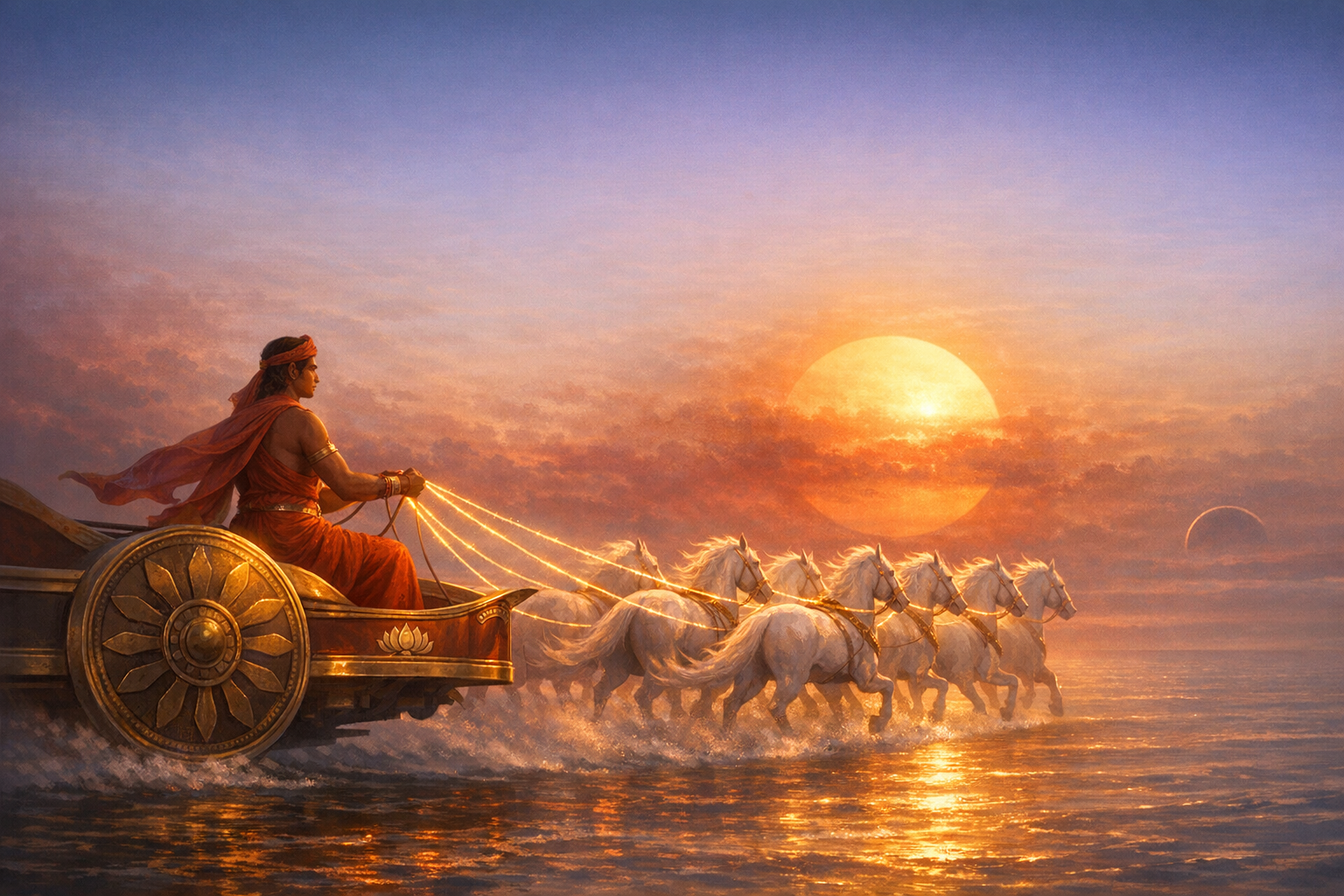
In several Purāṇic tellings, Brahma responds to this need for balance by appointing Aruna as Surya’s sārathi (charioteer). Aruna precedes the Sun like a burnished veil, absorbing and regulating the first surge of solar brilliance. Without such a mediator, Surya’s unmodulated blaze would be too intense for embodied beings. Thus, Aruna’s presence is both cosmologicalsecuring the cadence of daybreakand ethicalsignaling that illumination must be stewarded with wisdom.
Philologically, aruṇa denotes reddish-brown or crimson, the exact hue that suffuses the horizon at arunodaya (dawn). The personification of dawn as a protective herald occurs widely in Vedic and Purāṇic literature, where liminal times (sandhyā) are treated as ritually potent thresholds. Aruna’s iconography preserves this insight: the red mantle at daybreak becomes a symbol of measured revelationlight arriving not as a shock, but as an initiation.
Aruna’s origin, recounted in the Mahābhārata (Ādi Parva), deepens the motif of necessary restraint. Vinata, wife of Kaśyapa and mother of Garuḍa, prematurely broke one of her two eggs; from it emerged Aruna, not yet fully formed, embodying the perils of haste. He foretold Vinata’s future servitude to Kadru, yet also the eventual liberation through Garuḍa. In many retellings, Aruna’s later role as the dawn-charioteer resolves the initial imbalance: what began as untimely emergence matures into the precise governance of time itself.
Vedic cosmography offers a technical frame for this symbolism. Surya’s ratha (chariot) is traditionally drawn by seven horses (sapta-haya), often correlated with the seven chandas (metres) of Vedic poetryGāyatrī, Uṣṇih, Anuṣṭubh, Bṛhatī, Paṅkti, Triṣṭubh, and Jagatīlinking the cadence of light to the cadence of verse. The chariot’s single wheel, read as the samvatsara (solar year), bears twelve spokes (months) and is articulated by seasonal joints, a poetic geometry attested in hymns like Ṛgveda 1.164. As sārathi, Aruna holds the reins of this grand measure, ensuring that solar motion and terrestrial life remain in synchrony.
Another complementary motif appears in the well-known account of Viśvakarma “planing” Surya’s luminosity to tolerable proportions, with the excess radiance forging divine weaponsthe Sudarśana Chakra, the triśūla, and others. Aruna’s function dovetails with this rite of moderation: even a perfected source of light benefits from a mindful mediator. Together, these myths advance a coherent theology of measure: power (śakti) attains auspiciousness when guided by proportion (māna) and discernment (buddhi).
The narrative resonates with observational astronomy. At dawn, the Sun’s rays traverse a longer atmospheric path, and Rayleigh scattering enhances red wavelengths, presenting the world with a softened disc before full brilliance. Eclipses, mythically attributed to Rahu and Ketu, reflect celestial alignments in the Sun–Earth–Moon system. Far from competing worldviews, the Purāṇic allegory and the sky’s mechanics illuminate each other: myth frames meaning; observation refines measure; together they sustain calendrical time reckoning and solar year calculation central to ritual and agrarian life.
Ethically, Aruna exemplifies the charioteer principle articulated across Indian thought. The Kaṭha Upaniṣad images the self’s journey as a chariot where buddhi (discriminative intelligence) serves as the charioteer holding the reins of the senses. In the Mahābhārata, Kṛṣṇa’s guidance of Arjuna models the same architecture of restraint and right direction. Aruna’s governance of Surya’s momentum belongs to this family of images: illumination and energy flourish when yoked to wisdom and restraint.
The image of dawn also embodies a shared sensibility across dharmic traditions. Sandhyā-vandana in Hinduism, samayik and pratikraman in Jainism, early meditation vigils in Buddhism, and the Sikh practice of Amrit Vela all converge on pre-dawn as a preferred time for clarity and renewal. Aruna’s arunodaya, read inclusively, becomes a symbol of unity in diversitydifferent paths orienting toward the same horizon of insight, compassion, and self-mastery.
Culturally and ritually, Surya’s presence remains vibrant: from the Āditya Hṛdayam of the Rāmāyaṇa to the wide practice of Surya Namaskāra and Navagraha invocations. Within this living tapestry, Aruna is not a marginal figure but a structuring presence, marking the first light by which all other practices commence. By mediating Surya’s radiance, Aruna frames the day’s rhythman ancient template for aligning work, worship, and wellbeing.
Interpreted this way, Brahma’s appointment of Aruna communicates an enduring lesson in leadership, science, and spirituality: truth (satya) and brilliance (tejas) serve life best when guided by proportion and empathy. As a theological statement, it explains why creation survives the Sun’s power; as a philosophical statement, it urges the governance of strengths through discernment; as a practical statement, it validates the human instinct to meet vast forcescosmic or personalthrough graduated, mindful approaches.
At arunodaya, when the world is quiet and the sky is a luminous red, many experience a wordless assurance: the day will brighten, but not all at once. That assurance is Aruna’s gift. It binds cosmology to ethics, poetry to astronomy, and diverse dharmic practices to a single, welcoming horizon. In every measured dawn, the ancient sārathi still holds the reins.
Inspired by this post on Hindu Blog.