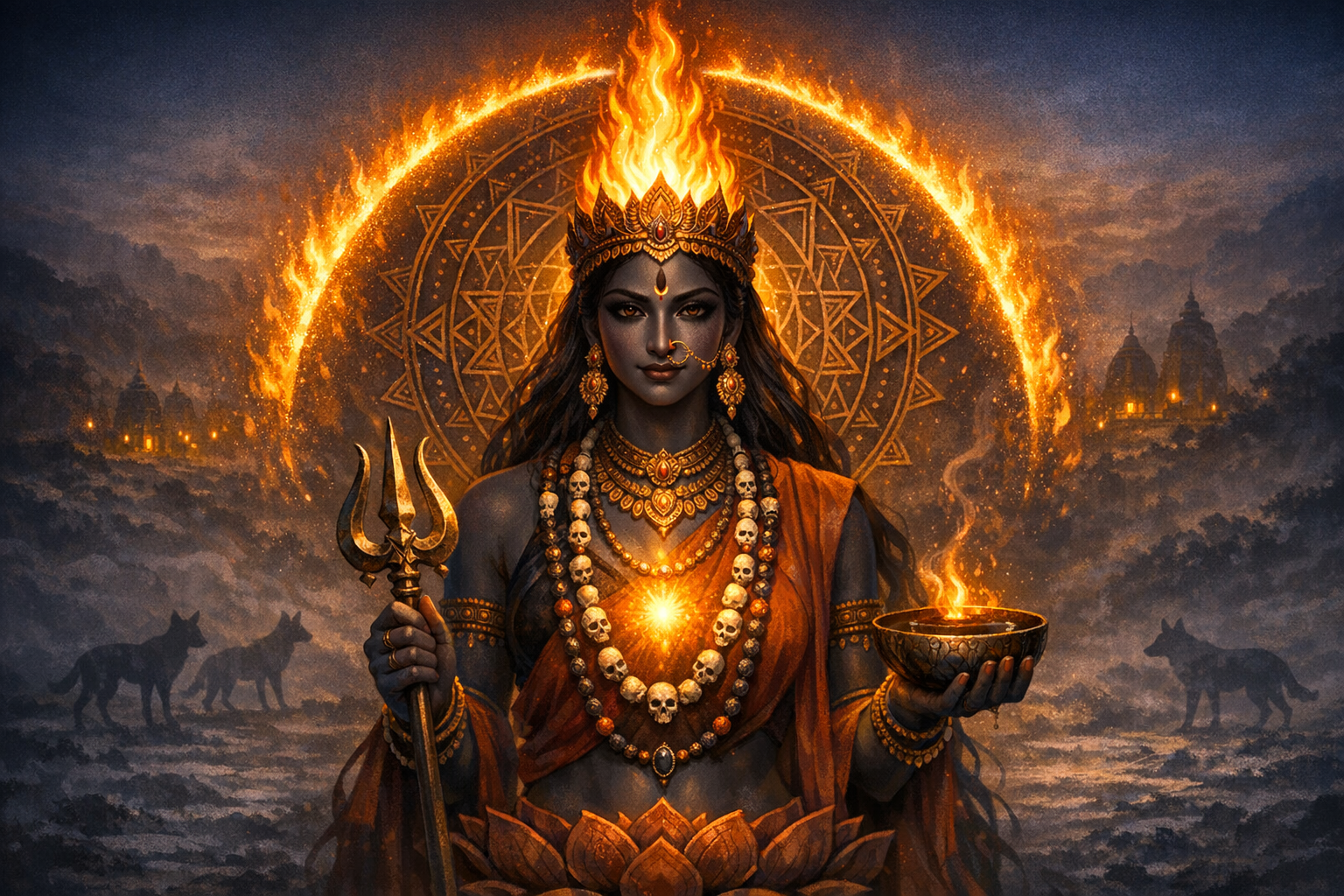
Chamunda, a formidable manifestation of the Divine Mother within Shakta traditions, is frequently portrayed with a crown of living flame. In this iconography, often described as a jvālāmukuṭa, the fire rises sharply yet remains perfectly contained. The image communicates disciplined power: a deity who commands Agni without allowing it to devolve into destructive conflagration. This motif, celebrated as “The Divine Flames of Chamunda: Sacred Fire and Spiritual Transformation,” foregrounds purification, protection, and the transmutation of inner darkness into resilient clarity.
Scriptural and liturgical narratives illuminate this symbolism. In the Devi Mahatmya of the Markandeya Purana, the fierce dimension of the Goddess manifests to defeat demonic forces such as Chanda and Munda; the epithet “Chamunda” memorializes that triumph. In battlefield depictions inspired by this narrative world, the fiery crown signifies a radiant, uncompromising discernment (viveka) that incinerates adharma. Rather than depicting indiscriminate devastation, the flames present a vision of just forceenergy marshaled with precision to protect the cosmic order.
Chamunda’s broader iconography situates the flame crown within a coherent semiotic field. Texts and images portray an emaciated yet invincible form, garlanded with skulls (muṇḍamālā), adorned with a kapāla, and attended by jackals in the cremation ground (śmaśāna). She often stands upon a corpse or occupies a pañchamuṇḍi āsana, emphasizing sovereignty over death and the subrational impulses that cloud wisdom. In this field of symbols, the head-borne fire becomes the apex sign: the triumph of conscious light over the thresholds of decay and fear.
At the doctrinal level, Agni functions as purifier, messenger, and transformer in Vedic and Puranic thought. The Bhagavad Gita’s metaphor“jñānāgni” that reduces karma to ashclarifies the spiritual grammar of Chamunda’s flame. The crown does not spread without purpose because the Deity governs it completely; the fire’s boundaries teach that authentic Shakti aligns power with dharma. The result is a pedagogy of disciplined luminosity: illumination without hubris, force without excess.
Yogic anatomy deepens the reading. The fire principle (agni-tattva) concentrates in the manipūra chakra, generating tejas when harmonized through sādhana. In esoteric expositions, the ascent of kundalinī through suṣumṇā culminates in the sahasrāraoften described as a blossoming radiance or flame. The headborne fire in Chamunda’s image thus echoes the perfected rise of subtle energy: a stable luminosity seated at the crown that no longer flickers with craving or fear.
Within Tantric hermeneutics, fierce goddesses (ugra devīs) embody catalytic energies that transmute obstacles when responsibly engaged. Chamunda’s contained blaze resembles a sacrificial altar carried upon the headthe highest altar being awakened awareness. It is as if a perpetual homa occurs within the deity’s crown: offerings of ignorance, timidity, and delusion are consumed, releasing clarity and compassionate strength. This is virāgni in an inner register, a fire of heroic resolve steered toward liberation.
The battlefield context highlights ethical intent. In images where Chamunda advances amidst asuras, the fire crown becomes a halo of jurisprudence, a living “tejo-kavacha” that guarantees proportionality. Such portrayals insist that righteous warfare (dharma-yuddha) is less about annihilating enemies and more about incinerating the roots of disorderavarice, cruelty, and deceitwhile protecting the vulnerable and restoring balance.
The crown’s containment also marks a philosophical boundary: power under wisdom’s governance. Unchecked flame signals chaos; a precise crown of fire signals mastery. In lived practice, this distinction encourages devotees to refine passion into purpose, courage into care, and anger into lucid moral energy. The icon, therefore, doubles as an ethical diagram mapping how to hold intensity without harm.
Ritual life mirrors the image. Chamunda upāsakas chant sections of the Chandi Pāṭha and perform homa with attentiveness to mantra, meter, and measure. The fire pit’s clear geometry echoes the crown’s disciplined perimeter; the rising flame trains the gaze to recognize steadiness amid heat. Practitioners often testify that such observances build emotional resilience and sharpen discrimination, reinforcing the icon’s core teaching: mastery begins where inner fires meet steady intention.
Regional art offers variations that reinforce the theme. In some temple traditions, the jvālāmukuṭa flares sharply upward; in others it radiates laterally, recalling Nataraja’s cosmic ring of fire but anchored to the head. Himalayan visual cultures sometimes emphasize fierce, cresting tongues of flame reminiscent of Jwala Ji, while eastern schools prefer a gem-like, contained glow. Across these variations, the throughline remains unaltered: fire signals wisdom-in-action, not rage unbound.
Psychologically, the flame crown speaks to transmutation, not repression. Unassimilated fear and anger can scorch indiscriminately; refined through tapas, breath, and mantra, the same energies become moral heat and creative resolve. Devotees often describe encounters with the image as a lesson in converting agitation into clarityan alignment that steadies speech, action, and intention in moments of high stakes.
The cremation-ground setting (śmaśāna) recontextualizes everyday anxieties. By enthroning radiance over a landscape of endings, the icon declares that luminosity is not the denial of finitude but its fearless witness. The crown of fire, carried calmly above skulls and ash, affirms that ultimate victory is inward: freedom from panic, fixation, and the compulsion to cling where change is certain.
Comparative Dharmic resonances strengthen a shared civilizational ethos. In Vajrayāna Buddhism, dharmapālas and vidyārājas are wreathed in flames that symbolize the wisdom fire consuming kleshas; the parallel with Chamunda’s contained blaze is instructive. Jain narratives valorize the radiant purity of kevala-jñāna, a cool yet penetrating illumination that, like controlled fire, leaves no residue of bondage. Sikh thought reveres the eternal jyot within; the language of light burning away duality echoes the same grammar of inner transformation. Taken together, these motifs affirm a common principle across Hinduism, Buddhism, Jainism, and Sikhism: fierce luminosity serves compassion, truth, and liberation.
Ecologically, the image teaches regeneration. In many landscapes, carefully managed burns reduce fuel load and catalyze new growth. Chamunda’s crown visualizes a spiritual controlled burn: unnecessary accumulations are cleared, vitality returns, and the forest of consciousness breathes freely again. The icon thus frames restraint not as denial but as a sophisticated form of care.
Gendered readings emphasize protective love. As the Mother in an ugra form, Chamunda holds intensity without losing tenderness of purpose. The flame crown reveals severity guided by compassionheat that cauterizes wounds rather than inflicts them. In domestic and civic life alike, this becomes a model for principled firmness in service of communal well-being.
For contemplative practice, several approaches align with the icon’s grammar. Trāṭaka on a single flame cultivates one-pointedness; pranayama refines inner heat into steady tejas; mantra-japa of Chamunda’s names stabilizes intention. Ethical disciplines (yamas and niyamas) serve as the crown’s boundaryclear commitments that keep intensity beneficial. These methods do not imitate danger; they interiorize order, transforming agitation into trustworthy strength.
Iconographers underline the didactic clarity of the flame crown: it is a metonym for enlightened agency. The hand may wield a trident or sword, but the head bears fire that directs all instruments. Where the mind is lucid, implements of power become tools of healing; where the mind is clouded, even soft speech can turn harmful. The crown, therefore, is not an adornment but a thesis on ethical action.
In sum, the raging flames upon Chamunda’s head signify a controlled, sanctifying Agni that transforms violence into protection, fear into courage, and confusion into wisdom. Rooted in the Devi Mahatmya and elaborated across Shakta iconography, the motif is doctrinally consistent with Vedic and Yogic accounts of purificatory fire and resonates with parallel insights across Buddhism, Jainism, and Sikhism. By honoring this imagery as a Hindu symbol of Shakti and as a shared civilizational teaching on disciplined luminosity, communities can affirm unity-in-diversity and cultivate a spiritual culture in which intensity serves truth, compassion, and liberation.
Inspired by this post on Hindu Blog.