
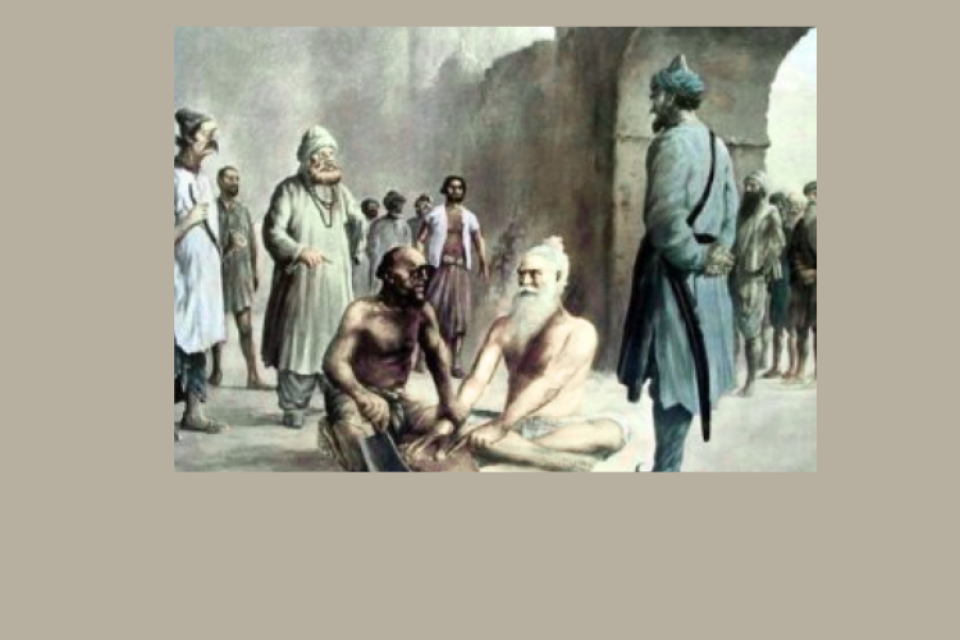
Bhai Mani Singh occupies a revered place in Sikh history as a scholar, organizer, spiritual servant, and martyr whose life continues to speak to the moral anxieties of the modern world. His legacy is not confined to one community’s memory alone; it belongs to the wider dharmic tradition of courage, learning, discipline, seva, and fidelity to truth. In an age marked by confusion, cultural dislocation, shallow argument, and weakening public ethics, his example offers seven enduring lessons that remain practical, demanding, and deeply humane.
The historical Bhai Mani Singh is remembered as a close Sikh of the Guru tradition, associated with the court and service of Guru Gobind Singh, and later with the stewardship of Sri Harmandir Sahib at Amritsar. Sikh memory honors him as a learned interpreter of Gurbani, a custodian of community institutions, and a martyr who accepted death rather than compromise the dignity of his faith. His martyrdom in Lahore in 1738, traditionally described as death by dismemberment under Mughal authority after a dispute connected with a religious gathering and a punitive demand, became one of the defining episodes of Sikh resistance and spiritual resolve.
To understand Bhai Mani Singh only as a victim of persecution would be inadequate. His life was not merely a tale of suffering; it was a disciplined response to disorder. He lived during a period when the Sikh Panth faced political pressure, social disruption, and repeated attempts to weaken its institutions. Yet his answer was not despair. He strengthened memory, preserved sacred learning, served the sangat, and maintained the centrality of dharma even when force tried to silence conscience.
The first lesson from Bhai Mani Singh is that knowledge must be preserved with reverence and responsibility. He is remembered in Sikh tradition for his association with the compilation, organization, and teaching of sacred texts. Whether one approaches this history through devotional memory or academic inquiry, the larger principle is clear: communities survive when they protect their intellectual and spiritual inheritance. A people who forget their scriptures, languages, songs, and ethical vocabulary become vulnerable to every fashionable ideology that promises meaning without discipline.
This lesson applies across Hinduism, Sikhism, Buddhism, and Jainism. Each dharmic tradition has survived not only through temples, gurdwaras, monasteries, and pilgrimage centers, but also through manuscripts, oral recitation, commentary, debate, and disciplined transmission from teacher to student. Bhai Mani Singh’s life reminds modern readers that tradition is not a museum object. It is a living trust. To study Gurbani, the Vedas, the Upanishads, the Agamas, the Tripitaka, Jain Agamas, Itihasa, Purana, and the works of saints is not nostalgia; it is civilizational continuity.
The second lesson is that service is the strongest foundation of leadership. Bhai Mani Singh did not build authority through self-display. His authority emerged through seva, scholarship, administrative responsibility, and moral steadiness. In dharmic culture, leadership is not meant to be a performance of power; it is a disciplined offering for the welfare of the community. This is why the memory of figures like Bhai Mani Singh remains powerful long after kingdoms, offices, and titles have disappeared.
Modern society often confuses visibility with leadership. Public life rewards speed, outrage, branding, and emotional manipulation. Bhai Mani Singh represents a different model. He shows that the most durable leaders are those who quietly hold institutions together, protect sacred spaces, teach the next generation, and absorb pressure without abandoning principle. Such leadership is not passive. It is active, organized, and courageous, but it is free from vanity.
The third lesson is that courage is not the absence of fear, but the refusal to surrender conscience. Bhai Mani Singh’s martyrdom is remembered because it revealed a profound hierarchy of values. Physical life was precious, but truth was higher. Survival was desirable, but not at the cost of dishonor. In this sense, his courage belongs to the broader dharmic ideal that the body is temporary, while dharma, truth, and the soul’s integrity must not be traded for comfort.
This lesson has contemporary relevance far beyond the battlefield or the prison cell. Moral courage is required in classrooms, courts, homes, offices, media spaces, and public institutions. It is required when truth is unpopular, when heritage is mocked, when communities are pressured to erase their memory, and when silence becomes easier than honesty. Bhai Mani Singh’s example does not encourage recklessness; it teaches principled firmness. Courage without wisdom can become aggression, but wisdom without courage becomes helplessness.

The fourth lesson is that community cohesion requires shared discipline. The Sikh Panth endured immense hardship in the eighteenth century because it possessed institutions, collective memory, martial discipline, devotional practice, and a sense of sacred belonging. Bhai Mani Singh’s role in strengthening community life points to a truth that applies to every society: unity cannot be built only through slogans. It requires regular practice, ethical conduct, shared spaces, and a willingness to place collective duty above narrow ego.
For dharmic communities today, this lesson is urgent. Hindu, Sikh, Buddhist, and Jain traditions have distinct histories, philosophies, rituals, and identities, yet they share civilizational concerns: the preservation of sacred knowledge, the protection of places of worship, the dignity of spiritual practice, the importance of family and community, and the pursuit of liberation, wisdom, compassion, and righteous conduct. Unity does not require sameness. It requires respect, literacy, and the maturity to recognize kinship without erasing difference.
The fifth lesson is that martyrdom must be understood as moral testimony, not as a cult of suffering. Bhai Mani Singh is not remembered because pain is valuable in itself. He is remembered because he transformed suffering into witness. His death became a declaration that coercion cannot command genuine faith. This distinction matters. Dharmic traditions do not glorify cruelty or victimhood. They honor tapas, sacrifice, restraint, and courage when these are anchored in truth and directed toward the protection of dharma.
In the modern world, suffering is often politicized, commercialized, or converted into resentment. Bhai Mani Singh’s memory offers a higher standard. It asks whether pain can deepen compassion, whether injustice can strengthen responsibility, and whether historical memory can produce wisdom rather than bitterness. A mature remembrance of martyrdom should lead to ethical clarity, not hatred. It should deepen commitment to justice while preserving inner dignity.

The sixth lesson is that sacred institutions must be protected through competence as well as devotion. Bhai Mani Singh’s association with Sri Harmandir Sahib is not only spiritually significant; it is institutionally significant. Sacred centers require administrators, scholars, granthis, musicians, custodians, donors, defenders, teachers, and ordinary devotees who understand that devotion must be organized. A temple, gurdwara, monastery, or pathshala survives when love is joined with discipline.
This insight is especially important in contemporary debates about temple governance, heritage preservation, religious education, and community autonomy. Sacred institutions cannot be treated merely as cultural monuments or revenue-generating sites. They are centers of memory, worship, learning, charity, and identity. Bhai Mani Singh’s legacy encourages a serious approach to institutional stewardship: transparent management, scriptural literacy, historical awareness, and accountability rooted in dharma.
The seventh lesson is that spiritual identity must remain open to compassion while firm in truth. Bhai Mani Singh belonged to a tradition shaped by the teachings of the Sikh Gurus, whose message joined devotion, equality, courage, and service. That tradition grew within the broader sacred geography of Bharat, where multiple dharmic paths developed their own language of liberation and ethical life. His example therefore should not be read through narrow sectarianism. It should be read through the expansive principle that genuine faith strengthens dignity, responsibility, and compassion.
This balance is difficult but necessary. A community that loses firmness may be dissolved by pressure. A community that loses compassion may betray its own spiritual foundations. Bhai Mani Singh’s life demonstrates that firmness and compassion are not opposites. The same person can serve humbly, teach patiently, preserve sacred learning, defend community dignity, and accept suffering without surrendering to hatred. This is the mark of spiritual strength.

His relevance to the modern world becomes clearer when placed against today’s crises. Many societies are experiencing loneliness, historical amnesia, ideological polarization, and a decline in trust. Younger generations often inherit fragments of tradition without the tools to understand them. Public debate often rewards contempt rather than careful study. In such a climate, Bhai Mani Singh’s life offers a disciplined alternative: learn deeply, serve quietly, stand firmly, remember accurately, and act with integrity.
There is also an emotional dimension to his legacy. For many who encounter his story, the first response is not academic analysis but silence. The image of a saint-scholar accepting death rather than abandoning principle forces a difficult question: what values are truly non-negotiable? This question is uncomfortable because modern life often trains people to compromise everything for convenience. Bhai Mani Singh’s memory interrupts that habit. It asks whether comfort has replaced conviction and whether identity has been reduced to sentiment without sacrifice.
Yet his legacy should not be reduced to severity. It also contains tenderness. The preservation of scripture, the service of sangat, the care of sacred institutions, and the teaching of future generations all arise from love. His life shows that dharma is not sustained by anger alone, nor by intellectual pride, nor by ritual without responsibility. It is sustained by love disciplined into action. That is why his example continues to move people across time.
For scholars of Sikh history, Bhai Mani Singh represents the intersection of textual tradition, community organization, and martyr memory. For devotees, he represents uncompromising faith. For dharmic communities more broadly, he represents a model of civilizational resilience. These perspectives need not compete. Academic study can clarify context; devotional memory can preserve reverence; ethical reflection can make the past useful for the present.
The enduring power of Bhai Mani Singh lies in this combination. He was not merely a figure of the past, sealed within eighteenth-century conflict. He remains a mirror for the present. His life asks whether knowledge is being preserved, whether leaders are serving, whether sacred institutions are being protected, whether communities are united without becoming intolerant, and whether truth still commands loyalty in an age of convenience.
Seven lessons emerge with clarity: preserve sacred knowledge, lead through seva, defend conscience, build disciplined community, remember martyrdom ethically, protect institutions competently, and hold firmness together with compassion. These lessons are not abstract ideals. They are practical disciplines for families, educators, community leaders, students, and all who care about the future of dharmic civilization.
Bhai Mani Singh’s legacy endures because it answers a universal human problem: how to remain truthful when the world becomes hostile to truth. His answer was not withdrawal, bitterness, or compromise. It was service, scholarship, courage, and sacrifice. That is why his memory remains luminous. In remembering him, the modern world is invited not only to admire a martyr, but to recover the discipline required to live with dignity.
Inspired by this post on SikhNet – News.








Leave a Reply
You must be logged in to post a comment.