
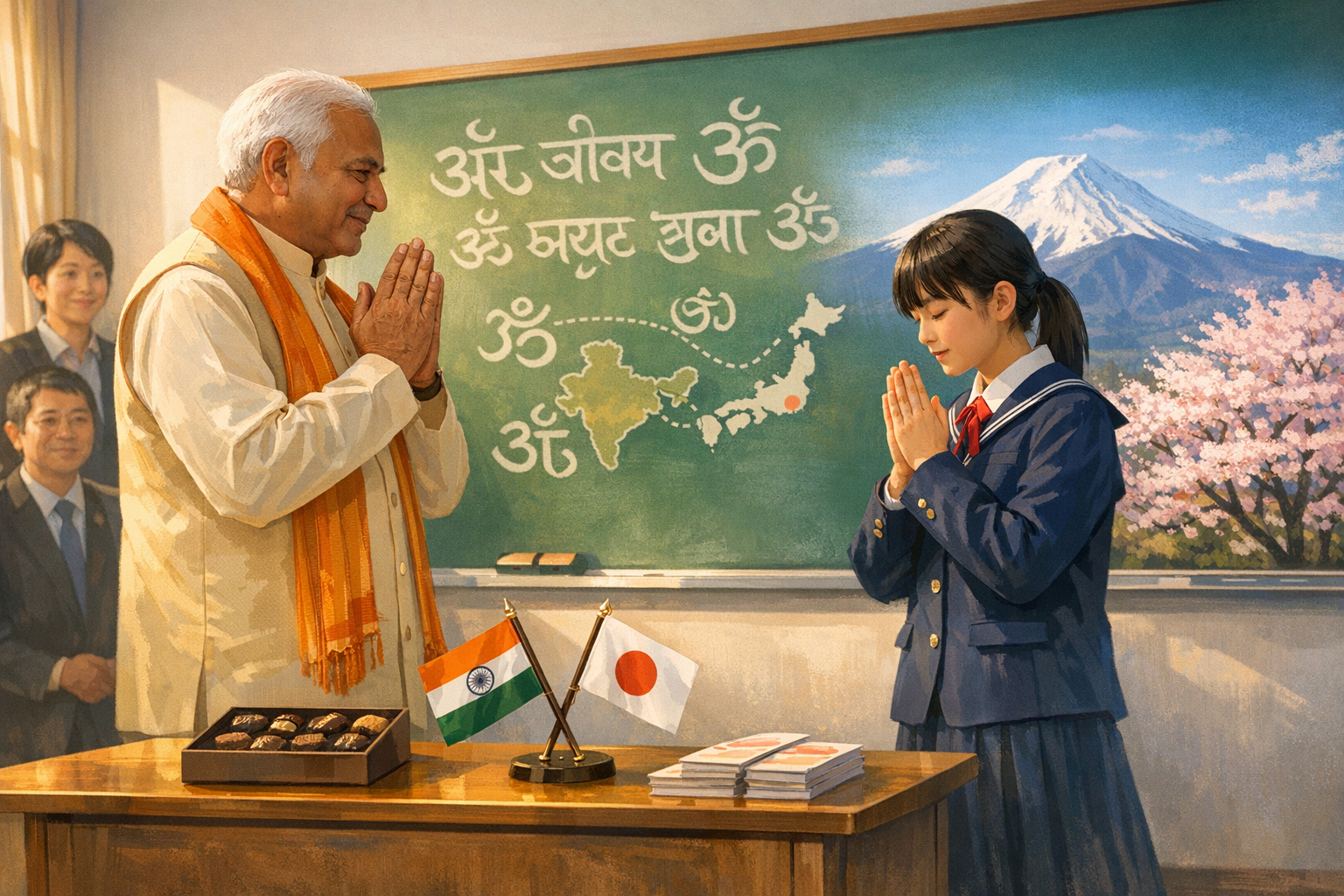
A brief classroom moment in Yamanashi Prefecture became the defining image of a larger diplomatic mission when a student at Yamanashi Public School greeted Uttar Pradesh Chief Minister Yogi Adityanath with a namaste, touched his feet in a gesture of reverence, and recited Sanskrit shlokas to which the visiting dignitary responded in kind. The interaction, simple yet profound, captured how cultural familiarity and shared values can quietly advance the aims of foreign engagement.
Eyewitness accounts and video circulating online show a calm, respectful exchange: the child initiates with namaste, proceeds to Sanskrit recitation, and receives a warm acknowledgement as the delegation later distributes chocolates to students. As a vignette of education diplomacy, the scene illustrates how cross-cultural learning thrives on dignity, curiosity, and recognition of each other’s heritage.
The clip quickly went viral, drawing praise for the student’s poise and for the dignitary’s spontaneous participation. While the formal agenda of the visit focused on expanding trade ties, strategic cooperation, and encouraging Japanese investment in Uttar Pradesh, public memory gravitated to this emotive classroom encounteran instance of soft power at work where human connection communicates more than any policy paper.
In the dharmic cultural matrix, namaste signifies both respect and the recognition of a shared inner dignity. The añjali mudrāpalms joined at the heartembodies equality between greeter and greeted. As used across Hindu, Buddhist, Jain, and Sikh contexts, it functions as a universally intelligible gesture of humility and welcome, well-suited to intercultural education settings where verbal cues may falter but courtesy does not.
The student’s charan sparsha (touching of feet) reflected a further layer of the guru–shishya ethos that values gratitude toward elders and teachers. Across dharmic traditions, honoring a knowledge-giver is not about hierarchy for its own sake but about acknowledging responsibility, discipline, and the ethical dimension of learning.
Sanskrit shlokas contribute a rhythmic pedagogy that has historically trained attention, memory, and articulation. Beyond religious contexts, metrical recitation is an effective cognitive tool; cadence helps learners internalize complex phonetics and semantics. When such recitation travels across borders, it brings with it an ecosystem of learning techniques that can be adapted for secular language and literature classrooms.
Japan’s own historical encounter with Sanskrit is neither novel nor peripheral. In esoteric Buddhist traditions such as Shingon and Tendai, Sanskrit seed syllables transmitted in the Siddham scriptknown in Japan as bonjiremain objects of study and veneration. This heritage underscores why Sanskrit sounds and symbols can feel strikingly familiar in Japanese religious art and pedagogy, even if encountered today through classrooms rather than monasteries.
Yamanashi Prefecture, known for its proximity to Mount Fuji and a strong culture of technical and environmental education, offered a fitting venue for this exchange. School interactions of this sort provide a textured complement to official meetings, anchoring strategic dialogue in student curiosity, teacher initiative, and community hospitality.
From an education diplomacy perspective, the encounter exemplifies Track 1.5 and Track 2 dynamics where government-led visits intersect with people-to-people engagement. Such forums build what scholars of public diplomacy call “relational capital”: trust earned through repeated, respectful contact in which local stakeholders are participants rather than mere spectators.
Soft power theorypopularized by Joseph Nyehelps explain the outsized resonance of a short video. Cultural affinity and moral credibility can influence attitudes more effectively than coercion or transactional bargaining. Here, the circulation of a namaste and Sanskrit shlokas functioned as narrative assets that reframed a trade-focused itinerary in terms that felt humane, familiar, and trust-enhancing.
For Uttar Pradesh, which seeks greater integration into Indo-Pacific value chains, Japan represents a partner with strengths in manufacturing, quality management, and infrastructure systems. Education-facing moments like this signal openness to long-term collaborationan especially relevant message for Japanese firms that calibrate investment to workforce skills, cultural compatibility, and policy stability.
Reports noted parallel engagements with senior Japanese leaders, including Toshimitsu Motegi, underscoring the visit’s formal diplomatic arc. Yet, as often happens, the most widely shared images were not from a boardroom but from a classroomaffirming the axiom in international relations that public diplomacy is most effective when it is locally grounded and emotionally legible.
Crucially, the gestures observed in Yamanashi align with a dharmic ethic of unity-in-diversity. Namaste, respect for teachers, and Sanskrit recitation are not exclusionary markers but shared civilizational touchpoints recognized across Hinduism, Buddhism, Jainism, and Sikhism. Their transmission across borders emphasizes inclusion over assertion, hospitality over hegemony, and learning over rivalryprecisely the sensibilities needed for durable partnerships.
Digital virality added a contemporary layer. What earlier required official broadcasting now unfolds organically when a compelling moment meets an engaged audience. In this sense, the classroom interaction constituted “Public Diplomacy 2.0”: citizen-captured content that advances mutual understanding without scripts, slogans, or spectacle.
Pragmatically, the episode offers replicable practices for future delegations. Schools can be prioritized in itineraries; educators can be briefed on intercultural classroom protocols; and language moduleswhether Sanskrit basics or Japanese greetingscan be exchanged as low-cost, high-impact teaching aids. Small tokens, like confectionery and bilingual bookmarks of common phrases, can serve as mementos reinforcing the joy of learning.
For curriculum designers, this moment recommends modest yet meaningful integrations: introductory Sanskrit phonetics for comparative linguistics; modules on bonji to connect Japanese students with regional Buddhist history; and short explorations of dharmic ethicsnon-harm, truthfulness, self-disciplineas universal civic values rather than sectarian claims.
Ultimately, the power of the Yamanashi interaction lies in its ordinariness. A child greeted a guest, a guest honored a child’s learning, and an audiencelocal and globalrecognized something valuable in that exchange. It is the sort of quiet continuity that sustains cultural diplomacy after press conferences have ended and investment roadshows have moved on.
In sum, the namaste and Sanskrit shlokas that moved Yogi Adityanath also moved the narrative of India–Japan engagement toward a more human register. By centering dignity, learning, and shared dharmic values, the visit demonstrated how education diplomacy can deepen international relations, support long-horizon economic goals, and cultivate a generation for whom cooperation feels not exceptional, but natural.
Inspired by this post on Hindu Human Rights Blog.










