Mayasuraalso known as Maya Dānavaoccupies a singular place in the epics and Purāṇas as a master of architecture, illusion, and cosmic design. Described as the son of Rishi Kaśyapa and Diti in the Itihāsa-Purāṇa tradition, he appears across the Ramayana and the Mahabharata as an engineer whose creations blend rigorous planning with visionary aesthetics. Within Dharma traditions, his figure invites a nuanced reading: beyond the label “asura,” Mayasura represents technical brilliance disciplined (or, at times, tempted) by the ethics of purpose, reminding readers that knowledge without right intent can entangle, while knowledge in service of Dharma can liberate.
Genealogically, Mayasura is a prominent Dānava, married to the pious and chaste lady Hema. Later narrative traditions describe four children, and identify Mandodari (often spelled Mandodari; also found as Mandhodhari in some sources) as his daughter. Through Mandodari’s marriage to Ravana in the Treta Yuga, Mayasura becomes linked to the royal house of Lanka, further expanding his presence in the epic imagination of South Asia.
In the Ramayana corpus, Mayasura’s profile is most visible through kinship rather than direct action. While the city of Lanka is traditionally attributed to Viśvakarma, the association of Mayasura with refined engineering and optical marvels helps explain the epic’s fascination with palatial splendor, aerial conveyances, and intricate urbanity. The figure of Mayasura symbolizes mastery over materials, space, and sensory experiencecapacities that, in the hands of a moral agent, can either enhance sacred life or amplify unchecked ambition.
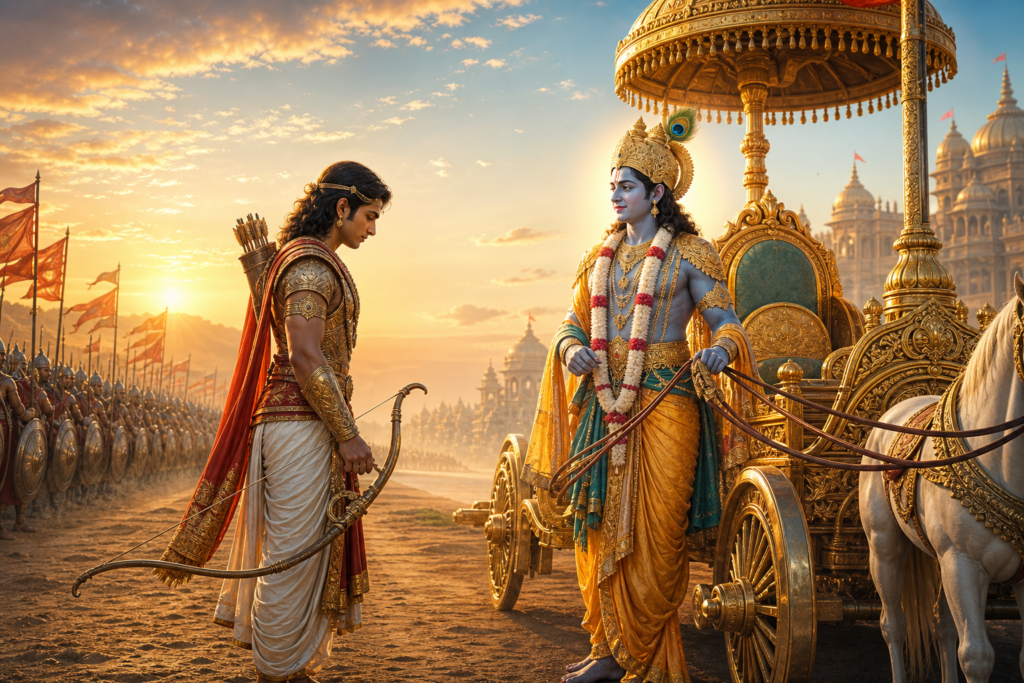
The Mahabharata gives the fullest account of Mayasura’s technical genius. During the Khandava-daha (the burning of the Khandava forest) in the Adi Parva, Krishna and Arjuna overpower the forest’s defenders. Mayasura, present there, is spared by Arjuna. In gratitude, he offers his skill to the Pāṇḍavas and proceeds to design and construct the legendary Maya Sabha (assembly hall) at Indraprasthaan architectural marvel whose aesthetic sophistication and sensory deceptions became the talk of the age.
The Maya Sabha, narrated in the Sabha Parva, is not merely a large courtly pavilion; it is a systemic exploration of how sightlines, reflections, materials, and thresholds can choreograph human movement and emotion. Floors resembling water and water resembling floors, concealed levels, and dazzling light-play collectively interrogate perception itself. The famous scene in which Duryodhana loses balancemisreading reflective floors as dry groundsignals not only Mayasura’s mastery of optics and surface finishing but also the epic’s moral psychology: pride, like a mirage, misleads even the powerful.
From a technical standpoint, the Maya Sabha invites analysis in terms familiar to architectural history: hydrological integration, controlled reflectivity (stone polishing, metal inlays, and water bodies), passive cooling through air–water interfaces, and carefully designed circulation patterns. The hall’s illusions can be read as deliberate “catoptric” effects (mirror- and surface-based deceptions), likely combined with finely worked stone and metal that produce specular highlights. Such features, cited across ancient building traditions, exemplify how sensory design can both serve and subvert human judgment.
Mayasura’s portfolio in the Purāṇic world extends yet further. In the celebrated narrative of Tripura, he designs three extraordinary, mobile citiesof gold, silver, and ironfor the sons of Tārakāsura. Their orbits align so that the fortified triad becomes vulnerable at a single moment. Śiva’s decisive act (Tripurantaka) dissolves the cities in one divine release of the Pāśupata weapon. Crucially, Mayasura is spared, underscoring a recurrent motif: divinity can annihilate hubris and unrighteous power while preserving craft, knowledge, and the potential for right application.
Across these accounts, the line between “illusion” (māyā) and “intuition” is philosophically rich. Mayasura’s works do not trivialize reality; they expose the layered nature of perception. In Dharma hermeneutics, this is not a nihilistic gesture but an ethical one: discerning truth from appearance is central to all four Dharmic pathsHinduism, Buddhism, Jainism, and Sikhism. When skill is aligned with restraint and compassion, architecture becomes a mandala for clarity; when yoked to pride, it becomes a labyrinth.
Traditional learning further associates Mayasura with scientific and technical texts. The Surya Siddhantaan influential Sanskrit treatise of mathematical astronomyis classically said to have been revealed by Surya to Maya (Maya Asura). While scholars date portions of the work to the first millennium CE, the internal tradition linking Maya and astronomical expertise is noteworthy. It suggests that the “demon architect” was remembered not only for construction but also for calendrics, planetary models, and the computational frameworks necessary for aligning sacred time with sacred space.
Vāstu-śāstra literature provides another strand. The Mayamata (Mayamatam) is a seminal South Indian treatise on architecture and town planning traditionally attributed to Maya/Mayasura. Together with allied works such as the Mānasāra, it discusses site selection, proportional canons (tāla-māna), measurement systems (aṅgula-based modules), orientation, foundation science, water systems, and typologies of sacred and domestic buildings. Whether as literal authorship or as an eponym for a “Maya school,” this attribution preserves the memory of a comprehensive technical tradition underpinning Hindu architecture.
When viewed comparatively, these textual legacies converse fruitfully with the built cultures of the broader Indic world. Mandala-based planning, axial alignments, sacred ratios, and cosmographic symbolism recur across Hindu temples, Buddhist viharas and stupas, Jain derasars, and even in the luminous geometries of many Sikh gurdwaras. In this wider canvas, Mayasura’s archetype represents a civilizational conviction: space choreographs consciousness. The unity of purpose across Dharmic traditionscultivating clarity, compassion, and couragerests upon a shared language of form, light, and orientation.
Material science in ancient architectureimplicit in Mayasura’s legendsspans more than stone and timber. Textual hints and archaeological analogues point to advanced stone polishing, metal cladding, lime plasters with organics, and engineered water bodies for climate control and reflection. These technologies, combined with patterned perforations and courtyards, managed heat and airflow in ways modern sustainability discourse can appreciate: comfort achieved through passive means and local materials rather than through extractive excess.
Acoustics and optics, central to the Maya Sabha narrative, are not mere curiosities. Whispering galleries, flank corridors that shape chant, and sancta that amplify a conch’s resonance are well-attested across the subcontinent’s temple architecture. In the Mahabharata’s portrayal, the limits of perception become a design material. The very same insights can sanctify ritual by sharpening awarenessor, if misapplied, unsettle discernment. The texts thereby embed a design ethic: aesthetics must be accountable to Dharma.
In the moral grammar of the epics, “asura” and “deva” are not simplistic labels of good and evil; they index tendencies. Mayasura’s skill is never trivialized; it is feared when untethered, revered when consecrated to rightful ends. This dialectic explains why Śiva spares him in Tripura, and why Arjuna preserves him in the Khandava-daha. Knowledge merits preservation; craving for domination merits correction.
The familial strand of Mayasura’s story enriches this ethic. Mandodarihis daughter in many retellingsstands in the Ramayana as a voice of wisdom, repeatedly counseling restraint to Ravana. Whether read historically or symbolically, the pairing of a consummate builder-father with an ethically lucid daughter captures a civilizational axiom: technical prowess attains meaning only when illumined by conscience.
Placing Mayasura alongside Viśvakarma clarifies the Indic taxonomy of skill. Viśvakarma, as the divine craftsman, largely symbolizes creation harmonized with the cosmic order; Mayasura, as master of illusion and formidable engineering, tests the practitioner’s maturity. Together, they bracket a spectrumfrom luminous creativity to seductive spectacleand urge the reader, designer, and policymaker alike to cultivate discernment.
The resonance of these themes extends across the Indian Ocean world. From the axial waterways and reflective causeways of the Khmer to the mandala-grounded plans of South Indian temple-cities, one encounters variations on Mayasura’s preoccupations with orientation, water, and visual dramaturgy. Without asserting direct lines of authorship, it is historically reasonable to recognize a traveling repertoire of techniques, measurements, and cosmogramsan architectural lingua franca connecting diverse Dharmic and allied Asian traditions.
For contemporary architects and heritage professionals, Mayasura’s corpusmythic yet method-richsuggests actionable principles: prioritize passive thermal comfort; use water to cool and to guide movement; deploy reflectivity and darkness to compose experience; articulate thresholds to train attention; and embed proportions that speak to the body’s innate sense of harmony. These are not archaic curiosities; they are blueprints for sustainable and meaningful design.
Students seeking textual anchors will find the Khandava-daha in the Mahabharata’s Adi Parva and the Maya Sabha in the Sabha Parva; Tripura narratives appear across Purāṇic sources (notably the Śiva Purāṇa). For technical literature, the Surya Siddhanta offers the astronomical and calendric armature of sacred time, while the Mayamata (Mayamatam) and allied Vāstu texts lay out site science, measurement, and typology. Read together, these works interlock: timekeeping, orientation, form, and ethics cohere into a single, civilizational pedagogy.
Crucially, this pedagogy aligns with the unifying aims of all Dharmic traditions. Hinduism emphasizes the sanctification of space (kṣetra) and time (kāla), Buddhism disciplines perception to see things as they truly are, Jainism refines conduct through careful attention and non-violence, and Sikhism grounds action in remembrance (simran) and righteous living. Mayasura’s archetypeengineering as a test of insightharmonizes with each path’s insistence on clarity over delusion and service over self-display.
In sum, Mayasura is less a marginal “demon” and more an enduring signifier of the subcontinent’s depth in architecture, optics, astronomy, and urban thought. He is a reminder that every dazzling hall, every mirrored pool, and every perfectly proportioned shrine carries a question: to what end is skill being used? The epics answer by pairing technique with Dharma, spectacle with sobriety, and power with responsibility.
Read this way, the legend of Mayasura becomes a guide for modern life. Institutions, cities, and technologies can be engineered to confuse or to console; to inflame or to illumine. The choice, the texts insist, is an ethical one. When knowledge, insight, and compassion converge, architecture becomes not a maze but a mandalaan instrument for awakening shared across Hindu, Buddhist, Jain, and Sikh traditions.
Inspired by this post on Hindu Pad.