
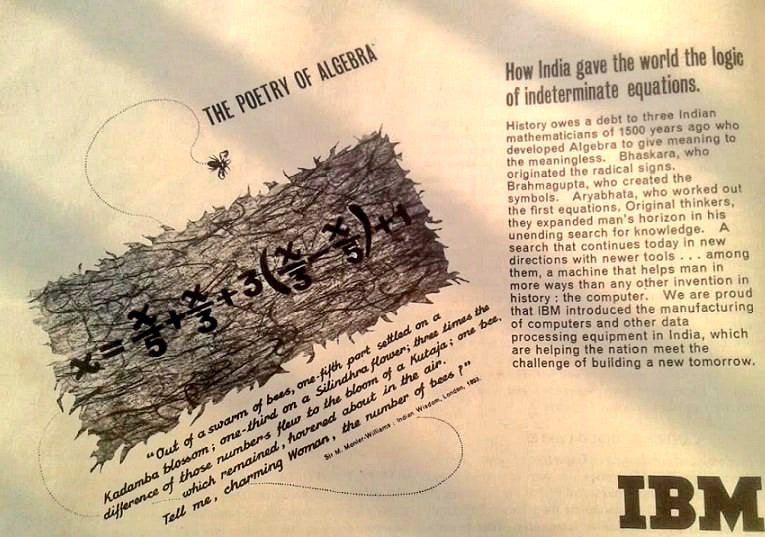
History owes a debt to three Indian mathematicians of 1500 years ago who developed Algebra to give meaning to the meaningless. Bhaskara, who originated the radical signs, Brahmagupta, who created the symbols, and Aryabhata, who worked out the first equations. Original thinkers, they expanded man’s horizon in his unending search for knowledge. A search that continues today in new directions with newer tools – among them, a machine that helps man in more ways than any other invention in history: the computer. We are proud that IBM introduced the manufacturing of computers and other data processing equipment in India, which are helping the nation meet the challenge of building a new tomorrow.
The Influence of Ancient Indian Mathematicians
India has a rich history of mathematical innovation, particularly in the field of algebra. Ancient Indian mathematicians such as Bhaskara, Brahmagupta, and Aryabhata made significant contributions that laid the foundation for modern algebra. Their work on indeterminate equations was revolutionary and continues to influence contemporary mathematics.
Bhaskara: Known for his work in the 7th century, Bhaskara introduced radical signs and made substantial contributions to the development of algebra. His treatises provided new methods for solving quadratic equations and exploring the properties of numbers.
Brahmagupta: In the 6th century, Brahmagupta authored the “Brahmasphutasiddhanta,” where he introduced the concept of zero as a number and developed rules for arithmetic operations involving zero. His work on indeterminate equations, particularly the solutions to quadratic equations, was groundbreaking.
Aryabhata: One of the earliest mathematicians, Aryabhata, worked on the first known equations and contributed significantly to trigonometry and astronomy. His methods for solving linear and quadratic equations were innovative and influenced subsequent mathematicians. Here is a notable shloka from Aryabhata’s “Aryabhatiya” that describes the area of a circle:
Sanskrit:
त्रैराशिकेण भुजस्य फलम् योजनस्यैकमिहार्धेन |
द्वित्र्यंशेनाSथवा प्रगुणैर्द्विगुणितैः स्पृहणात्साम्यविनाशम् ||
Transliteration:
Trairāśikeṇa bhujasya phalam yojanasyaikamihārdhena |
Dvitryaṃśenāthavā praguṇairdvi-guṇitaiḥ spṛhaṇātsāmyavināśam ||
Translation:
“The diameter multiplied by itself and then by the approximate value (3) or accurate value (the square root of ten) of pi gives the area of a circle.”
The Poetic Beauty of Algebra

The image in the blog post illustrates the poetic nature of algebra with a mathematical riddle involving a swarm of bees. The riddle exemplifies how algebra can transform a seemingly mundane scenario into an intellectual challenge, highlighting the beauty of mathematical thought.
“Out of a swarm of bees, one-fifth part settled on a Kadamba blossom; one-third on a Silindhra flower; three times the difference of those numbers flew to the bloom of a Kutaja; one bee remained in the air. Tell me, charming woman, the number of bees.”
This poetic representation of an algebraic problem underscores the elegance and creativity inherent in mathematics. It shows how algebra can be used not just for practical purposes but also for creating intellectual art that challenges and delights the mind.
The Legacy of Indian Mathematics in Modern Technology
The advancements made by these ancient mathematicians laid the groundwork for future technological developments, including the computer. The principles of algebra and the logic of equations are fundamental to computer science and data processing. Companies like IBM have built on this legacy, bringing advanced computing technology to India and supporting the country’s growth in the digital age.
Conclusion
The contributions of Bhaskara, Brahmagupta, and Aryabhata to algebra are a testament to the innovative spirit of ancient Indian mathematicians. Their work continues to inspire and influence modern mathematics and technology. The poetic beauty of their equations and the logical rigor they introduced have made lasting impacts that resonate through the centuries, reminding us of the timeless nature of mathematical inquiry.