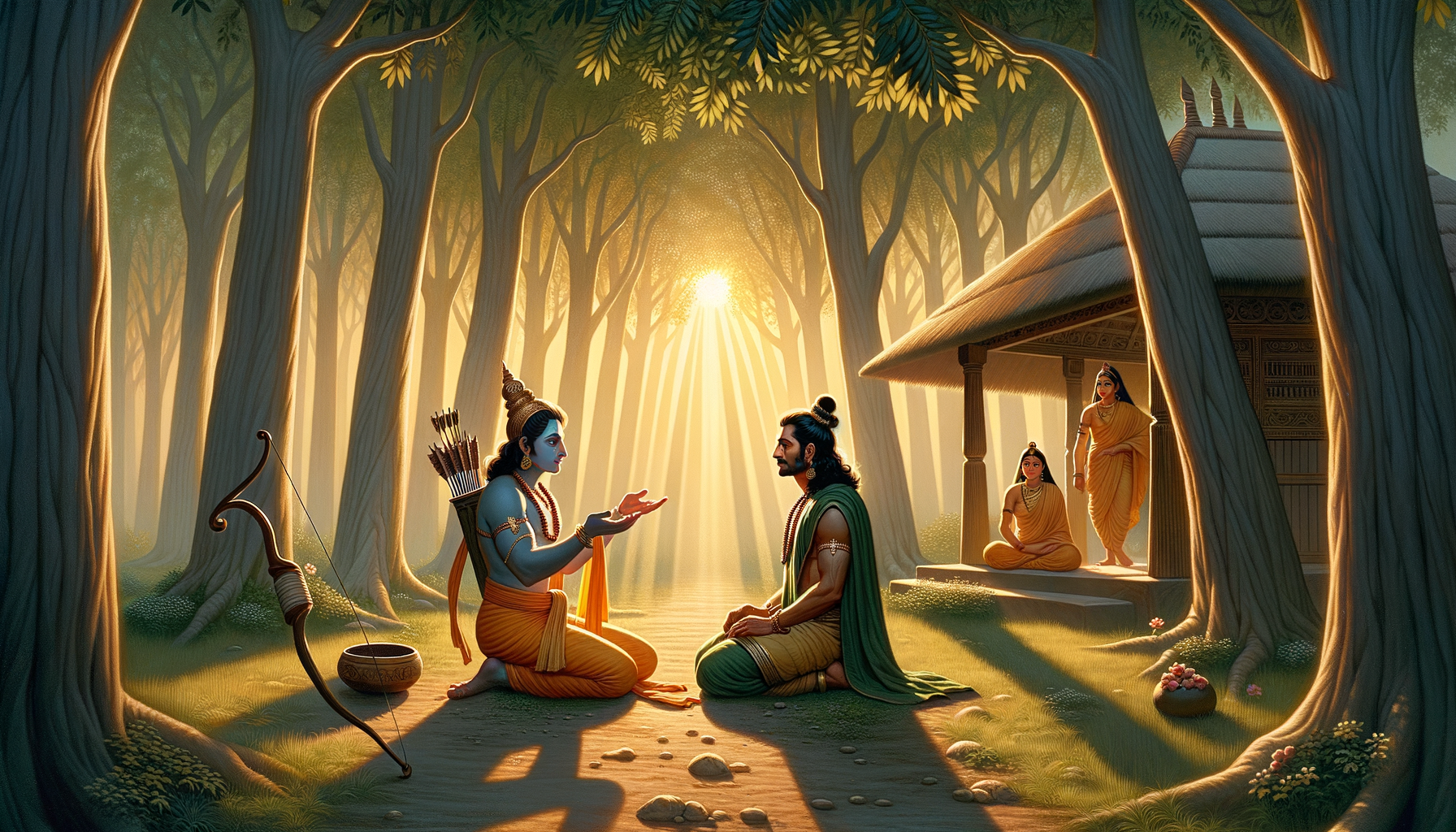
The episode of Surpanakha’s encounter with Rama in the Ramayana endures as a compelling study in cross-cultural misunderstanding, ethical boundaries, and the primacy of dharma. Read through the lens of cultural context rather than villainy or heroism alone, it reveals how differing social codes—regarding desire, consent, and duty—can collide with painful consequences. This scene continues to resonate because it speaks to the human propensity to misread intentions across cultural divides, even when all parties act within the norms familiar to them.
Set in Panchavati, the meeting unfolds with Surpanakha—sister of Ravana—approaching Rama with a direct proposal for marriage. Within the epic’s portrayal of rakshasa society, forthright self-expression and the swift articulation of desire are not unusual. Surpanakha’s approach can thus be understood as culturally intelligible in her world, a mode of courtship that seeks reciprocity without elaborate intermediaries.
Rama’s response emerges from a different ethical framework. As Maryada Purushottama, Rama affirms an unwavering commitment to Sita and the ideal of singular marital fidelity. Lakshmana’s deflective humor, while aligned with fraternal loyalty and ascetic restraint in the forest hermitage, deepens the cross-cultural gap: what reads as decorous self-control within the dharmic and ashrama-based code appears as rejection—and humiliation—from Surpanakha’s perspective.
The brief encounter escalates when Surpanakha, feeling publicly spurned, turns her frustration toward Sita. Lakshmana’s punitive act of disfigurement has been debated by readers across generations for its ethical proportionality. The text prompts difficult questions: How should boundaries be upheld when cultural norms conflict? What constitutes a measured response when honor, safety, and social order are at stake? The Ramayana does not trivialize these dilemmas; rather, it frames them within the wider tapestry of dharma.
Consequences follow swiftly. Surpanakha’s appeal to Khara and Dushana initiates confrontation, and her subsequent approach to Ravana becomes a key causal bridge to the abduction of Sita. In narrative terms, this episode serves as a pivot, transforming a pastoral exile into an epic struggle. Culturally, it highlights how a single misreading between communities—forest ascetics and rakshasas—can cascade into conflict when empathy and dialogue fail.
Viewed with cultural sensitivity, the episode underscores contrasting codes at play: the dharmic obligations of grihastha and vanaprastha life on one side, and a more fluid, assertive social ethos on the other. The Ramayana invites readers to consider how consent, commitment, hospitality, and restraint are defined and defended across communities. Surpanakha is neither a mere antagonist nor a simple victim; she is an agent shaped by her milieu, whose choices intersect—tragically—with a different moral architecture.
For plural societies today, the scene offers enduring guidance. It encourages reading the “other” with humility, clarifying boundaries without contempt, and addressing hurt without escalation. These are principles shared in varying emphases across the dharmic traditions of Hinduism, Buddhism, Jainism, and Sikhism: compassion, self-mastery, truthful speech, and non-harm. Unity in spiritual diversity is not passive coexistence; it is an active discipline of understanding.
Many have experienced, in workplaces or families, how intentions can be misconstrued across cultural lines. The Ramayana’s portrayal shows that ethical clarity must be paired with empathetic communication if harmony is to be sustained. When read this way, the Surpanakha episode becomes less a tale of personal failure and more a call to cultivate intercultural wisdom—so that dignity, duty, and compassion can coexist.
Revisiting Panchavati through this lens enriches the understanding of Ramayana while strengthening an ethic of unity. It invites a practice of listening across difference, honoring chosen commitments, and upholding boundaries with proportionality. In doing so, it offers a path toward cohesive community life—one in which diverse dharmic insights illuminate shared journeys toward harmony and justice.
Inspired by this post on Hindu Blog.