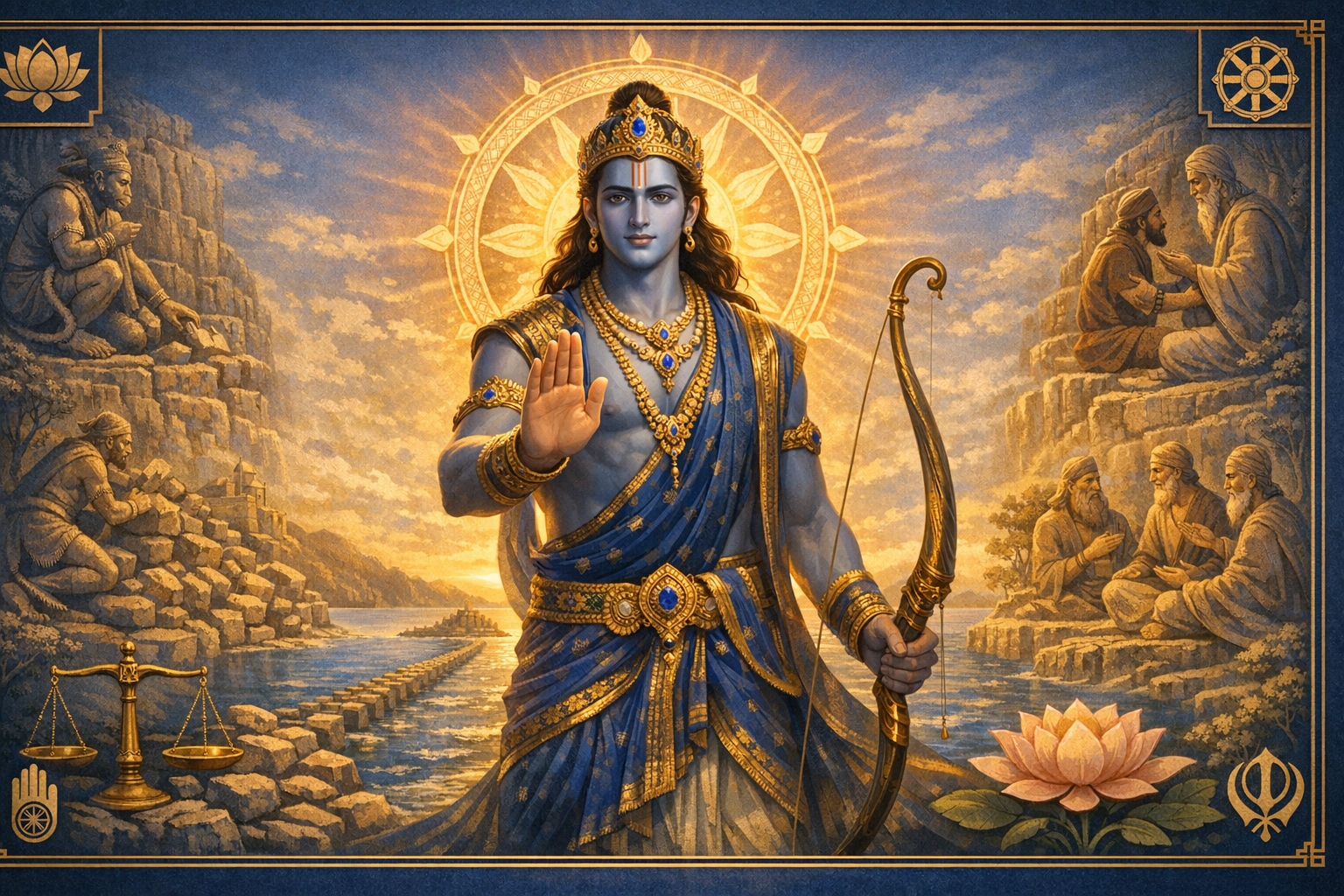
In the Ramayana, Sri Rama embodies an uncommon synthesis of virtue (dharma) and valor (kshatra), uniting moral clarity with decisive courage. This rare equilibrium, articulated in the ideal of Maryada Purushottama, remains a living template for personal integrity, just leadership, and societal harmony across the dharmic traditions of Hinduism, Buddhism, Jainism, and Sikhism.
The distinction of Sri Rama is not merely heroic prowess or austere self-restraint in isolation. Rather, it is the disciplined integration of dharma, karuna (compassion), and Kshatra Dharma (the protective duty to uphold order and protect the vulnerable). This balance secures a path that resists both moral timidity and unethical force, aligning power with propriety and empathy with responsibility.
Dharma in the Ramayana operates as a constitutional ethic: the normative framework that harmonizes truth (satya), right conduct (neeti), and the common good (lokasangraha). It is not a narrow rulebook but a context-sensitive compass that calibrates means and ends to preserve life, dignity, and a just social orderSanatana Dharma in action.
Kshatra, by contrast, denotes the disciplined capacity to protect, to administer, and when necessary to wage Righteous War under ethical constraints. Kshatra Dharma binds strength to accountability, ensuring force is a guardian of justice rather than an instrument of domination. In Sri Rama, these two currents join: lawfulness directs might; courage is purified by compassion.
The early arc of Rama’s life foregrounds dharma as lived fidelity. When faced with an unjust exile, he upholds Pitru-vakya-paripalana (keeping a father’s word) without resentment or recrimination. The choice secures constitutional continuity in Ayodhya and affirms a principle vital to public trust: promises and lawful processes outlast personalities and power struggles.
Equally significant is the social breadth of his courtesy. He embraces Guha, the Nishada chief, without hierarchical prejudice; he seeks counsel from sages; he treats citizens and forest-dwellers with the same composure. Dharma here is not exclusivist; it is expansive, relational, and restorative, reflecting the Hindu way of life at its most inclusive.
Valor appears first as restrained guardianship. The protection of yajnas against adharma is not adventurism but constitutional defense. Even when facing Tataka and other threats, Rama’s use of force is measured, proportionate, and for the singular purpose of safeguarding innocentsan early expression of Kshatra Dharma rooted in service, not conquest.
The Ramayana also traces a coherent ethic of Righteous War that foreshadows later just war formulations: just cause (defense against adharma), right intention (restoration of order, not vengeance), last resort (repeated diplomacy), proportionality (measured response), discrimination (targeting combatants while protecting noncombatants), and post-conflict reconciliation (restoration of rightful rule and social healing). These principles are not abstract dicta; they unfold narratively through choices taken and refused.
The debated episode of Vali-vadha is a crucible for this ethic. Commentarial traditions argue that Vali’s usurpation and violation of dharma, coupled with the jungle context and the protection pledged to Sugriva, shaped Rama’s tactical choice. Others read the moment as a didactic caution against the opacity of punitive force. The Ramayana allows both interpretive lessons: that ethical force must be justified publicly and that rulers must submit their conduct to scrutiny under dharma.
Nowhere is the synthesis of virtue and valor clearer than in Rama’s vow of śaraṇāgati-protection seen in the acceptance of Vibhishana. By granting refuge to a repentant seekereven from the enemy’s campRama binds sovereign power to an ethic of mercy. The capacity to forgive without abandoning justice is a defining signature of Maryada Purushottama.
Leadership method in the Ramayana is as rigorous as its morality. Rama employs the classic spectrum of upaya: sama (conciliation), dana (concession), bheda (strategic differentiation), and danda (coercive force) in that order, demonstrating procedural patience before sanction. Diplomatic missions precede open conflict; opportunities for peace are multiplied; punitive action is last, not first.
Hanuman’s reconnaissance in Sundara Kanda offers a technical study in strategic intelligence: clarity of objective, minimal footprint, reliance on discretion, verification through tokens, and primacy of mission over ego. The narrative’s devotional resonance co-exists with procedural exactness, which is why many practitioners find that recitation of Sundara Kanda cultivates resilience, focus, and hopeful courage in times of uncertainty.
The Setu-bandha to Lanka illustrates organizational genius and civilizational confidence. Under Nala and Nila, planning, logistics, morale, and engineering converge into a collaborative enterprise. The monumental crossing is not merely mythic spectacle; it encodes a lesson in systems leadershiphow distributed talent, shared purpose, and disciplined execution transform the impossible into the inevitable.
Weaponry and martial skill in the Ramayana are ethically delimited. Astras are deployed precisely, never as spectacles of indiscriminate power. Throughout, Rama exercises control over tempo and escalation, exemplifying how legitimate force stays coherent with dharma and side-steps the moral erosion that so often attends warfare.
In civic life, Rama Rajya stands as a sustained meditation on just governance. Its hallmarks include lawful order, compassionate administration, prosperity without exploitation, protection of the vulnerable, and a culture of mutual duty. The image is not utopian fantasy but a regulative idealan evaluative standard by which leaders and citizens can continually align policies with the common good.
Seen through a wider dharmic lens, the convergence is striking. Buddhism’s ideal of the righteous wheel-turning monarch (cakkavatti) emphasizes rule grounded in dhamma, generosity, and non-cruelty. Jain traditions uphold ahimsa as supreme while recognizing that householder-duties and protective responsibilities must minimize harm through restraint, intention, and proportion. Sikh thought articulates the Sant-Sipahi (saint-soldier) ideal, where spiritual depth and protective strength cohere as a single vocation of service. Across these traditions, the synthesis of virtue and valor is not an anomaly but a shared aspiration.
Accordingly, Sri Rama’s model illumines unity in diversity within the broader family of dharmic philosophies. While methods and metaphors vary, the underlying commitment is consistent: anchor strength in compassion, govern power by law, and seek peace through justice. The Ramayana’s ethical grammar thus reinforces inter-traditional respect and collaborative flourishing.
Contemporary relevance follows naturally. In public service, corporate leadership, community stewardship, and family life, decisions often demand both empathetic listening and firm boundaries. The Ramayana indicates a pathway: state the truth clearly, explore peaceful options exhaustively, act decisively when protection is due, and remain open to reconciliation whenever conscience allows.
Practical translation of this ethic can be staged: diagnose the dharma (facts, duties, and stakeholders), privilege peaceful means, calibrate proportionate response, safeguard noncombatants (or their analogs in civic settings), and institutionalize post-conflict healing. This sequence distills the Ramayana’s narrative wisdom into an actionable framework that is as spiritual as it is strategic.
For many devotees and seekers, contemplative engagement with Sri Ramathrough katha, japa, or reflective readingsteadies the mind and quickens moral courage. Communities across the dharmic spectrum often report that these practices, coupled with study of the Ramayana, deepen compassion without dulling clarity and strengthen resolve without breeding hostility.
The enduring appeal of Sri Rama lies, therefore, not only in triumph over adversity but in the manner of triumph: lawful, proportionate, and suffused with grace. This is the signature of Maryada Purushottamanever abandoning dharma to wield power, never abandoning courage to appear gentle.
As an integrated ethic for the present, Sri Rama’s virtue and valor establish a timeless blueprint: align means with moral law, center compassion, perfect craft, and protect without hatred. In doing so, the Ramayana offers a unifying language for Hinduism, Buddhism, Jainism, and Sikhism to meet shared challenges with wisdom, courage, and mutual respect.
Inspired by this post on Hindu Blog.