
Thottampattu: ritual song, sacred memory, and the living presence of Bhadrakali
Thottampattu occupies a distinctive place in Kerala culture because it is not merely a song performed in a temple setting. It is a ritual act, a verbal offering, a musical invocation, and a form of collective memory through which Bhagavathi, especially Bhadrakali, is praised, remembered, and ritually invited into the sacred space. In Kerala’s Bhagavathi temples, kavus, and performance traditions such as Theyyam, Mudiyettu, and Kaliyoottu, the spoken and sung word becomes a bridge between mythology, community, and devotion.
The term Thottam is often connected in local explanation with the Sanskrit Stothram, meaning a hymn of praise. Thottampattu, therefore, may be understood as a praise-song addressed to the deity, though its ritual function is richer than a simple devotional lyric. It narrates divine origin, heroic action, local sacred history, temple identity, and the emotional relationship between devotees and the protecting Mother Goddess. In this sense, Thottampattu is both literature and liturgy, both oral archive and living worship.
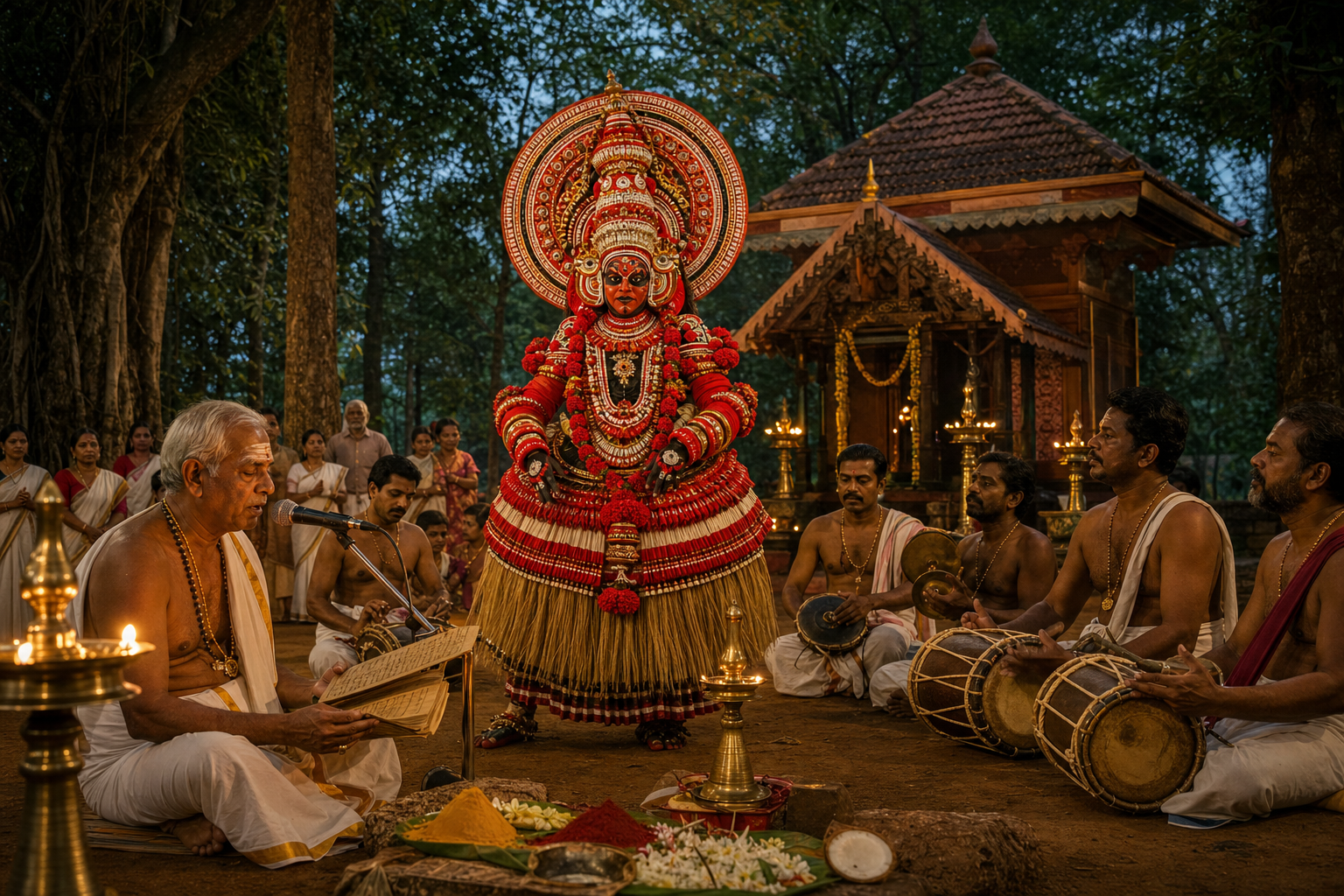
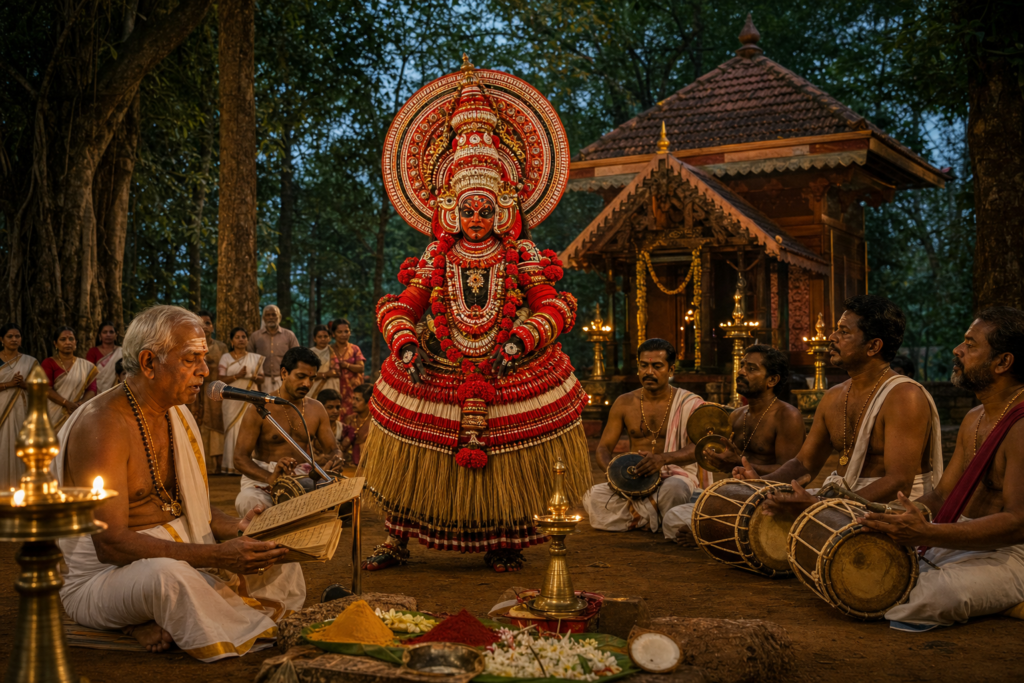
In North Malabar, Thottam Pattu is especially associated with Theyyam. It is sung before the full manifestation of the Theyyam performance, often during the preparation of the performer. The song announces the deity’s story and gradually transforms the ritual atmosphere. What begins as narration becomes invocation; what begins as memory becomes presence. The community does not encounter the song as entertainment alone, but as a disciplined ritual movement from ordinary time into sacred time.
The emotional force of Thottampattu lies in its ability to make theology audible. A listener hears not an abstract doctrine but the life of the deity: birth, anger, compassion, journey, battle, protection, and blessing. In Bhagavathi traditions, Bhadrakali is not treated only as a fearsome power. She is also Amma, the Mother who guards households, fields, village boundaries, children, ancestors, and moral order. The intensity of the hymn reflects this double vision: awe before divine power and intimacy with divine grace.
Bhadrakali’s presence in Kerala ritual culture is closely tied to the mythic defeat of Darika, a story widely performed and remembered in several regional forms. In Mudiyettu, the dramatic battle between Kali and Darika becomes ritual theatre. In Kaliyoottu, especially in southern Kerala, the Bhadrakali-Darika narrative is extended through long ceremonial sequences. In Theyyam, Bhagavathi forms appear with striking headgear, painted faces, fire, rhythm, and sung legend. Thottampattu belongs to this wider Shakti landscape, where sound prepares the ground for vision.
Technically, Thottampattu depends on oral discipline. The singer must preserve narrative order, melodic contour, ritual timing, and the dignity of the deity being invoked. The performance is not casual singing. It requires memory, breath control, familiarity with temple custom, and sensitivity to the ritual sequence. Percussion instruments such as chenda, thudi, elathalam, and related local instruments may accompany different forms, depending on region and tradition. Rhythm is not decorative; it organizes attention and intensifies the devotional field.
The language of Thottampattu is often layered. It may contain older Malayalam expressions, local place references, Sanskritic devotional vocabulary, Dravidian ritual idioms, clan memories, and temple-specific legends. This layered language is one reason the tradition is valuable for cultural history. It preserves how ordinary people understood divinity, kingship, land, kinship, protection, disease, fertility, justice, and social obligation. A Thottampattu can therefore be read as a poem, heard as a hymn, and studied as an ethnographic record.
In Kerala Bhagavathi temples, the sacred geography of the kavu is central. A kavu is not only a shrine but often a ritual ecosystem shaped by trees, serpent groves, lamps, drums, seasonal festivals, and hereditary obligations. Thottampattu belongs naturally in such a space because it is rooted in locality. The goddess praised in the song may be cosmic Bhadrakali, yet she is also the deity of a particular village, a particular shrine, and a particular community that has preserved her worship across generations.
This local rootedness does not make the tradition narrow. On the contrary, it reveals a key feature of Hindu spirituality: the universal is often approached through the particular. Bhagavathi may be understood as Devi, Shakti, Kali, Durga, or Bhadrakali, but she is encountered through a local name, a local ritual, a local memory, and a local song. Thottampattu demonstrates how Hindu traditions hold together philosophical breadth and regional intimacy without requiring uniformity.
The connection between Thottampattu and Theyyam is especially important for understanding performance as worship. Kerala Tourism describes Theyyam as a major ritual art of North Malabar in which divine power is understood to descend among the people. In this setting, Thottam Pattu is not a preliminary item of minor importance. It is the verbal foundation that identifies the deity, prepares the performer, and teaches the audience how the divine form should be recognized.
During Theyyam, the performer’s transformation involves costume, facial painting, headgear, bodily discipline, rhythm, and song. The Thottampattu helps move the performer and the community toward the moment of divine embodiment. The song tells the deity’s story while the body is being prepared to carry the deity’s presence. This union of word, body, color, drum, and faith is one of the most sophisticated features of Kerala’s ritual arts.
Mudiyettu offers another useful comparison. It is a ritual theatre and dance drama performed in Bhagavathi or Bhadrakali temples of central Kerala, particularly in districts such as Thrissur, Ernakulam, and Kottayam. Its central theme is the triumph of Kali over Darika. Before the dramatic performance, related ritual songs praise Bhadrakali and describe her form, power, and presence. These practices show that the praise-song is not separate from ritual action; it is one of the means by which ritual action becomes meaningful.
Kaliyoottu, associated especially with southern Kerala, also preserves the Bhadrakali-Darika narrative in an elaborate ritual dramatic form. In some Kaliyoottu traditions, Bhadrakalithottam is sung across a prolonged ceremonial period. The very duration of the song cycle reveals the seriousness with which the tradition treats sacred narration. The goddess is not invoked hurriedly. Her story is unfolded with patience, repetition, rhythm, and communal participation.
From an academic perspective, Thottampattu can be studied under several categories at once: oral literature, ritual music, temple tradition, Shakta theology, performance studies, folklore, and social history. Its survival depends on transmission rather than printed authority alone. The singer receives the song through a living chain of practice, often shaped by family, community, temple service, and apprenticeship. This makes the tradition vulnerable, but also deeply resilient.
The ritual power of Thottampattu also lies in repetition. Repeated names, epithets, episodes, and rhythmic phrases create a meditative accumulation. The audience may already know the broad story of Bhadrakali and Darika, yet hearing it again is itself meaningful. In dharmic traditions, repetition is not intellectual redundancy; it is a method of internalization. Just as mantra, japa, kirtan, and scriptural recitation deepen awareness through recurrence, Thottampattu renews memory through repeated sacred sound.
The figure of Bhadrakali in these songs deserves careful attention. She is fierce, but her fierceness is not disorder. It is protective force directed against adharma, arrogance, violence, and imbalance. The Darika narrative dramatizes this moral structure. Evil is not overcome by ordinary strength alone; it requires the awakening of Devi Shakti. The hymn therefore communicates a theological lesson: divine power is compassionate not because it is passive, but because it restores balance when the world is threatened.
For devotees, this theology is not remote. The Mother Goddess who defeats Darika is also believed to remove fear, disease, misfortune, injustice, and inner weakness. This is why the atmosphere around Bhagavathi worship can be emotionally intense. Lamps, drums, turmeric, vermilion, flowers, fire, and song together produce a sensory language of surrender. Thottampattu gives that surrender a narrative voice.
The community dimension of Thottampattu is equally significant. Kerala’s temple arts have historically involved many groups: singers, drummers, ritual specialists, artisans, families attached to the shrine, and devotees who gather for annual festivals. The performance is therefore not only an offering from an individual to the deity. It is a collective act that sustains social memory. When the song is performed, the village remembers who it is, whom it worships, and what moral world it inhabits.
This collective dimension also supports the broader aim of unity among dharmic traditions. Thottampattu is specifically rooted in Hindu Shakta worship, yet its underlying values resonate across Hinduism, Buddhism, Jainism, and Sikhism: reverence for disciplined sound, respect for lineage, ethical struggle against inner and outer disorder, community participation, and the preservation of sacred memory. Such traditions remind society that diversity of practice need not weaken unity; it can deepen it.
Kerala’s ritual arts also challenge simplistic categories such as folk versus classical or local versus scriptural. Thottampattu may arise from village settings, but its themes are philosophically rich. It may use local idiom, but it engages pan-Indian ideas of Devi, dharma, adharma, protection, sacrifice, and liberation from fear. It may be orally transmitted, but it is not intellectually unsophisticated. Its form demonstrates how knowledge can live in song, gesture, sound, and repeated communal practice.
The aesthetics of Thottampattu are inseparable from its religious purpose. The singer does not aim merely at beauty, though beauty is present. The aim is correct invocation, emotional intensification, and ritual alignment. The voice must carry dignity. The rhythm must support attention. The narrative must honor the deity. The audience must be drawn from distraction into reverence. This is why even a simple performance can feel profound when heard in the proper temple atmosphere.
The relation between sound and embodiment is especially visible in Theyyam. The performer becomes recognizable as the deity only through a sequence of transformations. Paint marks the face, costume enlarges the body, mudi crowns the form, percussion alters the atmosphere, and Thottampattu gives the deity a remembered identity. Without the song, the visual form would lose much of its interpretive depth. The hymn tells the community what it is seeing.
There is also a pedagogical function. Many devotees may not learn temple mythology through formal study. They learn it by hearing Thottampattu during festivals, by watching elders respond, by observing when lamps are lit, when drums intensify, when silence falls, and when the deity’s name is repeated. The ritual becomes a public classroom of memory. Children absorb not only stories but attitudes: reverence, patience, humility, courage, and gratitude.
Modernity has changed the conditions under which Thottampattu survives. Migration, urban schedules, shrinking ritual knowledge, amplified music, shortened festivals, and reduced apprenticeship can weaken oral traditions. At the same time, documentation, cultural scholarship, temple renewal, and responsible digital archiving can help preserve them. The challenge is to protect the living ritual context rather than reducing the tradition to a stage item or an isolated audio recording.
Preservation must therefore be respectful. Thottampattu should not be treated as a decorative cultural product detached from Bhagavathi worship. Its words, rhythm, sequence, and performance context matter. Scholars, devotees, cultural institutions, and younger community members can all contribute by learning from traditional practitioners, recording variants with consent, supporting temple festivals, and recognizing the dignity of those who carry the oral tradition.
The ecological dimension of Bhagavathi worship should also be noted. Many kavus are connected with groves, ponds, serpent worship, seasonal cycles, and agrarian rhythms. Mudiyettu, for example, is often associated with the post-harvest period in central Kerala. Such traditions reveal a worldview in which worship, land, water, fertility, and community well-being are interdependent. Thottampattu gives poetic expression to that integrated vision.
In this context, Bhadrakali is not merely a mythological figure from a distant past. She is a living symbol of protection in a fragile world. Her worship speaks to human anxieties that remain contemporary: fear of disorder, illness, injustice, loneliness, and moral confusion. The song does not solve these problems in a modern administrative sense, but it gives the community a sacred language for facing them. That language itself is a form of strength.
Thottampattu also invites a more generous understanding of Indian knowledge systems. Knowledge in India has never existed only in manuscripts, monasteries, courts, or universities. It has also lived in village shrines, temple courtyards, seasonal vows, grandmother stories, ritual songs, martial lineages, craft traditions, and pilgrim memory. To study Thottampattu seriously is to recognize oral performance as a legitimate intellectual and spiritual archive.
The devotional experience of Thottampattu can be deeply moving even for those who approach it academically. The slow unfolding of the goddess’s story, the sound of percussion in the night air, the glow of oil lamps, and the attentive silence of devotees together create a rare form of cultural intensity. It is not sentimentality; it is the emotional intelligence of a community that has learned to remember the sacred through disciplined beauty.
At its heart, Thottampattu teaches that devotion is not only private feeling. It is preserved through language, rhythm, duty, and shared participation. It asks the community to listen before it asks the community to witness. It places the goddess’s story before the goddess’s manifestation. It reminds devotees that sacred presence is approached through preparation, humility, and remembrance.
For Kerala’s Bhagavathi temples, this makes Thottampattu indispensable. It is the voice that precedes vision, the praise that prepares embodiment, and the memory that renews faith. In the praise of Bhadrakali, Kerala preserves not only a ritual song but a complete worldview: fierce protection joined with maternal grace, local tradition joined with universal Shakti, and inherited devotion joined with living community.
Thottampattu remains powerful because it refuses to separate art from worship, history from emotion, or theology from lived experience. Its continued relevance depends on careful preservation, accurate study, and sincere participation. When heard in its proper setting, it becomes clear why this sacred song of Bhadrakali’s glory and grace has endured for centuries: it gives a community the words with which to remember the Mother, and through that remembrance, to renew itself.
For factual orientation, this discussion draws on public cultural documentation including Kerala Tourism’s overview of Theyyam, Kerala Tourism’s account of Mudiyettu, and general reference material on Thottam Pattu, Kaliyoottu, and Bhadrakali temple traditions in Kerala.
Inspired by this post on Hindu Blog.






Leave a Reply
You must be logged in to post a comment.