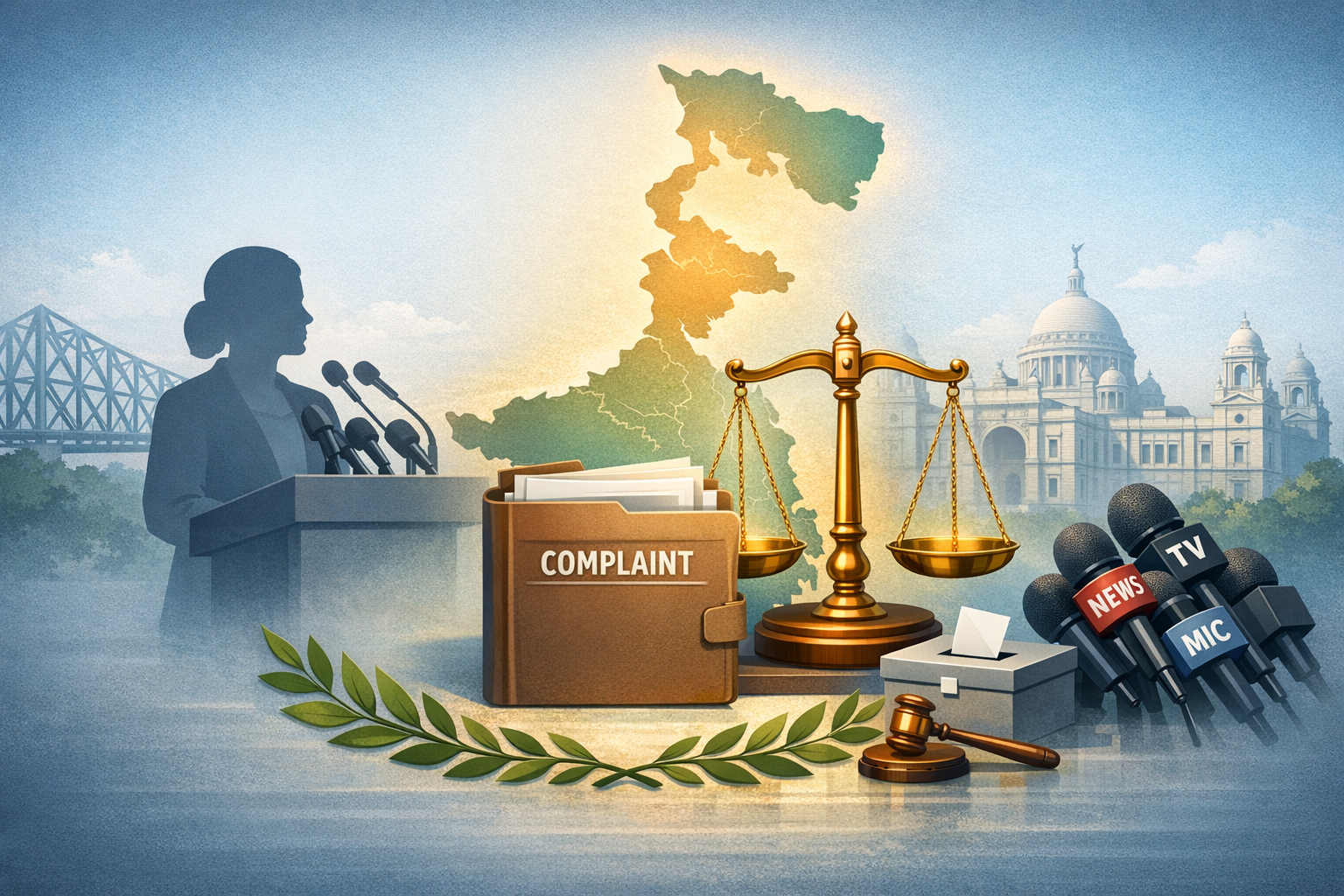
Rampurhat, March 26, 2026: A police complaint (First Information Report, FIR) has reportedly been filed by the Vishwa Hindu Parishad (VHP) against West Bengal Chief Minister Mamata Banerjee over remarks alleged to have instilled fear of targeted attacks on Hindus. The development has intensified a broader political row in West Bengal, with competing narratives emerging about speech, responsibility, and public order as the state moves toward the WB Assembly Election 2026.
At this stage, the allegations remain just thatallegations. Filing an FIR initiates the criminal law process under Section 154 of the Code of Criminal Procedure (CrPC), triggering a police duty to record information related to a cognizable offense and to commence investigation. No court has adjudicated the matter, and the presumption of innocence applies to all parties named in any complaint.
In speech-related complaints of this nature, complainants frequently cite provisions of the Indian Penal Code such as Section 153A (promoting enmity between groups), Section 295A (deliberate and malicious acts intended to outrage religious feelings), Section 505(2) (statements conducive to public mischief), or Section 506 (criminal intimidation). Whether any such sections have been invoked in this specific FIR will be determined by the registered text of the complaint and subsequent investigative steps. The legal threshold for each offense is distinct: for example, Section 295A requires a high bar of “deliberate and malicious intent,” while Section 153A turns on the likelihood that speech will promote enmity or disturb public tranquility.
The timing of the controversy is politically consequential. West Bengal’s electoral cycle, party realignments, and the approach of the WB Assembly Election 2026 together amplify the salience of political speech. The Election Commission of India’s Model Code of Conduct, along with provisions in the Representation of the People Act, 1951particularly Section 123(3A) on corrupt practices through promotion of enmity and Section 125 on prohibiting such promotion in connection with electionsprovide a regulatory frame likely to shape subsequent administrative or adjudicatory responses.
Public debate around what critics label the “Communal Politics of TMC” and what supporters describe as a platform of inclusive governance has long framed West Bengal’s political narrative. Against this backdrop, actions such as “VHP files FIR against WB CM” gain outsized visibility. The Trinamool Congress (TMC) typically contests allegations of divisive messaging, asserting a commitment to constitutional secularism and social peace, while organizations such as the VHP maintain that vigilant civic action is necessary to protect community security and dignity. These positions are tested by legal scrutiny, evidence standards, and the tempering role of independent institutions.
Jurisprudence around harmful speech offers guidance. The Supreme Court in decisions including Pravasi Bhalai Sangathan v. Union of India (2014) emphasized enforcement of existing penal provisions against hate speech, while cautioning against overbroad restrictions that chill legitimate political expression. Separately, Shreya Singhal v. Union of India (2015) clarified that restrictions on speech must be narrowly tailored to the constitutional grounds listed in Article 19(2), focusing on incitement rather than mere advocacy or discussion. Indian courts often distinguish between offensive or intemperate speech and unlawful incitement; context, audience, likelihood of harm, and intent are pivotal.
In practice, investigators evaluate both the literal content of the impugned words and the circumstances of their utterance: time, place, the speaker’s authority, and the prevailing local climate. West Bengal’s recent history of intense electoral competition heightens the responsibility of political actors to adopt language that reduces rather than raises the risk of communal polarization. Equally, diligent, transparent policing and even-handed application of law help reassure all communitiesHindu, Muslim, Sikh, Buddhist, and Jainthat public safety and constitutional rights are non-negotiable.
It is also important to recognize the dynamics of information disorder. Claims about incendiary speech often travel rapidly on social media, partially detached from full transcripts or contextual qualifiers. Analysts therefore recommend reliance on primary documentsFIR text, verified event footage, complete transcriptsbefore drawing conclusions. Responsible reportage and careful legal process can prevent rumor from crystallizing into grievance.
The human dimension remains central. Across districts such as Birbhumof which Rampurhat is a partfamilies, traders, and students routinely navigate the anxieties that follow polarizing headlines. Civil society groups recount practical steps that have worked in previous tense moments: establishing inter-community helplines, convening peace committees with respected representatives from Hindu, Buddhist, Jain, Sikh, and Muslim organizations, and creating rapid fact-checking channels to defuse rumors before they escalate. These everyday practices, though unglamorous, align with the shared dharmic values of ahimsa, karuṇā, dayā, and maitri, and often prove decisive in preserving neighborhood harmony.
From a rule-of-law perspective, proportionality and neutrality are essential. Any investigative action arising from the VHP complaint must be evidence-led and procedurally fair. If the alleged remarks meet statutory thresholds, the legal process should proceed; if they do not, closure with reasoned explanation maintains public trust. This twin commitmentto protect citizens from incitement and to safeguard robust political debateupholds both Article 19(1)(a) freedoms and the Article 21 promise of dignified life and security.
Community resilience can be strengthened through shared civic routines that transcend partisan lines. Temples, gurdwaras, viharas, and Jain upashrayas already serve as hubs of seva and social support; coordinated initiativesjoint blood drives, food relief, educational counselingtranslate the ethos of Vasudhaiva Kutumbakam into daily life. When such collaborations are publicized as widely as political controversies, they provide a powerful counter-narrative to polarization.
Policy-oriented next steps are relatively clear. First, make primary materials accessible: certified copies of the FIR and any official transcripts should be placed in the public domain to reduce speculation. Second, apply Election Commission advisories consistently to discourage provocative rhetoric by all sides during the pre-poll season. Third, encourage district-level peace committees to issue joint statements reaffirming non-violence and the shared heritage of Bengal’s plural society. Fourth, invest in rapid, multilingual myth-busting to counter misleading clips or decontextualized quotations online.
Ultimately, the legal questions raised by an FIR against a sitting Chief Minister will be settled through established procedures. The broader civic questionhow to keep society cohesive when political temperatures run highbelongs to everyone. West Bengal’s history, literature, and spiritual traditions offer ample resources for that task. Anchoring discourse in constitutional morality, promoting dharmic unity among Hindu, Buddhist, Jain, and Sikh communities, and treating all religious communitiesincluding Muslimswith fairness and respect together create the conditions for durable peace. In that equilibrium, law deters genuine incitement, politics remains competitive yet responsible, and citizens feel secure enough to thrive.
Inspired by this post on Struggle for Hindu Existence.