
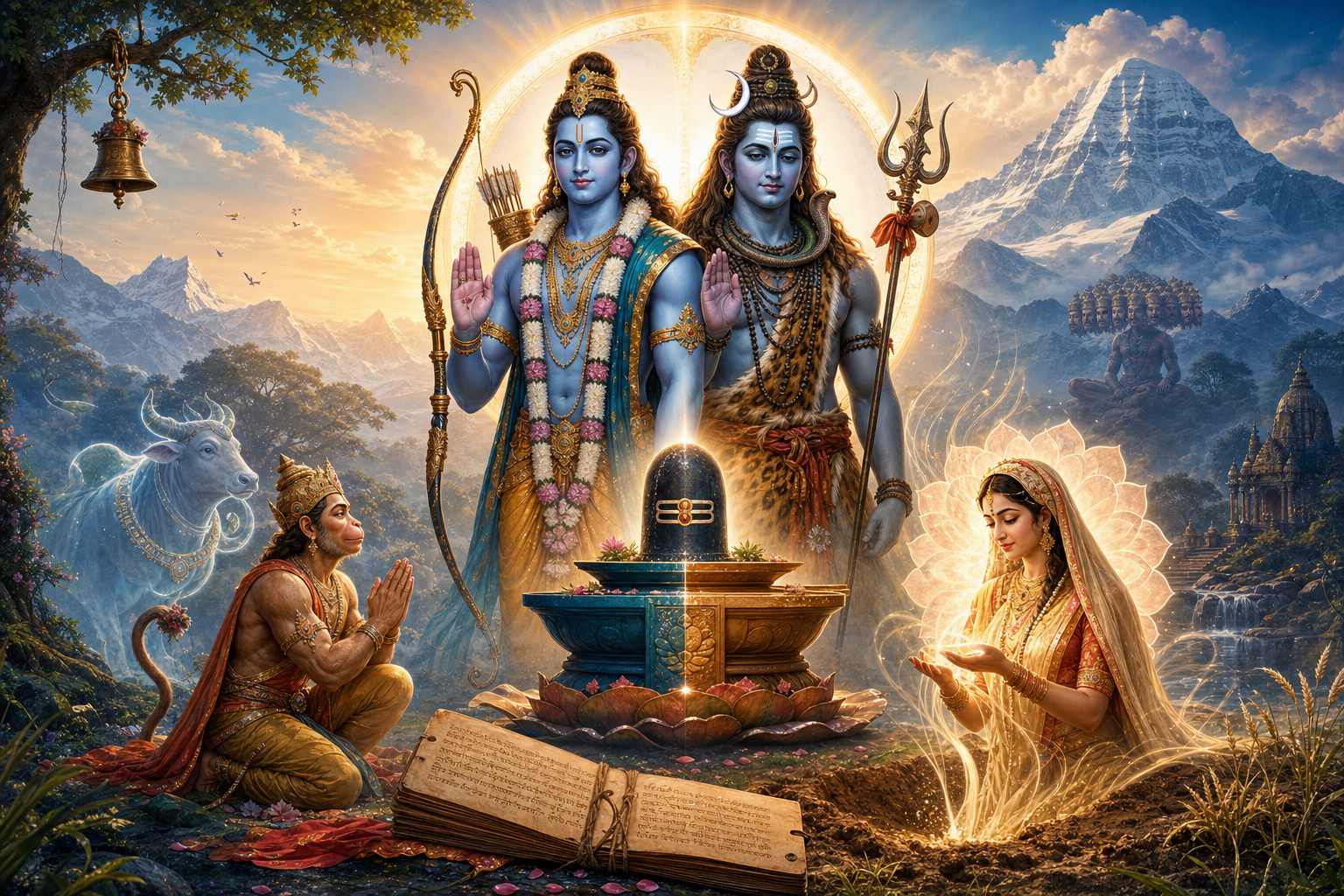
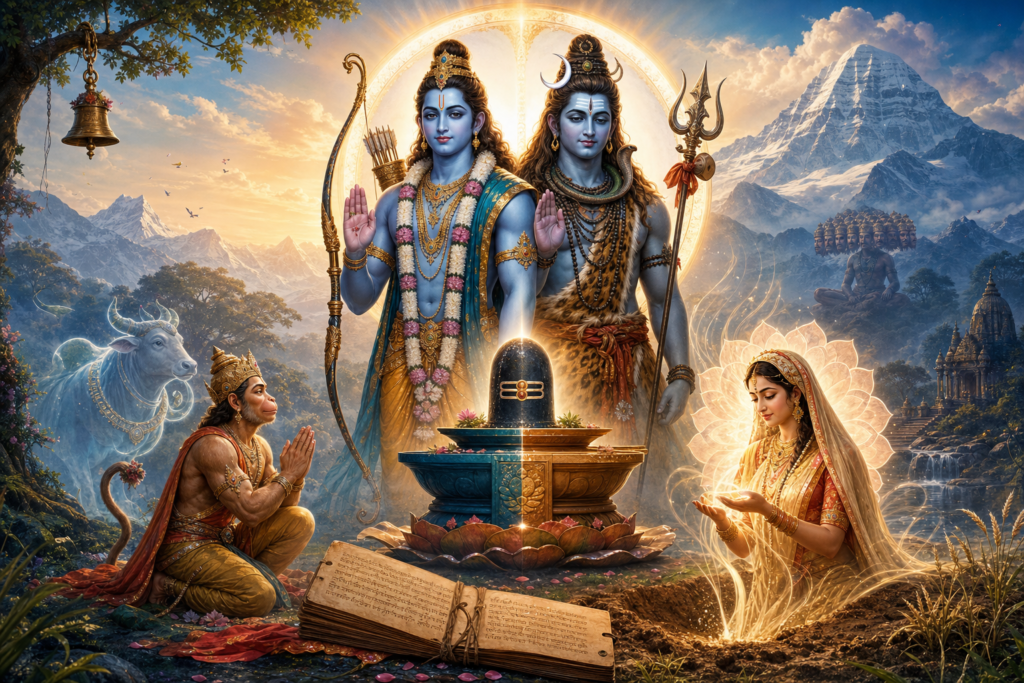
The Ramayana does not appear in the Kedāra Khaṇḍa as a shortened duplicate of Vālmīki’s epic. It emerges as something more concentrated: a theological account of why Rāma descends, why Rāvaṇa becomes almost invincible, how the Vānara allies enter the world, and why Sītā is indispensable to the restoration of dharma. In this retelling, familiar characters acquire striking new identities. Rāma embodies Viṣṇu, Sītā manifests Brahmavidyā, Hanumān embodies Nandī, and Rāvaṇa becomes the difficult example of a devotee whose extraordinary tapas is compromised by pride and destructive conduct.
For readers who know the Ramayana primarily through Vālmīki, Tulsidas, regional performance, temple recitation, or family storytelling, this Puranic version can feel both familiar and unexpected. The emotional outline remains recognizable, but its metaphysical emphasis changes the experience of the story. The conflict is no longer presented simply as a contest between a righteous prince and the ruler of Laṅkā. It becomes a meditation on power without ethical discipline, knowledge as liberating presence, divine self-limitation, and the profound unity of Śaiva and Vaiṣṇava devotion.
A necessary textual clarification: Kedāra belongs within Māheśvara
In the widely circulated seven-khaṇḍa printed arrangement represented by G. V. Tagare’s English translation, the Māheśvara Khaṇḍa—also written Maheshwara Khanda—is Book One of the Skanda Purana. Kedāra Khaṇḍa is its first major section, and its thirty-five chapters are followed by the Kaumārikā and Arunācala materials. The relevant Ramayana narrative occurs in Kedāra Khaṇḍa, chapter 8, titled in that translation The Story of a Thief: Incarnation of Rāma. The hierarchy is documented in the Māheśvara Khaṇḍa contents and the Kedāra Khaṇḍa contents.
Kedāra Khaṇḍa and Māheśvara Khaṇḍa should therefore not be treated as two parallel books that independently preserve the same Ramayana episodes. The more precise formulation is that the Ramayana material occurs in the Kedāra section of the larger Māheśvara book. This distinction matters because chapter references in Puranic studies are meaningful only when the edition, recension, and internal hierarchy have been identified.
Why manuscript history matters
The Skanda Purana is traditionally counted among the eighteen Mahāpurāṇas, but it is not a single, perfectly uniform composition preserved in one unchanging form. It is an extensive textual tradition transmitted through different manuscript families, regional collections, reorganizations, and printed editions. The modern Skandapurāṇa Project at Leiden University studies manuscripts ranging from the ninth to the nineteenth century and notes that the oldest known dated Purana manuscript, preserved in the Nepalese transmission, dates to 810 CE.
The early Nepalese recension under critical study does not correspond chapter for chapter with every work gathered into the later printed khaṇḍa arrangement. Consequently, the present discussion does not claim that every manuscript called Skandapurāṇa contains this Ramayana narrative in the same location or wording. It examines chapter 8 of the Kedāra Khaṇḍa as preserved in the commonly available Māheśvara Khaṇḍa recension. This source-conscious approach respects sacred tradition while avoiding the mistaken assumption that a large Purana has only one recoverable textual form.
The architecture of Kedāra Khaṇḍa chapter 8
The chapter contains 128 numbered verses in the cited English translation and unfolds in several movements. Verses 1–14 tell the paradoxical story of a thief who enters a Śiva temple. Verses 15–32 move from that story to devotion, the liṅga, and the identity of Śiva and Viṣṇu. Verses 33–86 recount Rāvaṇa’s austerities, conquests, encounter with Nandī, and the curse anticipating his defeat. Verses 87–115 describe the divine plan for the births of Rāma, Sītā, their companions, and the Vānaras. Verses 116–128 return to the chapter’s principal soteriological teaching: disciplined devotion can dispel Māyā and lead beyond the temporary rewards of ritual action.
This structure explains why the Ramayana material begins in a chapter apparently devoted to a thief. The episode is not an irrelevant preface. A gambler, driven by debt, enters a temple at night and attempts to steal its bell. Śiva interprets the incident with astonishing generosity and has the man brought to Kailāsa as one of his attendants. The story establishes the theological atmosphere in which the Ramayana account will be told: divine grace can reach an unlikely person, external appearances do not exhaust the meaning of an act, and devotion is not presented as the exclusive possession of a social or intellectual elite.
The chapter then contrasts transformative devotion with argument pursued only for victory. Its criticism of abstract disputation is characteristically Puranic rather than a rejection of careful reasoning as such. The larger point is that intellectual knowledge without humility, discipline, or spiritual practice can remain sterile. This concern becomes essential when Rāvaṇa enters the narrative, for he possesses learning, ascetic strength, and devotional intensity, yet fails to govern the power produced by them.
Hari-Hara unity is the narrative hinge
Before describing Rāvaṇa or Rāma, the chapter establishes its doctrine of Hari-Hara unity. Verse 20 declares, in the cited translation, that the one who is Viṣṇu should be known as Śiva and that Śiva is Viṣṇu. Verse 21 associates the pedestal, or piṇḍī, with Viṣṇu and the liṅga with Maheśvara. Earlier language also joins Śiva and Śakti. The symbol is therefore presented not as an isolated sectarian emblem but as a visible conjunction of divine principles.
This identity is not decorative theology added after the plot. It makes the plot possible. Rāvaṇa gains strength through devotion to Śiva, yet Viṣṇu descends as Rāma to end his oppression. If Śiva and Viṣṇu were imagined as hostile divine powers, the account would generate an unresolved contradiction. Hari-Hara unity instead allows Rāma’s victory to function within, rather than against, the grace of Śiva. The conflict concerns the ethical use of power, not a battle for supremacy between two Hindu traditions.
Rāvaṇa: immense tapas, incomplete integration
The Kedāra Khaṇḍa first places Rāvaṇa among numerous Rākṣasas and Daityas associated with the worship of Śiva. It then magnifies his tapas. At Gokarṇa, he performs austerities of an almost unimaginable severity. After long intervals, he cuts off his heads one after another as offerings and remains absorbed in dhāraṇā and samādhi. Śiva is pleased, restores or increases his power, and grants what he desires. The text even relates Rāvaṇa’s ten heads to twice the five faces attributed to Śiva.
Rāvaṇa’s resulting authority extends across the three worlds. The chapter credits his accomplishments to ascetic concentration rather than mere physical force. He overcomes celestial guardians, threatens sages, rules from Trikūṭa, and is associated with the famous attempt to lift Kailāsa. Such descriptions make him more than a conventional villain. He represents spiritual capacity severed from moral restraint: a person may master technique, endure hardship, and receive genuine gifts while still allowing pride and domination to deform their use.
The text occasionally interprets Rāvaṇa’s attacks through its own theological rhetoric, but the narrative outcome does not excuse the harm he causes. His ascetic achievements explain his power; they do not make oppression righteous. This distinction remains one of the chapter’s most relevant ethical insights. Tapas intensifies capacity, but increased capacity magnifies responsibility. Discipline that does not mature into dharma can turn spiritual achievement into an instrument of injury.
A further diagnosis appears in Nandī’s explanation of Rāvaṇa’s worship. Rāvaṇa has approached the liṅga while failing to recognize Viṣṇu in the supporting pedestal. Read symbolically, the problem is not insufficient sectarian loyalty. It is partial vision. Rāvaṇa grasps power but not its support, transcendence but not relational responsibility, devotion but not the full unity in which devotion must operate. The chapter turns ritual incompleteness into a metaphor for ethical and metaphysical fragmentation.
Nandī’s curse and the Puranic identity of Hanumān
When Rāvaṇa searches for Kubera near Kailāsa, he encounters Nandī. The account explains Nandī’s simian face as a form he received from Śiva and associates it with freedom from vanity, arrogance, and possessiveness. Rāvaṇa mocks that appearance and boasts of the heads obtained through his own austerities. Nandī responds with a curse: an exceptional man, accompanied by monkey-faced beings and with one like Nandī at their head, will enter Rāvaṇa’s city and kill him.
The contrast is carefully designed. Rāvaṇa values spectacular form as proof of greatness; Nandī accepts a form that becomes an occasion for ridicule. Rāvaṇa displays power; Nandī embodies service. Rāvaṇa treats appearance as rank; Nandī turns appearance into a vehicle of humility. The future Vānara army thus arises not as a random military device but as the answer to Rāvaṇa’s contempt for forms he considers beneath him.
The chapter later makes the connection explicit by stating that Nandī, son of Śilāda and attendant of Śiva, incarnates as Hanumān to assist Viṣṇu. This is among the passage’s most distinctive claims. Hanumān becomes a living bridge between Śaiva and Vaiṣṇava devotion: an embodiment of Śiva’s servant who offers perfect service to Rāma. The theological message is enacted through character rather than left as an abstract formula.
The divine decision to become human
After Rāvaṇa’s conquests, the Devas seek a remedy. The chapter depicts them as compromised by attachment and therefore unable to match the concentrated tapas that produced Rāvaṇa’s strength. Nandī instructs them that the divine must be realized within the heart by those who have disciplined their senses. He then directs them toward Viṣṇu, completing the transition from Śaiva devotion to the Vaiṣṇava avatāra without presenting the two as competing paths.
Viṣṇu announces that he will be born in Ayodhyā in the house of Daśaratha and asks the Devas to assume Vānara forms. The text says that he will become human while enveloped by ajñāna. This phrase requires careful interpretation. It need not mean that the Purana regards Rāma as morally deluded. In the avatāra framework, it can describe deliberate entry into the limitations of embodied human experience. Rāma’s divinity does not eliminate hunger, grief, separation, uncertainty, labor, or the need for allies. His greatness is disclosed through faithful action within those conditions.
The chapter also offers an etymological explanation for Rāma’s name: he is called Rāma because he delights or gratifies the universe. Such explanations are common in sacred literature, where a name condenses theology. Rāma is not identified only by royal ancestry or military victory. He is portrayed as the presence in whom the world finds joy and restoration.
Sītā as Brahmavidyā: the chapter’s most profound reinterpretation
Viṣṇu declares that Brahmavidyā will be born in Janaka’s household. The term means knowledge of Brahman, the liberating knowledge of ultimate reality. The chapter subsequently identifies this knowledge with Sītā, calls her the personification of metaphysical inquiry, and connects her with the earlier figure Vedavatī. Sītā is therefore not merely assigned a place beside the avatāra. She embodies the wisdom necessary for the avatāra’s mission.
The familiar account of her emergence from a furrow is retained. Her name is linked with the ploughed line in the earth, while her identities as Maithilī and Jānakī connect her with Mithilā and Janaka. The agrarian image and the philosophical image reinforce one another. A furrow is an opening in cultivated earth from which nourishment grows; Brahmavidyā is the opening in consciousness through which liberating understanding becomes possible. The passage joins earth, cultivation, feminine presence, and spiritual knowledge without reducing one to another.
This interpretation changes the perceived agency of Sītā. She is not a passive object whose abduction merely gives Rāma a reason to wage war. As Brahmavidyā, she is integral to the defeat of Rāvaṇa. Viṣṇu’s statement that an ascetic desiring Brahmavidyā can be overcome through virtue suggests an allegorical pattern: Rāvaṇa reaches for knowledge as possession, while Rāma remains in righteous relationship with it. Wisdom cannot be seized and converted into private power; it is received through truth, discipline, and dharma.
For many readers, this is the most emotionally arresting feature of the hidden Ramayana in the Skanda Purana. The forest journey, separation, and recovery are illuminated as more than external events. They also dramatize the threatened relationship between power and wisdom. The restoration of Sītā signifies not the acquisition of property but the re-establishment of an order in which knowledge, virtue, and legitimate power belong together.
The cosmic identities of Rāma’s companions
The Vānara and royal characters are assigned divine correspondences in rapid succession. Vālī arises from a portion of Indra, Sugrīva is associated with the Sun, and Jāmbavān with Brahmā. Nandī becomes Hanumān, while Mainda and other Vānaras embody celestial powers. Viṣṇu is born through Kausalyā as Rāma. Śeṣa descends as Lakṣmaṇa, and Bharata and Śatrughna are described as manifestations of Viṣṇu’s mighty arms.
This scheme transforms cooperation into a cosmic principle. Rāma does not restore dharma through isolated heroism. Divine purpose is distributed across brothers, forest allies, advisers, warriors, and the presence of Sītā. Each participant bears a distinct capacity, and victory becomes possible only when those capacities converge. The narrative’s theology therefore supports a practical insight: righteous leadership is relational, and even an avatāra accepts service, counsel, friendship, and shared sacrifice.
Hanumān is especially important to this synthesis. If Nandī serves Śiva and Hanumān serves Rāma, the two modes of service form one continuous discipline. Hanumān’s strength is inseparable from humility, and his learning is inseparable from action. He embodies precisely what Rāvaṇa lacks: power governed by devotion, knowledge governed by purpose, and achievement without possessiveness.
Exile reinterpreted as tapas
The Kedāra Khaṇḍa compresses most of the epic’s human drama. It does not narrate the courtly crisis in Ayodhyā, the forest encounters, the search for Sītā, the crossing to Laṅkā, and the war with the narrative fullness found in the Ramayana. Instead, it interprets Rāma’s stay in the forest as severe tapas undertaken for the defeat of Rāvaṇa and the fulfillment of the Devas’ purpose. Lakṣmaṇa, Bharata, and Śatrughna are also credited with great austerity.
This recasting does not erase the political or emotional meanings of exile; it places them within a different theological frame. Loss becomes disciplined preparation. Distance from the palace becomes a site of inner strength. The forest is not simply where royal power is suspended but where a deeper authority is formed. A reader who has experienced involuntary change can recognize the enduring insight without collapsing myth into autobiography: conditions that appear to be pure deprivation may also become places where character, clarity, and solidarity are tested.
The chapter then summarizes Rāma’s victory in only a few verses and says that Rāvaṇa and his followers are killed within six months. This compressed chronology should not be forced into exact agreement with the narrative calendar of another recension. Its purpose is not to reproduce every event. It provides a theological synopsis in which divine descent, tapas, collective assistance, and the restoration of dharma are the controlling elements.
Rāvaṇa’s death is judgment and transformation
The account does not end by depicting Rāvaṇa as an eternally discarded being. Killed by Viṣṇu in Rāma’s form, he receives sārūpya, likeness of form or proximity of status, in relation to Śiva. The passage further associates his realization with dvaitādvaita, the difficult conjunction of difference and non-difference. The enemy is defeated, oppression is ended, and consequences remain real; yet divine grace is not portrayed as exhausted by punishment.
This conclusion gives the narrative unusual moral depth. Rāvaṇa’s devotion is not declared imaginary merely because his conduct becomes destructive, and his devotion does not shield him from the consequences of that conduct. Justice and grace operate together. The person who misuses sacred power must be stopped, but the final horizon remains transformation rather than eternal hatred. Such a conclusion prevents the Ramayana from becoming a license for permanent hostility toward those cast as opponents.
Comparison with the Vālmīki Ramayana
The Kedāra Khaṇḍa shares the Ramayana’s fundamental framework: Rāvaṇa’s power disturbs the worlds; the Devas seek divine intervention; Viṣṇu accepts birth in Daśaratha’s family; celestial beings participate through Vānara forms; Sītā is associated with Janaka and the furrow; Rāma enters the forest; Hanumān and the Vānaras assist him; and Rāvaṇa is killed. These shared motifs make the passage unmistakably part of the wider Rama Katha tradition.
Several features, however, are distinctively developed. The Vālmīki tradition describes divine preparations for the avatāra and Vānara allies in Bālakāṇḍa 15–17, but the Kedāra account places that plan inside an emphatic Hari-Hara theology. Traditions associated with Vālmīki generally connect Hanumān’s birth most directly with Vāyu, whereas this chapter identifies him with Nandī. These identities need not be treated as mutually destructive in Puranic interpretation; different sources can illuminate different theological dimensions of the same sacred figure.
The Nandī motif is not wholly detached from the Vālmīki narrative. In Sundarakāṇḍa 5.50, Rāvaṇa looks at Hanumān and wonders whether the monkey before him might be Nandī, who had cursed him when Kailāsa was shaken. The IIT Kanpur Ramayana presentation of Sundarakāṇḍa 50 preserves this recollection. The Kedāra Khaṇḍa develops the association into an explicit incarnation claim, converting a suggestive resemblance into a complete theological identity.
Vālmīki’s Bālakāṇḍa also recounts Janaka finding Sītā while ploughing a sacrificial field, as seen in Bālakāṇḍa 66. The Kedāra version preserves the furrow birth but overlays it with the identification of Sītā as Brahmavidyā and philosophical inquiry. The shared narrative image is thus retained while its metaphysical meaning is intensified.
Rāvaṇa’s ascetic background also receives a strongly Śaiva reorientation. His devotion to Śiva, the offering of his heads, his relation to Kailāsa, and the final attainment of sārūpya become central to the explanation of both his rise and his fall. The Purana is less interested in retelling each battle than in answering a theological question: how can a powerful devotee become an oppressor, and how can that oppressor be defeated without denying the reality of divine grace?
These differences should not be classified mechanically as errors. Puranic retelling frequently works through selection, compression, expansion, and theological reinterpretation. The Kedāra Khaṇḍa does not attempt to replace the Vālmīki Ramayana as a continuous epic. It comments on the epic by reorganizing its characters around Śiva-Viṣṇu unity, tapas, Brahmavidyā, and liberation.
The chapter’s theological system
First, Hari-Hara unity resolves apparent sectarian conflict. Śiva grants Rāvaṇa power, while Viṣṇu in the form of Rāma ends Rāvaṇa’s misuse of that power. Nandī becomes Hanumān and serves Rāma. Rāvaṇa is killed by Viṣṇu yet receives Śiva’s grace. Every major transition crosses the boundary between Śaiva and Vaiṣṇava language. The chapter’s most constructive claim is not that one deity defeats the followers of another, but that divine unity corrects a fragmented understanding of devotion.
Second, tapas is morally powerful but ethically indeterminate. Ascetic discipline generates real capacity in Rāvaṇa, Rāma, and their allies. Its fruits depend on intention, self-knowledge, and the use to which power is put. Rāvaṇa’s tapas feeds domination because it remains joined to arrogance and possession. Rāma’s tapas serves restoration because it remains joined to dharma, cooperation, and Brahmavidyā.
Third, knowledge is relational rather than possessive. By identifying Sītā with Brahmavidyā, the text presents ultimate knowledge as a sacred reality that cannot be seized without consequence. Rāvaṇa’s abduction becomes the narrative form of a deeper mistake: the attempt to appropriate wisdom while refusing the ethical order that makes wisdom liberating. Rāma’s relationship with Sītā represents the reunion of rightful power and knowledge.
Fourth, avatāra means participation in human limitation. Rāma does not descend merely to display effortless omnipotence. The language of ajñāna and the emphasis on forest tapas allow the divine mission to unfold through human vulnerability, endurance, grief, friendship, and decision. This helps explain why the Ramayana remains emotionally accessible: its sacred protagonist does not make human difficulty unreal.
Fifth, liberation remains wider than social privilege. The final verses extend access to Śiva across gender and social status and even invoke the possibility of grace reaching animals. The vocabulary reflects the stratified society in which the passage circulated, but its devotional argument moves toward radical accessibility. Spiritual attainment is not restricted to those who possess learning, wealth, ritual opportunity, or recognized status.
A technical glossary for reading the passage
Khaṇḍa means a division, section, or book. Here it is essential to distinguish the larger Māheśvara Khaṇḍa from its internal Kedāra Khaṇḍa. Avatāra literally conveys descent and describes divine manifestation within the conditions of the world. Tapas denotes ascetic heat, disciplined austerity, and concentrated spiritual effort rather than suffering pursued for its own sake.
Brahmavidyā is liberating knowledge of Brahman or ultimate reality. Its identification with Sītā gives her metaphysical agency within the chapter. Ajñāna ordinarily means ignorance or non-knowledge, but in this avatāra context it can mark entry into the limits of embodied awareness. Dhāraṇā and samādhi describe advanced concentration and absorption, qualities that the passage surprisingly attributes to Rāvaṇa during his austerities.
Sārūpya is a form of liberation or divine proximity expressed as likeness of form. Dvaitādvaita joins duality and non-duality, indicating a relation in which distinction and unity are both meaningful. Liṅga is Śiva’s aniconic emblem, while piṇḍī here denotes its supporting pedestal. The chapter’s identification of that support with Viṣṇu turns ritual form into a statement of Hari-Hara interdependence.
What the passage reveals about Puranic literature
The Kedāra Khaṇḍa demonstrates that preservation does not always mean word-for-word repetition. A sacred story can be preserved by being interpreted. The Purana remembers the Ramayana’s central relationships and outcome while asking new questions about their metaphysical causes. Rāvaṇa’s heads, Nandī’s curse, Hanumān’s identity, Sītā’s wisdom, and Rāma’s tapas become instruments for thinking through devotion, knowledge, moral agency, and liberation.
Such retelling also creates a network of sacred literature. The Ramayana is not sealed inside one epic volume; it travels through Purāṇas, temple narratives, pilgrimage traditions, philosophical commentary, vernacular poetry, drama, dance, and oral performance. Each setting emphasizes different aspects while remaining recognizable as Rama Katha. The Skanda Purana’s version is especially valuable because it shows a Śaiva textual environment receiving Rāma not as an outsider but as an expression of the same divine reality.
From a historical perspective, the passage is best treated as evidence for the reception and reinterpretation of the Ramayana within a particular Puranic transmission. It is not a modern chronological record of when the events occurred, nor should its compressed six-month statement be used to override every other narrative calendar. Its historical value lies in showing how communities organized inherited sacred material and what theological problems they considered important.
A careful reading for unity among dharmic traditions
The chapter’s direct contribution to unity is primarily intra-Hindu. It binds Śaiva, Vaiṣṇava, and Śākta meanings through the unity of Śiva and Viṣṇu, the wisdom embodied by Sītā, and Hanumān’s movement from Nandī to the service of Rāma. Although the passage contains traces of sectarian rhetoric characteristic of its genre, its narrative logic repeatedly refuses a simple opposition between Hari and Hara.
The chapter does not directly discuss Buddhist, Jain, or Sikh interpretations, so those traditions should not be artificially inserted into its ancient narrative. A responsible contemporary dharmic reading can nevertheless draw a broader methodological lesson from it. Traditions may preserve distinct doctrines, practices, and sacred vocabularies while meeting around ethical discipline, compassion, humility, wisdom, and resistance to destructive power. Unity need not erase difference; like the chapter’s dvaitādvaita, it can hold relationship and distinction together.
This approach also changes how disagreement is handled. Multiple sacred retellings do not require communities to rank every variation as either authentic or worthless. Textual criticism can identify editions, recensions, and historical development, while devotional reading can explore the meanings communities have found in those texts. Respect for evidence and respect for living tradition are strongest when neither is forced to impersonate the other.
How to read this hidden Ramayana responsibly
Three safeguards are useful. First, every quotation or chapter number should be tied to a specified edition because Skanda Purana recensions differ. Second, condensed Puranic theology should not be mistaken for a complete narration of the epic. Third, differences from Vālmīki should be examined as interpretive choices before being dismissed as contradictions. Translation also matters: technical terms such as ajñāna, Brahmavidyā, sārūpya, and dvaitādvaita carry ranges of meaning that no single English gloss can fully preserve.
The principal textual basis for this discussion is the complete English presentation of Kedāra Khaṇḍa, chapter 8, read alongside its parent-book structure. The Leiden project provides the manuscript-critical context necessary to distinguish the later khaṇḍa arrangement from the early Skandapurāṇa transmission. Comparative references to Vālmīki’s Bālakāṇḍa and Sundarakāṇḍa identify shared motifs without assuming that either work is merely copying the other in a simple linear fashion.
Conclusion: a Ramayana of unity, wisdom, and accountable power
The Ramayana embedded in the Kedāra Khaṇḍa is brief in narrative scale but expansive in meaning. It explains Rāma’s descent through Hari-Hara unity, interprets Sītā as Brahmavidyā, identifies Hanumān with Nandī, and presents Rāvaṇa as a warning that spiritual achievement without ethical integration can become dangerous. It also refuses to let judgment become permanent hatred, granting the defeated Rāvaṇa a final horizon of transformation.
The result is not simply another list of Ramayana episodes in the Skanda Purana. It is a sophisticated reflection on the conditions under which knowledge liberates, power serves dharma, and diverse forms of devotion reveal their underlying relationship. A familiar sacred story becomes newly visible: Rāma restores order not by negating Śiva’s devotee, but by completing a divine unity that Rāvaṇa’s pride had failed to understand.
Inspired by this post on Hindu Blog.







Leave a Reply
You must be logged in to post a comment.