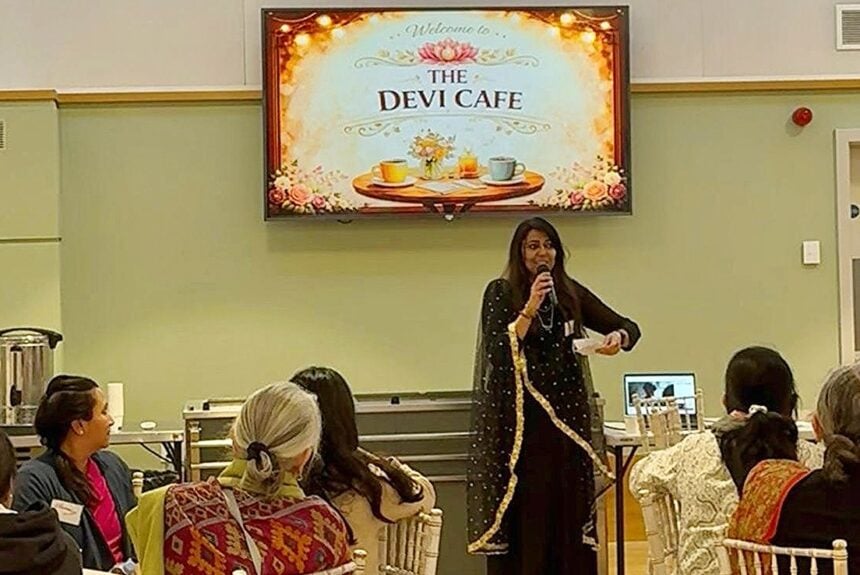
DEVI, an initiative dedicated to empowering, connecting, protecting and inspiring women, in collaboration with Devotee Care, convened a focused Women’s Wellbeing event at Bhaktivedanta Manor in Hertfordshire. Purposefully scheduled between International Woman’s Day and Mother’s Day, the gathering highlighted the full spectrum of societal and familial appreciation for women, while anchoring wellbeing within a dharmic framework that values dignity, resilience, and community support.
Guided by DEVI’s fourfold purposeempowerment, connection, protection, and inspirationthe program oriented participants toward holistic wellbeing. Empowerment centered on knowledge, skills, and voice; connection emphasized supportive peer networks; protection focused on safeguarding and ethical care; and inspiration drew from the Sacred Feminine (Shakti) to affirm women’s inherent potential. This scaffold ensured that spiritual insight translated into practical, protective, and uplifting action.
Devotee Care’s partnership added a structured care pathway that many faith-based communities increasingly adopt: trauma-informed facilitation, signposting to trusted services, and a culture of confidentiality and trust. The collaboration demonstrated how spiritual institutions can responsibly blend pastoral support with contemporary standards in wellbeing and safeguardingan approach consistent with dharma’s emphasis on lokasangraha (the welfare of all).
Positioning the event between International Woman’s Day and Mother’s Day lent a thoughtful temporal arcfrom public recognition of women’s contributions to the intimate honoring of motherhood. This sequencing underscored the continuity between civic celebration and day-to-day care, reinforcing that women’s health and dignity require consistent, year-round attention, not episodic observances.
Bhaktivedanta Manor, a vibrant hub in the ISKCON (International Society For Krishna Consciousness) network, served as an ideal venue. As a community anchor, the Manor supports devotional practice (bhakti), education, and social outreach. This event further illustrated how living heritage sites can be catalysts for CommunityEngagement, bringing together intergenerational audiences to explore wellbeing through devotion, learning, and service.
Among the guests were Cllr Parveen Rani from Hertfordshire County Council and Visakha, whose presence signified a productive interface between civic leadership, cultural institutions, and lived spiritual experience. Their participation reinforced the message that women’s wellbeing is a shared societal mandate that transcends sectors and traditions.
The core curriculum integrated dharmic wisdom with evidence-aligned practices. Sessions emphasized mindful movement and breath (Yoga), contemplative focus (Mindfulness), devotional singing and remembrance (bhakti-kirtan), reflective journaling, and community dialogue. Facilitators framed these elements as complementary pathways that cultivate inner steadiness, compassionate relationships, and moral clarityqualities central to WomenEmpowerment and community resilience.
Emerging research aligns with these practices: breath regulation and guided attention can reduce stress reactivity and improve emotional regulation; mantra-based practices support attentional stability and positive affect; and group singing fosters belonging and prosocial support. When embedded in a values-driven setting, these modalities can strengthen both individual coping and communal trustkey determinants of wellbeing.
Ayurveda’s emphasis on daily rhythm, balanced nourishment, and restorative rest was presented in accessible, non-prescriptive ways. Practical guidance on seasonal routines (ritucharya), gentle movement, and self-care rituals complemented the devotional ethos. The intention was not medical substitution, but informed self-care consistent with dharmic ethics, encouraging participants to consult qualified practitioners when needed.
Philosophically, the event situated wellbeing within the broader dharmic vision of human flourishing. In Hindu thought, the reverence of Shakti affirms the Sacred Feminine as foundational to balance and transformation; Buddhist karuna (compassion), Jain ahimsa (nonviolence), and Sikh seva (selfless service) converge to honor women’s dignity and agency. This shared civilizational canvas underscores unity in diversity across Hinduism, Buddhism, Jainism, and Sikhism, affirming that spiritual inclusivity strengthens societal harmony.
Protection was treated as indispensable. Facilitators highlighted clear routes for safeguarding, listening without judgment, and early referral to appropriate services. Boundaries, consent, and confidentiality were codified through simple, memorable principlesdemonstrating that compassionate spaces also need robust protective norms.
Connection was cultivated through small-group circles that encouraged reflective listening and mutual validation. Participants commonly resonate with the relief of being heard, the courage found in witnessing others’ journeys, and the hope sparked by shared wisdom. Such circles become incubators for peer support networks that persist beyond a single gathering.
Inspiration arose from narrative and symbol. Invoking archetypes associated with Durga, Lakshmi, and Saraswatistrength, abundance, and learningfacilitators emphasized that these qualities are not remote ideals but living possibilities. Framed within the Bhakti Tradition, devotion and service become accessible disciplines that sustain purpose during adversity.
Strategically, the presence of civic leadership underscored policy relevance. Partnerships between councils and faith-based organizations can amplify public health aims, from preventive mental health to social inclusion. Local authorities offer frameworks and resources; spiritual institutions contribute trust, continuity, and cultural fluencytogether forming a pragmatic alliance for measurable wellbeing gains.
Program design reflected best practices: clear objectives; accessible language; sensitivity to culture, age, and life stage; and provisions for aftercare. Volunteers were oriented to inclusive language, active listening, and non-directive support, mirroring standards that many leading community programs adopt for safe, effective engagement.
For communities seeking to replicate the model, a practical blueprint emerged: define objectives aligned to empowerment, connection, protection, and inspiration; convene a cross-functional team spanning pastoral care, safeguarding, and facilitation; co-create a modular curriculum integrating Yoga, Mindfulness, and bhakti practices; partner with local services for referral pathways; and plan for evaluation, feedback, and continuous improvement.
Evaluation can be approached through mixed methods: attendance patterns, demographic reach, and referral uptake; brief pre/post measures for perceived stress or belonging; qualitative themes from participant reflections; and follow-up checks on sustained practice. These data inform iterative refinement while honoring privacy and consent.
Crucially, the model is adaptable across dharmic settingstemples, gurdwaras, viharas, and derasarsbecause its foundation is universal: dignity, compassion, nonviolence, and service. By foregrounding unity in spiritual diversity, the approach resists sectarianism and strengthens the shared ethical core of the dharmic family.
As an exemplar of Cultural Heritage in action, the Women’s Wellbeing event demonstrated how living traditions can address contemporary challenges with intellectual clarity and devotional warmth. When spiritual communities adopt trauma-informed care, inclusive pedagogy, and measurable outcomes, they honor both timeless wisdom and modern responsibility.
In sum, the collaboration between DEVI and Devotee Care at Bhaktivedanta Manor offered a credible, replicable pathway for women’s holistic wellbeing. By integrating devotion, knowledge, protection, and community, it advanced a model of societal care that is both deeply rooted and forward-lookingempowering, connecting, protecting, and inspiring women in alignment with dharma.
Inspired by this post on Dandavats.