
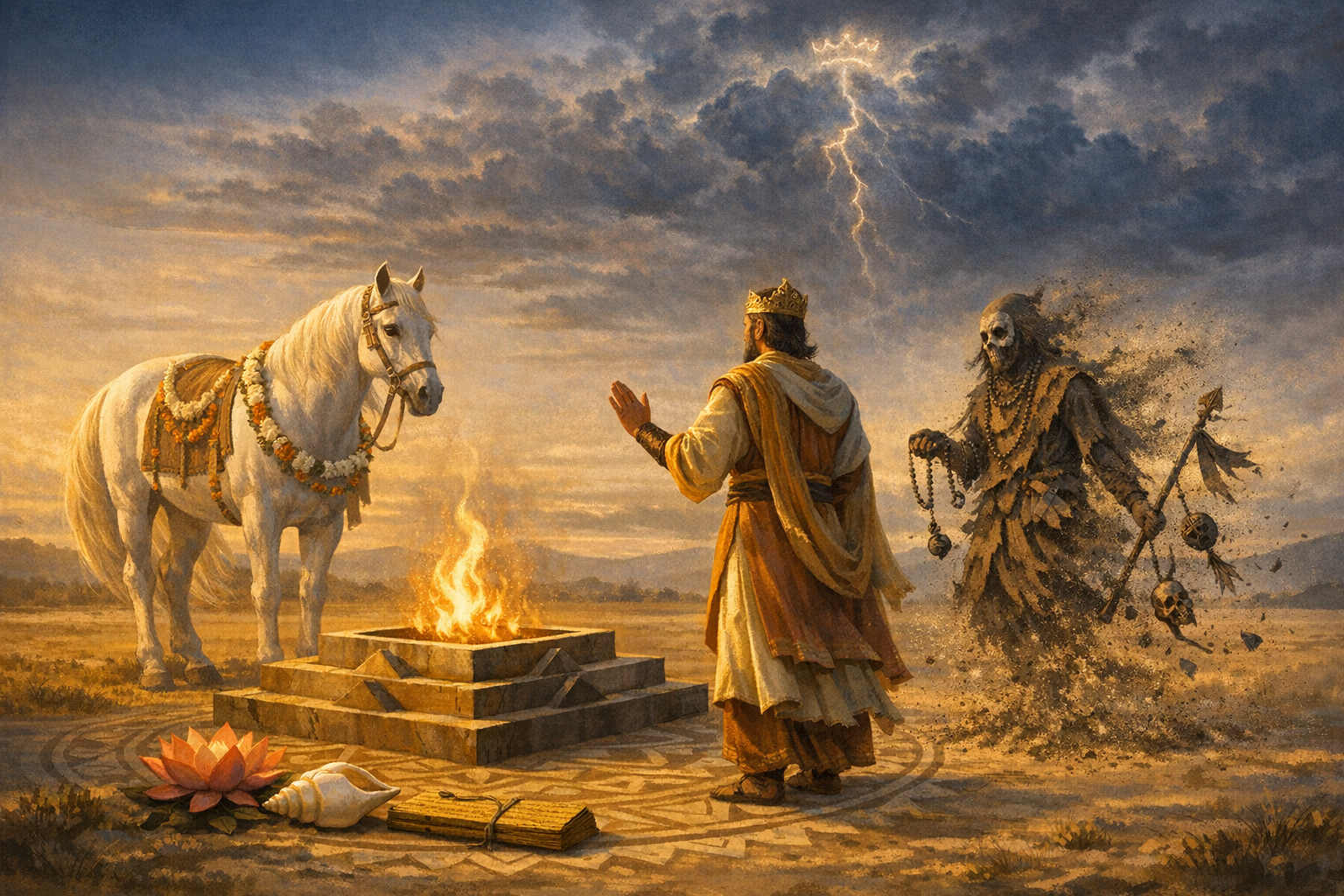
Śrīmad-Bhāgavatam (ŚB) 4.19.14–22 presents a tightly argued meditation on political power, ritual authority, and ethical restraint. Situated within the narrative arc of King Pṛthu’s aśvamedha-yajñas, these verses depict how Indra, unsettled by the prospect of Pṛthu equaling his own prestige through a hundred sacrifices, resorts to deception—appropriating ascetic insignia to cloak adharma. The passage is a classic of the Bhagavata Purana’s moral-political philosophy: it examines how signs of sanctity can be instrumentalized, how institutions must guard against performative piety, and how leaders preserve order by choosing principled de-escalation over retaliatory triumph.
Textually, Canto 4’s Pṛthu narrative establishes the king as a rāja-ṛṣi, a sovereign whose legitimacy arises from service to the people and fidelity to dharma. After restoring prosperity, Pṛthu undertakes a sequence of aśvamedha-yajñas—royal rites that, in Vedic statecraft, publicly verify sovereignty, consolidate alliances, and ritually affirm cosmic order (ṛta). ŚB 4.19 captures the political-theological tension that such rites can provoke: ritual excellence invites emulation, but it can also trigger rivalry in a cosmos that values both hierarchy and virtue.
Verses 14–22 focus on Indra’s interference with Pṛthu’s final (hundredth) aśvamedha. The narrative reports repeated thefts of the sacrificial horse and, crucially, describes Indra’s adoption of counterfeit ascetic markers to escape detection. These acts are not mere pranks; the text frames them as the deliberate creation of spurious religious practices—kūṭa-dharma—that sow confusion about legitimate renunciation, destabilize varṇāśrama norms, and erode public trust in spiritual institutions. The moral stakes are explicit: when religious insignia (liṅga) are decoupled from substance (sāra), society’s ethical compass falters.
Several philological features in this segment sharpen its argument. The term liṅga (sign) underscores that external marks—robes, shaved head, emblems—are signifiers, not proofs, of inner realization. The critique of kūṭa-dharma (counterfeit religiosity) warns against the appearance of sanctity devoid of adherence to yamas, niyamas, ahiṁsā, satya, and śaucam. The text’s concern is not with authentic ascetic lineages but with their mimicry for personal gain. In hermeneutic terms, the target is hypocrisy and institutional capture, not legitimate diversity of paths.
Within Vedic philosophy, the aśvamedha-yajña signifies more than royal spectacle; it is a constitutional rite that binds king, priesthood, and populace into a shared moral order. Indra’s anxiety is intelligible in this frame: a hundred flawless sacrifices symbolize unimpeachable sovereignty. Yet the Bhāgavata Purana insists that moral greatness cannot arise from rivalry (mātsarya). Indra’s envy becomes a didactic foil, dramatizing how even devas can err when reputation eclipses responsibility.
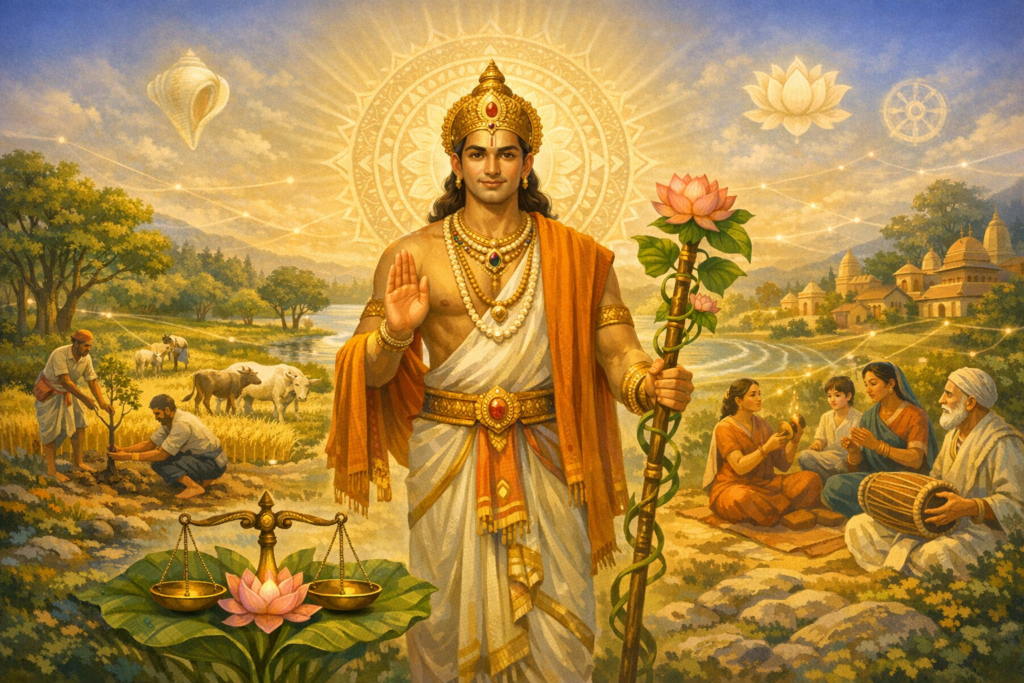
The narrative also models statecraft under ethical duress. Pṛthu’s camp rightfully pursues redress—retrieving the horse and seeking to neutralize sabotage—yet the broader episode (as the chapter proceeds) shows decisive restraint and a willingness to subordinate personal renown to public harmony. The ensuing divine counsel (developed immediately after these verses) validates this restraint: dharma is upheld when leaders relinquish zero-sum contests, even if that means foregoing the symbolic completion of a hundred sacrifices. In short, renunciation of escalation can be a higher form of victory.
Read as social critique, ŚB 4.19.14–22 anticipates a recurring civilizational problem: the co-option of sacred forms to advance profane ends. Hindu scriptures, including the Bhagavata Purana, repeatedly caution against dharma-dvāja—flaunting religion for status. Comparable admonitions appear across dharmic traditions: Buddhist critiques of silabbata-parāmāsa (clinging to mere rites), Jaina warnings against pakhaṇḍa (pseudo-asceticism), and Sikh calls to see through pakhandi sadhus (hypocritical holy-men). The shared principle is clear: authenticity in practice matters more than the costume of piety. This convergence underscores a core objective of unity in spiritual diversity.
For readers navigating contemporary institutions—religious, civic, or corporate—the passage remains strikingly relatable. Many have observed how “innovation” or moral branding can sometimes mask rule-breaking; symbols outrun substance; short-term optics eclipse long-term trust. ŚB 4.19.14–22 offers durable guidance: measure integrity by conduct aligned with first principles, not by performative markers. In public life, transparency, accountable counsel, and prudent de-escalation are not signs of weakness; they are instruments of stability.
A technical note on the rite itself helps situate the discussion. In earlier periods, aśvamedha-yajña was a constitutional-religious instrument embedded in a complex economy of vows, gifts, and ritual safeguards. The Bhāgavata tradition also affirms a progressive ethic: in Kali-yuga, the recommended sacrifice is saṅkīrtana (collective chanting), which preserves the yajña’s social-binding intent without violence. This evolution aligns with broader dharmic currents that privilege compassion, contemplative discipline, and communal well-being in the present age.
Ethically, the passage makes three interlocking claims. First, means and ends must cohere; one cannot safeguard dharma by violating its core restraints. Second, institutional trust depends on preventing “sign inflation,” where external badges of sanctity are awarded or imitated without inner qualification. Third, leadership maturity is measured by the capacity to yield prestige for the sake of peace. These claims together articulate a constitutional ethic for rāja-dharma that is as relevant to modern governance as it was to Vedic polity.
Philosophically, the narrative distinguishes between liṅga (sign) and lakṣaṇa (defining characteristic). Genuine renunciation is marked by detachment, truthfulness, compassion, and equipoise; these are lakṣaṇas. Clothing and titles are at best heuristic aids; they become spiritually inert—even harmful—when invoked to rationalize transgression. The verses thus press for an anubhava–yukti–āgama triangulation: lived realization (anubhava), reasoning (yukti), and scriptural guidance (āgama) must corroborate one another in discerning authentic practice.
The emotional contour of the episode also merits attention. Envy (asūyā, mātsarya) destabilizes even exalted beings when identity is tethered to comparison. ŚB 4.19.14–22 allows readers to recognize this impulse in social life and to choose differently. The catharsis arrives when ambition is transmuted into service, and rivalry into reverence for the common good. That turn—from contest to cooperation—sustains the moral imagination that the Bhagavata Purana seeks to cultivate.
In intertraditional perspective, the lesson is consonant across Hinduism, Buddhism, Jainism, and Sikhism: inner transformation, not external posturing, is the criterion of spiritual progress; compassion and truthfulness outrank ceremonial one‑upmanship; public harmony deserves precedence over private glory. This shared ethic is not a lowest common denominator but a unifying summit—affirming unity in spiritual diversity while honoring the unique disciplines that each path contributes.
Taken together, ŚB 4.19.14–22 offers a constitutional charter for ethical leadership: safeguard symbols by safeguarding substance; prefer reconciliatory strength over retaliatory spectacle; and ground authority in service rather than in tallying victories. As a study in the Bhagavata Purana’s statecraft, it shows that the highest triumph is often invisible—the quiet preservation of dharma when provoked to do otherwise. That wisdom, continually reinterpreted within Hindu scriptures and resonant across dharmic traditions, remains a practical compass for communities seeking stability, integrity, and shared flourishing today.
Inspired by this post on Dandavats.








Leave a Reply
You must be logged in to post a comment.