
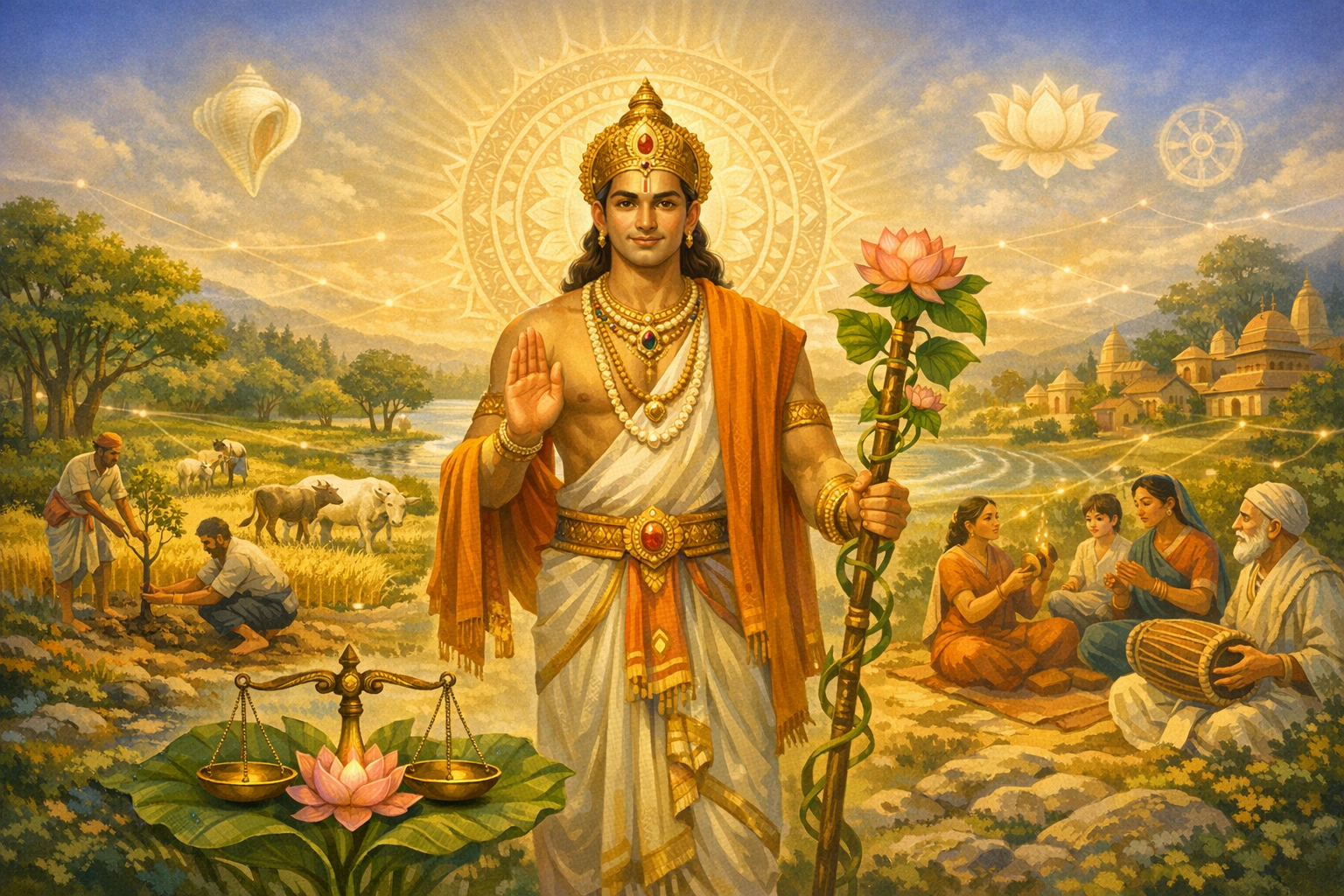
Srimad-Bhagavatam Canto 4, Chapter 21, verses 37–52 present a compact charter that integrates rajadharma (ethical governance) with bhakti-yoga (devotional practice). In Gaudiya Vaishnava study circles—such as classes taught by Jamuna Jivani Devi Dasi—this passage is frequently highlighted for its rare synthesis of spiritual interiority and social responsibility. The verses close Maharaja Prithu’s public instructions, distilling a vision in which political leadership, social cooperation, and personal sadhana are mutually reinforcing and teleologically ordered toward pleasing the Supreme.
Situated after the divine theophany of Lord Vishnu (Canto 4.20), the chapter turns from extraordinary revelation to ordinary duty. Here, Maharaja Prithu articulates how a ruler and citizens align their conduct with Sanatana Dharma: protecting all beings, regulating the senses, honoring functional social roles, and anchoring prosperity in dharma rather than in unrestrained artha and kāma. The concluding movement in 4.21.37–52 emphasizes that collective well-being is inseparable from devotion—the state becomes stable, households become peaceful, and individuals become inwardly free when the Supreme is remembered, praised, and served.
Three interlocking themes organize these verses. First, leadership is conceived as stewardship: the king safeguards justice, resources, and education without exploiting the populace. Second, society operates as an ethical ecology (varna–āśrama dharma), where diverse functions cooperate for the common good while aiming at transcendental realization. Third, inner practice—especially śravaṇa (hearing), kīrtana (chanting), and smaraṇa (remembering)—is not merely private piety but the engine of equanimity, restraint, and compassion that makes just governance and social harmony possible.
On rajadharma, the text envisions a ruler who administers danda (law and consequence) with impartiality while tempering it through compassion and restraint. In contemporary terms, this implies non-oppressive taxation, predictable rule of law, and a bias toward rehabilitation over cruelty. It also spotlights resource guardianship—agriculture, animal welfare, and ecological stability—so that economic life remains sattvic and future-facing rather than extractive. Such statecraft complements classical dharma-śāstra insights and aims at lokasaṅgraha (the gathering up and protection of society).
Social order is treated functionally rather than as a hierarchy of worth: brahmana, kshatriya, vaishya, and shudra roles are lenses for service and competence, not vehicles for pride or domination. When each person performs sva-dharma with integrity and orients the fruits toward the Supreme, the social body becomes coordinated and purposeful. These verses thereby reject envy and exploitation, elevating sarva-bhūta-hita (the welfare of all beings) as a practical barometer of dharmic authenticity.
The devotional core is explicit. Bhakti-yoga—especially through the accessible triad of śravaṇa, kīrtana, and smaraṇa—cultivates a stable, clarified mind capable of sustained ethical action. Rather than divorcing spirituality from public life, the text insists that remembrance of the Supreme purifies intention, reduces reactivity, and steadies judgment, which in turn refines leadership, community relations, and household responsibilities. This is praxis-centered religion: practice first, transformation follows.
Equally central is the Paramātman perspective—the Lord dwelling within all beings—which reframes interpersonal conduct. Recognizing the divine presence curbs envy, invites forgiveness, and grounds nonviolence beyond utilitarian calculation. In this way, Bhagavatam 4.21.37–52 resonates with the wider dharmic family: ahimsa-paramo dharmah (Jainism), mettā and the dasa-rāja-dhamma (Buddhism), and sarbat da bhala held alongside miri-piri (Sikhism). These shared ethics—dāna (generosity), satya (truthfulness), ahiṁsā (non-harm), tapas (discipline), and sevā (service)—form a civilizational grammar for unity-in-diversity.
For leadership today, Maharaja Prithu’s stance reframes power as trusteeship and administration as service. Decisions must be transparent, proportionate, and compassionate, with human dignity protected at every step. At the institutional level, this translates into ethical governance frameworks, fair resource allocation, and impact metrics that privilege long-term social and ecological flourishing over short-term gains. In households, the same logic recommends disciplined livelihood, honest speech, and daily remembrance practices that harmonize relationships and responsibilities.
A practical modernization of the chapter’s guidance can be sketched as follows: leaders adopt the dharmic triad of clarity (viveka), courage (śaurya), and compassion (dayā); communities structure education around character and competence; families establish a rhythm of study and reflection (nitya-śravaṇa and mindful kīrtana); and citizens cultivate stewardship habits that translate devotion into social benefit. In each case, bhakti-yoga supplies the motivational engine, while rajadharma supplies the guardrails that prevent charisma from devolving into coercion.
Read narrowly, verses 37–52 close a royal speech; read broadly, they chart a civilizational template: inner devotion stabilizes outer order. The likely sequence runs from seeing the Lord within, to honoring mutual duties, to purifying speech and action through remembrance, and finally to the assurance that society prospers when the Lord is worshiped and beings are protected. The text’s anthropology is uplifting—humans can govern desire, align with truth, and choose compassion—while its politics is chastened—authority is legitimate only when yoked to protection and service.
Methodologically, the passage rewards multilayered reading: historical-narrative (Maharaja Prithu’s role in Canto 4), normative-ethical (how justice and compassion co-govern), and devotional-mystical (how remembrance reconstitutes attention and intention). It fruitfully dialogues with the Bhagavad-Gita on lokasaṅgraha (3.20–26) and sva-dharma (18.41–46), and with classical discussions of navadha-bhakti found elsewhere in the Bhāgavata tradition. Such triangulation helps contemporary readers avoid anachronism while extracting living principles for policy, leadership, and daily practice.
In sum, Srimad-Bhagavatam 4.21.37–52 presents a unifying thesis for the dharmic traditions: interior transformation through bhakti-yoga empowers ethical action; ethical action, in turn, safeguards social harmony; and both together nourish a culture of universal goodwill. By cultivating remembrance and service, leaders and citizens can align governance with worship and prosperity with compassion—realizing, in practice, the civilizational ideal of Vasudhaiva Kutumbakam.
Inspired by this post on Dandavats.








Leave a Reply
You must be logged in to post a comment.