
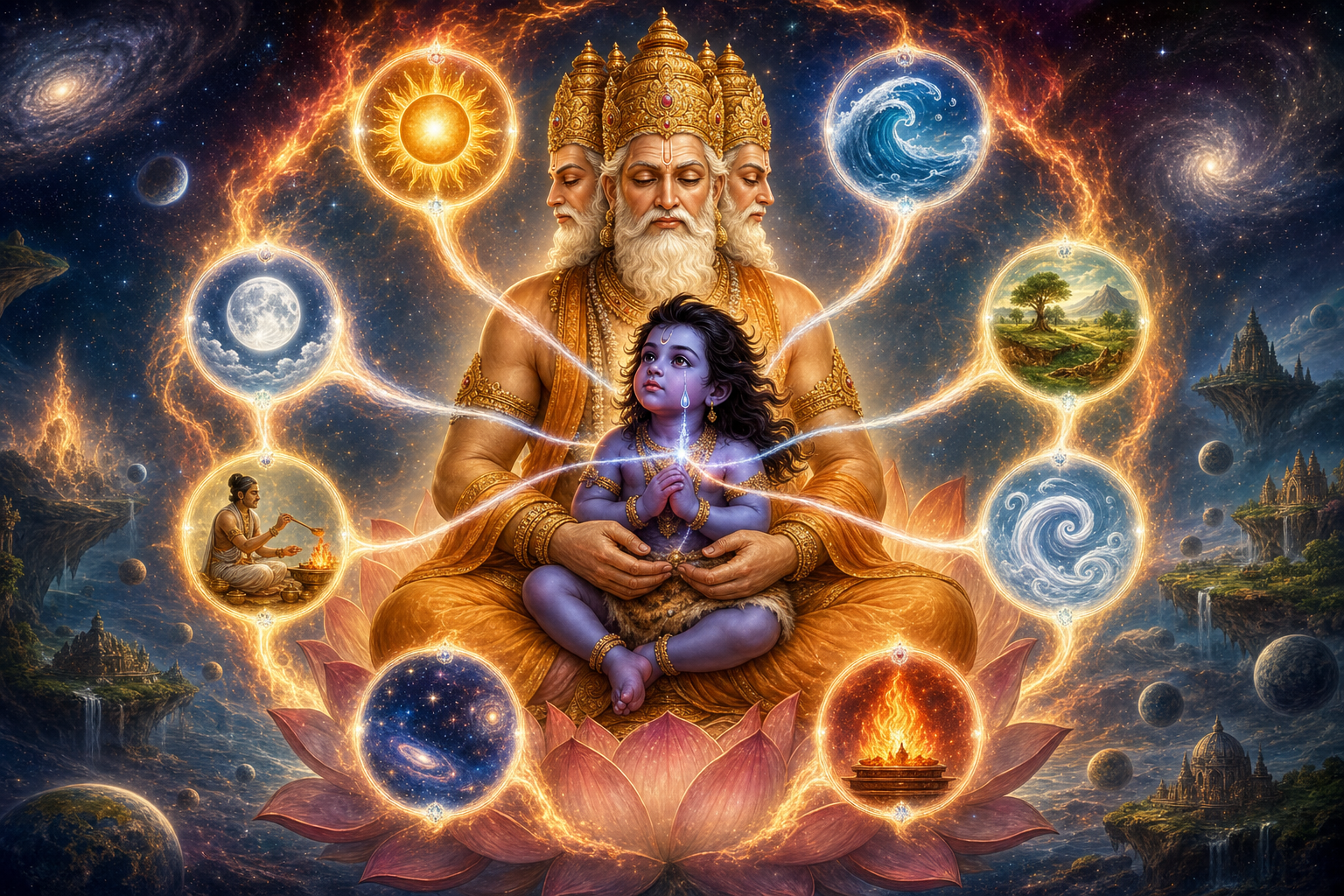
Rudra at the threshold of creation
The birth of Rudra in the Vishnu Purana is brief in its narrative form but immense in its theological reach. A child appears at the beginning of a cosmic age, cries for a name, and receives not one identity but eight. The episode links tears with speech, names with cosmic functions, and divine emotion with the forces that sustain and transform the universe. It also reveals why Rudra cannot be reduced to the familiar description of a god of destruction. Within the Purāṇic vision, destruction is one phase of a continuous process that includes creation, preservation, dissolution, and renewal.
The relevant material occurs in Book One of the Vishnu Purana, principally in Chapters 7 and 8, within the dialogue between the sage Parāśara and his student Maitreya. These adjacent chapters present two related descriptions of Rudra’s manifestation. Chapter 7 associates him with Brahmā’s blazing anger and describes his division into multiple male and female forms. Chapter 8 presents the more intimate image of a crying child who asks Brahmā for a name. Reading the passages together preserves their differences while revealing a shared idea: Rudra embodies the concentrated power through which undifferentiated energy becomes ordered cosmic activity.
The Purāṇic setting: creation as a recurring process
The story does not describe a unique beginning in the modern historical or scientific sense. It unfolds at the opening of a kalpa, a vast cosmic period associated with a day of Brahmā. Purāṇic cosmology treats the universe as cyclic: worlds arise, endure, dissolve, and arise again. Divine births within this framework are therefore manifestations of functions required for a new cycle, not biological births constrained by ordinary time.
This distinction is essential. When Rudra emerges from Brahmā, the episode is not primarily establishing a human-style genealogy in which one deity simply precedes another. It is expressing a relationship among cosmic powers. Brahmā represents creative projection, but creation cannot continue through production alone. It requires differentiation, limitation, change, mortality, and the removal of exhausted forms. Rudra makes those dimensions of existence possible.
The Vishnu Purana places the entire process within a still wider theological unity. At the conclusion of Chapter 7, Parāśara explains that the powers of creation, preservation, and destruction operate through Viṣṇu, who abides in all beings. The text consequently presents Brahmā and Rudra as genuine divine agents without isolating them from the all-pervading foundation of existence. This is characteristic of Purāṇic theology: different deities may receive distinct narrative roles while remaining interconnected expressions of a reality that exceeds any single image.
The first account: Rudra arises from Brahmā’s cosmic anger
Chapter 7 begins with Brahmā’s attempt to populate the universe. His mind-born sons include sages endowed with knowledge and detachment. Sanandana and others, however, have no desire for worldly life or procreation. Their refusal is not described as moral failure; it reflects the path of renunciation. Nevertheless, it frustrates the immediate work of cosmic expansion because beings capable of reproduction are still required.
Brahmā’s frustration becomes wrath powerful enough to consume the three worlds. The text imagines its flame surrounding heaven, earth, and the lower regions like a burning garland. From Brahmā’s furrowed forehead springs Rudra, fierce, vast, and radiant like the midday sun. He appears in a form that is half male and half female, visually containing complementary powers before they have separated into the diversity of creation.
Brahmā commands Rudra to divide himself. Rudra separates the male and female dimensions of his being, divides the male aspect into eleven forms, and multiplies the female aspect into many forms of light and dark complexion. Some male manifestations are mild and pleasing; others are fierce or awe-inspiring. The imagery refuses to confine Rudra to one emotional or moral category. His nature includes gentleness and terror, fertility and withdrawal, unity and multiplicity.
The fire surrounding this birth is therefore not merely the fire of rage. It is also the heat of transition. Brahmā’s anger becomes productive when it takes form as Rudra. What might otherwise burn the worlds without direction is transformed into a differentiated cosmic power. In this sense, the narrative does not glorify uncontrolled anger. It portrays the conversion of overwhelming energy into purposeful action—an insight that remains psychologically recognizable even outside the formal framework of Purāṇic cosmology.
The second account: the child who asks for a name
Chapter 8 shifts from grandeur to tenderness. At the beginning of the kalpa, Brahmā meditates upon a son equal to himself. A boy of striking reddish, purple, or blue-red appearance manifests in his lap. Translation choices vary, while the traditional designation Nīlalohita conveys the conjunction of blue and red. The child runs about and cries. Brahmā does not rebuke him; he asks why he is weeping.
The child’s answer is direct: he wants a name. Brahmā responds by naming him Rudra and instructing him to become composed. The text connects the name with the act of crying through the Sanskrit verbal root rud, meaning to weep, cry, or wail. An older explanatory tradition also associates the scene with crying and running. The etymology operates on the narrative level even though the historical development of a divine name can be linguistically more complex.
The child continues to cry seven more times. Brahmā therefore gives him seven additional names: Bhava, Śarva, Īśāna, Paśupati, Bhīma, Ugra, and Mahādeva. Together with Rudra, these constitute eight manifestations. Each receives a cosmic station, a wife, and a son. The child’s tears do not remain an undefined expression of distress; each cry becomes the occasion for another identity and another relationship with the cosmos.
This is one of the episode’s most affecting ideas. The first need expressed by the newborn deity is not for territory, weaponry, or worship, but for recognition through a name. In human experience, naming can provide belonging and orientation. In a Purāṇic account, its significance is even greater: a divine name discloses a function, makes a presence available to thought and devotion, and places that presence within an intelligible network of relationships.
Why the eight Rudras and eleven Rudras should not be confused
Chapter 7 speaks of an elevenfold division, whereas Chapter 8 enumerates eight named forms. These are distinct schemes preserved next to one another. They should not be compressed into a single list or treated as an error that must be eliminated. Purāṇic literature frequently transmits multiple classifications, genealogies, and symbolic arrangements. The numbers may organize different theological concerns rather than supply one modern-style biographical chronology.
The elevenfold scheme emphasizes Rudra’s multiplication after emerging from the fire of Brahmā’s anger. The eightfold scheme organizes Rudra through names, cosmic locations, spouses, and descendants. Traditional commentators and translators have also compared these lists with related but non-identical accounts in other Purāṇas. Careful reading therefore requires identifying the particular scripture and chapter being discussed instead of importing every well-known Rudra tradition into the Vishnu Purana.
The eight names and their theological range
Rudra is the first name and the name most directly joined to the child’s crying. In Vedic and later Sanskrit literature, Rudra is a complex deity who can inspire fear, grant healing, protect beings, and wield destructive power. The name in this story preserves the sound of grief while also suggesting the formidable voice of a deity whose presence cannot be ignored.
Bhava is related to being, becoming, or existence. Applied to Rudra, it challenges any account that treats him as destruction alone. The force that ends a form also participates in the conditions under which new forms become possible. Bhava therefore places Rudra inside the mystery of existence rather than outside it as a merely negative power.
Śarva is an ancient name of Rudra associated in traditional interpretation with the archer and the power to strike. The image recalls the unpredictable reach of natural forces, illness, time, and mortality. Yet the divine archer is also approached for protection. The same power feared for its capacity to wound is invoked to turn danger away.
Īśāna conveys lordship, sovereignty, and governing authority. In later Śaiva traditions, it carries rich associations with transcendence and sacred directionality. Within the eightfold list, it shows that Rudra’s fierce energy is not chaotic. It is capable of rule, orientation, and order.
Paśupati means Lord of creatures or Lord of beings, with paśu often referring particularly to animals and, in later theology, to bound individual beings. The title gives Rudra a pastoral and protective dimension. The deity who confronts mortality is also guardian of vulnerable life.
Bhīma means formidable, tremendous, or terrifying. Its purpose is not to classify Rudra as evil. Sacred terror acknowledges powers too vast to be domesticated by ordinary preference. Storm, fire, disease, time, and death can be experienced as frightening while remaining parts of the cosmic order.
Ugra signifies fierceness, intensity, or concentrated force. It expresses the uncompromising aspect of transformation. Some attachments, injustices, and exhausted structures cannot be overcome through passivity alone. Ugra represents the energy that breaks obstruction, although the narrative context also implies that such energy must receive form and direction.
Mahādeva, the Great God, crowns the sequence. The crying child has not ceased to be the child who sought a name, but his eightfold identity now extends across the world. Vulnerability and greatness are not opposites in this account. The deity’s tears precede the disclosure of his cosmic magnitude.
The eight cosmic stations
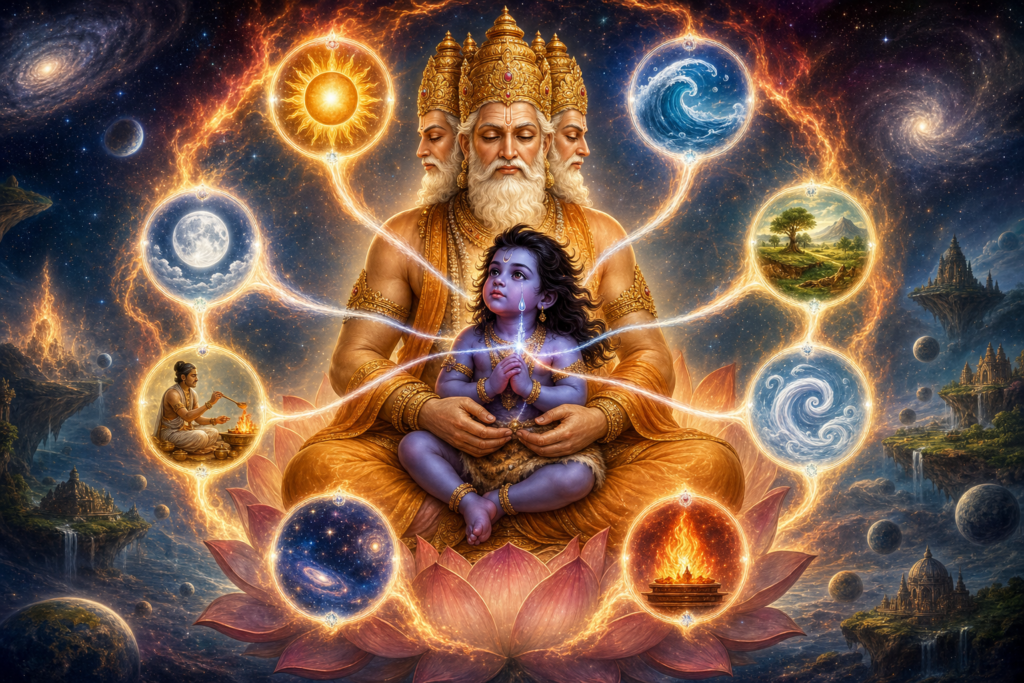
Brahmā assigns the eight forms to the sun, water, earth, wind, fire, space or ether, the consecrated officiating Brāhmaṇa, and the moon. The list moves across luminous bodies, material elements, atmospheric movement, ritual presence, and sacred time. Rudra is consequently not confined to a distant celestial residence. His manifestations are distributed through the structures that make embodied and ritual life possible.
The sun illuminates and ripens but can also scorch. Water nourishes yet can overwhelm. Earth supports life while receiving the bodies of the dead. Wind gives breath and can become a storm. Fire cooks, purifies, sacrifices, and consumes. Space accommodates all forms without being limited to any of them. The consecrated ritual specialist represents disciplined sacred action, while the moon governs rhythms of time, fertility, and change. Each station contains a union of sustaining and transforming power appropriate to Rudra’s nature.
The ritual station deserves particular attention. Older English translations sometimes obscure it, but the reference is not simply to an abstract social identity. It concerns the Brāhmaṇa qualified by consecration to perform a ritual role. The eightfold arrangement thus connects cosmology with yajña: sacred transformation occurs not only in the elements but also through disciplined human participation in ritual order.
Consorts, descendants, and an inhabited universe
The corresponding wives are listed as Suvarcalā, Uṣā, Vikeśī, Śivā, Svāhā, Diśā or Diśas, Dīkṣā, and Rohiṇī. Their names evoke radiance, dawn, distinctive appearance, auspiciousness, the sacrificial invocation, directions, ritual consecration, and lunar or stellar associations. The eight forms are therefore relational. Their powers become intelligible through complementary presences rather than through isolated masculine agency.
The sons are given in corresponding order as Śanaiścara or Saturn, Śukra or Venus, fiery Mars, Manojava, Skanda, Svarga, Saṃtāna, and Budha or Mercury. English translations vary in the spelling and interpretation of several names. The list links the Rudra forms with planetary, martial, heavenly, generative, and mental or swift-moving powers. Its purpose is not merely genealogical. Through family relationships, cosmic forces are placed in an ordered field of descent, correspondence, and mutual dependence.
Modern readers may find such catalogues difficult because they do not resemble linear storytelling. In Purāṇic literature, however, lists are often compressed maps. Names, spouses, offspring, elements, planets, ritual acts, and directions create a network through which the universe can be remembered as an integrated whole. Genealogy becomes a language of cosmology.
From Rudra to Śiva
Rudra is closely identified with Śiva, yet the historical and textual relationship between the names is layered. Rudra is prominent in Vedic literature, where he is fierce, healing, protective, and associated with dangerous natural power. Śiva, meaning auspicious or gracious, becomes the dominant name of the great deity in later traditions. Purāṇic narratives often use Rudra, Śiva, Bhava, Mahādeva, and other names for overlapping manifestations of the same divine reality.
The transition should not be described as though a crying child gradually acquired the modern occupational title of destroyer. The Vishnu Purana presents Rudra from the beginning as a cosmic power with multiple aspects. His identity encompasses being, sovereignty, protection, terror, intensity, and greatness. Destruction is part of that field, especially as the removal of forms whose time has ended, but it does not exhaust his meaning.
Satī, Umā, and continuity through transformation
Chapter 8 adds that this Rudra married Satī, who relinquished her body because of Dakṣa’s hostility or displeasure. She was later born to Himālaya and Menā and, as Umā, was reunited with Bhava. The passage states the continuity concisely, without narrating every detail familiar from fuller accounts in other scriptures.
Satī’s return as Umā reinforces the chapter’s central pattern. Loss is followed by renewed embodiment; identity survives transformation; relationship is broken and restored in another form. Rudra’s association with dissolution is therefore immediately placed beside rebirth and reunion. The apparent ending becomes a passage into another configuration of life.
Why the tears matter
The tears should not be dismissed as a primitive explanation for a divine name. They supply the emotional center of the narrative. Rudra enters the world with tremendous potential but without an articulated place within it. His cry precedes definition. Brahmā responds by listening, questioning, naming, and assigning relationships. The exchange transforms raw feeling into identity and responsibility.
That sequence offers a restrained but relatable insight. Distress often intensifies when experience remains nameless. Naming grief does not automatically remove it, just as the child continues to cry after receiving his first name. Yet language can begin to differentiate an overwhelming condition into aspects that can be understood and integrated. In the myth, repeated cries generate repeated names until the child’s presence has been mapped across the cosmos.
The episode therefore does not oppose emotion and power. Rudra’s tears do not diminish his divinity; they introduce it. His later fierceness is not presented as compensation for weakness. Tears, fire, protection, terror, healing, and transformation belong to the same many-sided sacred personality.
Creation requires the power to end
A universe in which nothing ended would soon become incapable of renewal. Seeds must break for shoots to emerge, bodies must change, seasons must turn, and old structures must yield to new conditions. Purāṇic cosmology gives sacred form to this observation. Rudra’s destructive dimension is not an enemy of creation; it protects creation from permanent stagnation.
This does not mean that every act of destruction is righteous or that suffering should be romanticized. Hindu ethical traditions distinguish transformation aligned with dharma from violence driven by ignorance, cruelty, or selfishness. Rudra’s cosmic role cannot be used to sanctify arbitrary harm. The myth instead places unavoidable change within a larger order and asks how formidable energy may be disciplined toward renewal.
The chapter’s fire is consequently both warning and revelation. Unbounded wrath threatens the worlds, but energy given form becomes capable of service. Rudra embodies the difficult truth that power must be acknowledged before it can be directed. Denied intensity may become destructive; named and integrated intensity may protect life, confront disorder, and clear the ground for regeneration.
A Vaiṣṇava text with an expansive vision of Śiva
Because the story appears in the Vishnu Purana, it also illuminates the relationship between Vaiṣṇava and Śaiva traditions. The text is centered on Viṣṇu, yet Rudra is treated as a profound cosmic manifestation rather than a disposable rival. Later in the same chapter, the inseparability of Viṣṇu and Lakṣmī is expressed through wide-ranging correspondences, including an identification of Viṣṇu with Śiva and Lakṣmī with Gaurī.
Such passages should not erase the real theological distinctions among Hindu sampradāyas. They do, however, challenge simplistic claims that devotion to one deity necessarily requires contempt for another. Purāṇic traditions frequently preserve both difference and unity: Viṣṇu, Śiva, Devī, and other deities may have distinctive forms, stories, and paths of worship while participating in an interconnected sacred universe.
This perspective also supports respectful engagement across the wider family of Dharmic traditions. Hindu, Buddhist, Jain, and Sikh teachings differ significantly in doctrine, authority, ritual, and accounts of ultimate reality. Unity is strengthened not by pretending that these differences do not exist, but by approaching them through disciplined study, non-hostility, ethical conduct, and reverence for sincere spiritual inquiry.
How the narrative may be read today
At the cosmological level, Rudra represents a necessary power of differentiation and dissolution. At the ritual level, his eight stations connect natural forces with consecrated action. At the theological level, his names reveal a deity who is fierce and auspicious, terrifying and protective, destructive and generative. At the psychological level, his birth portrays emotion becoming intelligible through recognition and naming.
These levels need not be treated as mutually exclusive. A traditional devotee may understand Rudra as an actual divine presence, while an academic reading may examine narrative structure, etymology, ritual correspondences, and sectarian theology. A philosophical reader may focus on impermanence and renewal. The text has endured partly because it permits these approaches to coexist without exhausting its meaning.
The most enduring lesson lies in the transformation of the cry. Rudra begins as an unnamed intensity. Brahmā does not silence that intensity by force; he gives it names, places, relationships, and functions. The result is not a smaller or safer deity, but a power integrated into the order of the universe. The story suggests that creation becomes complete only when it makes room for change, grief, fierce protection, and the endings from which new life can emerge.
Textual note
This account follows Book One, Chapters 7 and 8 of the Vishnu Purana. Spellings and certain English renderings vary among translations; these variations have been acknowledged where they affect the description of Nīlalohita, the cosmic stations, or the names of descendants. The eightfold list in Chapter 8 has been kept distinct from the elevenfold manifestation in Chapter 7.
Sources consulted: The Vishnu Purana, Book I, Chapter VII, translated by H. H. Wilson; The Vishnu Purana, Book I, Chapter VIII, translated by H. H. Wilson; and The Eight Forms of Rudra, translated by McComas Taylor.
Inspired by this post on Hindu Blog.

Leave a Reply
You must be logged in to post a comment.