
A Quiet Spiritual Presence in Srikalahasti
In Srikalahasti, a sacred town in Andhra Pradesh, the life of Sadguru Subrahmanyam Garu offers a compelling study of Self-Realization expressed through humility, family responsibility, Guru-bhakti, meditation, and silence. Srikalahasti is traditionally counted among the five Pancha Bhoota Siva Kshetras of South India, each associated with one of the elemental principles. Its celebrated temple represents Vayu, or air. The symbolism is appropriate: air is invisible yet indispensable, gentle yet capable of movement, and known primarily through its effects. In a comparable manner, Sadguru Subrahmanyam’s spiritual influence has not depended on institutional authority, elaborate ceremonies, or public acclaim. It has been recognized most often through the stillness experienced by people who sit in his presence.
Outwardly, Sadguru Subrahmanyam appears remarkably ordinary. He is a retired schoolteacher, a householder, a father, and a respected elder who has often been seen sitting quietly near his modest home. There is no obvious separation between his spiritual life and the everyday world of work, relationships, illness, grief, and social responsibility. Devotees nevertheless describe an unusual peace around him and regard him as a jnani, a person established in direct knowledge of the Self. Such descriptions belong to the language of devotional testimony and cannot be verified in the same manner as dates or public records. They remain significant, however, because they reveal how his conduct and presence have been experienced by those who know him.
His importance lies partly in the way his life challenges a persistent misunderstanding about Indian spirituality: the assumption that profound realization requires withdrawal from society. His example suggests that inner freedom may mature within the responsibilities of household life. Teaching children, raising a family, receiving visitors, enduring loss, and caring for others did not stand outside his sadhana. They formed the human conditions within which spiritual discipline was tested. This makes his life especially relevant to contemporary seekers who cannot abandon their professions or families but still long for depth, clarity, and inner peace.
Biographical Sources and the Need for Careful Reading
Much of what is known about Sadguru Subrahmanyam comes from the recollections and writings of disciples, particularly Sri T.V.N. Babu. These materials preserve biographical details, conversations, devotional memories, and accounts of extraordinary events. An academically responsible reading distinguishes between documented chronology, remembered teaching, and hagiography. Hagiography is not simply unreliable history; it is a traditional form of sacred biography in which events are preserved for their moral and spiritual meaning. Miraculous episodes may therefore be received as matters of faith, interpreted symbolically, or studied as expressions of a community’s understanding of sanctity. This distinction allows the tradition to be treated respectfully without presenting every devotional account as independently established fact.
Early Life in Konathaneri
Subrahmanyam was born in Konathaneri, in the Chittoor district of Andhra Pradesh, to Sri Siddaiah and Smt. Vijayalakshmi. His family belonged to an agricultural background characterized in preserved accounts by simplicity, devotion, and disciplined living. Little detailed information survives about his childhood, formal spiritual training, or the precise stages through which his contemplative awareness developed. This scarcity is not unusual in the biographies of regional saints whose lives initially unfolded far from major institutions and publishing networks. What survives indicates that reverence, restraint, compassion, and contemplative seriousness were present long before he became widely known as a spiritual guide.
At nineteen, he married Smt. Padmavati, affectionately called Vayyamma. The couple had three sons and led a modest family life. Subrahmanyam worked as a schoolteacher, a profession requiring patience, consistency, communication, and care. Outside school hours, he devoted time to meditation, reflection, and the company of saints. His professional identity is important because it prevents his spiritual development from being reduced to a story of escape. He did not first abandon ordinary life and then seek truth. The rhythms of employment and family became the setting in which concentration, surrender, and equanimity were cultivated.
Following his father’s death and the division of ancestral property, Subrahmanyam moved with his family to Srikalahasti in 1975. This relocation became a decisive chapter in his spiritual life. The town’s Shaiva sacred geography, its association with Vayu, and its living culture of pilgrimage placed him within an environment where temple worship, renunciation, household devotion, and saintly lineages met. His home gradually became a place of informal spiritual conversation. Seekers did not initially gather around a formal organization; they came to meet a quiet teacher whose manner appeared to embody the teachings being discussed.
The Householder as a Serious Spiritual Practitioner
The Bhagavad Gita’s portrait of the sthita-prajna, the person of steady wisdom, provides a useful philosophical framework for interpreting Sadguru Subrahmanyam’s life. Steadiness does not mean emotional numbness or indifference to suffering. It refers to a mind no longer governed by every movement of attraction, fear, pride, and aversion. Biographical recollections portray him as someone who continued to meet practical responsibilities while remaining inwardly composed. Whether dealing with family needs, visitors, work, hardship, or bereavement, he is remembered for refusing self-dramatization and spiritual display.
This model is demanding because household life continually reveals the difference between intellectual spirituality and embodied transformation. It is comparatively easy to speak about detachment in a protected setting; it is harder to practice it while caring for relatives, earning a livelihood, responding to criticism, and facing uncertainty. Sadguru Subrahmanyam’s example does not romanticize domestic life. Instead, it suggests that ordinary relationships can function as a rigorous field of sadhana. Patience is tested when expectations are frustrated, humility when recognition is absent, and compassion when service becomes inconvenient.
Sri Veeraiah Garu and the First Movement of Grace
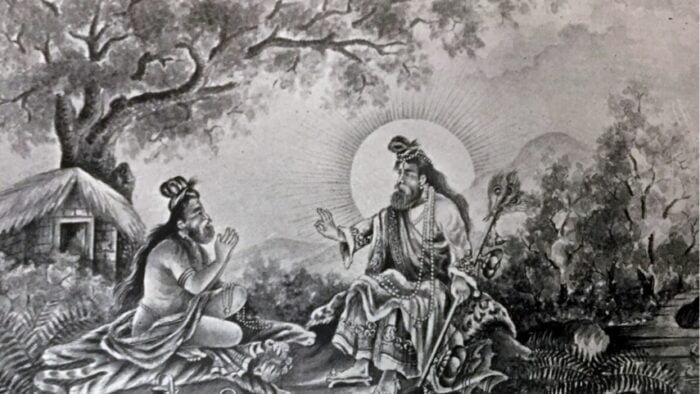
Two spiritual figures are especially prominent in the accounts of Sadguru Subrahmanyam’s development: Sri Veeraiah Garu and Tat Baba Garu, also remembered as Thatha Garu Swamy. Veeraiah Garu was Padmavatamma’s brother and therefore related to Subrahmanyam through marriage. Yet their relationship came to be understood in spiritual rather than merely familial terms. Veeraiah was associated with Sambhu Guru Swamy and with a regional lineage connected to Easwaramma, a descendant of the celebrated Siddha Pothuluri Veerabrahmendra Swamy.
Devotional accounts describe Veeraiah Garu as having received a radiant vision and mantra initiation near the Samadhi of Sambhu Guru Swamy. He subsequently became known among followers for spiritual insight, healing, and an ability to anticipate events. A famous narrative holds that skeptics challenged his claim of receiving guidance from a saint who had died centuries earlier. Sambhu Guru Swamy was then said to have appeared before those assembled. The episode cannot be treated as ordinary documentary evidence, but its theological meaning is clear: within the community’s understanding, the Guru’s presence was not limited by physical death.
Subrahmanyam recognized Veeraiah’s spiritual stature and received his blessing. Veeraiah reportedly predicted that Subrahmanyam’s first child would be a son and instructed that he be named after their Guru. The firstborn was accordingly called Sambhu Prasad. Veeraiah’s influence helped establish the devotional foundation upon which Subrahmanyam’s later non-dual teaching developed. This sequence is significant because it demonstrates that Bhakti and Jnana were not treated as opposing paths. Devotion purified intention, softened self-importance, and prepared the mind for insight into the nature of the Self.
Veeraiah Garu’s Samadhi at Surayapalem, near the temple of Sri Umameswara Swamy in Nellore district, remains associated with devotional remembrance. Within the Guru-Shishya Tradition, a Samadhi site is not merely a monument to the past. It serves as a focal point for gratitude, contemplation, and the perceived continuity of grace. The relationship between Veeraiah and Subrahmanyam therefore illustrates how lineage can operate through family ties, sacred geography, memory, and direct spiritual trust.
Thatha Garu Swamy and Discipline Beyond Convention
If Veeraiah Garu awakened devotional receptivity, Thatha Garu Swamy is remembered as the Guru who tested and refined it. Thatha Garu was an ascetic of Srikalahasti whose unconventional behavior resisted polished stereotypes of holiness. Accounts portray him as fiercely independent, compassionate, and indifferent to the social performance of sanctity. He revered his consort Nanamba, Lord Siva, Lord Subrahmanya, and Yogi Vemana. Traditions surrounding him also connect his devotional world with Shirdi Sai Baba, showing a spiritual outlook grounded in particular forms of worship yet open to saints beyond a single regional community.
Stories of Thatha Garu’s childhood describe early bereavement and renunciation. He was reportedly entrusted as an infant to a mendicant and later received ochre robes from that guardian. In old age, he remained vigorous and was remembered for habits that confounded conventional expectations of an ascetic. The deeper principle communicated by these memories is that renunciation cannot be judged solely through clothing, diet, or public demeanor. From the standpoint of Advaita Vedānta, freedom concerns the dissolution of possessiveness, compulsive desire, and egoic identity rather than conformity to an external image.
Thatha Garu subjected Subrahmanyam to demanding tests of patience and obedience. One remembered episode describes the Guru instructing him to read continuously from a book concerning Pothuluri Veerabrahmendra Swamy. The exercise continued for hours without any indication of when it would end. Subrahmanyam is said to have inwardly resolved that he would continue until instructed to stop. At that moment, the Guru ended the test. Within the narrative, the point is not supernatural mind-reading as spectacle. It is the disciple’s release of bargaining, resistance, and concern for personal comfort.
Another account states that Thatha Garu once bowed before Subrahmanyam. In a conventional hierarchy, a Guru bowing to a disciple appears paradoxical. Non-dual traditions interpret such gestures through the recognition that the same Self is present in both. The story consequently functions as a theological statement: spiritual maturity may remain concealed beneath social simplicity, and realized awareness is not owned by rank. It also discourages the disciple from construing realization as a personal possession, since the reverence is directed toward the Self rather than the individual ego.
Subrahmanyam’s relationship with Thatha Garu was defined by trust rather than intellectual negotiation. Preserved recollections emphasize that he followed the Guru’s instruction and regarded subsequent transformation as the operation of grace, not personal accomplishment. This understanding is central to Guru-bhakti. It does not require the suspension of ethical judgment in every modern relationship claiming spiritual authority. Rather, within an established and tested bond, it describes the gradual surrender of egoic defensiveness to disciplined guidance.
Accounts also describe Subrahmanyam undertaking a ninety-day fast under Thatha Garu’s direction, walking barefoot in intense heat and completing the austerity without public display. Such an episode belongs to the biographical history of a particular Guru-disciple relationship; it should not be treated as a general prescription. Prolonged fasting can present serious health risks and should never be imitated without qualified medical supervision. The spiritual meaning of the narrative lies in endurance, obedience, and freedom from self-advertisement, not in reproducing an extreme physical act.
Thatha Garu passed away on 18 October 1990. In accordance with his expressed wish, no Samadhi was constructed for him, and his remains were cremated beside the Swarnamukhi River. This choice is consistent with the freedom from institutional commemoration attributed to him. His influence nevertheless continued through the transformed lives of disciples, especially Sadguru Subrahmanyam. A lineage need not depend upon buildings or administrative structures when its essential transmission is carried through conduct, teaching, and memory.
Padmavatamma: The Often-Unseen Discipline of Guru Seva
Any comprehensive account of Sadguru Subrahmanyam must include Padmavatamma, or Vayyamma. Spiritual biographies have often concentrated on a recognized saint while overlooking the labor that made sustained practice possible. Padmavatamma maintained family life, cared for children, received visitors, and accommodated the unconventional demands associated with Thatha Garu. Devotees remember her patience, hospitality, cheerfulness, and willingness to serve without seeking recognition. Her life therefore broadens the meaning of sadhana beyond meditation and philosophical discourse.
Some traditional accounts describe difficult instructions being accepted as Guru leela: relatives might be turned away unexpectedly, while stray animals could be welcomed and cared for. Such actions may appear incomprehensible outside their specific context. Their remembered significance lies in Padmavatamma’s capacity to respond without resentment and to perceive service as an offering. Guru Seva, in this sense, is not passive subordination. It is a discipline through which preference, pride, and the demand for acknowledgment are repeatedly examined.
Padmavatamma passed away on 14 January 1999 with “Om Siva” remembered as her final utterance. Her body was laid to rest beside the Swarnamukhi River, where a small Samadhi Mandir became associated with daily worship. Sadguru Subrahmanyam interpreted her life as an example of liberation through sustained Guru Seva. Whether approached devotionally or historically, her story restores visibility to the spiritual contribution of a woman whose household labor, resilience, and faith supported an entire contemplative community.
Sri T.V.N. Babu and the Preservation of Living Memory
Sri T.V.N. Babu occupies a vital position in the preservation of Sadguru Subrahmanyam’s life and teaching. Babu’s family lived close to Subrahmanyam’s home, and his father was a friend of the teacher. Babu first encountered him in 1975 at approximately five years of age while accompanying Krishna Prasad, one of Subrahmanyam’s sons. These early recollections provide an intimate view of a spiritual presence encountered in ordinary neighborhood life rather than through a distant institution.
Babu remembered Subrahmanyam’s daily puja as simple and distinctive. Among the objects of reverence were a few sacred pictures, a walking stick associated with Veeraiah Garu, and an image bearing the word “Nēnu”, meaning “I.” The preserved staff functioned as more than memorabilia. In the ritual culture of Guru-bhakti, an object used by a revered teacher can become a material point of continuity between memory and practice. It directs attention not to the commercial value of a relic but to gratitude for the lineage it represents.
By 1988, Babu and his friend Devi Prasad had begun spending evenings with Sadguru Subrahmanyam. They listened to his observations, asked questions, practiced mantra, and sat with him in silence. These informal meetings gradually developed into the Sri Ramana Satsangs. Babu carefully recorded dialogues and teachings, referring to himself with humility as “Jnana Shishu,” the child of wisdom. His Telugu works associated with this living tradition include Sri Ramana Satsangalu, Jnana Prasnalulu, and Parama Vedam.
Other Telugu works associated with Sadguru Subrahmanyam’s teachings include Sadguru Hrudhayam, Sadguru Dharshanam, Gnana Prasoonalu, Ippudu Ikkada Ila, and Paramapadam. These texts preserve reflections, dialogues, and aphoristic teachings in the linguistic environment in which they were originally communicated. Their existence is important for regional intellectual history. Indian philosophy has never been transmitted through Sanskrit alone; Telugu and other vernacular languages have carried sophisticated teachings into homes, devotional circles, and local communities.
The Sri Ramana Satsangs
The Sri Ramana Satsangs began without elaborate organization. Participants gathered near Sadguru Subrahmanyam’s home and later met in a small room on Naikal Street. The meetings drew inspiration from Sri Ramana Maharshi and the discipline of Atma Vichara, or Self-enquiry. Their attraction lay less in ceremonial complexity than in direct conversation, quiet attention, and the experience of sitting with a teacher whose life appeared integrated with his instruction. Seekers came with questions about the mind, ego, devotion, sorrow, action, and the nature of lasting happiness.
Satsang literally indicates association with truth or with those committed to truth. In practice, it can include scriptural reading, questioning, chanting, meditation, and silence. The silence remembered in Sadguru Subrahmanyam’s gatherings was not simply the absence of speech. It functioned as a method of slowing habitual mental activity so that the seeker could observe thought rather than remain unconsciously driven by it. Words clarified the path; silence made room for direct examination.
The connection with Sri Ramana Maharshi is especially evident in the emphasis on turning attention toward the one who experiences. This inward movement does not reject temples, deities, mantras, or devotional practices. It asks what these practices ultimately reveal about consciousness. Outer forms can collect the distracted mind, cultivate reverence, and purify emotion. Self-enquiry then examines the identity of the worshipper. Bhakti and Jnana consequently become mutually reinforcing: devotion loosens egocentrism, while knowledge reveals the ground from which genuine devotion arises.
“Nēnu” and the Technical Meaning of Self-Enquiry
The Telugu word “Nēnu”, meaning “I,” stands at the center of the teaching associated with Sadguru Subrahmanyam. In ordinary life, the word “I” refers interchangeably to the body, personality, profession, family role, memory, opinion, and emotional state. Vedantic inquiry examines whether any of these changing attributes can constitute the final Self. The body changes from childhood to old age. Social roles appear and disappear. Thoughts, sensations, and moods continually arise and subside. Yet each change is known. Self-enquiry directs attention toward the awareness by which change is recognized.
This inquiry is not an attempt to produce a verbal answer to the question of identity. Repeating “I am consciousness” can remain another thought. The discipline instead traces the felt center of personal identity. When anger arises, it asks who knows the anger. When fear appears, it examines the one to whom fear appears. When pride claims an achievement, it investigates the claimant. The inquiry is therefore experiential and recursive: every object of awareness, including a thought about the Self, is recognized as something perceived.
Advaita Vedānta describes the ultimate Self, Atman, as non-different from Brahman, the foundational reality. This does not mean that the individual personality becomes cosmically powerful. It means that the deepest awareness is not a private object enclosed within the ego. Sadguru Subrahmanyam’s statement, “Everything, including myself, exists within me,” can be understood in this technical sense. The “me” is not the biographical individual claiming possession of the universe; it is consciousness as the field in which the experiences called self and world become known.
The distinction is crucial. Without it, non-dual language can be confused with grandiosity, denial of reality, or emotional dissociation. Authentic Self-enquiry does not justify neglecting duties, suppressing pain, or claiming superiority. If insight is genuine, it should weaken possessiveness and increase ethical sensitivity. The recognition of shared consciousness ought to deepen compassion because the rigid boundary between self-interest and the welfare of others becomes less absolute.
Action, Doership, and the Bhagavad Gita
Sadguru Subrahmanyam’s teaching on action aligns with a central theme of the Bhagavad Gita: freedom does not necessarily require the abandonment of activity. The deeper bondage lies in the egoic conviction that it is an isolated doer who controls action and owns every result. Renunciation of doership does not mean refusing responsibility. It means acting carefully while surrendering the demand that reality must conform to personal expectation.
This principle has immediate practical relevance. A teacher can prepare a lesson with diligence without making self-worth dependent on praise. A parent can care deeply for a child without treating the child as a possession. A professional can pursue excellence without allowing success or failure to define the whole person. The work still requires skill, accountability, and moral judgment. What is gradually released is the compulsive inner narrative that converts every event into proof of personal triumph or humiliation.
Such freedom is not passivity. It often enables more intelligent action because attention is no longer consumed by anxiety about status. When the sense of doership softens, mistakes can be corrected without total self-condemnation, and success can be received without arrogance. Sadguru Subrahmanyam’s own life as a teacher and householder illustrates this integration of contemplation and action. Self-Realization is presented not as an alternative to Dharma but as the clarity through which Dharma can be performed without psychological enslavement.
The Transformative Role of Silence
Visitors to Sadguru Subrahmanyam frequently emphasize silence and peace rather than dramatic instruction. Silence has a precise function in contemplative traditions. Ordinary consciousness is often crowded by rehearsal, comparison, prediction, resentment, and self-defense. In the presence of a person who does not continually reinforce these patterns, the mind may briefly stop feeding them. This pause can be experienced as relief, but its deeper value lies in revealing that awareness remains present even when the usual commentary becomes quiet.
The traditional idea of silent transmission should not be used to place any spiritual teacher beyond ethical scrutiny. It is better understood phenomenologically: posture, attention, emotional regulation, and freedom from self-display can communicate forms of understanding that propositions alone cannot convey. A calm person can make another person aware of previously unnoticed agitation. In this sense, presence becomes pedagogical. Sadguru Subrahmanyam’s quiet manner is remembered as teaching because it offered seekers an embodied example of the inward steadiness they wished to cultivate.
Animals, Sacred Memory, and Hagiographical Symbolism
Some recollections surrounding Sadguru Subrahmanyam describe unusual interactions with animals, including pigeons gathering near him and a goat repeatedly approaching and gazing at him. Such episodes are familiar within Indian sacred biography, where animals may symbolize innocence, receptivity, or the wider reach of spiritual harmony. They should not be exaggerated into scientific claims. Their value lies in the community’s perception that compassion and stillness are not restricted to human social boundaries.
This symbolism also supports a broader Dharmic ethic. Hindu, Buddhist, Jain, and Sikh traditions differ in doctrine and practice, yet all contain powerful resources for compassion, restraint, service, and respect for life. Jain ahimsa, Buddhist karuna, Hindu recognition of the divine presence throughout existence, and Sikh seva each resist the reduction of spirituality to private belief. The stories associated with Sadguru Subrahmanyam can therefore be read as invitations to cultivate gentleness toward the entire living world.
A Living Example of Dharmic Unity
Sadguru Subrahmanyam belongs specifically to a Hindu spiritual environment shaped by Shaiva sacred geography, Advaita Vedānta, Guru-bhakti, mantra, and the influence of Sri Ramana Maharshi. Respecting that specificity is essential. Dharmic unity does not require collapsing Hinduism, Buddhism, Jainism, and Sikhism into a single doctrine. Their understandings of Self, no-self, liberation, divine reality, scripture, and authority remain distinct. Unity is better grounded in respectful dialogue and the recognition of shared ethical disciplines.
His life nevertheless offers principles that can be understood across these traditions: humility is more valuable than spiritual display; disciplined awareness is necessary for freedom; service can purify self-centeredness; compassion must accompany insight; and liberation requires a transformation in the way identity is experienced. These common concerns create space for solidarity without erasing philosophical difference. Such an approach strengthens the Dharmic family by allowing each tradition to contribute its distinctive wisdom.
Practical Lessons for Contemporary Seekers
Sadguru Subrahmanyam’s life suggests a practical sequence for seekers living amid work and family obligations. The first step is regularity: a short period of daily silence practiced consistently is more transformative than occasional intensity. The second is observation: thoughts and emotions can be noticed before they are converted into speech or action. The third is Self-enquiry: the changing experience is examined together with the sense of “I” claiming it. The fourth is service: insight is tested through patience, honesty, and care for others. The fifth is surrender: results are accepted without abandoning responsible effort.
These disciplines can be incorporated into ordinary life without theatrical gestures. Before responding during a conflict, a person can observe the injured identity demanding immediate victory. While completing routine work, attention can return to the task instead of feeding resentment. When praised, the mind’s urge to build a permanent identity from approval can be noticed. When criticized, the difference between useful correction and wounded pride can be examined. Such moments turn everyday life into a field of Atma Vichara.
The goal is not emotional perfection. Grief, anger, fatigue, and uncertainty remain part of embodied life. The discipline lies in refusing to define the whole Self through a temporary state. This distinction can create psychological space without denying experience. It allows pain to be acknowledged, appropriate help to be sought, and ethical action to continue. Spiritual practice complements rather than replaces medical or mental-health care when such support is needed.
Guru devotion must likewise be joined with discernment. Traditional accounts celebrate Subrahmanyam’s complete trust in tested spiritual guides, but contemporary seekers should distinguish an authentic relationship from manipulation. A trustworthy teacher does not exploit fear, demand secrecy around misconduct, encourage dependency for personal gain, or place charisma above Dharma. The clearest evidence of sound guidance is not spectacle but the growth of humility, responsibility, clarity, and compassion in the disciple.
The Continuing Legacy of Srikalahasti’s Quiet Teacher
Sadguru Subrahmanyam’s legacy continues through satsangs, meditation, Telugu texts, the records preserved by Sri T.V.N. Babu, and the memories of those who have sat with him. His influence demonstrates the importance of regional spiritual cultures that may remain largely invisible to national or international audiences. A modest room, a neighborhood gathering, a vernacular conversation, or a period of shared silence can preserve philosophical depth as effectively as a major institution.
His life also protects Self-Realization from abstraction. Advaita can easily become an intellectual system discussed without altering conduct. Sadguru Subrahmanyam’s example returns attention to the qualities by which understanding becomes visible: simplicity, steadiness, service, absence of self-promotion, reverence for the Guru, and care within household life. These qualities do not prove metaphysical realization in a scientific sense, but they provide the ethical context in which claims of realization become meaningful.
The image of a retired teacher sitting quietly beneath a tree is therefore more than a picturesque detail. It represents a radical alternative to cultures of constant performance. No spiritual brand is required, no spectacle is staged, and no distance is created between wisdom and ordinary life. The seeker is directed back toward the most immediate yet difficult question: what is the “I” present before every role, thought, memory, and desire?
Sadguru Subrahmanyam’s enduring lesson is that the Supreme Self is not acquired as another possession. It is recognized when identification with the restless, defensive, and appropriating ego begins to loosen. Family life need not prevent this recognition; work need not prevent it; and the diversity of Dharmic traditions need not prevent mutual reverence. Through silence, Guru Seva, disciplined inquiry, and compassionate action, ordinary life itself can become a doorway to inner freedom.
This profile is based on the biographical and devotional material presented in “Sadguru Subrahmanyam: The Light of Supreme Self-Realization,” published by Indica Today on July 7, 2026, together with related accounts of his teachings and satsangs. Miraculous narratives have been identified as matters of devotional testimony rather than independently verified historical events.
Inspired by this post on Hindu Post.







Leave a Reply
You must be logged in to post a comment.