
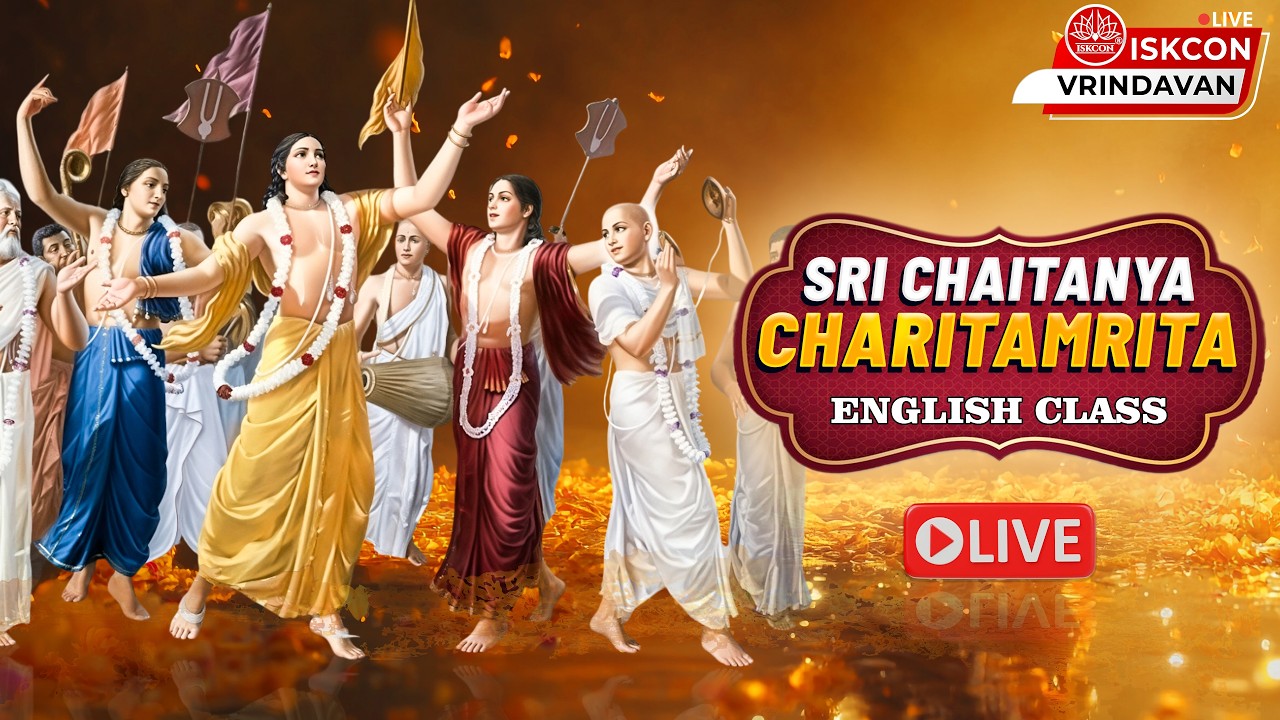
His Grace Deena Bhandu Prabhu’s class on Śrī Caitanya-caritāmṛta, Ādi-līlā 5.43, delivered through ISKCON Vrindavan on 29-06-2026, centers on a compact but theologically rich statement about spiritual energy, pure existence, and the nature of Vaikuṇṭha. The verse belongs to the fifth chapter of Ādi-līlā, traditionally known for glorifying Lord Nityānanda Balarāma and for explaining the ontological place of Mahā-saṅkarṣaṇa within Gauḍīya Vaiṣṇava theology.
The verse reads: চিচ্ছক্তি–বিলাস এক—‘শুদ্ধসত্ত্ব’ নাম । শুদ্ধসত্ত্বময় যত বৈকুণ্ঠাদি–ধাম ॥ ৪৩ ॥
Its transliteration is: cic-chakti-vilāsa eka — ‘śuddha-sattva’ nāma śuddha-sattva-maya yata vaikuṇṭhādi-dhāma
The central teaching is that one manifestation of the Lord’s spiritual energy is known as śuddha-sattva, or pure spiritual existence, and that all Vaikuṇṭha abodes are composed of that reality. This is not merely a poetic description of heaven, nor a sentimental image of a distant sacred realm. In Gauḍīya Vaiṣṇava thought, it is a precise metaphysical claim: the spiritual world is not made of refined matter, psychological projection, or moral imagination. It is constituted of pure consciousness, pure being, and pure devotional reality.
The phrase cic-chakti is especially important. Cit means consciousness or spirit, and śakti means energy or potency. Together, the term indicates the Lord’s internal spiritual potency, distinct from material energy and from the marginal potency of the living beings. In this framework, reality is not reduced to matter alone. Consciousness is not treated as a late accident of chemical complexity. Rather, consciousness is fundamental, and the highest domain of existence is the domain in which consciousness is fully purified, fully relational, and fully centered upon the Supreme.
The term vilāsa, often translated as pastime, expansion, or manifestation, adds a devotional dimension to the metaphysics. The spiritual energy is not inert. It is dynamic, expressive, and relational. In the Vaiṣṇava understanding, ultimate reality is not a silent abstraction without qualities, relationships, or affection. It is filled with form, service, beauty, personality, and loving exchange. This is why the verse can speak of Vaikuṇṭha not simply as a location but as a manifestation of spiritual energy.
Śuddha-sattva requires careful distinction from ordinary sattva-guṇa. In the Bhagavad-gītā and broader Hindu philosophical vocabulary, sattva is one of the three material qualities, alongside rajas and tamas. Material sattva is associated with clarity, harmony, knowledge, and restraint, yet it remains within material nature. Śuddha-sattva, by contrast, is not merely goodness within the world; it is pure goodness beyond material contamination. This distinction prevents a common misunderstanding: spiritual purity is not just ethical refinement, intellectual calm, or pleasant temperament. It is a transformed mode of being rooted in spiritual reality.
For a practitioner, this distinction carries practical significance. A person may cultivate discipline, study scriptures, practice kindness, and live with moderation, yet still be operating within the field of material identity if the center remains ego, prestige, fear, or subtle self-importance. Śuddha-sattva points toward a deeper reorientation, where life becomes transparent to devotion. In that sense, the verse speaks not only about Vaikuṇṭha but also about the aspiration of sādhana: to allow consciousness to be cleansed of possessiveness and restored to its natural relation with the Divine.
Within the immediate sequence of Ādi-līlā chapter five, verse 5.42 identifies Mahā-saṅkarṣaṇa as the shelter of the spiritual potency and the cause of all causes. Verse 5.43 then explains the nature of one manifestation of that spiritual potency as śuddha-sattva. Verse 5.44 continues by stating that the six opulences in that realm are spiritual manifestations of Saṅkarṣaṇa. This sequence gives the verse its technical force. It is not isolated devotional imagery; it is part of a systematic explanation of divine expansion, spiritual potency, and the structure of transcendental existence.
The six opulences traditionally associated with Bhagavān are wealth, strength, fame, beauty, knowledge, and renunciation. In the material world these qualities are often fragmented and unstable. Wealth may create anxiety, strength may produce domination, fame may distort character, beauty may fade, knowledge may inflate pride, and renunciation may become performance. In Vaikuṇṭha, however, such opulences are described as spiritual. They are not instruments of ego; they are expressions of divine fullness. This transforms the meaning of greatness itself.
This is one reason the verse has enduring relevance. Modern life often trains people to admire power without purification, intelligence without humility, productivity without inner clarity, and influence without service. The doctrine of śuddha-sattva challenges that assumption. It suggests that the highest excellence is not merely capability, but purified capability; not merely knowledge, but knowledge in service of truth; not merely beauty, but beauty free from exploitation; not merely authority, but authority anchored in compassion and dharma.
ISKCON Vrindavan is a fitting setting for such a reflection because Vrindavan itself is central to Gauḍīya Vaiṣṇava sacred geography. The tradition does not treat sacred space as a cultural ornament alone. Sacred geography becomes a theological language through which devotees learn to perceive reality differently. The land of Vraja, the worship of Krishna and Balarāma, the chanting of the holy names, and the study of Śrī Caitanya-caritāmṛta all work together to train consciousness toward remembrance, humility, and loving service.
The mention of Vaikuṇṭha also invites a broader reflection on unity within dharmic traditions. Hinduism, Buddhism, Jainism, and Sikhism differ in metaphysical vocabulary, ritual structure, and theological emphasis, yet they share a serious concern with purification of consciousness, liberation from ego-centered bondage, discipline of the senses, ethical living, and reverence for a reality higher than ordinary consumption. In this setting, śuddha-sattva can be appreciated as a Vaiṣṇava articulation of a wider dharmic intuition: the human being is not complete when governed by impulse, pride, fear, and forgetfulness.
From an academic perspective, Śrī Caitanya-caritāmṛta is both a devotional text and a theological synthesis. It presents the life and teachings of Śrī Caitanya Mahāprabhu while also consolidating the metaphysics of Gauḍīya Vaiṣṇavism. Ādi-līlā establishes foundational categories: the identities of Śrī Caitanya and Nityānanda, the expansions of the Divine, the energies of the Lord, the nature of bhakti, and the place of the living being. Verse 5.43 belongs to this architecture of thought.
The verse also clarifies that the spiritual world is not merely a negation of suffering. Vaikuṇṭha literally suggests a realm free from anxiety, but the tradition does not define it only by what is absent. It is full of positive spiritual content: service, beauty, knowledge, relationship, and divine presence. This matters because many spiritual seekers initially approach religion as relief from distress. That beginning is understandable, but the verse points beyond relief toward participation in a higher reality.
A listener approaching this teaching may find it emotionally resonant because ordinary life often feels mixed: moments of goodness are interrupted by fatigue, comparison, disappointment, and distraction. Even noble intentions can become clouded by insecurity or the need for recognition. The idea of śuddha-sattva gives language to a longing many people carry quietly: the longing for a state of being in which goodness is no longer fragile, love is no longer transactional, and consciousness is no longer pulled apart by competing demands.
At the same time, the teaching should not be reduced to psychology. Gauḍīya Vaiṣṇavism does not present Vaikuṇṭha merely as an inner mood. Inner transformation matters, but it is grounded in an objective spiritual reality. The purified heart becomes capable of perceiving and serving that reality. Thus the movement is both inward and upward: inward through purification of consciousness, upward through surrender to the Supreme Person.
This balance between doctrine and practice is central to bhakti. Philosophy without practice can become dry speculation. Practice without philosophy can become routine or sentimentality. A verse such as CC Ādi-līlā 5.43 protects both sides. It gives practitioners a metaphysical map while reminding them that the goal is not intellectual mastery alone. The goal is purified consciousness, devotional service, and loving alignment with Krishna.
His Grace Deena Bhandu Prabhu’s teaching tradition is associated with making such scriptural topics accessible to devotees and seekers. The value of a class on a single verse lies in slowing down the reading process. Rather than rushing through scripture as information, the listener is invited to dwell on each term, each theological connection, and each practical implication. In a culture of speed, such careful hearing becomes a form of discipline.
The verse also raises an important question about what counts as reality. Material perception treats the visible and measurable as primary. The Gauḍīya Vaiṣṇava framework reverses that hierarchy. The spiritual is not less real because it is subtle; it is more real because it is not subject to decay, ignorance, and material limitation. Vaikuṇṭha is therefore not an imaginary compensation for worldly suffering but a higher order of existence in which the Lord’s internal potency is fully manifest.
In practical devotional life, the path toward purified consciousness is cultivated through hearing, chanting, remembrance, worship, service, study, association with sādhus, and honoring prasadam. These practices are not random religious habits. They are disciplines designed to gradually loosen the grip of material conditioning and awaken the soul’s natural relationship with Krishna. When connected to the doctrine of śuddha-sattva, everyday devotional practice gains a clear philosophical purpose.
The verse’s emphasis on spiritual energy also protects against reductionist interpretations of religion. Temples, images, mantras, sacred texts, and devotional communities are sometimes viewed externally, as cultural artifacts or social formations. While they certainly have cultural and historical dimensions, Gauḍīya Vaiṣṇava theology sees them as potential channels of divine energy when approached with proper understanding and devotion. The external form becomes spiritually meaningful when connected with cit-śakti.
This has implications for temple culture and community life. A temple is not meant to be only an architectural structure, a social center, or a heritage marker. Ideally, it becomes a place where consciousness is refined, service is organized, knowledge is transmitted, and divine remembrance is strengthened. The more a community aligns itself with humility, purity, compassion, and scriptural integrity, the more it reflects the principle of śuddha-sattva in lived form.
There is also a strong ethical dimension. If the spiritual world is constituted of pure goodness, then spiritual aspiration cannot be separated from character. One cannot genuinely contemplate Vaikuṇṭha while cultivating cruelty, arrogance, sectarian hatred, or indifference to suffering. The dharmic ideal calls for firmness in truth and gentleness in conduct. This is especially important in inter-tradition dialogue, where clarity of conviction should coexist with respect for sincere seekers across Hindu, Buddhist, Jain, and Sikh paths.
The unity of dharmic traditions does not require erasing differences. Gauḍīya Vaiṣṇavism has its own theological identity, centered on Krishna, Śrī Caitanya Mahāprabhu, Nityānanda Prabhu, bhakti, nāma-saṅkīrtana, and the teachings of the Gosvāmīs. Respectful unity means presenting these teachings with confidence while recognizing the shared civilizational commitment to self-discipline, liberation, truthfulness, compassion, and transcendence. In that spirit, CC Ādi-līlā 5.43 can be studied as a Vaiṣṇava jewel within the larger treasury of Sanatana Dharma.
The verse is also relevant for contemporary spiritual education. Many modern readers encounter Sanskrit and Bengali theological terms as unfamiliar vocabulary. Yet these terms carry conceptual precision that is often lost in simplified translation. Śuddha-sattva, cit-śakti, Vaikuṇṭha, and Mahā-saṅkarṣaṇa are not decorative words. They name categories of reality. Serious study requires preserving them, explaining them, and allowing their meanings to reshape the reader’s assumptions.
A key lesson of this verse is that purification is not emptiness. Sometimes renunciation is misunderstood as the rejection of life, emotion, beauty, and relationship. The Vaikuṇṭha vision corrects that error. The spiritual realm is not void of qualities; it is full of purified qualities. It is not loveless transcendence; it is love without material distortion. It is not the destruction of individuality; it is individuality perfected in service.
This teaching can help practitioners examine their own motivations. Are devotional acts performed for recognition, belonging, fear, habit, or genuine service? Such questions need not create discouragement. They can create honesty. The journey toward śuddha-sattva is gradual, and the tradition repeatedly emphasizes mercy, association, and sincere effort. The point is not to pretend purity but to move toward it through humble practice.
The class title’s association with CC Ādi-līlā 5.43 therefore opens a much wider field of reflection. It invites study of Lord Nityānanda Balarāma, Mahā-saṅkarṣaṇa, the internal potency, the nature of Vaikuṇṭha, and the purified condition of consciousness. It also invites a practical question: how can daily life become less governed by the restless mixture of material qualities and more influenced by clarity, devotion, and service?
The answer offered by the bhakti tradition is both simple and demanding. One hears sacred wisdom, chants the holy names, serves with humility, honors the Vaiṣṇavas, studies śāstra, and gradually allows the heart to be cleansed. This process does not deny the world’s difficulties. It gives the practitioner a way to live through them without surrendering consciousness to cynicism, distraction, or despair.
In conclusion, CC Ādi-līlā 5.43 is a brief verse with significant theological depth. It teaches that the Vaikuṇṭha realms are manifestations of the Lord’s spiritual energy known as śuddha-sattva. It distinguishes pure spiritual existence from material goodness, connects Vaikuṇṭha with Mahā-saṅkarṣaṇa’s divine shelter, and gives practitioners a vision of consciousness purified through bhakti. For students of Caitanya Caritamrita, ISKCON, Vrindavan, and Gauḍīya Vaiṣṇava philosophy, the verse offers both metaphysical clarity and a practical standard for spiritual life.
Primary textual source consulted: Śrī Caitanya-caritāmṛta Ādi-līlā 5.43. Contextual verses consulted: CC Ādi 5.42, CC Ādi 5.44, and CC Ādi 5.45.
Inspired by this post on Dandavats.







Leave a Reply
You must be logged in to post a comment.