
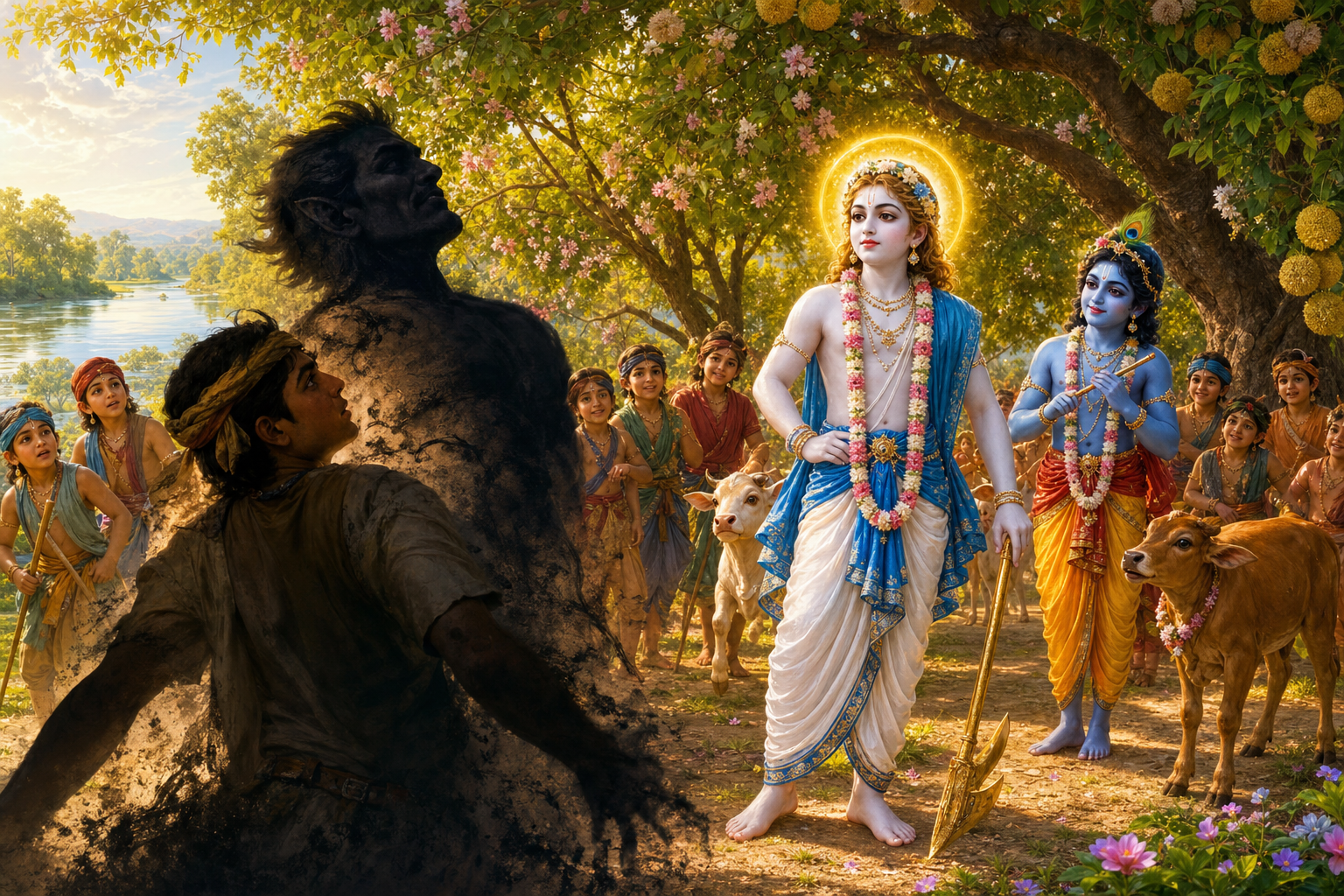
The story of Balarama and the demon Pralamba belongs to the Vrindavan cycle of Krishna narratives preserved most famously in the Bhagavata Purana, especially in the account of Krishna and Balarama’s cowherd life among the gopas. At first glance, it appears to be a vivid childhood adventure: boys divide into teams, play in the forest, carry one another on their shoulders, and one disguised intruder is exposed. Yet the episode is far more than a charming pastoral tale. It presents Balarama as the guardian of dharma, Krishna as the master of divine play, and Vrindavan as a sacred landscape where ordinary village life becomes a theater of spiritual revelation.
Vrindavan in the Bhagavata tradition is not merely a geographical setting. Its forests, riverbanks, groves, grazing lands, and footpaths are described as places where divine reality becomes intimate, playful, and approachable. Krishna and Balarama, though revered as supreme and divine figures in Vaishnava theology, move among cowherd children with complete naturalness. They run, laugh, wrestle, sing, eat with friends, imitate animals, and tend calves and cows. This fusion of divinity and village simplicity is one of the most distinctive features of Krishna bhakti.
Balarama occupies a special place in this world. He is Krishna’s elder brother, born to Vasudeva and Rohini and raised in the household of Nanda and Yashoda. His names reveal his theological depth: Balarama suggests strength and delight, Sankarshana indicates divine attraction and connection, and Haladhara, the bearer of the plough, links him with agriculture, stability, nourishment, and the ordering of the earth. In many Vaishnava traditions, Balarama is understood as the first expansion of Krishna and the source of spiritual strength that supports devotion itself.
The demon Pralamba enters this sacred landscape through deception. He does not arrive openly as an enemy with weapons raised. Instead, he assumes the appearance of a cowherd boy and joins the company of Krishna, Balarama, and their friends. This detail is central to the meaning of the story. Pralamba represents concealed hostility, the kind of threat that does not challenge dharma directly but imitates innocence in order to penetrate a trusting community.
The boys are engaged in play, and Krishna, fully aware of Pralamba’s intention, allows the drama to unfold. The game described in the tradition involves two groups of cowherd boys competing with one another. Those who lose must carry the winners on their shoulders. Krishna leads one side, while Balarama is placed with another group. Pralamba, intending to abduct Balarama, arranges matters so that he must carry him away after the contest.
This playful structure is important. The danger does not interrupt the world of lila; it becomes part of it. In the Bhagavata vision, divine play does not deny the existence of evil, fear, or conflict. Rather, it reveals that even threat and deception can be transformed into occasions for the manifestation of wisdom, courage, and divine protection. Krishna permits Pralamba to act, but only within limits already governed by divine knowledge.
Pralamba lifts Balarama onto his shoulders and begins moving away from the other cowherd boys. As he carries Balarama farther from the play area, his true nature begins to emerge. The charming disguise can no longer hold. The cowherd form gives way to a terrifying demonic appearance: vast body, blazing presence, and destructive intention. The false companion is revealed as an enemy of the community.
Balarama, however, is not deceived in any ultimate sense. The narrative emphasizes that Pralamba underestimated the one he tried to carry away. What seemed to the demon like an opportunity became his undoing. Balarama’s body became unbearably heavy, signifying not only physical strength but spiritual gravity. Adharma may imitate friendship, but it cannot bear the weight of truth for long.
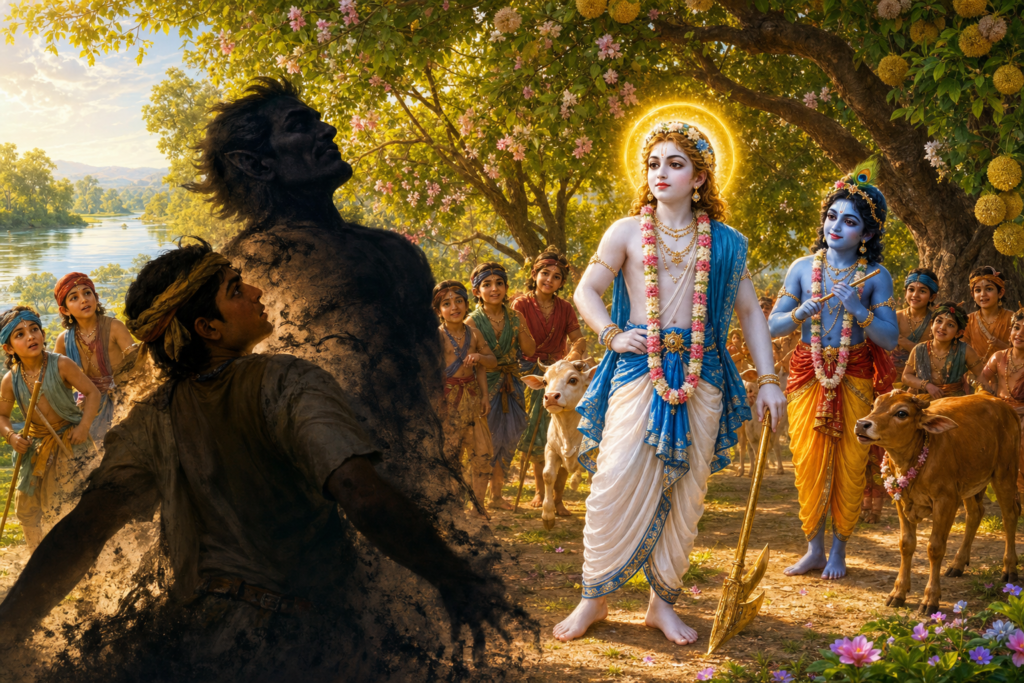
When Pralamba reveals himself fully, Balarama responds with decisive force. He strikes the demon on the head with his fist, a blow compared in traditional retellings to the force of Indra’s thunderbolt. Pralamba collapses, his deception shattered and his violence ended. The cowherd boys, witnessing Balarama’s victory, rejoice in amazement and affection. Their friend and protector has destroyed the danger that had entered their midst.
The episode is often called Pralambasura-vadha, the slaying of Pralambasura. The Sanskrit suffix asura identifies Pralamba as a being opposed to divine order, while vadha marks the act of destruction or killing. Yet the story is not only about physical conquest. It is also about discernment, the exposure of false appearance, and the restoration of trust within a sacred community.
In literary terms, the story works through contrast. The pastoral beauty of Vrindavan is placed beside the hidden violence of Pralamba. The innocence of childhood play is placed beside calculated deception. Balarama’s calm strength is placed beside Pralamba’s restless cunning. The result is a compact but powerful moral drama in which the simplicity of dharmic life proves stronger than the sophistication of deceit.
Balarama’s role is especially significant because he does not merely assist Krishna in this episode; he is the central heroic figure. Krishna recognizes the danger and allows events to move toward revelation, but Balarama delivers the decisive blow. This affirms Balarama’s independent majesty within Krishna tradition. He is not a secondary ornament to Krishna’s life but a divine protector whose strength preserves the conditions in which love, play, and devotion can flourish.
Theologically, Balarama’s strength is not brute force. It is ordered strength, dharmic strength, and protective strength. His power is exercised only when deception becomes harmful and when innocence is threatened. This distinction matters. Hindu scriptures frequently distinguish between violence born of anger, greed, or domination and force used to protect dharma, community, and the vulnerable. Balarama’s action belongs to the latter category.
The story also illuminates the meaning of divine childhood in Hindu sacred literature. Krishna and Balarama are children in form, but their actions reveal cosmic authority. The child form does not reduce divinity; it makes divinity intimate. The cowherd setting does not diminish theological depth; it brings sacred truth into familiar human experience. A game among boys becomes a lesson on vigilance, courage, and the hidden presence of the divine in ordinary life.
Pralamba’s disguise as a cowherd boy offers a subtle social teaching. Communities are sustained by trust, but trust also requires discernment. Vrindavan’s cowherd society is marked by affection, shared labor, music, food, and collective care. Pralamba attempts to exploit that openness. The narrative therefore does not teach suspicion as a way of life; it teaches that innocence must be protected by wisdom.
This point has enduring relevance. In everyday experience, harmful intentions rarely announce themselves in dramatic form. They often appear through flattery, imitation, manipulation, or false familiarity. The story of Pralamba gives symbolic language to a common human reality: not every friendly appearance is rooted in friendship, and not every participant in a sacred or social space honors its values.
At the same time, the tale avoids cynicism. The center of the episode is not fear of betrayal but confidence in divine protection. The cowherd boys continue to play, rejoice, and remain close to Krishna and Balarama. Their world is not permanently darkened by Pralamba’s intrusion. In this sense, the Bhagavata Purana preserves a hopeful vision: adharma may enter, but it does not define the sacred community.
The emotional power of the story lies in its familiarity. Many people understand the shock of discovering that something trusted was not what it appeared to be. The experience can unsettle the heart and make simplicity seem naive. Balarama’s victory offers another possibility. Trust need not be abandoned; it must be joined with strength, clarity, and devotion. This is one reason the episode continues to speak across generations.
Within the broader Krishna narrative, Pralamba is one among several hostile figures sent or inspired by Kamsa’s fear of Krishna. Demons such as Putana, Trinavarta, Vatsasura, Bakasura, Aghasura, and Pralamba appear in different forms, each embodying a distinct distortion: poisoned affection, pride, animalistic cunning, predatory violence, suffocating danger, or concealed malice. The Vrindavan stories therefore function not only as miracles but also as symbolic studies of the obstacles that threaten spiritual life.
Pralamba’s particular symbolism is deception through assimilation. Unlike an enemy who attacks from outside, he enters by appearing to belong. This makes Balarama’s discernment essential. His response suggests that dharma is not merely defended at borders; it is also protected within relationships, institutions, habits, and intentions. The purification of the inner field is as important as the defense of the outer field.
The setting among cowherds also deserves attention. Cattle culture in the Krishna tradition is associated with nourishment, mutual dependence, ecological rhythm, and rural sacredness. The cowherd life of Vrindavan is not presented as primitive or insignificant. It is idealized as a life of intimacy with nature, community, and divine presence. By entering this world in disguise, Pralamba threatens not only individuals but a whole pattern of harmonious living.
Balarama’s association with the plough deepens this interpretation. The plough prepares the field, turns the soil, and makes cultivation possible. Symbolically, Balarama prepares the ground of spiritual life. He clears obstruction, gives steadiness, and supports growth. The destruction of Pralamba can therefore be read as the removal of a hidden obstruction from the field of Vrindavan’s devotion.
In Vaishnava devotional understanding, Balarama is also associated with guru-tattva, the principle of spiritual guidance and strength. This does not mean the episode should be reduced to a single allegory, but the connection is meaningful. A genuine guide exposes deception, strengthens the seeker, and protects the path of devotion from forces that imitate spirituality while undermining it. Balarama’s blow against Pralamba becomes a symbol of truth striking illusion at its root.
The literary beauty of the episode also lies in the way it preserves the innocence of the boys. The cowherd companions do not become philosophers in the middle of the story. They react as children and friends would react: with astonishment, relief, admiration, and love. This emotional realism allows the narrative to remain accessible even while carrying profound theological meaning. It is a sacred story that does not lose its human warmth.
For readers of Hindu Stories, the tale of Balarama and Pralamba is a reminder that the Puranic imagination often teaches through layered narrative rather than abstract doctrine alone. A forest game becomes theology. A demon’s disguise becomes moral psychology. A fist-blow becomes the triumph of dharma. A group of village boys becomes the audience for divine revelation. This is why such stories endure in oral recitation, temple discourse, children’s teaching, classical commentary, and devotional reflection.
The story also supports a broader dharmic principle shared across Hindu, Buddhist, Jain, and Sikh ethical traditions: outward appearance is less important than inner intention and conduct. Dharma is recognized through truthfulness, self-control, compassion, courage, and alignment with the good. Pralamba fails because his outer form and inner motive are divided. Balarama prevails because his strength is integrated with clarity and righteousness.
In academic reading, it is useful to observe how the Bhagavata Purana uses play as a mode of revelation. Lila does not mean trivial amusement. It indicates divine freedom, the spontaneous expression of the sacred without compulsion or lack. Krishna and Balarama do not act because they are bound by necessity. They act out of fullness. Their play reveals that the highest reality can be joyful, relational, and intimate rather than distant and abstract.
This understanding of lila transforms the meaning of the Pralamba episode. The demon believes he has entered a vulnerable space because the boys are playing. In truth, he has entered the field of divine play, where his deception is already known and his defeat is certain. What appears to be casual childhood recreation is, from the theological perspective of the Bhagavata Purana, a manifestation of divine sovereignty.
Balarama’s heaviness on Pralamba’s shoulders is one of the most striking symbolic details. The demon can carry the appearance of Balarama for a short distance, but he cannot carry Balarama’s reality. This distinction is spiritually rich. Falsehood can mimic language, dress, role, or relationship, but it cannot sustain the weight of truth. The moment truth becomes fully present, deception loses balance.
The cowherd boys’ celebration after Pralamba’s fall also matters. They do not respond with hatred as a permanent emotion. Their joy is rooted in the restoration of safety and the recognition of Balarama’s greatness. The mood returns to devotion and companionship. This emphasis is important for a dharmic reading: the defeat of adharma is not an invitation to cruelty; it is the clearing away of harm so that harmony may continue.
From a cultural perspective, the story has helped shape the devotional memory of Balarama as a figure of strength, loyalty, elder-brotherly protection, and agricultural rootedness. In temple images, festivals, kirtan, and storytelling, Balarama often stands beside Krishna as both companion and protector. His presence reassures devotees that divine love is not fragile. It is guarded by strength that is calm, direct, and righteous.
The story of Balarama and Pralamba therefore should not be read only as a mythic battle. It is a study in the protection of sacred trust. It teaches that play and seriousness are not opposites in the divine world, that innocence and discernment must live together, and that strength becomes sacred when it serves the preservation of dharma. In the groves of Vrindavan, the cowherd who could not be fooled reveals that truth may appear gentle, but it is never weak.
For contemporary readers, the enduring value of the episode lies in its balanced wisdom. It does not recommend fearfulness, isolation, or suspicion. It recommends alertness rooted in devotion. It honors community without ignoring the possibility of deception. It celebrates strength without glorifying aggression. Above all, it presents Balarama as the divine force that steadies the heart, protects the innocent, and exposes what cannot survive in the presence of truth.
Inspired by this post on Hindu Blog.





Leave a Reply
You must be logged in to post a comment.