
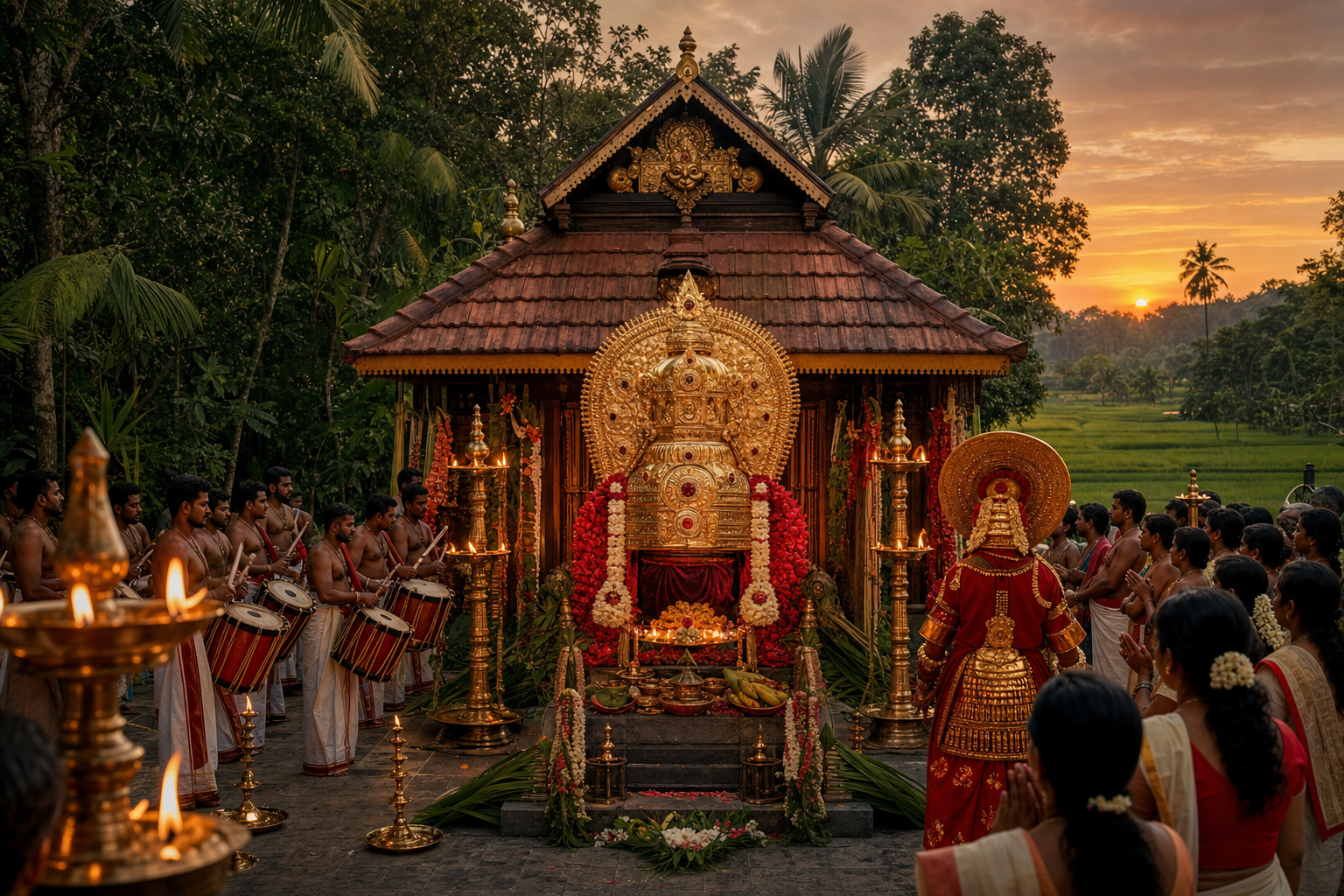
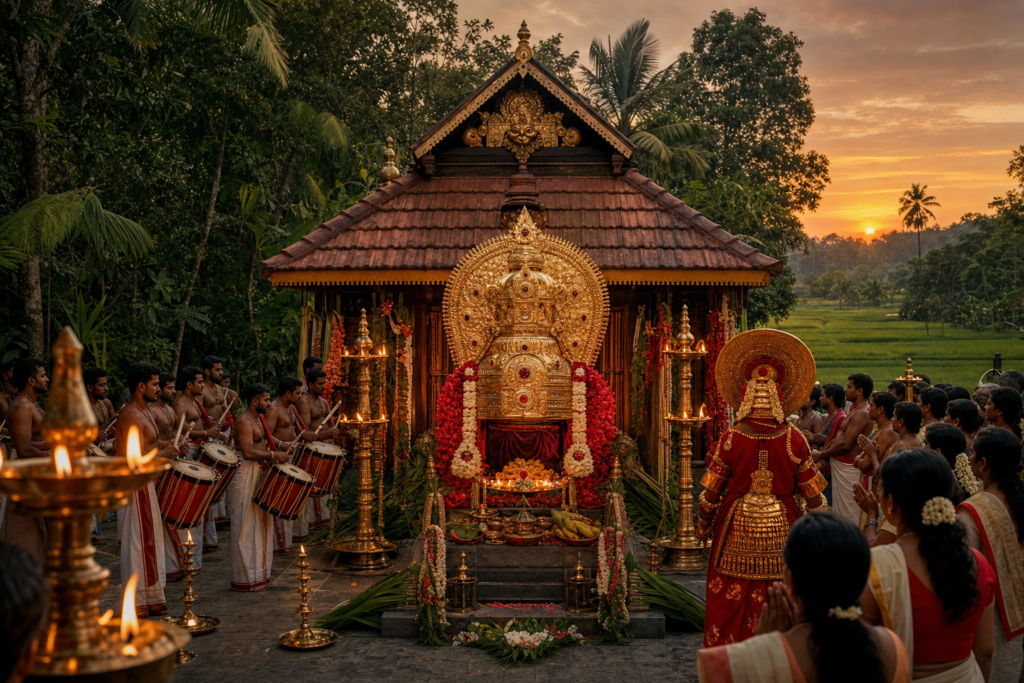
Thirumudi and Mudippura in southern Kerala: The Mudippura tradition belongs to one of the most distinctive streams of Kerala temple culture, especially in the southern districts of Thiruvananthapuram and Kollam. A Mudippura is commonly understood as the sacred house of the Mudi or Thirumudi, the consecrated crown, head-form, or visible emblem through which Bhadrakali is invoked, adored, carried, and encountered by devotees. In ordinary language, mudi can mean hair or head, while in this ritual setting Thirumudi becomes something far more powerful: the auspicious, sanctified presence of the Goddess herself.
The importance of this tradition lies in the fact that the Goddess is not treated merely as an image enclosed in a shrine. In many Mudippura contexts, Bhadrakali is experienced as a living force who can move through the village, receive offerings, search out disorder, bless households, and restore moral balance. The temple is therefore not only a built structure; it becomes a social, ritual, and emotional centre where memory, protection, agriculture, kinship, and devotion come together.
The sacred meaning of Thirumudi: The Thirumudi is often described as a crown, but the word crown alone does not capture its ritual depth. It is the decorated and consecrated form through which Devi’s presence is made visible. In some temples, such as the famous Vellayani Devi Temple near Thiruvananthapuram, the deity is locally associated with the Thirumudi, and the golden form of the Goddess becomes the emotional heart of the festival cycle. For devotees, darshan of the Thirumudi is not an aesthetic event alone; it is a moment of nearness to Shakti.
This explains why the Mudippura is sometimes translated as “Crown House” and sometimes interpreted as the house where the divine mudi is kept. Both interpretations point toward the same sacred idea: the Goddess is present through a ritually empowered form that is protected, ornamented, invoked, and revealed at specific moments. The Mudippura becomes a chamber of containment and revelation, holding the fierce maternal power of Bhadrakali until the ritual calendar calls her into public movement.
Bhadrakali as the living Goddess: In Kerala’s Shakta traditions, Bhadrakali is not only a theological figure from Puranic imagination. She is Amma, the Mother who protects land, family, cattle, harvest, and moral order. Her fierce appearance does not negate compassion; rather, it expresses the intensity of divine protection. The story of Bhadrakali and Darika, repeated in ritual theatre across Kerala, gives theological structure to this devotion. Darika represents arrogance, disorder, and destructive power; Bhadrakali represents the force that restores dharma when ordinary methods fail.
The narrative is well known across several Kerala art forms. Darika receives a boon that makes him invulnerable to men, and his power becomes oppressive. Shiva then brings forth Kali or Bhadrakali, a female divine power capable of defeating him. The Goddess goes into battle, destroys Darika, and restores order. In ritual terms, the story is not reduced to a simple battle between good and evil. It becomes a seasonal, communal, and psychological drama in which society confronts fear, anger, injustice, disease, uncertainty, and the need for renewal.
Mudippura temples and southern Kerala’s sacred geography: Mudippura shrines are especially associated with the old cultural landscape of Travancore, including Thiruvananthapuram, Kollam, and adjoining regions. They often stand close to older forms of village worship, sacred groves, family shrines, and Bhagavathy temples. Some are large public temples with elaborate festivals, while others are smaller local shrines rooted in hereditary custodianship and community memory. The scale may vary, but the central idea remains consistent: Devi is present as a guardian force tied to place.
The southern Kerala context is important because the ritual grammar of these temples differs from the more Sanskritic temple model found in many pan-Indian settings. The Mudippura tradition preserves a layered religious culture in which Agamic worship, local goddess traditions, oral songs, trance, performance, martial symbolism, caste-based ritual responsibilities, and agrarian rhythms coexist. This is not a contradiction within Hindu Dharma; it is one of the ways Sanatana Dharma has historically absorbed local forms without erasing their distinctiveness.
Kaliyoottu and the public life of the Goddess: The ritual most strongly associated with many Mudippura traditions is Kaliyoottu, also called Kali natakam in some contexts. Kaliyoottu means the ceremonial feeding or propitiation of Kali, and it dramatizes the birth, movement, battle, and victory of Bhadrakali over Darika. It is particularly prominent in southern Kerala and parts of the older Travancore cultural region. At Vellayani, the Kaliyoottu festival is famous for its exceptional duration, traditionally extending for about 65 to 70 days and taking place once in three years.
Kaliyoottu is not merely a performance watched by an audience. It is a ritual environment into which the village enters. Songs, drums, offerings, vows, processions, costumes, lamps, and sacred movement combine to transform ordinary space into Devi’s field of action. The Goddess is believed to move through directions, search for Darika, confront him, and finally restore peace. The community does not simply remember the myth; it participates in the myth’s renewal.
The role of the Vathi: In Mudippura worship, ritual specialists known as Vathis hold a crucial position. During major ceremonies, the Vathi may carry or embody the presence of the Goddess, especially in rituals such as Kalamkaval. This should not be understood as theatre in the modern secular sense. It is a disciplined ritual role shaped by inheritance, training, austerity, bodily control, and community recognition. The Vathi’s movement, costume, ornaments, and trance-like intensity make visible the passage from human service to divine representation.
The emotional power of such moments is difficult to convey through description alone. For many devotees, watching the Thirumudi emerge from the Mudippura or seeing the Vathi move as Bhadrakali produces a sense of awe, fear, tenderness, and surrender at once. Academic language may call this embodied ritual presence; devotees often understand it more directly as Amma coming near.
Important ritual stages: Kaliyoottu and related Mudippura festivals include several distinctive ritual elements, though details vary from temple to temple. Kalamkaval often represents the Goddess moving in search of Darika. Uchabali involves offerings and symbolic gestures. Dikkubali marks the movement toward the directions. Paranettu dramatizes the confrontation in an elevated or aerial setting. Nilathil Poru, the ground battle, becomes the climactic ritual moment in which Bhadrakali destroys Darika. These stages allow the myth to unfold spatially, musically, and emotionally.
Such ceremonies also show how Kerala ritual traditions use the body as a sacred text. Gesture, rhythm, direction, ornament, colour, and movement all carry meaning. A crown is not only a crown; it is a seat of power. A procession is not only movement; it is the Goddess surveying and sanctifying her territory. A battle is not only spectacle; it is the ritual defeat of forces that threaten social and cosmic balance.
Relationship with Mudiyettu and other Kerala ritual arts: Mudippura traditions should also be studied alongside Mudiyettu, Theyyam, Padayani, Thirayattam, and Bhuta Kola. Mudiyettu, recognised by UNESCO in 2010 as an intangible cultural heritage form of India, is a ritual theatre of Kerala that enacts the battle between Kali and Darika in Bhadrakali temples. While Mudiyettu is more closely associated with central Kerala districts such as Thrissur, Ernakulam, Kottayam, and Idukki, it shares a theological world with Kaliyoottu and Mudippura worship.
The comparison is useful because it shows the wide cultural reach of Bhadrakali devotion. Across Kerala, the Goddess appears in different ritual languages: as the Thirumudi of the Mudippura, as the dramatic Kali of Mudiyettu, as fierce Bhagavathy forms in Theyyam and Thirayattam, and as a guardian presence in kavus and family shrines. These are not isolated fragments. They are regional expressions of Shakti worship within the broader Hindu sacred imagination.
Agrarian roots and community renewal: Many Bhadrakali festivals are linked to harvest cycles, seasonal transitions, and the well-being of the land. The timing of performances after harvest in several Kerala traditions suggests that the Goddess is approached not only for personal blessings but also for agricultural stability and collective protection. In this sense, the Mudippura is deeply ecological. It preserves a worldview in which land, deity, food, rain, labour, and social harmony are connected.
This ecological dimension is one reason the tradition remains emotionally durable. A temple festival is not an escape from everyday life; it is a return to the forces that make everyday life possible. The offering of grain, the lighting of lamps, the sounding of drums, and the gathering of families all acknowledge dependence on powers larger than the individual. In an age of urban isolation, such rituals continue to remind society that sacred community is built through shared participation.
Social participation and inherited responsibility: Kerala’s ritual arts often preserve older patterns of shared responsibility among communities. Different families and social groups may be entrusted with music, costume preparation, lamp tending, offerings, performance roles, or specific ritual rights. Modern readers should approach these patterns with historical sensitivity. They reflect both the complexities of older social order and the remarkable capacity of temple culture to bind diverse participants into a common sacred task.
The more constructive way to understand this inheritance today is through the principle of dharmic unity. Traditions such as Mudippura worship show that sacred culture has rarely survived through individual devotion alone. It survives through shared custodianship. Priests, Vathis, artisans, drummers, singers, donors, women preparing offerings, children watching processions, elders preserving oral memory, and devotees maintaining vows all contribute to continuity.
Women, Shakti, and sacred power: The Mudippura tradition is also significant for the way it places feminine divinity at the centre of village life. Bhadrakali is not a passive symbol of beauty; she is power, justice, protection, anger, nourishment, and liberation. Her worship gives theological legitimacy to fierce compassion, a quality often misunderstood in modern discussions of religion. The Mother protects not by avoiding conflict, but by confronting forces that endanger dharma.
At the same time, Bhadrakali worship is not reducible to aggression. The same Goddess who destroys Darika also receives Pongala, protects children, guards thresholds, heals fear, and blesses households. This combination of ferocity and tenderness is central to Shakta philosophy. The divine feminine is not limited to one mood; she contains many rasas, from maternal affection to cosmic wrath.
Architecture and sacred containment: Mudippuras are often architecturally modest compared with monumental temple complexes, but their ritual importance is immense. The structure is designed around containment, secrecy, protection, and controlled revelation. The sacred object is not casually displayed. It is brought out according to ritual discipline, which heightens the meaning of darshan. The architecture teaches a theological lesson: divine power is accessible, but not ordinary.
This controlled revelation also explains the emotional anticipation surrounding festivals. When the Thirumudi emerges, devotees encounter a form that has been ritually prepared, ornamented, and invoked. The transition from inner chamber to public procession mirrors the movement from hidden Shakti to manifest grace. In that moment, temple architecture, ritual timing, and devotional emotion become one experience.
Oral songs and memory: Ritual songs such as Bhadrakalithottam preserve the mythic and theological framework of the tradition. These songs are not merely decorative additions to the festival. They transmit memory across generations, teach the story of Devi and Darika, and establish the proper emotional atmosphere for worship. In societies where oral transmission carried sacred knowledge for centuries, the singer was also a custodian of theology.
The preservation of these songs matters today because oral traditions are vulnerable to neglect when festivals become reduced to spectacle. A Mudippura festival is best understood when its soundscape is taken seriously: the drumbeat, the chant, the ritual recitation, the silence before the deity appears, and the collective cry of devotion. These sounds carry meanings that written summaries can only partly recover.
Dharmic unity and respectful interpretation: The study of Mudippura temples also supports a larger principle important to Hindu, Buddhist, Jain, and Sikh civilisational understanding: living traditions must be interpreted with respect for their internal logic. A ritual crown, a trance movement, or a village procession may look unusual to an outsider, but within the community it may carry centuries of memory, ethics, sacred geography, and emotional healing.
Dharmic traditions have always contained multiple paths: temple worship, meditation, renunciation, mantra, seva, philosophy, martial discipline, pilgrimage, ritual theatre, and household devotion. Mudippura worship is one such path. Its value lies not in conforming to a single model of religiosity, but in revealing how local communities experience the divine through form, place, movement, and inherited duty.
Why the tradition matters now: In contemporary Kerala and the wider Indian diaspora, traditions like Mudippura worship face both renewed interest and real challenges. Urbanisation, migration, reduced knowledge of ritual vocabulary, changing family structures, and the conversion of sacred festivals into entertainment can weaken traditional understanding. Yet the continued devotion to Bhadrakali shows that such traditions still answer deep human needs: protection, belonging, continuity, and the assurance that disorder can be confronted.
For younger generations, the Mudippura tradition offers an important lesson in cultural literacy. It teaches that Hindu temple culture is not uniform. Kerala’s sacred world includes Sanskritic temples, folk shrines, kavus, goddess houses, ritual theatres, family deities, and philosophical lineages. To understand Hindu Dharma properly, one must make room for all these forms without ranking them simplistically as high or low, classical or folk, refined or primitive.
Vellayani, Sarkara, and the public memory of Bhadrakali: Major temples such as Vellayani Devi Temple and Sarkara Devi Temple are often discussed in relation to Kaliyoottu and southern Kerala’s Bhadrakali worship. Vellayani is especially known for its long festival cycle and association with the Thanka Thirumudi. Sarkara is connected in tradition with royal patronage and the expansion or renewal of Kaliyoottu under Travancore memory. These temples show how local goddess worship could become part of regional political, cultural, and devotional history.
Such histories should be read carefully. Legends of kings, vows, battles, and temple patronage may combine historical memory with sacred narration. Their value is not only in whether every detail can be verified through modern documentation, but in what they reveal about the relationship between power and protection. Rulers sought Devi’s blessing, communities preserved her festivals, and the Goddess remained the moral centre of the story.
A theological reading of Darika Vadham: Darika Vadham, the slaying of Darika, can be read as an outer myth and an inner discipline. Outwardly, it narrates the destruction of a destructive asura. Inwardly, it represents the defeat of arrogance, uncontrolled desire, injustice, and the misuse of power. Bhadrakali’s rage is therefore not random violence; it is sacred energy directed toward restoration. This distinction is essential for a factual and respectful understanding of the ritual.
Many devotees experience this symbolism personally. The Goddess who defeats Darika also helps them face illness, grief, family difficulty, fear, and moral confusion. A festival that appears public and dramatic is also inward and intimate. The collective myth gives individuals a language for private struggle. This is one reason Bhadrakali remains deeply beloved across Kerala.
Preservation without fossilisation: Protecting Mudippura traditions does not mean freezing them as museum objects. Living traditions survive by careful continuity, not by artificial stillness. Documentation, respectful scholarship, temple-based education, support for ritual artists, preservation of songs, and intergenerational participation are all necessary. At the same time, the ritual core must remain under the care of the communities that inherited and practise it.
This balance is especially important when sacred traditions attract tourism, media attention, or online curiosity. Public visibility can bring appreciation, but it can also flatten meaning. The Thirumudi should not be reduced to a visual spectacle, and Kaliyoottu should not be treated merely as performance art. Their deeper identity is devotional, theological, and communal.
Conclusion: The Mudippura tradition of southern Kerala is one of the most powerful examples of living Shakti worship in India. Through the Thirumudi, Bhadrakali becomes present not as an abstract idea but as a visible, mobile, protective, and emotionally immediate Goddess. Through Kaliyoottu, the community retells the story of cosmic disorder and divine restoration. Through the Mudippura, sacred power is preserved, revealed, and returned to the people.
In academic terms, Mudippura temples reveal the layered structure of Kerala’s religious culture: local and pan-Indian, oral and textual, fierce and maternal, artistic and theological, agrarian and cosmic. In devotional terms, they affirm something simpler and more enduring: Amma is present, the land is protected, and dharma is renewed whenever the living Goddess is remembered with discipline, humility, and love.
Selected references for further study: Useful starting points include the UNESCO listing on Mudiyettu, ritual theatre and dance drama of Kerala, available at ich.unesco.org; the overview of Mudiyettu at Wikipedia; the entry on Kaliyoottu at Wikipedia; and the background on Vellayani Devi Temple at Wikipedia. These references should be supplemented with local temple records, Malayalam oral histories, and field-based study of living ritual practice.
Inspired by this post on Hindu Blog.

Leave a Reply
You must be logged in to post a comment.