
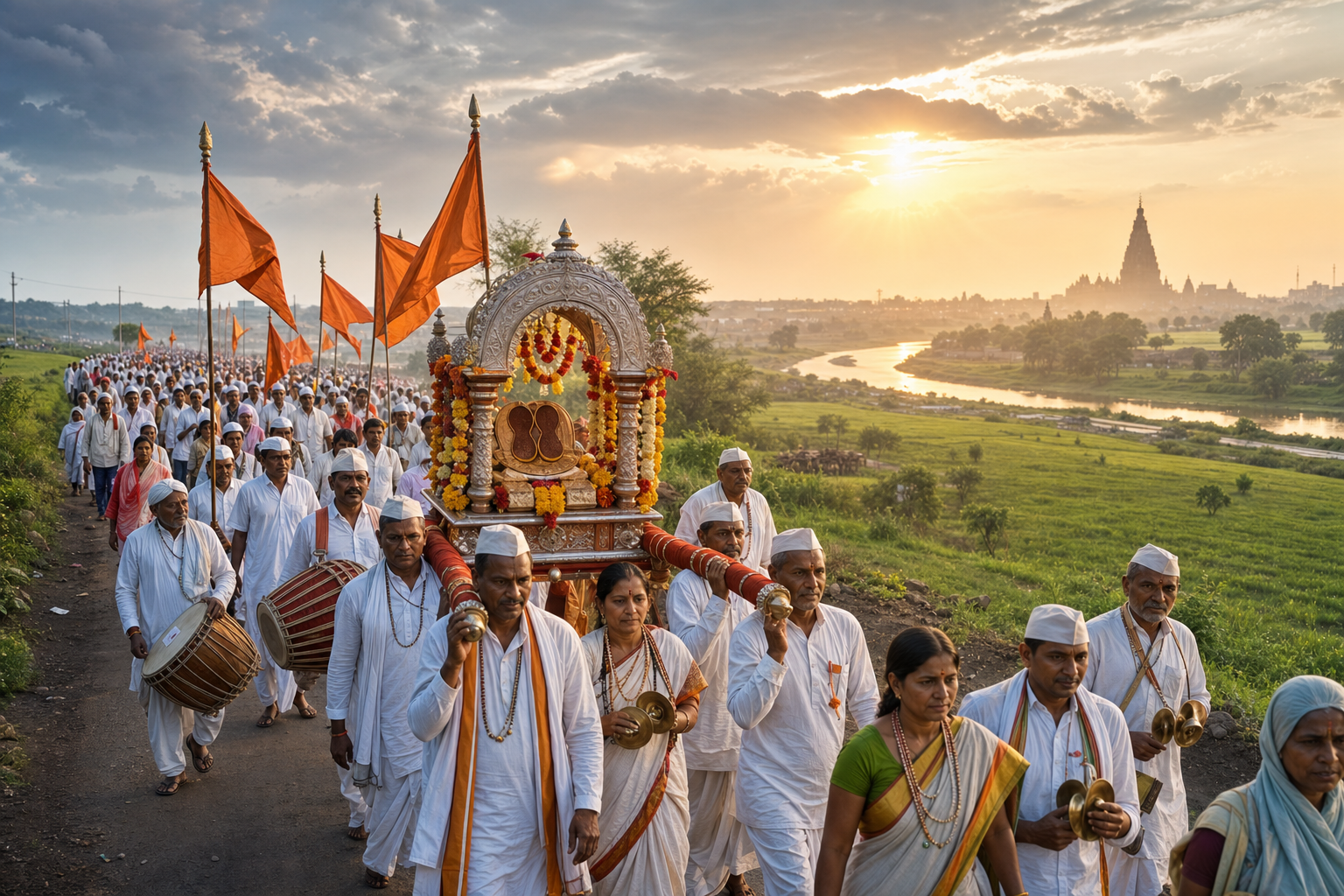
Sant Nilobaraya Palkhi Sohala 2026 is an important devotional procession within the wider Ashadhi Wari pilgrimage of Maharashtra. It carries the memory, teachings, and sacred presence associated with Sant Nilobaraya Maharaj, remembered in the Varkari tradition as a revered disciple of Jagadguru Sant Tukaram Maharaj. The journey from Ahilyanagar, historically known as Ahmednagar, toward Pandharpur is not merely a movement across geography; it is a disciplined public expression of bhakti, collective remembrance, and spiritual equality centered on Lord Vithoba.
The announcement of the Sant Nilobaraya Maharaj Palkhi Sohala 2026 schedule gives devotees, local communities, administrators, and seva groups a framework for preparing for the annual pilgrimage. In practical terms, a Palkhi route involves dates, halting places, food arrangements, security coordination, sanitation planning, medical aid, traffic diversions, and crowd management. In spiritual terms, however, the schedule becomes a sacred rhythm. Every halt, every collective chant, and every step toward Pandharpur becomes part of a living tradition shaped by centuries of Varkari devotion.
The Ashadhi Wari is among the most enduring pilgrimage traditions of India. It culminates at Pandharpur, where devotees worship Vithoba, also called Vitthal or Pandurang, a form of Vishnu-Krishna deeply rooted in Maharashtrian devotional culture. The pilgrimage is associated especially with the saint-poets Sant Dnyaneshwar Maharaj and Sant Tukaram Maharaj, yet its spiritual landscape is much wider. Many Palkhis and Dindis connected with different saints join the devotional movement toward Pandharpur, creating a remarkable network of shared faith, cultural continuity, and disciplined community life.
Sant Nilobaraya Maharaj occupies a meaningful place in this network because his memory is connected with the lineage of Sant Tukaram Maharaj. Tukaram’s abhangas gave ordinary people a language of devotion that was direct, poetic, ethical, and emotionally accessible. The Varkari tradition that grew around such saints emphasized nama-smarana, kirtan, humility, compassion, and the rejection of spiritual arrogance. Sant Nilobaraya’s Palkhi therefore belongs to a tradition in which discipleship is not a narrow institutional identity but a living commitment to carry forward the saint’s values in public life.
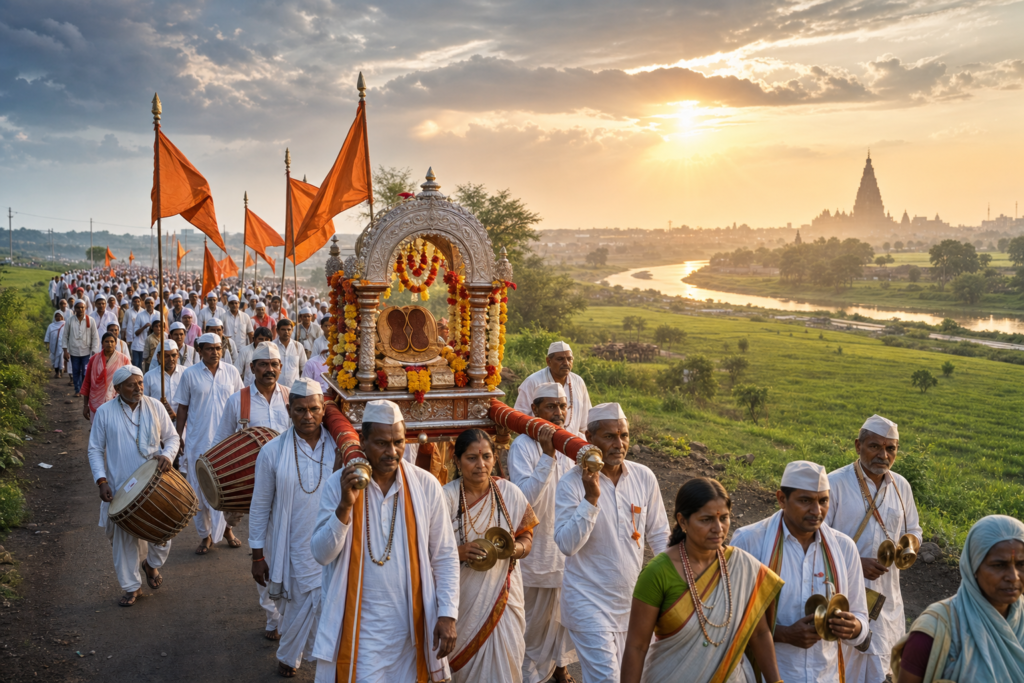
The word Palkhi refers to the palanquin in which the paduka or sacred symbols of a saint are ceremonially carried. In the Varkari world, the Palkhi is not treated as a decorative object. It becomes a moving shrine, a portable center of devotion, and a symbol of the saint walking with the people. This symbolism explains why devotees often speak of the pilgrimage not as an event they attend, but as a journey in which the saint’s presence accompanies them through heat, rain, fatigue, song, and service.
The route from Ahilyanagar to Pandharpur also reflects the regional depth of Maharashtra’s devotional geography. Ahilyanagar, widely known by its earlier name Ahmednagar, has long been connected with historical, social, and religious currents in the Deccan. Pandharpur, on the banks of the Chandrabhaga River, functions as the emotional destination of the Wari. Between these two points lies a landscape of villages, roads, fields, temples, community kitchens, temporary shelters, and homes that open themselves to the annual passage of Varkaris.
The Sant Nilobaraya Palkhi 2026 schedule should be understood with both devotional and logistical seriousness. Devotees planning to join the procession need to confirm exact dates, halts, and local arrangements through official Palkhi organizers or district administration notices before travel. Public summaries can give the broader shape of the pilgrimage, but the daily movement of a Palkhi depends on official coordination, weather conditions, route permissions, and crowd-flow management. This is especially important in 2026 because Ashadhi Wari activity is expected to draw large participation across Maharashtra.
At the heart of the Wari is the Dindi system. A Dindi is an organized group of Varkaris who walk together under a disciplined structure. Each Dindi usually has its own internal order, devotional practices, flag, musical rhythm, and service responsibilities. This system allows a massive pilgrimage to function with surprising order. The Varkari does not walk as an isolated individual but as part of a community shaped by mutual care, shared food, collective singing, and respect for the discipline of the route.
The technical efficiency of the Wari is often underestimated. A procession of this scale requires coordination between pilgrimage trusts, police, health workers, municipal bodies, gram panchayats, transport departments, volunteers, local residents, and religious leaders. Temporary drinking water points, mobile toilets, first-aid centers, lost-and-found support, route barricading, waste management, and crowd dispersal plans are not peripheral details. They are essential parts of preserving the sanctity and safety of the pilgrimage.
For devotees, however, the technical arrangements remain in the background. What is most visible is the emotional texture of the journey: the sound of taal and mridang, the repetition of the divine name, the saffron flags moving in rhythm, the sight of elderly pilgrims walking with quiet determination, and the collective cry of devotion directed toward Vithoba. Such scenes explain why the Wari has survived not as a museum-like tradition but as a living and participatory form of spiritual culture.
The Varkari tradition is also significant because it brings together devotion and ethical social life. The saint-poets of Maharashtra did not present bhakti as withdrawal from society. Their teachings repeatedly connected devotion with humility, service, compassion, and moral self-correction. Sant Tukaram’s abhangas, for example, challenged pride and empty ritualism while calling attention to sincerity and love for God. A Palkhi connected with Sant Nilobaraya Maharaj therefore belongs to a broader current in which spirituality is measured through conduct as much as through worship.
This is why the Sant Nilobaraya Palkhi Sohala has cultural importance beyond its immediate religious setting. It preserves Marathi devotional literature, oral singing traditions, local memory, rural hospitality, intergenerational learning, and the public visibility of bhakti. Children who watch the procession from roadsides encounter a tradition that is older than modern institutions but still active in the present. Elderly devotees who continue walking despite physical difficulty reveal the strength of disciplined faith. Local households that offer water or food participate in seva without needing formal recognition.
The pilgrimage also supports the ideal of unity among Dharmic traditions by demonstrating how shared discipline, non-possessive devotion, and reverence for saints can create social harmony. The Wari is rooted in Hindu devotion to Vithoba, yet its ethical vocabulary of humility, service, self-control, compassion, and remembrance resonates with wider Dharmic values found across Hinduism, Buddhism, Jainism, and Sikhism. In this sense, the Palkhi becomes a public classroom of inner refinement and community responsibility.
The 2026 Sant Nilobaraya Palkhi is especially relevant for those studying pilgrimage as a social system. It shows how sacred movement can organize time, space, and community. The calendar gives the spiritual year a structure; the route converts ordinary roads into devotional corridors; the halts transform villages into temporary centers of service; and the collective body of pilgrims creates a mobile community governed by song, restraint, and shared purpose. Few traditions combine devotion and logistics with such continuity.
From an academic perspective, the Wari may be read as an embodied archive. Its songs preserve theology. Its walking preserves memory. Its routes preserve historical relationships between settlements. Its food-sharing practices preserve community ethics. Its Palkhis preserve the authority of saints without turning them into distant figures. The devotee does not merely read about Sant Nilobaraya Maharaj or Sant Tukaram Maharaj; the devotee encounters their legacy through movement, sound, discipline, and service.
The practice of nama-smarana is central to this experience. Repetition of the divine name is not treated as mechanical chanting. In Varkari understanding, it is a means of aligning speech, breath, memory, and intention with the divine. When thousands chant together, the individual voice becomes part of a larger field of devotion. This collective sound is one reason the Ashadhi Wari remains emotionally powerful even for observers who may not be walking the entire route.
Kirtan and abhanga singing also give the Sant Nilobaraya Palkhi Sohala its intellectual and emotional depth. The abhangas associated with the Varkari saints are not simply devotional songs; they are compact works of theology, social criticism, moral instruction, and poetic reflection. Their language is accessible, but their insight is profound. Through them, the pilgrimage becomes a moving university of bhakti where learning happens through repetition, melody, and lived experience.
The destination, Pandharpur, carries a unique devotional magnetism. Vithoba is often depicted standing on a brick, waiting for the devotee. This image has shaped the emotional imagination of Maharashtra for centuries. The deity is both royal and intimate, transcendent and approachable. For the Varkari, reaching Pandharpur is not only an arrival at a temple; it is an arrival into a relationship of trust, surrender, and recognition.
The Chandrabhaga River adds another layer of sacred meaning to the pilgrimage. Pilgrims traditionally associate the river with purification, devotion, and arrival. The sight of Pandharpur after days of walking carries a powerful emotional charge. Fatigue, dust, and hardship are reinterpreted as offerings. The body that has endured the road becomes part of the prayer.
For those intending to join the Sant Nilobaraya Palkhi in 2026, preparation should include both faith and practical planning. Comfortable walking footwear, simple clothing, personal medicines, reusable water containers, rain protection, identification documents, and awareness of official instructions are essential. Devotees should avoid carrying unnecessary valuables and should remain with their Dindi or known group. Respect for sanitation, local communities, traffic discipline, and public safety is itself a form of seva.
Participation also requires mental preparation. The Wari is not designed as a tourist spectacle. It is a disciplined devotional journey in which personal comfort is secondary to collective order. Patience during delays, courtesy toward volunteers, care for elderly pilgrims, and restraint in crowded spaces are practical expressions of bhakti. The most meaningful participation is not measured by how loudly one chants, but by how carefully one upholds the dignity of the pilgrimage.
The 2026 Palkhi also invites reflection on heritage preservation. Modern roads, urban expansion, administrative pressures, and changing lifestyles can affect pilgrimage routes and practices. Yet the Wari continues because communities actively preserve it. Documentation of routes, accurate schedules, oral histories, abhangas, photographs, local memories, and administrative learning can help future generations understand not only what happened, but why it mattered.
Sant Nilobaraya Palkhi Sohala 2026 therefore deserves attention as a devotional, cultural, and civilizational event. It links Ahilyanagar with Pandharpur, disciple with guru, saintly memory with public practice, and personal devotion with community service. Its power lies in the fact that it does not separate spirituality from daily life. The road itself becomes a place of learning; the crowd becomes a community; the song becomes theology; and the act of walking becomes worship.
In a time when public life often feels fragmented, the Sant Nilobaraya Palkhi offers a compelling model of disciplined unity. It shows how a shared sacred goal can bring together people across age, region, occupation, and social background. It also reminds contemporary society that tradition is not static when it is lived with sincerity. The Palkhi moves forward each year because devotees continue to carry not only the symbols of a saint, but also the values of humility, service, remembrance, and devotion.
The essential message of Sant Nilobaraya Palkhi 2026 is therefore both simple and profound. The journey to Pandharpur is a journey toward Vithoba, but it is also a journey toward inner discipline, shared responsibility, and cultural continuity. For the Varkari, every step becomes an offering. For observers and scholars, the procession remains one of Maharashtra’s clearest examples of how bhakti can shape society, preserve memory, and sustain unity across generations.
Inspired by this post on Hindu Pad.







Leave a Reply
You must be logged in to post a comment.