
Dharma Chintana
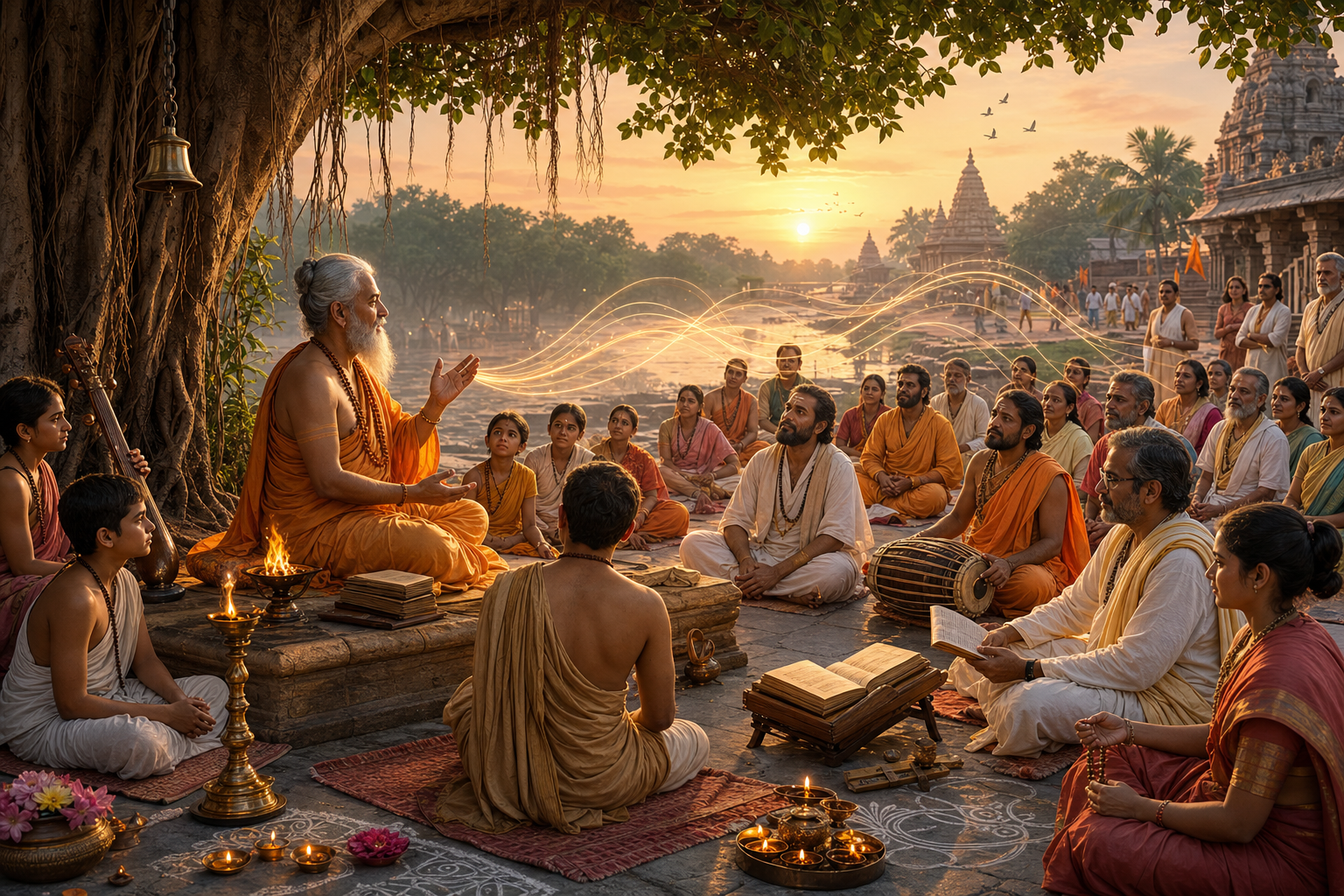
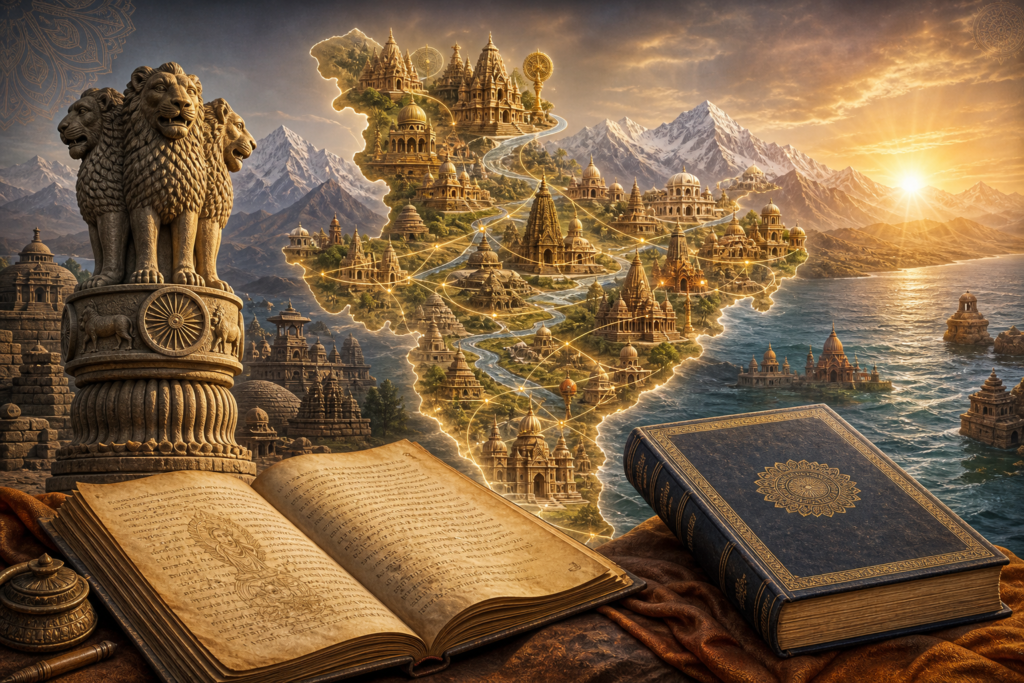
A civilization does not endure merely because it builds monuments, writes books, or accumulates wealth. It endures when it can transmit its deepest values, disciplines, memories, practices, arts, sciences, ethical commitments, spiritual insights, festivals, food habits, and ways of living from one generation to the next with continuity and care. In the Dharmic world, this transmission has rarely depended on a single book, a single institution, or a single historical moment. It has moved through homes, temples, monasteries, gurukulams, ashrams, pilgrimage routes, festivals, songs, debates, rituals, stories, and disciplined practices of learning.
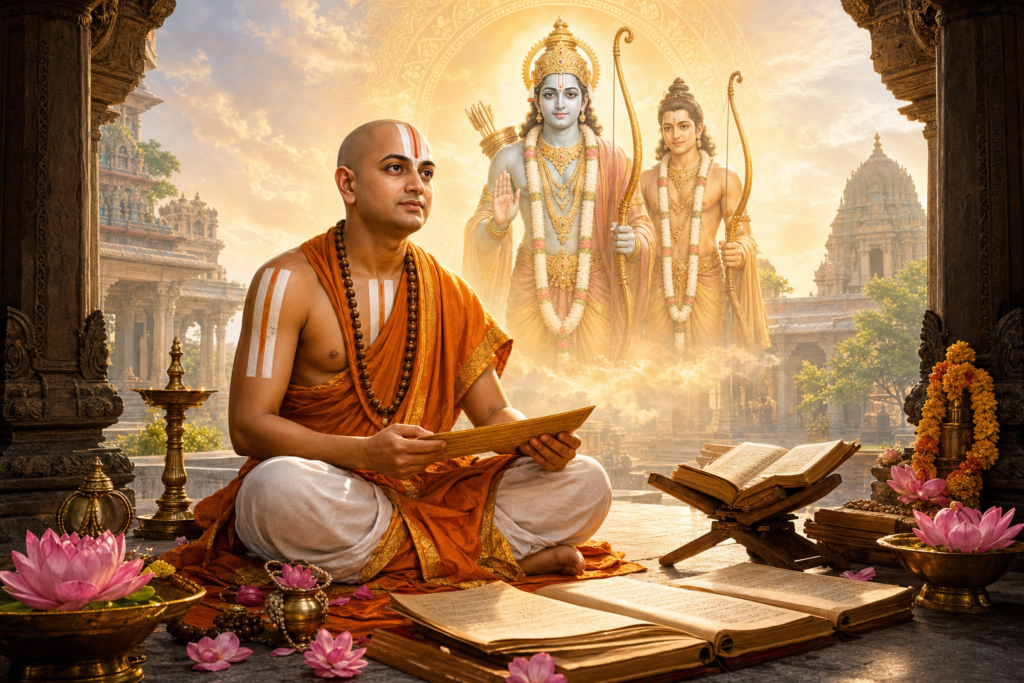
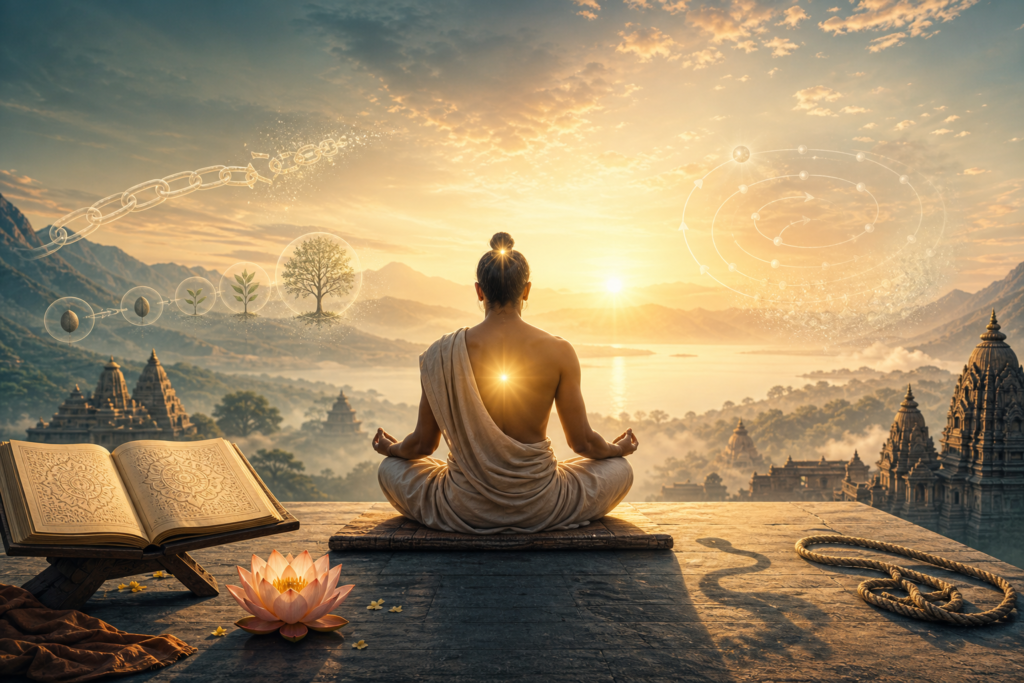
The distinctive strength of Sanatana Dharma lies in this living and distributed mode of cultural preservation. Texts are honored deeply, but they are not isolated from life. The Veda is called Shruti, that which is heard, because its authority and preservation were inseparable from oral transmission through teacher, student, family, and community. This does not reduce the importance of scripture; rather, it places scripture inside a disciplined chain of memory, pronunciation, interpretation, practice, and realization. A book may sit silently in a library, but a tradition lives only when someone chants, explains, questions, practices, remembers, and embodies it.
This is why the concept of Sampradaya is central to Hindu Dharma and to the wider family of Dharmic traditions. A Sampradaya is not merely a sect or denomination in the modern sense. It is a lineage of understanding, a disciplined continuity of practice, and a community of transmission. It preserves not only information but also method, temperament, interpretation, discipline, and lived orientation. Without such continuity, even learned engagement with texts can become detached from the inner grammar of the tradition.
Asampradayavid, Sarva-Sastravid Api, Murkhavad Eva Upekshaniya
Adi Shankara, Gita Bhashyam, 13.2
This statement attributed to Adi Shankara is often understood as a strong reminder that scholarship without Sampradaya is incomplete. A teacher who does not know the living tradition, even if well-versed in many disciplines of knowledge, is treated as unworthy of serious reliance. The point is not anti-intellectual. It is a warning against severing knowledge from the chain of transmission that gives it accuracy, context, and transformative power. In the Dharmic understanding, knowledge is not only read; it is received, tested, internalized, practiced, and transmitted responsibly.
The oral transmission of Dharma is therefore not a primitive stage before writing. It is a sophisticated civilizational technology. Vedic recitation traditions developed rigorous methods of memorization, accent, rhythm, and cross-checking. Patha methods such as sequential and patterned recitation were designed to preserve sound with extraordinary precision. The spoken word was treated as a sacred instrument, not as casual speech. The human body, breath, memory, and attention became the archive. In a world accustomed to external storage, this older discipline reveals a different understanding of knowledge: what matters most must be carried within living persons and communities.
Yet Dharma was never transmitted only through Vedic recitation. Its genius lies in plurality. Different temperaments require different doors into truth. A philosophical mind may enter through Vedanta, a devotional heart through Bhakti, a disciplined practitioner through Yoga, a community through festival, a child through story, an artist through music and dance, and a pilgrim through sacred geography. The result is not fragmentation but an ecosystem. Hindu Dharma, Buddhism, Jainism, and Sikhism all demonstrate, in their own ways, that living traditions require teachers, practices, communities, memory, ethics, and disciplined transmission.
Shruti – Bhashya traditions represent the intellectual and interpretive streams of Dharma. These traditions preserve texts, commentaries, sub-commentaries, treatises, debates, and systems of reasoning. They include categories such as Vedanta, Upanisad, Sutra, Smriti, Shastra, Nibandha, Vritti, Tikha, Vartika etc. Their importance lies not only in preserving doctrine but in training the mind to think with precision. When a student studies Upanishads, Brahma Sutra, Bhagavad Gita, Dharmasastra, or philosophical works across different schools, the aim is not mere accumulation of quotations. The deeper aim is Jnana, a transformation in understanding that can reorder life itself.
In this intellectual domain, the Dharmic traditions developed a rich culture of commentary. A Bhashya does not simply explain a text; it places the text inside a lineage of reasoning. A Vritti may clarify meaning, a Vartika may expand or refine a point, and a Tikha may guide later readers through difficult passages. This layered method of interpretation shows that Dharma is not hostile to analysis. It insists, however, that analysis must be accountable to the tradition, to reason, to experience, and to the goal of liberation. Knowledge that does not refine conduct, attention, and self-understanding remains unfinished.
Yoga – Dhyana traditions transmit Dharma through disciplined inward practice. These traditions focus on the mind, body, breath, senses, memory, and consciousness. Their vocabulary includes Sadhana, Japa, Asana, Pranayama, Mantra, Abhyasa, Kriya etc. They are often associated with Raja Yoga, but their influence extends across many schools. The practitioner learns that Dharma is not only a matter of belief or identity. It is a way of training attention, regulating desire, purifying intention, and discovering a deeper center of awareness.
The relevance of Yoga and Dhyana is especially clear in modern life. Anxiety, distraction, restlessness, and constant stimulation have made the discipline of inwardness more necessary, not less. A person who sits for Japa, practices Pranayama, or enters silent meditation participates in a long chain of embodied knowledge. Such practices are not abstractions. They change posture, breath, speech, sleep, relationships, and priorities. When pursued with steadiness, they may lead toward Samadhi, but even before that highest aim, they cultivate clarity, restraint, humility, and inner order.
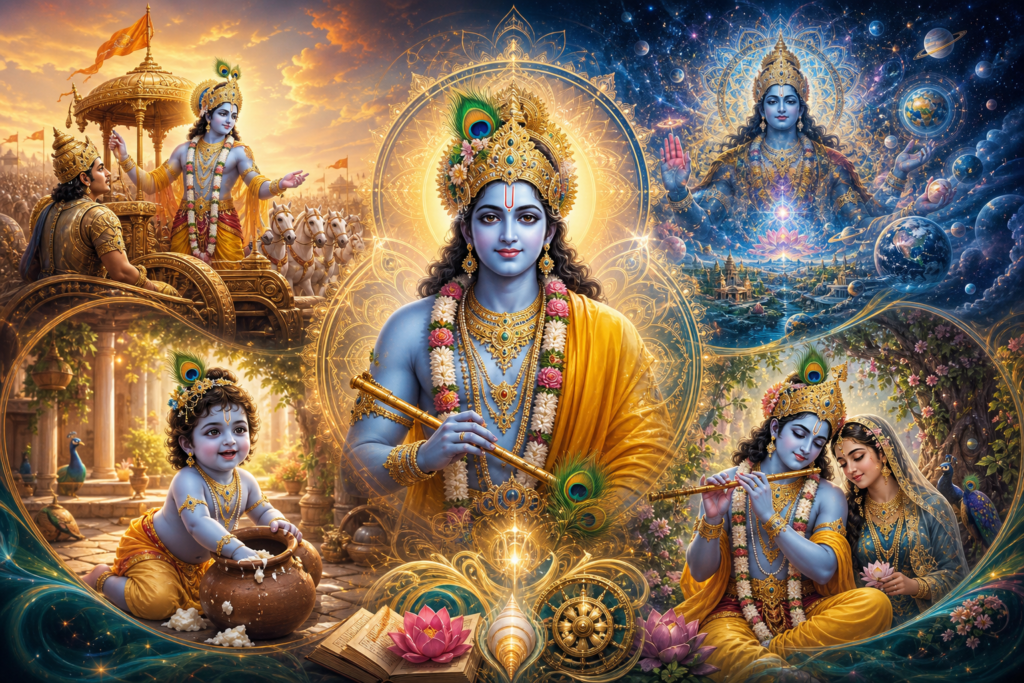
Katha – Pravachan traditions transmit Dharma through story, listening, interpretation, and communal reflection. The Itihasa, Ramayana and Mahabharata, Purana, Kavya traditions are not merely literary inheritance. They are moral laboratories. Through Upanyasam, Saptaham, Katha Kalkshepam, and similar formats, communities revisit stories of duty, courage, error, devotion, exile, conflict, reconciliation, and liberation. A child may first hear the Ramayana as adventure, later encounter it as ethics, and later still contemplate it as a study of Dharma under pressure.
The power of Katha lies in its accessibility. Not everyone begins with metaphysics, but almost everyone can begin with a story. The lives of Rama, Sita, Hanuman, Krishna, Draupadi, Bhishma, Prahlada, Nachiketa, Mirabai, Basava, Akka Mahadevi, the Sikh Gurus, Jain Tirthankaras, and Buddhist teachers become mirrors through which communities examine their own choices. These narratives entertain, but their higher purpose is education. They prepare the Jiva to recognize Dharma not as a slogan but as a difficult and living question.
Yagna – Puja traditions transmit Dharma through ritual action. These include Homa, Abhisheka, Sanskara, Sandhyavandana, Arati, Nigama, Agama, and many other forms of worship and sacred discipline. Modern observers sometimes misunderstand ritual as mechanical repetition. Within the tradition, however, ritual is embodied philosophy. It trains time, space, gesture, sound, offering, purity, attention, gratitude, and humility. It gives the household and community a repeated structure through which sacred memory can be renewed.
When performed with Bhavana and Bhakti, ritual becomes more than ceremony. It creates shared sacred space. A temple bell, a lamp waved in Arati, a child watching elders prepare for a festival, a family gathering for a Sanskara, or a community participating in Homa all carry knowledge that is difficult to convey through explanation alone. Ritual teaches through repetition, beauty, fragrance, sound, gesture, and participation. It is memory made visible.
Sangeetha – Natya traditions preserve Dharma through classical music, dance, rhythm, emotion, and aesthetics. These traditions are centered on Rasa and Ananda. They include complex systems of training that require many years of disciplined practice. A serious student of Bharatanatyam, Odissi, Kathak, Kuchipudi, Carnatic music, Hindustani music, or other classical forms does not merely learn performance technique. The student enters a world of poetry, devotion, mythology, rhythm, language, philosophy, and bodily discipline.
These art forms show that Dharma is not confined to doctrinal instruction. It is also carried by melody, movement, expression, and aesthetic refinement. The stories invoked in music and dance often arise from the Katha and Purana streams. The artist’s body becomes a vehicle of remembrance. The audience, too, participates in transmission, because witnessing a performance with attention can awaken devotion, reflection, and cultural memory. In this sense, art becomes Sadhana, and beauty becomes a path toward insight.
Bhajan – Kirtan traditions extend musical transmission into wider community life. Unlike classical disciplines that require long formal training, Bhajan and Kirtan allow broad participation. A person may not know grammar, philosophy, or complex ritual procedure, yet can still sing the divine name, join a refrain, clap in rhythm, and experience shared devotion. These traditions combine Bhakti and Yoga in a form that is emotionally immediate and socially unifying.
In many homes and temples, Bhajan and Kirtan are among the first ways children encounter Dharma. The melodies become part of memory long before the meanings are fully understood. Later in life, the same songs can return as sources of strength, consolation, and belonging. This emotional continuity is not incidental. Traditions survive when they are loved, not only when they are argued for. Shared singing allows Dharma to become intimate, communal, and portable.
Tirtha – Yatra traditions transmit Dharma through sacred geography and pilgrimage. A Yatra is not ordinary travel. It is disciplined movement toward a place made sacred by memory, presence, austerity, revelation, or long association with saints and communities. Journeys to Kashi, Rameshwaram, Badrinath, Puri, Dwarka, Pandharpur, Amarnath, Sabarimala, Bodh Gaya, Shravanabelagola, Amritsar, and countless other sites connect the pilgrim with histories larger than individual life.
Tirtha – Yatra traditions also reveal the plural structure of Dharmic civilization. Pilgrimage routes cross linguistic, regional, sectarian, and social boundaries. They create contact between one’s own inherited practice and the many sibling traditions called Sampradayas within the wider Dharmic world. A pilgrim may begin with local devotion and return with a widened imagination of Bharat, Dharma, and sacred community. Such journeys combine Karma Yoga and Bhakti Yoga, turning the mind from the constant pull of the Apara world toward Para Vidya.
Utsava – Mela traditions transmit Dharma through celebration. Festivals mark cosmic cycles, agricultural seasons, historical memory, sacred narratives, and community bonds. Deepavali, Holi, Navaratri, Janmashtami, Rama Navami, Guru Purnima, Maha Shivaratri, Kumbh Mela, Onam, Pongal, Vaisakhi, Vesak, Mahavir Jayanti, and many regional observances show that time itself can be sacralized. A festival is not only a holiday. It is a recurring civilizational classroom.
The transmission here is often quiet and non-verbal. A child learns by watching lamps being lit, food being prepared, elders being greeted, stories being retold, homes being cleaned, offerings being made, and communities gathering. The meaning may be explained later, but the first lesson is often sensory and emotional. Festivals produce shared memories, and shared memories produce continuity. They bind the individual to family, family to community, and community to sacred time.
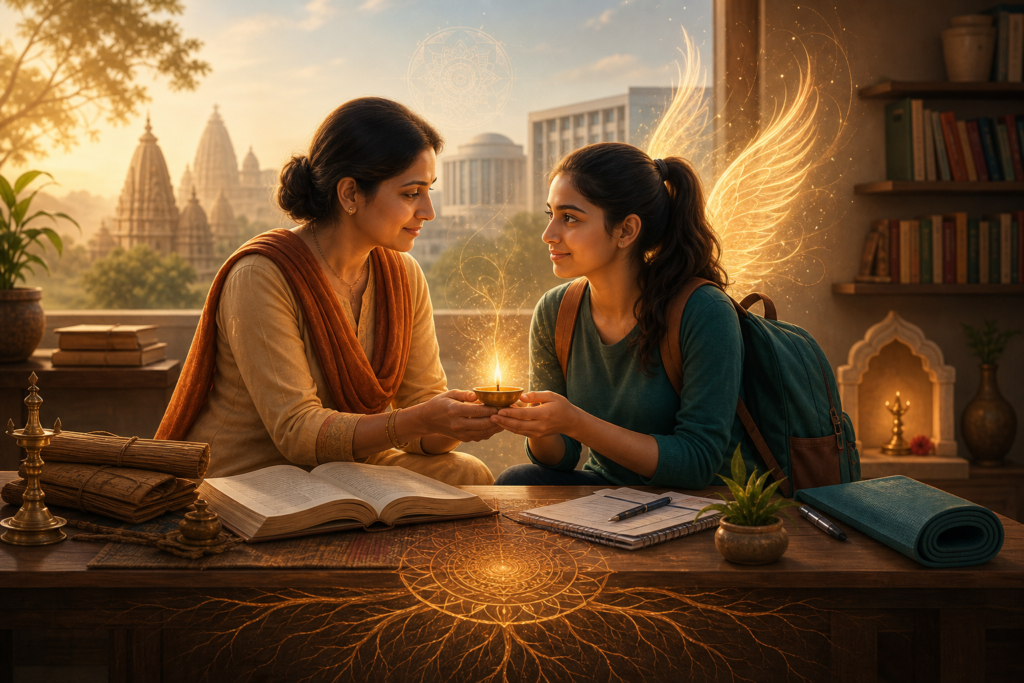
Guru – Sishya traditions form the central relational structure of Dharmic transmission. The relationship between Guru and Shishya is not reducible to instruction. It involves trust, discipline, observation, correction, humility, and gradual maturation. Whether in an Ashram, Gurukulam, monastery, temple, music school, philosophical lineage, or modern classroom inspired by older ideals, the teacher-student relationship preserves a mode of learning that is personal and transformative.
The Satsangha, the community gathered around truth, is equally important. Learning accelerates when seekers gather with seriousness and mutual respect. In such settings, questions are not treated as threats; they are instruments of clarification. Dialogue, or Samvada, has always been central to Dharmic inquiry. The Upanishadic model itself is filled with questions between teacher and student, seeker and sage, king and philosopher, parent and child. The living teacher does not replace scripture but helps the student approach scripture with preparation, humility, and discrimination.
Varna – Jati traditions historically localized transmission through family, community, occupation, region, and village life. Each Varna, Jati, Kula, and Grama developed particular expressions of Dharma, including ritual practices, professional skills, festivals, oral histories, foodways, and local deities. A careful academic treatment must acknowledge both the civilizational role of these structures in preserving knowledge and the ethical need to examine distortions, exclusions, and injustices that accumulated over time.
For a contemporary Dharmic vision, inherited community traditions must be approached with discernment. Their strengths include continuity, specialization, memory, and responsibility. Their weaknesses, wherever they hardened into hierarchy without compassion or dignity, require reform in the spirit of Dharma itself. The goal is not deracination but renewal. Local traditions can be honored without denying the equal spiritual worth of all persons. This is essential for unity among Hinduism, Buddhism, Jainism, Sikhism, and the many communities that share Dharmic ethical and spiritual vocabularies.
Taken together, these modes of transmission created a widely distributed civilizational network. Because Dharma did not depend on one institution alone, it proved resilient across periods of political upheaval, social disruption, invasion, colonial restructuring, missionary pressure, economic change, and intellectual challenge. Libraries could be destroyed, institutions weakened, and communities displaced, yet songs, rituals, stories, pilgrimage routes, family practices, and lineages could continue elsewhere. This distributed structure is one reason Hindu Dharma and related Dharmic traditions retained continuity across many centuries.
This history should be studied with seriousness rather than anger. Dharmic traditions encountered conflict, assimilation, adaptation, and renewal in many periods. The task today is not to cultivate resentment but to understand how cultural memory survives, how institutions decline, how knowledge is lost, and how renewal becomes possible. A mature civilizational response requires confidence without contempt, memory without hatred, and scholarship without ideological dependence. Dharma is weakened when it forgets its past, but it is also weakened when memory is reduced to grievance alone.
The modern challenge differs from earlier forms of disruption. Today, many critiques of Hindu Dharma and other Dharmic traditions arise from secular, liberal, progressive, postcolonial, Marxist, or social-scientific frameworks. Some critiques are careless or ideologically hostile. Others raise legitimate questions about power, gender, caste, social change, historical interpretation, and institutional accountability. The Dharmic response cannot be anti-intellectual. It must be thoughtful, evidence-based, ethically serious, and rooted in deep learning.
The idea that rational and scientific progress automatically renders Dharma obsolete is philosophically weak. Science is indispensable for understanding the material world, developing technology, improving medicine, and testing empirical claims. Dharma addresses a broader field that includes meaning, consciousness, duty, suffering, liberation, ethical self-formation, social responsibility, and the disciplined transformation of the human person. These domains can interact with science, but they cannot be dismissed by slogans about progress. The Vedas, Upanishads, Yoga traditions, Buddhist analysis of mind, Jain ethics of non-violence, and Sikh teachings on devotion and service continue to speak to enduring human questions.
At the same time, Dharmic traditions must not retreat into anti-modern defensiveness. Modern academia, philology, archaeology, comparative philosophy, cognitive science, sociology, and historical method can all contribute to deeper understanding when used responsibly. The problem is not scholarship itself. The problem arises when scholarship begins with contempt, ignores traditional voices, treats living practitioners merely as objects of study, or assumes that Western categories are universally sufficient. A balanced intellectual culture must allow traditional scholars, practitioners, monks, acharyas, historians, philosophers, and modern researchers to engage in serious Samvada.
There is therefore a pressing need for new Centers of Excellence dedicated to Hindu Studies, Dharmic Studies, Sanskrit learning, Indian philosophy, Buddhist studies, Jain studies, Sikh studies, temple traditions, ritual studies, classical arts, and oral history. Such centers should not function as propaganda institutions. Their credibility must come from rigor, language competence, textual depth, fieldwork, philosophical clarity, and openness to debate. They should train scholars who can read primary texts, understand living traditions, engage modern theory, and communicate with both academic and community audiences.
The recovery of Dharma in the intellectual sphere also requires respect for traditional knowledge holders. Many lineages preserve forms of expertise that are not easily captured by modern credentialing systems. Vedic chanters, temple priests, classical musicians, dancers, ritual specialists, Sanskrit pandits, yoga practitioners, storytellers, monks, nuns, granthis, Jain scholars, Buddhist teachers, and community elders all carry forms of knowledge that deserve documentation and dialogue. A university that studies Dharma without listening to its living transmitters remains incomplete.
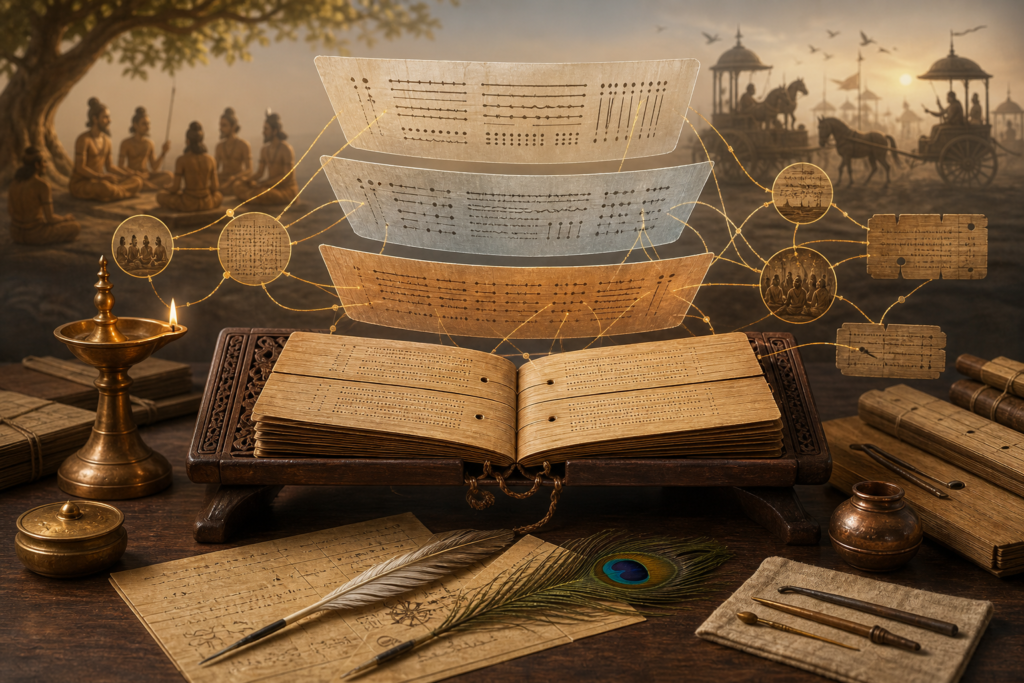
Digital technology adds another layer to the question of transmission. Recordings, online classes, digitized manuscripts, searchable archives, and virtual communities can help preserve and share knowledge. Yet digital access cannot fully replace embodied learning. A recording can preserve a chant, but it cannot correct the student’s breath in real time. A scanned manuscript can preserve a text, but it cannot ensure interpretive competence. A video can demonstrate ritual, but it cannot form the humility, discipline, and responsibility expected in a living tradition. Technology should support transmission, not substitute for the human relationships that make transmission meaningful.
The family remains one of the most important sites of Dharmic continuity. A home where stories are told, festivals are observed, elders are respected, food is prepared with care, prayers are remembered, ethical choices are discussed, and children are encouraged to ask questions becomes a small but powerful center of transmission. Even modest practices matter. Lighting a lamp, reciting a verse, visiting a temple, serving food, practicing kindness, learning a song, or discussing the meaning of Dharma can create impressions that last for decades.
For the diaspora, this responsibility is especially delicate. Many Hindu, Buddhist, Jain, and Sikh families live in societies where Dharmic categories are often misunderstood or flattened into stereotypes. The challenge is to transmit identity without isolation, confidence without hostility, and devotion without rigidity. Children need more than cultural performance; they need explanations that can survive honest questioning. They need to know why Dharma matters, how ritual relates to ethics, why pluralism is not confusion, and how ancient wisdom can guide modern life.
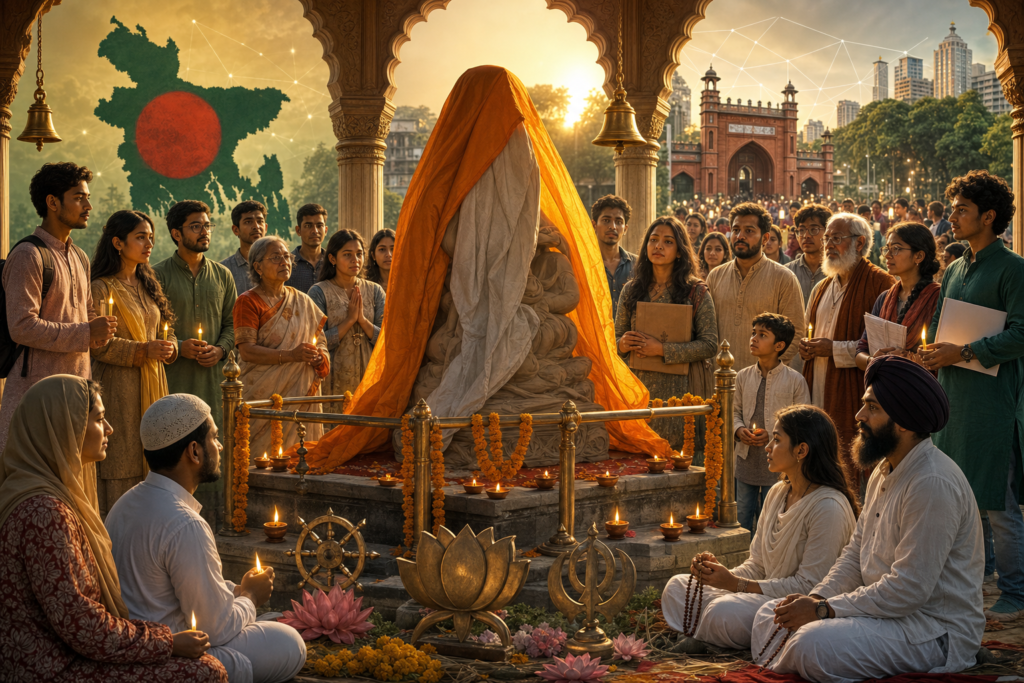
The unity of Dharmic traditions should be understood through shared civilizational concerns rather than forced sameness. Hinduism, Buddhism, Jainism, and Sikhism differ in theology, metaphysics, scripture, ritual, and institutional form. Yet they share deep concerns with liberation, discipline, karma, ethical conduct, self-transformation, compassion, truthfulness, restraint, service, meditation, and the possibility of spiritual realization. Their differences should be studied carefully, while their shared resistance to reductionist materialism and coercive uniformity should be appreciated.
Transmission therefore requires both preservation and renewal. Preservation without renewal becomes fragile nostalgia. Renewal without preservation becomes rootless innovation. The Dharmic method is more subtle: it protects what is essential while allowing expression to adapt across time, region, language, and circumstance. This is why new teachers, saints, reformers, philosophers, poets, monks, and community leaders arise in different generations. They do not create Dharma from nothing. They recover, reinterpret, and re-energize what is already present in the civilizational inheritance.
The future of Dharma will depend on whether its communities can rebuild seriousness. Sentiment alone will not be enough. Identity alone will not be enough. Occasional festival attendance, social media slogans, or inherited labels will not be enough. Transmission requires study, practice, discipline, institutions, teachers, translations, commentaries, artistic training, community participation, and ethical reform. It also requires courage to distinguish knowledge from error, and error from fashionable opinion.
A new Samvada is necessary for new Jnana to arise. This dialogue must include traditional scholars and modern academics, householders and renunciants, artists and philosophers, youth and elders, practitioners and researchers, Hindu and other Dharmic voices. It must be intellectually rigorous and spiritually humble. When error is not distinguished as error, it can masquerade as knowledge. When tradition is not examined with care, it can harden into habit. When modern critique is not tested, it can become ideology. The path forward requires discrimination, devotion, and disciplined learning.
The transmission of Dharma is ultimately the transmission of a way of seeing, living, questioning, serving, and becoming. It is carried by sound, text, teacher, family, ritual, pilgrimage, art, debate, silence, and community. Its continuity is not accidental. It has survived because countless people, many unnamed, chose to remember, practice, teach, and hand forward what they received. The task before the present generation is to receive that inheritance with gratitude, examine it with intelligence, reform it where Dharma demands reform, and transmit it with fidelity, courage, and compassion.
Inspired by this post on Dharma Civilization Foundation.


Leave a Reply
You must be logged in to post a comment.