
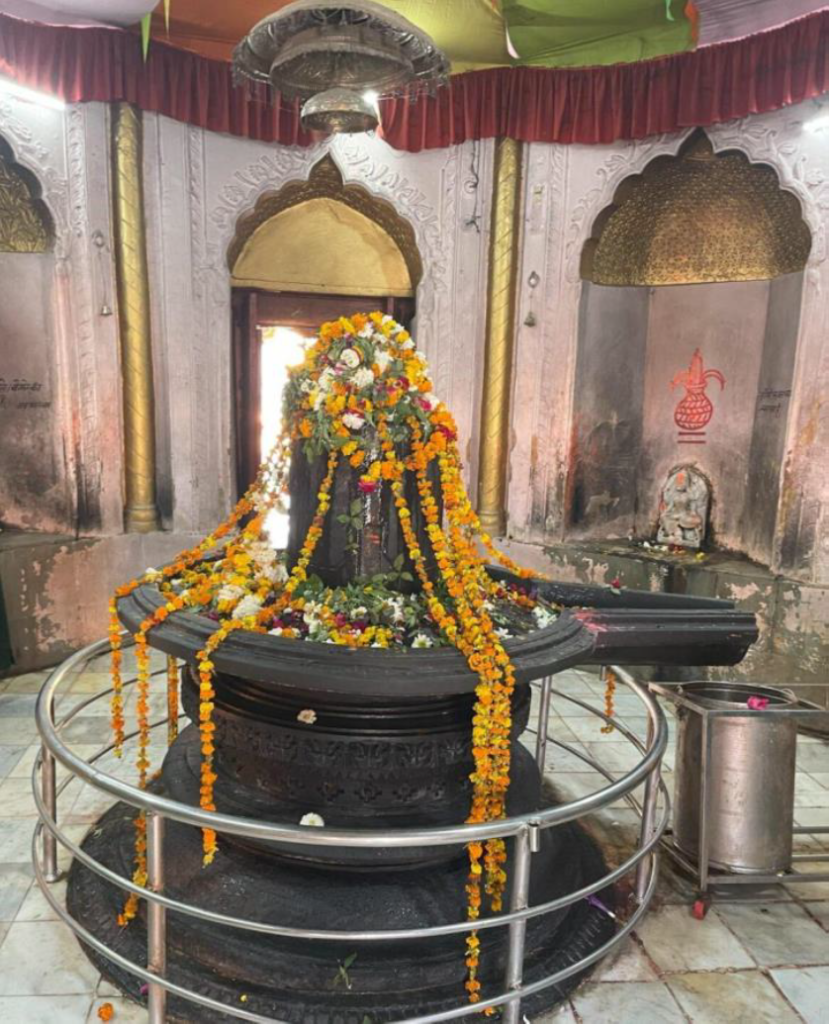
Prithvinath Temple in the Khargupur region of Gonda, Uttar Pradesh, is most widely known for its massive Shivling. Local tradition describes this Lingam as among Asia’s largest and heaviest, and associates its installation with Bhīma, the second eldest Pandava, during the exile of the Pandavas in the Dvapara Yuga. For devotees, the temple is a living centre of worship; for visitors, it offers serenity, architectural beauty and the emotional force of inherited sacred memory.
Yet the most historically suggestive material at Prithvinath Temple does not lie only in the celebrated Shivling. It is also visible along the temple walls, where several sculptural fragments and idols have been placed after being reportedly unearthed from the same sacred zone. These pieces are easy to overlook because the eye is naturally drawn to the sanctum and to the scale of the Linga. However, for anyone interested in Indian history, temple archaeology, iconography and heritage preservation, these weathered sculptures may be the most urgent part of the site.
A visit to Prithvinath Temple therefore becomes more than a pilgrimage. It becomes an encounter with layered time. The immediate devotional experience is powerful, but the surrounding fragments create another kind of reverence: the quiet realization that an ancient sacred landscape may be standing in partial ruin, still worshipped, still loved, yet not fully understood. Such moments are common across India, where living temples often preserve archaeological clues that formal records have not yet studied in depth.
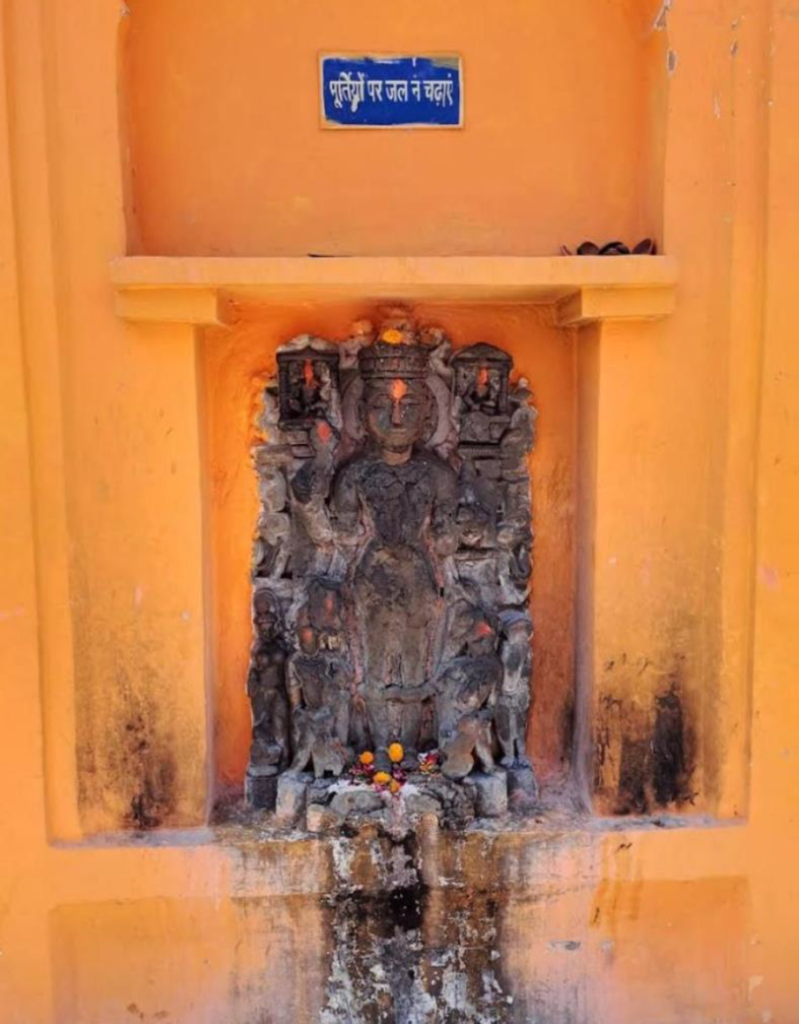
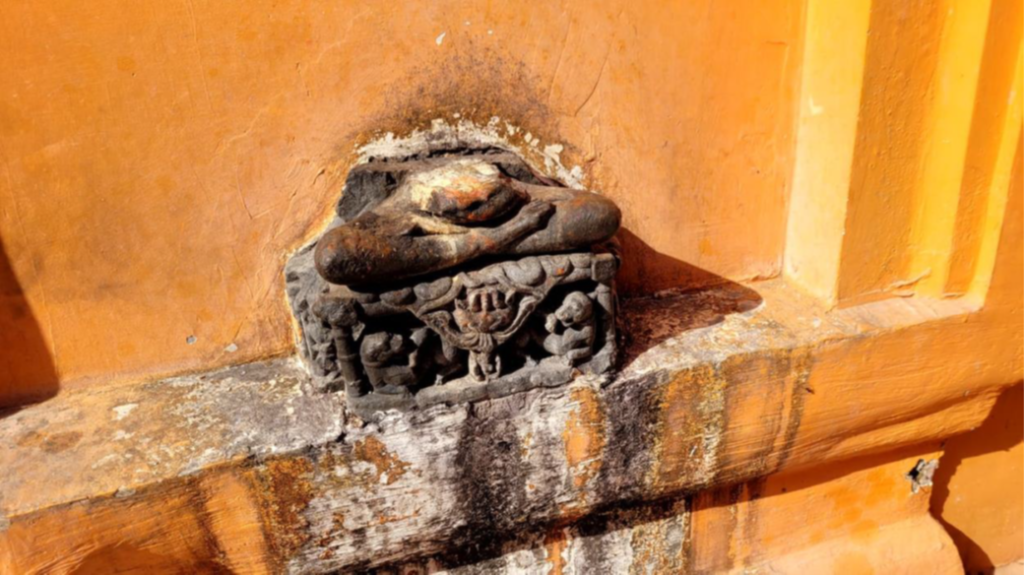
The temple’s present form draws pilgrims to a peaceful and culturally rich environment, but the sculptural pieces around it point toward an older history. Roughly seven or eight idols and fragments are placed against or within the outer walls. Many appear heavily worn. Their surfaces show signs of erosion from exposure to sun, wind and rain, and also from devotional substances such as chandan, flowers, rice water and milk. These offerings are made with reverence, but on fragile stone they may slowly accelerate surface loss, staining, salt activity and biological growth.
This is the central tension at Prithvinath Temple: the same devotional affection that keeps the site alive can unintentionally damage the material heritage through which earlier generations expressed their devotion. The issue is not a conflict between faith and preservation. It is a question of how living worship can coexist with responsible conservation. A sacred object may be revered through darshan, circumambulation, lamps and prayer without requiring direct application of substances to an already fragile surface.
Local accounts and temple tradition indicate that the idols were discovered during construction activity in the area around the ancient Linga. Once found, they were treated as belonging to the temple and were placed for devotees to see. This practice is understandable in a living sacred institution, but from an archaeological perspective, it also means that crucial information may have been lost. The original depth, orientation, stratigraphy, associated bricks, pottery, floor levels, plinth remains and architectural debris would have helped establish chronology and function with far greater precision.
Temple authorities appear to have recognized the importance of the sculptures and have reportedly installed boards asking devotees not to make offerings on them. This is a necessary first step, but signage alone is rarely enough. In living temples, preservation works only when priests, devotees, local administrators, conservation specialists and visitors all understand the reason behind the restriction. A notice that merely says “do not touch” may be ignored; a notice that explains that chandan, water and milk are eroding ancient sculpture can create a different ethical response.
The visual character of the idols suggests that they are not modern works. Without professional survey, scientific documentation or inscriptional evidence, no firm date should be assigned. Still, their iconographic features, worn sculptural style and fragmentary condition make a medieval or early historical attribution plausible enough to demand careful study. At minimum, the pieces should be treated as potential antiquities until trained archaeologists and art historians complete a formal assessment.
Prithvinath Temple and the Sacred Geography of Gonda
Gonda’s location gives the Prithvinath Temple question added importance. The district lies within the broader cultural zone of Awadh and near the sacred geography associated with Ayodhya, Kosala, Shravasti and the middle Gangetic plain. This region was not peripheral to ancient Indian civilization. It was linked to movements of pilgrims, monks, merchants, teachers, rulers and artisans. Temples, monasteries, markets and routes often developed together, making religious sites important nodes in both sacred and economic networks.
Ayodhya, historically associated with Sāketa and the Ramayana tradition, emerged as a significant urban and sacred centre in early Indian history. The dating of the Valmiki Ramayana remains debated, with scholars generally recognizing a long process of composition and redaction rather than a single fixed moment. Even so, the textual, religious and cultural importance of Ayodhya shaped the region’s prestige over many centuries. Prithvinath Temple must be viewed within this broader landscape of sacred memory rather than as an isolated rural shrine.
The possibility that older Shaiva, Vaishnava and Buddhist material existed in the same zone should not surprise students of Indian religious history. Ancient and early medieval India often produced overlapping sacred landscapes. A single region could support shrines dedicated to Shiva, Vishnu, Devi, local Yaksha-Yakshini figures, the Buddha, Bodhisattvas, Jain Tirthankaras and regional forms of worship. These were not always neatly separated into the modern categories through which religion is often described today.
This shared sacred geography is especially important for a Dharmic understanding of heritage. The presence of Shiva, Vishnu and a possible Buddha image in one temple zone need not be treated as an anomaly or contradiction. It may instead reflect the plural and layered devotional world of the Indian subcontinent, where Hindu, Buddhist and Jain artistic languages developed in conversation with one another. Such evidence supports a more integrated view of India’s civilizational past.
The Possible Pashupati or Shaiva Image
One of the most striking pieces has been interpreted locally as a possible Pashupati image. The suggested basis for this identification is the deity’s meditative posture and the presence of animals around the central figure. In Shaiva traditions, Pashupatinath or Pashupati evokes Shiva as lord of beings, animals and the wider living world. The iconographic theme carries deep associations with ascetic power, wilderness, fertility, protection and cosmic sovereignty.
At the same time, caution is necessary. A damaged or weathered sculpture can easily invite overconfident identification. Animal motifs may appear in several religious and decorative contexts. A meditative figure may be Shaiva, Buddhist, Jain or associated with local ascetic traditions depending on attributes, posture, attendant figures, headgear, hand gestures, vehicle, halo, base and inscriptional evidence. The Prithvinath fragment therefore deserves close visual documentation rather than immediate certainty.
If the Pashupati identification is supported by later study, it would strengthen the view that the temple complex once included a richer Shaiva sculptural programme. A temple centred on a Linga could also include sculptural depictions of Shiva, Pārvatī, Ganesha, Kartikeya, attendants, ganas, river goddesses, guardians and related forms. Such ensembles were common in classical and medieval Hindu temple architecture, where the sanctum, walls, niches, pillars and gateways together expressed a theological universe.
Mathura School Resonances and Shared Artistic Idioms
The Prithvinath sculptures have been compared with the Mathura school of art, and this comparison is worth exploring carefully. Mathura was one of the most important artistic centres of ancient India. From roughly the early centuries BCE through the Kushan and Gupta periods, it produced major sculptural traditions associated with Buddhist, Jain and Hindu worship. Its red sandstone images, strong bodily forms, refined iconography and devotional intensity influenced artistic production across northern India.
Mathura art is especially significant because it demonstrates that early Indian sacred sculpture was not confined to a single religious community. Buddha and Bodhisattva images, Jain ayagapatas and Tirthankara figures, Yaksha-Yakshini forms, Vaishnava imagery and Shaiva elements all participated in a broader artistic ecosystem. Workshops, patrons and visual conventions circulated across traditions. This is why a site containing Shaiva, Vaishnava and possible Buddhist material can be read as part of a shared Dharmic artistic vocabulary rather than as evidence of cultural contradiction.
The features often associated with Mathura sculpture include robust physical modelling, frontal presence, broad shoulders, expressive faces, elaborate jewellery, relatively light drapery and a preference for sacred figures that appear both humanly present and spiritually charged. Compared with Gandhara, which often shows stronger Hellenistic and northwestern stylistic influences, Mathura developed a more indigenous idiom rooted in local stone, regional devotional forms and long-standing Yaksha traditions.
However, resemblance should not be confused with proof of origin. A sculpture in Gonda need not have been produced in Mathura simply because it shares some stylistic features. Mathura’s influence spread widely, and regional workshops could adapt similar forms. To determine whether any Prithvinath sculpture is Mathura-made, Mathura-influenced or simply part of a broader north Indian style, specialists would need to examine stone type, carving technique, iconographic details, tool marks and comparative parallels from museum collections and excavated sites.
Trade Routes, Temples and Economic Geography
The original observation that temples were often linked to trade routes is historically sound, though it must be applied with care. Ancient Indian temples were not only ritual spaces. They could also function as landholding institutions, centres of redistribution, employers of artisans, hosts for festivals, protectors of water structures, patrons of learning and anchors of local markets. Where pilgrimage and trade overlapped, religious institutions could become economically powerful and socially durable.
Mathura itself became important partly because it was situated at the meeting point of major routes across the Indo-Gangetic plain and toward western and central India. Ayodhya-Sāketa also belonged to an ancient network of roads connecting significant urban centres. The middle Gangetic world, extending toward Magadha, was one of the most dynamic cultural and political zones of early India. Against this background, it is reasonable to ask whether the Prithvinath region stood near a route of movement between sacred, commercial and administrative centres.
The hypothesis that Prithvinath Temple may have served as a checkpoint or sacred node on a route linking northwestern India, Mathura, Ayodhya, Gonda and Magadha is intriguing but not yet proven. To test it, researchers would need systematic evidence: ancient road alignments, river crossings, mound distributions, pottery scatters, inscriptions, coins, brick sizes, settlement patterns and comparable shrines. The presence of Ashokan, Gupta or other inscriptions in the wider region may provide context, but it cannot by itself establish the temple’s precise role.
Even as a hypothesis, the trade-route angle is valuable because it shifts attention away from the temple as a single isolated monument. It encourages a landscape approach. Instead of asking only what the Shivling represents, one begins to ask what kind of settlement, route, patronage network or sacred cluster may have existed around it. This is exactly the kind of question that archaeology is designed to answer.
The Standing Vishnu Image and Vaishnava Possibilities
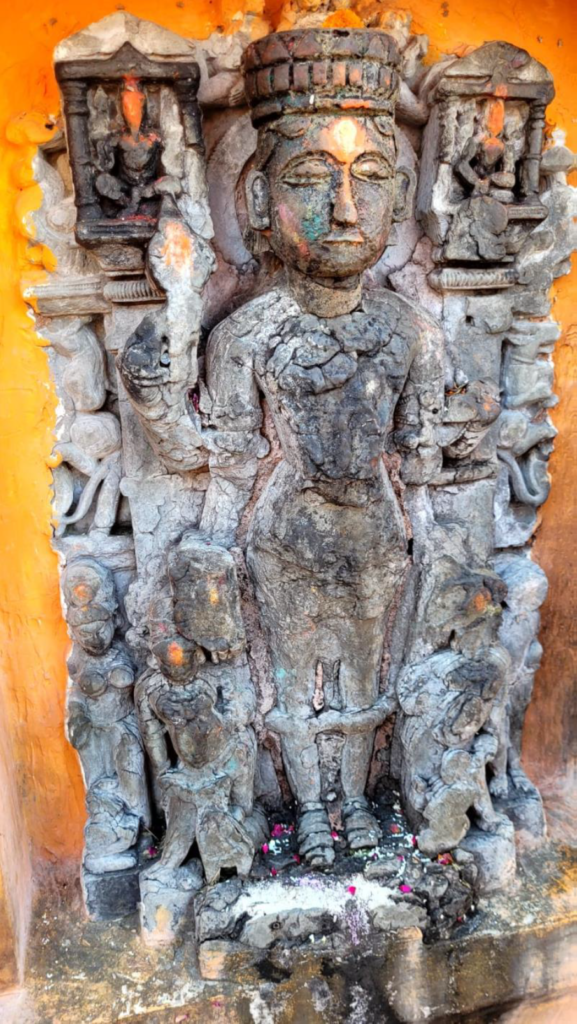
Another important fragment has been interpreted as a standing Vishnu image. If this identification is correct, the sculpture would point toward a Vaishnava layer within or near the same sacred landscape. A standing Vishnu image can be recognized through attributes such as the shankha, chakra, gada and padma, though these may be lost in a damaged piece. Attendant figures, crown form, posture and side panels can also assist identification.
The observed figure with a trunk on the upper left may represent Ganesha, while another figure on the upper right has been tentatively linked to Lakshmi. These readings are possible, but again require professional study. In temple sculpture, subsidiary figures can represent attendants, donors, guardians, grahas, river goddesses, consorts, celestial beings or narrative characters. A single damaged panel may carry multiple iconographic layers that are not immediately obvious to the untrained eye.
The suggestion that a standing image may have been a principal idol is also plausible but not definitive. Principal icons, door guardians, niche figures and pillar-attached sculptures can all be large and formally composed. The base, back slab, prabhavali, pedestal inscription, tenon marks and breakage pattern would help determine whether the image once stood independently in a sanctum or formed part of an architectural surface.
This uncertainty does not reduce the sculpture’s importance. On the contrary, it increases the need for expert analysis. A broken Vishnu image at a major Shaiva temple site may indicate reuse, relocation, multi-shrine planning, sectarian coexistence or later collection of nearby finds. Each possibility tells a different story about the religious history of Gonda and the wider sacred geography of Uttar Pradesh.
Dwarpalas, Pillar Images and the Problem of Context
One fragment has been described as too broken to identify with confidence. It may represent a deity, a Dwarpal, or a figure attached to a pillar or architectural member. This is precisely where archaeological context becomes decisive. Dwarpalas commonly flank entrances and are often shown as powerful guardians, sometimes with weapons, dynamic stance and intense expression. Pillar figures may be more decorative, narrative or symbolic, depending on their placement.
When a sculpture is separated from its architectural setting, interpretation becomes difficult. A fragment found near a temple may not originally belong to the present temple. It may have come from an earlier structure on the same site, a nearby shrine, a demolished wall, a plinth, a gateway or even a secondary deposit. This is why careful excavation records matter. The absence of context does not make interpretation impossible, but it does require restraint.
The presence of devotee figures on the sides of a fragment may suggest that the piece belonged to a devotional panel. Donor figures and worshippers often appear at the margins of sacred compositions, visually acknowledging the relationship between the devotee and the deity. If such details are still visible at Prithvinath, they should be photographed under controlled lighting and mapped before further erosion makes them unreadable.
The Possible Yakshini and Nature Symbolism
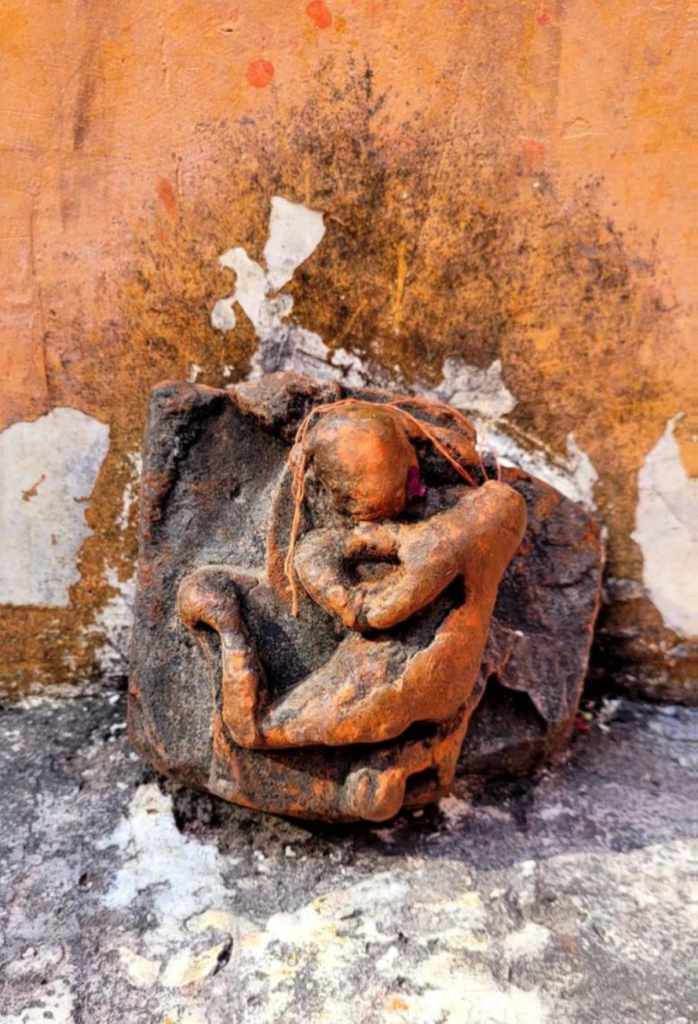
Another eroded piece has been compared to a Yakshini, a female nature-associated figure known from early Indian art. Yakshas and Yakshinis occupy an important place in the development of Indian sacred imagery. They are linked to fertility, abundance, trees, water, thresholds and local protective powers. Over time, their forms and symbolism were absorbed into Buddhist, Jain and Hindu visual traditions.
The described posture, with folded hands and upward-twisted legs, may suggest reverence or participation in a larger scene. If the figure is offering flowers, it could represent a devotee, celestial attendant, nature spirit or subsidiary feminine presence. Such imagery often marks the boundary between the human and divine worlds. It makes the sacred scene feel inhabited, relational and alive.
The possible Yakshini is especially significant because it reminds viewers that temple art is not limited to major gods alone. Sacred architecture is filled with secondary figures: guardians, donors, musicians, dancers, river goddesses, ganas, vidyadharas, mithuna couples, nature spirits and devotees. These figures help reconstruct the social and symbolic world of a temple. Losing them to erosion means losing more than decoration; it means losing evidence of how earlier communities imagined the sacred cosmos.
The Speculated Buddha Image and Dharmic Continuity
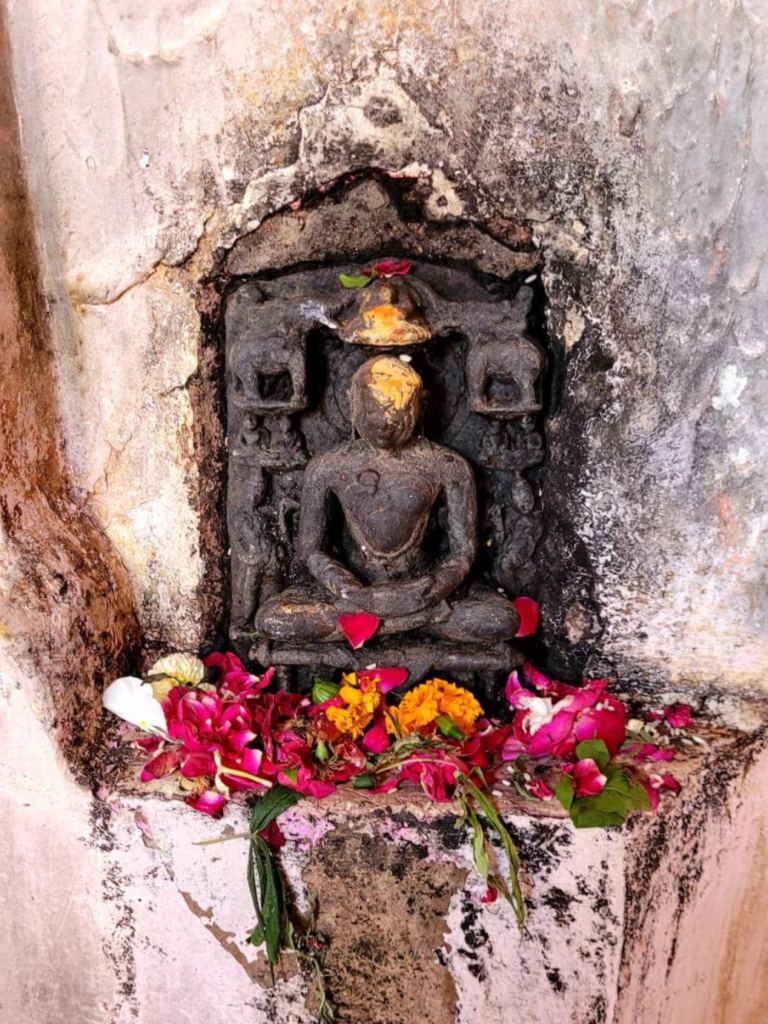
The most historically sensitive object at the site is the sculpture interpreted as a possible Buddha image. The identification is based on the seated posture, described as Padmasana, with four seated disciples or attendants on either side, elephants above, and a small figure or symbol at the top that may relate to the personified Bodhi tree. Because the surface is reportedly covered in chandan, the iconographic details are difficult to read.
If the image is indeed Buddhist, it would be a major clue to the religious history of the area. Buddhist sites often developed along routes of travel, patronage and urban exchange. Monks, merchants and lay donors were deeply connected in early Buddhist institutional life. The presence of a Buddhist image near Shaiva and Vaishnava material would fit the wider Indian pattern of religiously plural landscapes rather than requiring a theory of rupture.
Elephants, Bodhi tree symbolism, seated attendants and meditative posture are all meaningful in Buddhist art, but they are not sufficient for absolute identification without closer study. The posture, hand gesture, robe treatment, halo, ushnisha, facial form, pedestal, attendant arrangement and any surviving inscription would need examination. A high-resolution photographic record, 3D scan and comparative study with Mathura, Sarnath and other north Indian Buddhist images would help clarify the matter.
The possible Buddha image also offers a valuable opportunity for cultural unity. Rather than treating Buddhist presence as separate from the temple’s Hindu identity, the site can be understood as part of India’s wider Dharmic inheritance. Hindu, Buddhist, Jain and Sikh traditions share many civilizational spaces, ethical concerns, pilgrimage habits, philosophical vocabularies and reverence for sacred memory. Preserving such images strengthens a shared heritage rather than diminishing any one tradition.
Why Multiple Traditions May Appear in One Place
The question naturally arises: why would images associated with Shiva, Vishnu and possibly the Buddha appear in the same temple area? Several explanations are possible. The site may have contained more than one shrine. It may have been a sacred cluster with separate but nearby structures. Sculptures from damaged temples may have been gathered and preserved at the surviving shrine. Later communities may have relocated images for protection. Some pieces may have been reused architecturally. Only excavation can determine which explanation is strongest.
Multi-shrine sacred complexes are well known in South Asian history. Large religious centres often included main shrines, subsidiary shrines, monastic spaces, water bodies, mandapas, gateways, memorial stones and rest houses. Taxila, Takht-i-Bahi, Sarnath, Mathura, Shravasti, Nalanda and many temple towns demonstrate that religious life was spatially complex. A visitor could move through different shrines and institutions within the same broad sacred landscape.
In this light, Prithvinath Temple may be preserving the remains of a larger sacred geography now reduced to scattered fragments. The Shivling remains the living devotional centre, but the surrounding sculptures may be witnesses to vanished structures. Their value lies not only in their individual beauty, but in the historical questions they ask: What stood here before the present temple? Who patronized it? Which communities worshipped here? Was the site linked to a route, market, settlement or monastic network? What periods of construction, damage, reuse and renewal can be identified?
Conservation Concerns: Ritual, Weather and Stone Decay
The conservation problem at Prithvinath Temple is urgent because stone decay is cumulative. Rainwater enters cracks and pores. Temperature changes expand and contract surfaces. Dust and biological growth obscure carving. Chandan and other pastes can trap moisture and alter surface chemistry. Milk and rice water may leave organic residues that encourage microbial activity. Flowers can stain. Repeated touching polishes high points and destroys subtle carving.
These processes are often slow, which makes them easy to ignore. A sculpture may seem unchanged from one festival to the next, yet over a decade the loss can be significant. Once facial features, inscriptions, hand gestures or miniature attendants disappear, they cannot be recovered by devotion or scholarship. Conservation must begin before the object looks completely ruined.
The solution should not be hostile to religious practice. Instead, the temple can establish a heritage-sensitive worship protocol. Devotees may offer flowers and chandan to designated modern icons, lamps, trays or symbolic platforms placed near the antiquities rather than directly on them. Clear barriers can preserve darshan while preventing contact. Priests can explain the rule as a form of seva to the deity and to ancestors. Preservation then becomes a devotional act, not a bureaucratic restriction.
What a Proper Archaeological Response Should Include
A responsible response should begin with documentation. Each sculpture should be assigned a number and photographed from all sides in consistent light. Measurements, material description, condition notes, visible iconographic features, local oral history and current placement should be recorded. Photogrammetry or 3D scanning would create a digital record before further damage occurs. Even a modest documentation project could transform the site from an informal display into a study-ready heritage collection.
The next step should be expert assessment by archaeologists, art historians, epigraphists and conservation specialists. If inscriptions or faint marks exist, raking light and digital enhancement may reveal them. If stone type can be identified, it may help determine whether pieces were locally made or imported from another workshop. Stylistic comparison with Mathura, Sarnath, Shravasti, Ayodhya and other north Indian traditions could narrow the likely chronology.
A non-invasive site survey should follow. Ground observation, mapping of mounds, study of older bricks, documentation of water bodies, collection of oral histories and review of local land records may identify earlier structural remains. If warranted, a controlled archaeological excavation could then be planned. Excavation should never be casual digging; it must preserve stratigraphic relationships, because context is often more important than the object alone.
Conservation measures should be immediate and practical. The idols should be moved, if appropriate and legally permitted, into a sheltered but visible protected gallery within the temple precinct. If relocation is not possible, they should be covered by a ventilated protective structure that prevents rain exposure without trapping humidity. Direct offerings should cease. Informational panels in simple Hindi and English should explain the antiquity, significance and fragility of the sculptures.
The Role of Local Community and State Institutions
Heritage preservation cannot succeed through government action alone. Local priests and devotees are the daily custodians of the site. Their participation is essential. If they are made partners in documentation, interpretation and protection, the sculptures will be safer. If they are treated merely as obstacles, conservation will fail. The best model is collaborative: temple authorities safeguard access and devotion, while archaeological and municipal institutions provide technical protection.
The local municipality, district administration, state archaeology department and the Archaeological Survey of India should take note of the site’s potential. Even if the temple is not immediately declared a protected monument, a preliminary survey can establish its importance. Remote and semi-rural sites often preserve material that is academically valuable but institutionally neglected. Prithvinath Temple appears to belong to this category and should not wait for irreversible damage before receiving attention.
Educational outreach would also help. Schools, local history groups and cultural organizations in Gonda and Ayodhya can create awareness around the temple’s sculptural heritage. A small booklet, a guided heritage walk, a digital archive or a temple noticeboard can teach visitors why these fragments matter. Once people understand that they are looking at possible medieval or ancient remains, casual touching often decreases.
Why Prithvinath Matters Beyond One Temple
Prithvinath Temple matters because it represents a wider Indian problem. Across the country, ancient sculptures sit in active shrines, village platforms, open courtyards, roadside structures and temple walls. They are loved but undocumented, worshipped but unprotected, visible but academically unseen. Many survive precisely because local communities preserved them, yet many are also damaged because their antiquity is not fully recognized.
This is not a reason to blame devotees. It is a reason to build better cultural literacy. A person offering chandan to an old idol is usually expressing reverence, not neglect. The task of heritage education is to refine that reverence so that devotion protects rather than erodes. In Dharmic terms, preserving a murti, fragment or sacred memory is itself a form of dharma, because it honours the continuity between past, present and future.
The emotional force of Prithvinath Temple lies in this continuity. The giant Shivling anchors a living tradition. The scattered sculptures whisper of older artistic worlds. The possible presence of Shaiva, Vaishnava and Buddhist material invites a generous reading of India’s sacred past. The site does not need sensational claims; it needs patient study, careful language and immediate protection.
What stands at Prithvinath is therefore not only stone. It is a fragile archive of worship, movement, artistic exchange and regional memory. If documented properly, the temple may contribute to the study of ancient temples in Uttar Pradesh, the spread of Mathura-influenced art, trade-route sacred geography, Hindu-Buddhist interaction and local patterns of heritage survival. If ignored, the same evidence may disappear one offering, one monsoon and one season of neglect at a time.
The most responsible conclusion is both cautious and urgent. The sculptures at Prithvinath Temple should not be dated or identified with certainty without professional examination. Yet they are significant enough to deserve protection now. Their preservation would serve devotees, historians, archaeologists and all communities committed to India’s Dharmic heritage. The temple’s celebrated Shivling draws attention to the sacred centre; its buried and weathered past asks for stewardship.
Inspired by this post on Pragyata.
