
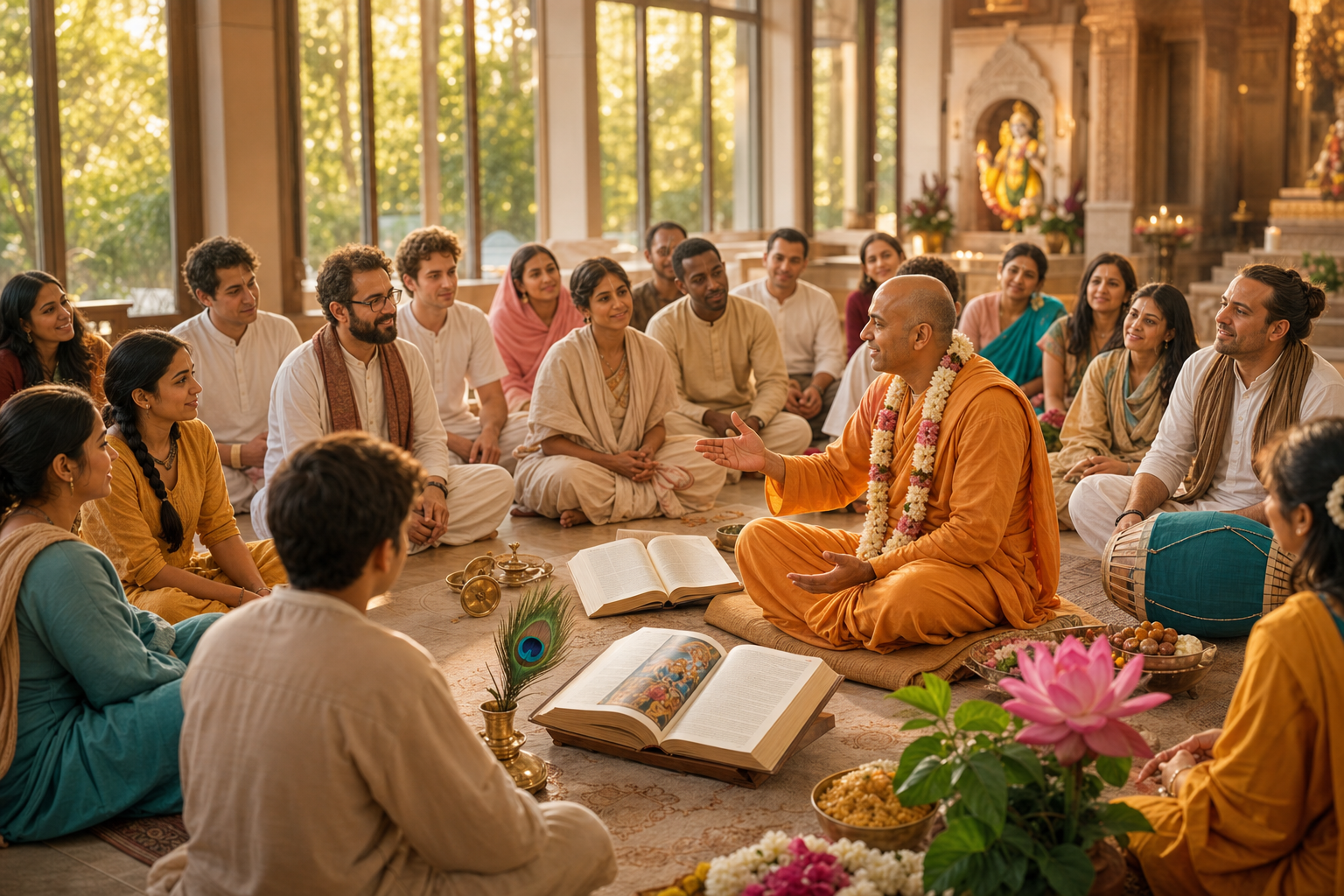
The phrase “Lead By Love,” associated with ISKCON Houston and Keshava Maharaja, points to one of the most important principles in bhakti: spiritual leadership is not domination, performance, or institutional control, but disciplined service rooted in divine love. In the Gaudiya Vaishnava tradition, love is not treated as a vague emotion. It is understood as a cultivated spiritual capacity, refined through sadhana, humility, seva, scriptural reflection, and compassionate conduct toward all living beings.
ISKCON, the International Society for Krishna Consciousness, emerged in 1966 through the work of A. C. Bhaktivedanta Swami Prabhupada, who carried the teachings of Krishna bhakti from India to a global audience. Its philosophical foundation rests in the Bhagavad Gita, the Srimad Bhagavatam, the teachings of Sri Chaitanya Mahaprabhu, and the wider Vaishnava understanding that devotion to Krishna transforms the heart. In that framework, leadership is meaningful only when it helps others move closer to dharma, self-discipline, inner clarity, and loving remembrance of the Divine.
To lead by love is therefore a technical spiritual discipline, not merely a pleasant slogan. It requires mastery over anger, pride, envy, harsh speech, and the subtle desire to be honored. A leader in bhakti is expected to become an instrument of service rather than a collector of prestige. This distinction is crucial because religious communities can easily confuse external responsibility with inner advancement. The bhakti tradition repeatedly warns that position without humility can become spiritually dangerous, while even simple service performed with sincerity can become transformative.
The Bhagavad Gita offers a precise model for this kind of leadership. Krishna does not force Arjuna into obedience. He teaches, reasons, reveals, consoles, challenges, and finally gives Arjuna the dignity of choice. The instruction concludes with freedom, not coercion. This is one of the most profound leadership lessons in Hindu philosophy: truth may be taught firmly, but it must be received through awakened understanding. Love, in this sense, respects agency while guiding the soul toward responsibility.
In contemporary community life, this principle has direct relevance. Families, temples, educational spaces, and social organizations often struggle when authority becomes transactional. People may obey out of fear, habit, social pressure, or emotional dependence, but such obedience rarely produces mature spiritual character. Bhakti leadership aims for a deeper result. It seeks to awaken voluntary dedication, where service becomes joyful because it is connected to Krishna, dharma, and the welfare of others.
ISKCON Houston, like many Hindu temples in the diaspora, functions not only as a place of worship but also as a cultural, educational, and social center. Such institutions carry a delicate responsibility. They preserve Hindu traditions in a modern Western environment, support families raising children across cultures, introduce seekers to Krishna consciousness, and provide a shared space for kirtan, prasadam, festivals, scriptural study, and seva. In that setting, “Lead By Love” becomes a practical ethic for holding a diverse community together.
Love in bhakti is inseparable from discipline. This is sometimes misunderstood. A loving leader does not avoid standards, nor does compassion mean indifference to conduct. Rather, love gives standards their proper purpose. Rules, rituals, and vows are meant to soften the heart, steady the mind, and direct human energy toward the Divine. When discipline is separated from love, it can become dry moralism. When love is separated from discipline, it can become sentimentality. Bhakti requires both.
The concept of seva is central here. Service is not simply volunteer work; it is a theological act. In Vaishnava understanding, every living being is connected to Krishna, and therefore service to others can become service to Bhagavan when performed with purified intention. This explains why prasadam distribution, kirtan, temple cleaning, teaching, hospitality, and caring for guests are not peripheral activities. They are forms of applied theology. They turn devotion into visible culture.
There is also a psychological dimension to leading by love. Human beings are shaped by recognition, belonging, and trust. A community that corrects without care produces defensiveness. A community that welcomes without guidance produces confusion. A loving spiritual culture does both: it receives people with dignity and gradually invites them into higher discipline. This balance is especially important for young Hindus and spiritual seekers who may be drawn to temple life but remain cautious of judgment, rigidity, or cultural unfamiliarity.
Gaudiya Vaishnavism places special emphasis on humility through the famous teaching associated with Sri Chaitanya Mahaprabhu: one should be humbler than a blade of grass, more tolerant than a tree, ready to offer respect to others, and free from the demand for personal honor. This is not passive weakness. It is a demanding spiritual psychology. It asks the practitioner to become strong enough not to be ruled by ego. A leader shaped by this principle becomes less reactive, more patient, and more capable of protecting unity.
The goal of such leadership also aligns with the broader dharmic commitment to harmony among Hinduism, Buddhism, Jainism, and Sikhism. These traditions differ in doctrine, metaphysics, and practice, yet they share deep concern for self-mastery, compassion, truthfulness, non-exploitation, and liberation from ego-centered living. A bhakti-centered discussion of love can therefore be offered without sectarian hostility. It can affirm Krishna devotion while respecting the wider family of dharmic paths and their contributions to spiritual civilization.
This point matters because religious identity is often discussed today through conflict, competition, or political suspicion. A dharmic approach to leadership must resist reducing spirituality to group pride. Pride may defend a boundary for a time, but it cannot purify the heart. Love, when grounded in truth, protects tradition more deeply because it makes the tradition livable, beautiful, and morally credible. Communities endure when people experience their sacred inheritance as nourishment rather than burden.
In the Bhagavad Gita, Krishna describes the qualities of a dear devotee in terms of non-hatred, friendliness, compassion, steadiness, forgiveness, and freedom from possessiveness. These qualities are not abstract virtues. They are measurable in daily interactions: how criticism is handled, how newcomers are treated, how disagreements are resolved, how elders guide youth, how volunteers are appreciated, and how leaders respond when their preferences are not followed. Love becomes real when it survives inconvenience.
The title “Lead By Love” also challenges a common modern assumption that leadership is primarily about visibility. In spiritual life, the most important leadership is often hidden. The person who arrives early to prepare the temple, the devotee who cooks with attention, the teacher who patiently explains a verse, the parent who brings children to kirtan despite fatigue, and the elder who quietly reconciles conflict all participate in leadership. Bhakti expands leadership beyond hierarchy and returns it to service.
For Hindu communities in the diaspora, this insight is particularly valuable. Temples must preserve sacred continuity while also speaking to children, converts, interfaith families, students, professionals, and seekers shaped by contemporary life. A love-based model does not dilute tradition; it translates tradition through patience, hospitality, and clarity. It allows people to approach Krishna consciousness step by step, without pretending that every person begins from the same level of knowledge, faith, or cultural confidence.
There is an emotional truth in this as well. Many people come to spiritual spaces carrying fatigue, loneliness, grief, ambition, doubt, or quiet disappointment. A temple that only instructs may not reach them. A temple that only comforts may not elevate them. The bhakti model is stronger: it offers sacred sound, prasadam, philosophy, community, discipline, and affection together. It recognizes that the heart needs both tenderness and direction.
Kirtan is one of the clearest examples of this synthesis. The chanting of the Hare Krishna maha-mantra is theological, musical, communal, and contemplative at the same time. It does not require advanced scholarship before participation, yet it carries deep scriptural meaning. In a community setting, kirtan can dissolve social distance and remind participants that devotion is not merely an idea to be debated but a shared practice to be entered.
Prasadam functions similarly. Food offered to Krishna and shared with others becomes an embodied lesson in grace. It teaches that spiritual culture is not confined to lectures or rituals; it enters the kitchen, the dining hall, the family table, and the act of feeding strangers. In many ISKCON communities, prasadam has been one of the most accessible forms of outreach because it communicates care before argument. Love becomes edible, ordinary, and memorable.
Theologically, leading by love rests on the Vaishnava understanding that the jiva is not independent in the absolute sense but eternally related to Krishna. Forgetfulness of this relationship produces anxiety, competition, and false ownership. Devotional practice restores proper identity. A leader who understands this does not see people as resources, followers, or problems to manage. They are souls to be honored, guided, and served.
This vision does not remove accountability. On the contrary, it strengthens it. Because each person is spiritually significant, harm cannot be dismissed. Love requires transparent conduct, ethical speech, protection of the vulnerable, and responsible use of authority. A mature devotional community must be able to combine reverence for gurus and scriptures with practical safeguards, honest dialogue, and humility about human fallibility.
When understood in this complete way, “Lead By Love” becomes a disciplined framework for spiritual leadership. It begins with the heart but does not end in emotion. It shapes speech, service, governance, education, worship, conflict resolution, and intergenerational transmission. It invites devotees to ask a difficult question: does leadership increase attachment to Krishna and compassion for others, or does it increase attachment to control?
The enduring relevance of this message lies in its simplicity and depth. A society can possess impressive buildings, strong programs, and large gatherings, yet still lose its spiritual center if love disappears. Conversely, even a small community can radiate power when devotion is sincere, service is humble, and people feel seen as souls. In the bhakti tradition, love is not ornamental. It is the evidence that spiritual knowledge has begun to mature.
Thus, the teaching associated with “Lead By Love” can be read as both a devotional invitation and a community standard. It calls practitioners to lead homes, temples, classrooms, friendships, and public life through seva, humility, scriptural wisdom, and respect for the sacred presence within all beings. For Krishna consciousness, this is not secondary ethics. It is the living expression of bhakti itself.
Inspired by this post on Dandavats.










Leave a Reply
You must be logged in to post a comment.