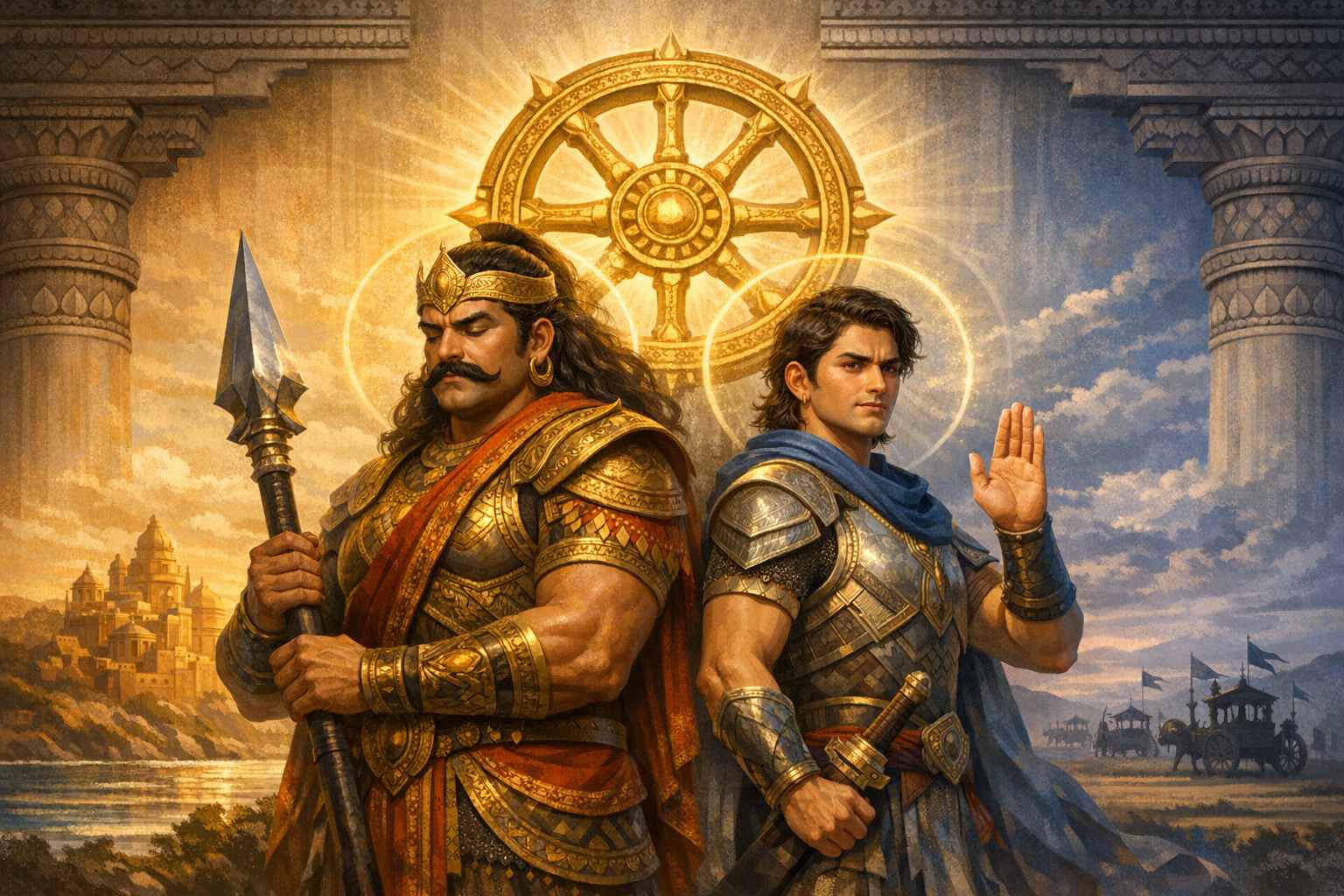
Kumbhakarna of the Ramayana and Vikarna of the Mahabharata exemplify a recurring ethical drama in Indian epic literature: the clash between unwavering loyalty to kin and the higher claims of dharma. Read side by side, these figures illuminate how “warriors of conscience” navigate kṣātra-dharma (the warrior’s code), bandhu-dharma (duty to family), and rāṣṭra-dharma (duty to the polity), even as they recognize adharma unfolding before their eyes. Their tragic nobility continues to engage readers who look to the epics for guidance on moral conflict, leadership, and righteousness under pressure.
Both characters arise at moral inflection points. Vikarna publicly questions the violations of justice in the Kuru court during the vastraharana of Draupadī, while Kumbhakarna privately admonishes Rāvaṇa in Laṅkā to return Sītā and avert ruin. Each makes the right diagnosis and gives the right counselyet each ultimately marches to war on the side he has already judged to be in the wrong. That paradox makes their stories essential case studies in Dharma and Adharma, Righteous War, and the ethics of loyalty in the Mahabharata and Ramayana.
Epic sources situate their words with stark clarity. In the Vyāsa Mahābhārata (notably in the Sabha Parva and subsequent war books), Vikarna argues that Yudhiṣṭhira could not rightfully wager Draupadī after staking and losing himself, and that humiliating a queen violates dharma and statecraft (nīti). In the Vālmīki Rāmāyaṇa (Yuddha Kāṇḍa), Kumbhakarna, newly awakened from his boon-induced slumber, rebukes Rāvaṇa for abducting another man’s wife and urges a return of Sītā to Rāma, whose righteousness (Maryādā Puruṣottama) he acknowledges.
Vikarna’s moral stand in the Kuru court has become emblematic of ethical dissent. While many elders fell into troubled silence, Vikarna spoke with dispassionate precision about dharma, possession, and due process. He recognized that a lawful order cannot be built upon humiliation and injustice. Karṇa derided him as naïve; Duryodhana ignored him. The court proceeded, and a stain marked the Kuru polity that no military victory could erase.
The poignancy of Vikarna’s character deepens on the Kurukṣetra battlefield. Despite having denounced adharma in the assembly, he nevertheless joined his brothers in warbound by bandhu-dharma, fealty to the Kuru crown, and his own kṣātra-dharma. In the ferocity of the fourteenth day’s fighting, he faced Bhīma. The exchange between them, marked by mutual recognition of Vikarna’s integrity, ended with Bhīma slaying him. The scene reads as a lament for the costs of competing duties, when a virtuous man’s allegiance ties him to a doomed cause.
Kumbhakarna’s ethical profile unfolds through a different arc. The famed boon storywhere a request for Indrāsana is confounded into Nidrāsana by Sarasvatī’s intervention, resulting in long cycles of sleepcasts him as a titan with a clouded destiny. When awakened for Laṅkā’s defense, his first instinct is not brute force but clear counsel. He indicts the policy error itself: the adharma of abducting Sītā and the inevitability of divine justice when confronting Rāma. He even anticipates strategic disaster, correctly reading the moral asymmetry of the conflict.
Yet Kumbhakarna, like Vikarna, marches to war after his counsel is rejected. He frames his choice in terms of rāṣṭra-dharma and fraternal loyalty: a vow to defend Laṅkā and his elder brother, even if the cause is lost. On the battlefield he displays extraordinary valor, fully aware that his strength cannot overturn a moral deficit. His death is not just heroic; it testifies to the tragic costs when leadership refuses ethical correction.
Together, these figures enable a precise comparison across the epics. Vikarna’s dissent is public and procedural, foregrounding juridical dharma and the legitimacy of institutions. Kumbhakarna’s dissent is private and strategic, foregrounding policy realism and the consequences of violating righteousness. Vikarna speaks in the court before war; Kumbhakarna speaks in the war’s shadow. Both diagnose adharma accurately, both confront the limits of their agency, and both accept death fighting for the very orders they had tried to correct.
The tension they embody can be modeled across several dharmic vectors: (1) ātma-dharma (dictates of conscience), (2) bandhu-dharma (loyalty to kin), (3) rāṣṭra-dharma (duty to the realm), and (4) kṣātra-dharma (the warrior’s code). Vikarna privileges ātma-dharma in counsel but bandhu- and kṣātra-dharma in action; Kumbhakarna privileges ātma-dharma in counsel and rāṣṭra- and bandhu-dharma in action. In both cases, a tragic inversion occurs when ātma-dharma yields to loyalties that bind them to compromised causes.
Seen through the lens of the Bhagavad Gita’s teaching on svadharma (one’s intrinsic duty), their choices also highlight a practical dilemma: when multiple layers of duty conflict, which duty is hierarchically prior? The Gita enjoins steadfastness in svadharma, yet the epics insist that discernment (viveka) must evaluate both means and ends. Vikarna and Kumbhakarna demonstrate that right speech without right follow-throughand right intention without right policyare each insufficient to avert catastrophe.
The Ramayana underscores that leadership ignoring truthful counsel imperils the rāṣṭra. Rāvaṇa’s refusal to heed Kumbhakarna and Vibhīṣaṇa dissolved Laṅkā’s strategic options, leaving only attritional heroism against a morally superior enemy, Lord Rāma. The Mahabharata underscores how institutional silence corrodes legitimacy; the Kuru court’s failure to protect Draupadī made the subsequent Kurukṣetra War less a contest of power than a reckoning of justice long deferred.
For readers today, these narratives offer emotionally resonant guidance. Many recognize the lived experience of Vikarnaspeaking up in rooms where power resists correctionand the predicament of Kumbhakarnaserving teams, firms, or states that refuse ethical course corrections. Their stories validate truth-telling while warning that loyalty, if detached from righteousness, converts courage into tragedy.
A comparative ethical frame also connects these lessons across dharmic traditions, reinforcing unity rather than division. In Buddhism, Right Speech and Right Action in the Noble Eightfold Path align with Vikarna’s insistence on justice and due process. In Jainism, the vows of satya (truth) and ahiṃsā (non-violence) emphasize that humiliating or exploiting the vulnerable is adharma, irrespective of expediency. In Sikh traditions, dharam yudh presupposes a just cause and moral discipline in conduct, echoing Kumbhakarna’s recognition that valor cannot sanitize an unjust policy. These convergences underline a civilizational consensus: power must be yoked to righteousness.
From the standpoint of nīti-śāstra (statecraft), both episodes reveal the cost of sidelining principled advisors. Rāvaṇa’s court diminishes strategic optionality by treating ethical counsel as weakness. Duryodhana’s circle treats legal critique as disloyalty, undermining procedural legitimacy. In both cases, inflexibility magnifies riskan axiom familiar to modern governance and corporate leadership, where cultures that punish dissent often drift toward error cascades.
Psychologically, the epics expose the grip of group loyalty and the phenomenon now termed “groupthink.” Vikarna’s isolation in the Kuru assembly shows how moral clarity can be socially penalized; Kumbhakarna’s choice shows how identity and belonging compel action even when conscience objects. Both depict cognitive dissonance resolved not by re-evaluating the cause but by overperforming the role of the loyal warrior.
Symbolically, Kumbhakarna’s cyclical sleep has often been read as the culture’s warning about dormant conscience. His brief wakingdevoted first to truth-speaking and then to sacrificial valorsuggests that recognizing adharma without institutional repentance may only allow courage to postpone, not prevent, inevitable downfall. Vikarna’s lone voice in the court functions as an ethical alarm: when dharma is silenced in assembly, it returns as destiny on the battlefield.
The two also sharpen the contours of War in Hinduism and the idea of Righteous War (dharma-yuddha). The epics insist that just ends and just means are mutually reinforcing. Duryodhana’s victory in dice, achieved through humiliation and deceit, delegitimizes his later appeals to order. Rāvaṇa’s sovereign pride cannot transmute abduction into policy. In both narratives, martial excellence without moral legitimacy is tactically impressive but strategically futile.
Leadership lessons are explicit. First, cultivate environments where truth can be spoken without reprisal; otherwise, talented advisors become tragic prophets. Second, benchmark policy against dharma, not merely against power arithmetic. Third, recognize that loyalty is a virtue only when tethered to righteousness; detached, it becomes complicity. These lessonsderived from the Mahabharata, Ramayana, and the Bhagavad Gitaare as applicable to public administration as to private organizations and civic life.
There is also a gendered dimension in Vikarna’s protest. Draupadī’s humiliation is not a private injury but a public negation of justice that weakens the state’s moral authority. A polity that cannot defend its queens, mothers, or citizens in its own sabhā is already at war with itself. Vikarna saw this clearly; his warning anticipates the Mahabharata’s relentless exposition of how adharma at home becomes disaster abroad.
Similarly, Kumbhakarna’s counsel centers the rights of Sītā and the inviolability of another’s spousebasic markers of social order in the Ramayana’s imagination. His argument is not a plea for timidity but for strategic foresight: he reads Lord Rāma as a force aligned with cosmic order and predicts the asymmetry that such alignment introduces. Valor deployed against dharma is merely a deferral of defeat.
Contrasting Vibhīṣaṇa and Vikarna is instructive. Vibhīṣaṇa’s dissent culminates in principled defection to the side of dharma, while Vikarna’s dissent culminates in loyal participation despite moral objection. The epics thus present a spectrum of ethical responses: counsel within, departure in conscience, or loyalty in tragedy. Each response is portrayed with empathy, but their outcomes place a premium on aligning allegiance with righteousness.
From a comparative civilizational perspective, these stories support unity across Hinduism, Buddhism, Jainism, and Sikhism. All four traditions prize truth, compassion, disciplined courage, and accountability. Whether framed as dharma, dhamma, vrata, or dharam, a consistent instruction emerges: when power and righteousness diverge, fidelity to righteousness ultimately safeguards the community and restores balance.
For contemporary readers seeking practical application, three practices follow. First, institutionalize ethical reviewformal forums where “Vikarna-voices” can question direction before crisis. Second, reward advisors who surface uncomfortable truths in time, echoing the value of Kumbhakarna’s admonition. Third, teach the next generation that courage includes saying “no” to unjust commands, not only “yes” to difficult tasks. Such habits translate epic insight into civic resilience.
In sum, Kumbhakarna and Vikarna are not marginal figures; they are diagnostic instruments the epics use to measure the health of leadership, institutions, and moral vision. Their stories show that dissent rooted in dharma is a form of service; that loyalty without righteousness is self-cancelling; and that valor achieves its telos only when aligned with justice. By reading them together, students of the Mahabharata and Ramayana obtain a rigorous framework for evaluating conflict, conscience, and the ethics of allegiance.
Their legacies endure because they speak to a perennial human drama: how to act when one’s heart knows better than one’s banner. The epics answer with sober claritylet speech be truthful, policy be righteous, and courage be yoked to dharma. Where these converge, communities flourish; where they diverge, even giants fall.
Inspired by this post on Hindu Blog.