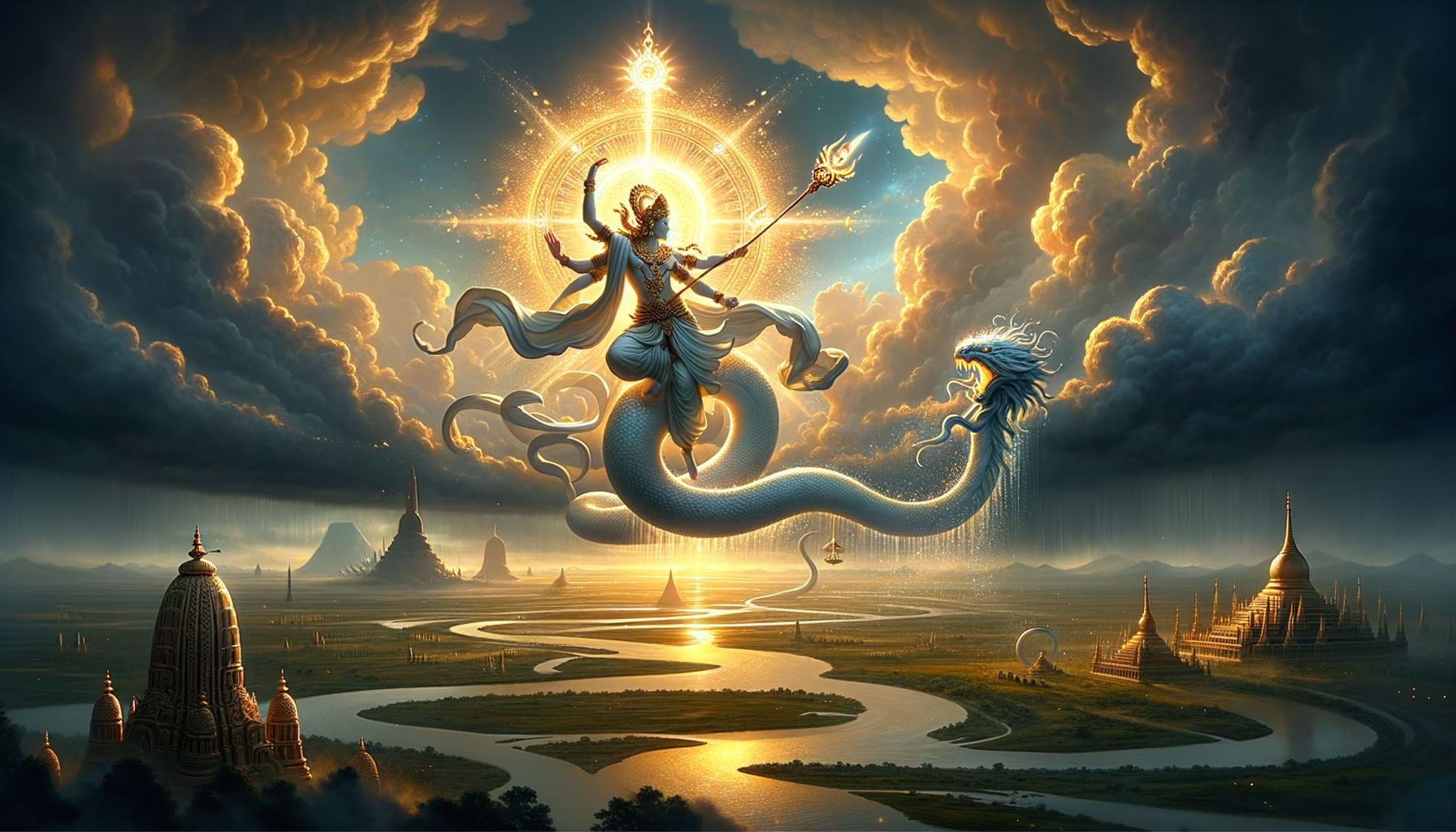
Vritrasura Samhara Murthy refers to Lord Indra as the vanquisher of the demon Vritrasura, a title that emerges from a celebrated episode in Hindu mythology where the chief of the Devas restores balance through his divine weapon, the Vajrayudha. In this narrative, Vritrasuraendowed with formidable powersoppresses the Devas and challenges cosmic order, prompting Indra to act in defense of dharma.
As preserved in Vedic and Puranic literature, Indra confronts Vritrasura with the Vajrayudha, traditionally understood as the vajra forged from the self-sacrificial bones of the sage Dadhichi. The defeat of Vritrasura symbolizes the removal of obstructionsoften portrayed as the release of waters or rainsand the renewal of life and harmony in the universe. From this decisive victory, Indra is venerated as Vritrasura Samhara Murthy, the slayer of Vritrasura.
Beyond its historical-mythic setting, the episode communicates enduring symbolic meaning. Indra represents the courageous, discerning force aligned with cosmic law (dharma), while Vritrasura personifies inner and outer impedimentsfear, pride, droughts of insight, and social discord. The Vajrayudha acts as a metaphor for unwavering clarity and ethical resolve. Readers frequently relate to this paradigm as a guide for confronting personal challenges with steadiness and integrity.
This account resonates across dharmic traditions. In Hindu thought, it exemplifies restoration of order through righteous courage. In Buddhism, the vajra signifies the indestructible truth and the thunderbolt of insight that dispels ignorancean echo of the Vajrayudha’s purpose. Jain philosophy emphasizes conquering kashāyas (passions) and inner asuras to attain self-mastery, a parallel to overcoming Vritrasura within. Sikh teachings on righteous conduct and inner strength similarly affirm the defeat of egoic obstruction and the upholding of justice. Read together, these perspectives highlight shared values of discipline, compassion, and steadfastness across Hinduism, Buddhism, Jainism, and Sikhism.
Devotees and students of the Puranas often describe a felt sense of renewal when encountering this story in temple narratives, festival recitations, or contemplative study. The imagery of Indra’s Vajrayudha inspires practical reflection: identifying the “Vritras” in daily lifeapathy, divisiveness, or despairand cultivating virtues that cut through them, such as satya (truthfulness), karuṇā (compassion), and sevā (selfless service). This lived engagement transforms a mythic victory into a framework for ethical action and inner equilibrium.
Viewed academically and devotionally, Vritrasura Samhara Murthy encapsulates the synergy of myth, ethics, and spiritual psychology. It offers a unifying lens for dharmic traditions, affirming that courage guided by wisdom can remove obstacles, restore harmony, and nourish collective well-being. As a touchstone in Hindu mythology, the epithet reminds that the thunderbolt of clarityVajrayudhabelongs to every seeker committed to upholding dharma and fostering unity.
Inspired by this post on Hindu Pad.