Day two of the Lanka war in the Ramayana is remembered for a decisive escalation in the grammar of combat: Indrajit (Meghanaada) transformed the battlefield through maya-yuddha (war by illusion) and high mastery of astras, forcing Rama’s coalition to confront not only material force but also occult strategy and psychological shock. The episode reveals how warfare in the Valmiki Ramayana unites skill, ethics, and cosmology into a single, tightly woven fabric of dharma-yuddha.
Contextually, the first engagements had already tested the Vanara army’s courage and cohesion. By the second day, Lanka’s battlements held firm, and reconnaissance suggested that Ravana’s commanders were prepared to deploy their most esoteric capabilities. It was at this juncture that Indrajit, Lanka’s supreme field general, assumed the initiative, carrying the fight into a domain where sight itself could not be trusted.
Indrajit’s reputation preceded him. The epithet “Indra-jit” (he who subdued Indra) signals an ascendant kshatra endowed with extraordinary siddhi. As sources across the Ramayana tradition recount, he combined disciplined mantra-vidya, refined astravidya (knowledge of divine weapons), and battlefield cunning to achieve effects that, to opponents, appeared preternatural. In this campaign phase, Indrajit’s signal advantage lay in rendering himself unseen, using smoke, speed, and mantra to dissolve the enemy’s visual frame of reference.
To interpret these events technically, it is essential to distinguish shastra and astra. Shastra denotes conventional arms—bows, swords, spears—operated through muscle, training, and technique. Astra denotes ritually consecrated, mantra-invoked “missiles” keyed to deities and cosmic principles—Agneyastra (fire), Varunastra (water), Vayavyastra (wind), Nagastra (serpent), and at the apogee, Brahmastra. The effective use of astras demanded concentration, ethical restraint, and correct ritual alignment.
Indrajit exploited this taxonomy expertly. Contemporary readers may liken his approach to the integration of stealth, precision munitions, and electronic warfare—tools that degrade an adversary’s senses and cohesion before massed force arrives. In the Ramayana’s idiom, the “sensor fog” was maya; the “precision strike” was the astra; the “rules of engagement” were dharma.
Accounts of day two repeatedly emphasize the terror of the unseen. Arrows whistled from nowhere; formations broke under the rain of shafts; the Vanaras scanned empty sky while the ground around them erupted. Panic is not a mere embellishment here; it is tactical effect, achieved by the systematic removal of reliable perception.
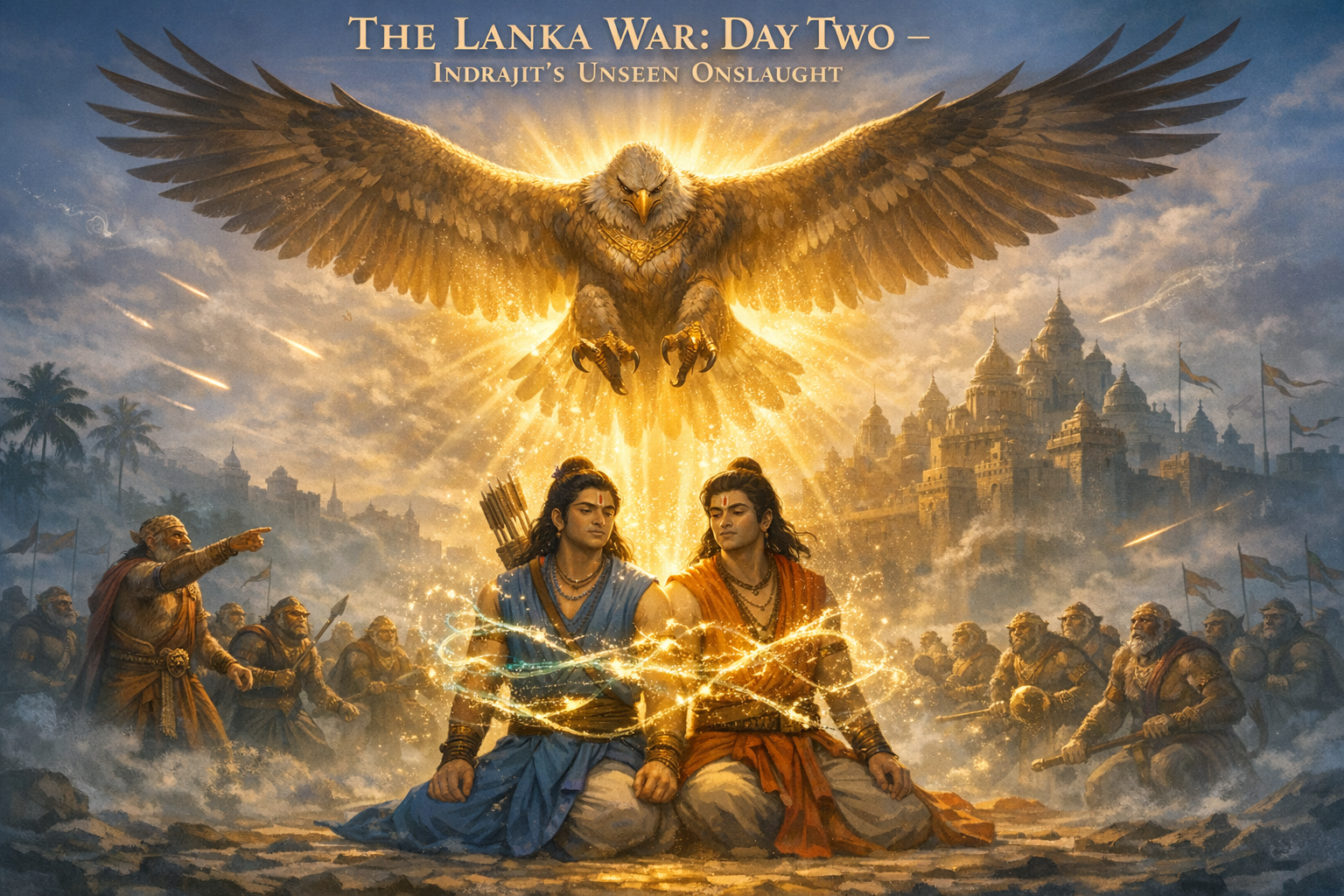
The turning point of the day arrived with Indrajit’s deployment of the Nagastra, specifically the Naga-pasha—an entangling serpent weapon whose serpentine energies bind and immobilize. Rama and Lakshmana, despite their valor and skill, were seized by coils that tightened with every effort to break free. The scene is rendered in the tradition with chilling calm: the princes, fully conscious, recognized that this was no ordinary restraint but an astral bond animated by a divine matrix.
Technically, the Naga-pasha belongs to a family of astra whose efficacy derives from invoking Naga devatas and the cosmic symbolism of the serpent: coiling energy, constriction, and the power to arrest prana and motion. In practice, it is a combined-arms instrument: it halts command elements, paralyzes morale, and opens a narrow window for decisive follow-up attacks.
The Vanara army’s immediate response reveals sophisticated battlefield discipline. Senior figures like Jambavan and Sugriva directed troops to stabilize flanks and screen the incapacitated princes without compounding losses. The lesson is classic: against a saturation of uncertainty, reduce movement, guard the center of gravity, and wait for the right countermeasure.
Rama and Lakshmana remained composed, adhering to the ethics of astra engagement. The Ramayana often indicates that rash force against a correctly invoked astra is futile or even forbidden by dharma; a right remedy must answer a right cause. Their stillness underscored a disciplined trust in dharma as the operative logic of the battlefield.
The countermeasure arrived as Garuda (Vainateya), whose very presence dissolves serpent energies. As Garuda descended, the Naga-pasha’s bindings slackened; serpents fled, and the princes rose, uninjured but chastened by the magnitude of Indrajit’s capability. This intervention is more than rescue; it is instruction. In the universe the Ramayana inhabits, forces are balanced by complementary principles, and understanding these correspondences is itself a strategy.
The ethical architecture of the engagement bears emphasis. Dharma-yuddha demands proportionality, truthfulness, and a refusal to exploit power for cruelty. Indrajit’s art lay not in violating these norms but in pressing them to their limits—testing the allied army’s cohesion without desecrating the larger frame of righteous conduct. The response—discipline, patience, and sanctioned counter—affirmed those same norms.
From a comparative Indic lens, the episode speaks across dharmic traditions. The Buddhist recognition of maya as a veiling of true perception, the Jain commitment to ahimsa as a discipline of restraint even in conflict-laden life, and the Sikh articulation of dharam-yudh (righteous struggle) as ethically bounded force find resonances here. The Ramayana’s day-two narrative thus becomes a shared Indic meditation on power guided by conscience.
Tactically, Indrajit chose timing, terrain, and tempo shrewdly. Morning light through sea-mist, city shadows, and the acoustics of fortified Lanka magnified the effect of unseen volleys. By attacking perception first, he forced the allied army to consume bandwidth on survival, not maneuver. It is a lesson familiar to modern doctrine: control the adversary’s mind, and the body of the army follows.
Intelligence rapidly became the campaign’s decisive currency. Vibhishana’s later counsel about Indrajit’s rites at Nikumbhila—how ritual preparation amplified his battlefield potency—would shape allied counter-strategy in subsequent days. Day two, therefore, is not only a story of shock; it is the prologue to a focused disruption of the adversary’s power-generation cycle.
Operational learning was immediate. The allies redistributed scouts, adjusted signal calls to confound echoing shafts, and paired archers with spotters trained to track tiny wakes of dust and foliage—the only traces of an invisible archer’s line of fire. Hanuman and Angada intensified reconnaissance, seeking not the man but the method, not the arrow but the invocation that launched it.
Reading the episode as technical literature, the Ramayana offers a taxonomy of counters: elemental neutralization (e.g., Varunastra against fire), deity-aligned antidotes (e.g., Garuda against serpents), and behavioral discipline (e.g., stillness against binding astra). Crucially, each counter is both physical and ethical, demanding right intention and right invocation.
The emotional cadence of day two is carefully scored. Awe at Indrajit’s craft shades into dread as the princes are bound, then resolves into relief and renewed resolve with Garuda’s descent. For readers and practitioners of dharmic traditions, the cycle models resilience: see clearly, respond correctly, and return swiftly to purpose.
Intertextual traditions enrich this portrait. Valmiki’s Yuddha Kanda crafts the canonical arc; Kamban’s Iramavataram heightens poetic texture; later retellings across regions sustain the strategic and ethical stakes, even as imagery varies. The constants remain Indrajit’s invisible onslaught, the Naga-pasha’s shock, and the reassertion of dharma through disciplined counter.
Symbolically, Indrajit personifies the potency of unexamined fear: when perception is clouded, even the strongest can feel bound. Garuda embodies clarifying wisdom that unknots constriction. In this reading, day two is a lesson in inner statecraft: master attention, align intention, and illusions lose their hold.
The legacy of this day extends beyond narrative. It instructs statesmanship, command, and civil life in equal measure: invest in perception, safeguard ethical boundaries under pressure, and cultivate counters that heal as they defend. In this way, the Ramayana models a unity of force and virtue that resonates across Hinduism, Buddhism, Jainism, and Sikhism.
Thus, the second day of the Lanka war stands as a pivotal chapter in the Ramayana’s strategic and spiritual education. Indrajit proved that fear can be engineered and that astras without dharma are as dangerous to their wielder as to their target. The allied response proved something greater: that clarity, restraint, and rightful aid restore balance and prepare the ground for victory grounded in dharma.
Inspired by this post on Hindu Blog.