The Ramayana’s battlefield at Lanka extends beyond visible horizons into Patala, the underworld, where the sorcerer-king Mahiravana (often rendered as Ahiravana in several traditions) is said to have engineered a daring abduction of Rama and Lakshmana. This episode, preserved richly in later and regional Ramayana literatures such as the Krittivasi Ramayana, Adbhuta Ramayana, and various South Indian oral traditions, explores themes of vigilance, maya (enchantment), and the triumph of dharma through courage and discernment. Though absent in the critical edition of Valmiki’s text, the narrative has become a powerful cultural memory, prompting close reading for symbolic and ethical insight.
Within this narrative ecology, Ravana, strained by the protracted war, seeks covert advantage. He approaches Mahiravanahis half-brother and lord of a subterranean domainwhose mastery over sorcery and illusion (maya-tantra) makes him a formidable asura adversary. The result is a conflict that unfolds not only in the physical fortifications of Lanka but also in liminal spaces of consciousness and underworld thresholds, where moral clarity and attentiveness are tested in new ways.
As the guardian of the night, Hanuman assumes the role of sentinel at Rama’s and Lakshmana’s quarters. Some traditions describe him fashioning a defensive architecture by coiling his tail into a protective domean imaginative, living fortress that functions both as a physical barrier and a subtle emblem of pranic containment. This “tail-dome” evokes the idea of an energetic kavaca (protective sheath), a motif that resonates with broader dharmic understandings of consecrated enclosures and sacred boundaries.
Despite this innovative defense, deception enters as Mahiravana assumes the persona of Vibhishana, the righteous brother of Ravana and ally of Rama. By mimicking familiar voice, gesture, and devotional cues, Mahiravana exploits the ethics of trust within a dharmic alliance. The guardian is not physically overpowered; rather, the gate is opened from withinan enduring lesson that, in dharmayuddha, a weakened inner vigilance can undo even the strongest outward ramparts.
Once inside the protective circle, the sorcerer spirits Rama and Lakshmana away along a hidden passage into Patala. There, the captor prepares a sacrificial rite to a fierce form of the Goddessvariously identified in different recensions as Chandika or Bhadrakaliseeking occult victory through ritual violence. The urgency of the moment underscores a central ethical query of the Ramayana: how dharma counters adharma when the latter cloaks itself in ritual and semblance of sacred order.
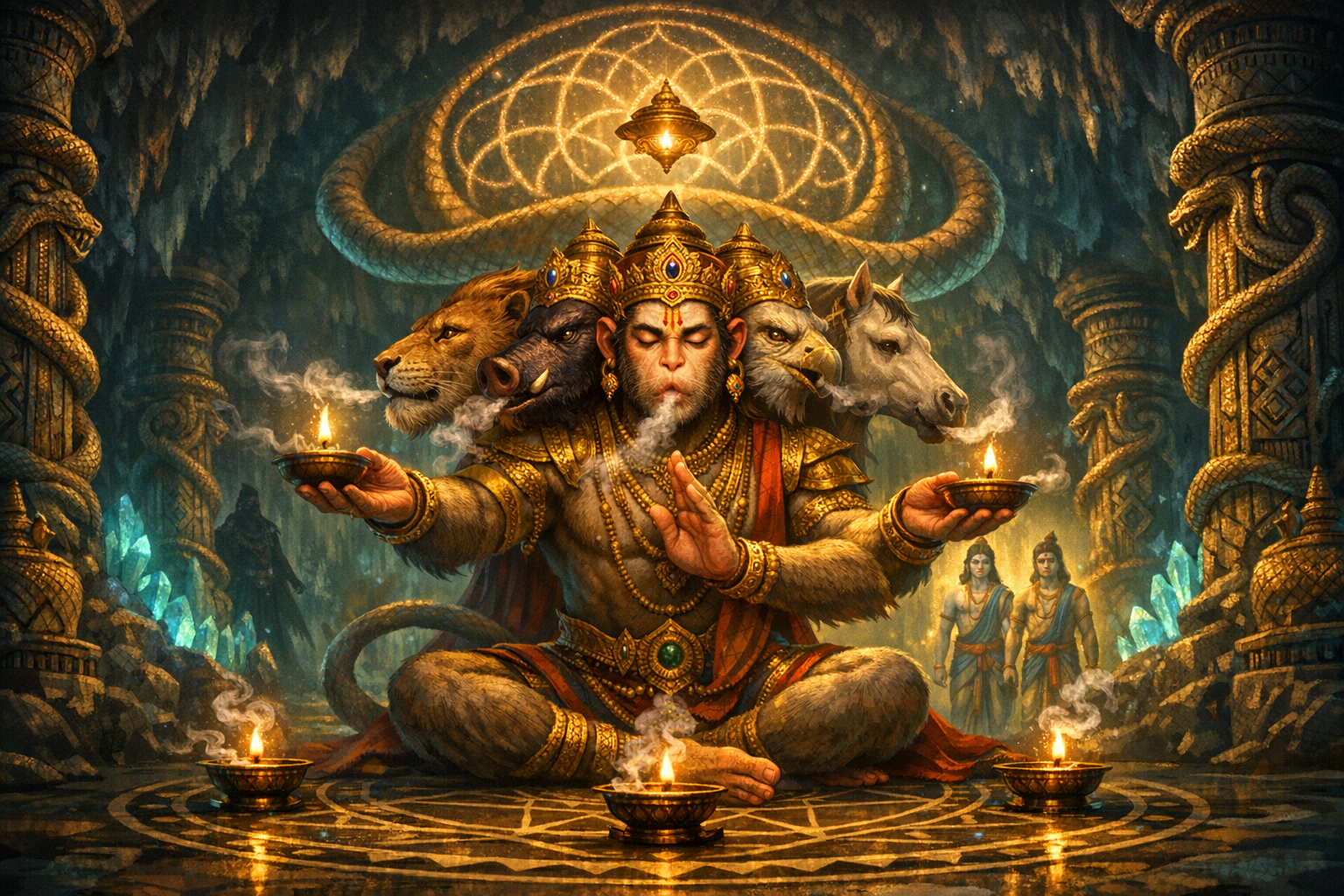
Hanuman’s realization of the ruse often unfolds in dialogue with the real Vibhishana, who discloses the otherworldly terrain and the arcane constraints binding Mahiravana’s life. The counsel centers on a precise vulnerability: the asura’s life-force is sustained by five lamps placed in cardinal directions (east, west, north, south) and at the zenith. Only by extinguishing all five simultaneously can Hanuman defeat the sorcerer. This instructional moment reflects a technical hermeneutic: dharma does not merely oppose wrongdoing with force; it studies the system, discerns the pattern, and remedies it at its governing structure.
Hanuman descends to Patala, a realm described across Purāṇic cosmology as an intricate, luminescent underworldnot a place of moral depravity by default, but a domain of different beings and energies, where deception and trial often arise. Crossing liminal guardians, ensorcelled gateways, and serpentine paths, Hanuman exemplifies strategic intelligence tightly yoked to devotion: bhakti guiding buddhi.
To meet the technical constraint of fivefold simultaneity, Hanuman assumes the celebrated form of Panchamukhi Hanumanfive-faced and oriented to multiple directions at once. The iconographic tradition commonly names these faces as Hanuman, Narasimha, Garuda, Varaha, and Hayagriva, each face indexing a distinct protective or liberative potency in Vaishnava-Shaiva devotional frames. The transformation is not spectacle alone; it is doctrinally expressive, encoding a multi-vector response to a multi-directional threat.
With the five faces aligned, the lamps are extinguished in a single, decisive act. Bereft of his life-supporting matrix, Mahiravana is overcome. The sacrificial rite collapses; Rama and Lakshmana are freed. The rescue thus concludes not as a mere contest of brawn, but as a synthesis of devotion, iconographic knowledge, and tactical precisionqualities held to be integral to dharmic accomplishment.
On returning to Lanka, the narrative re-centers vigilance. The failure that permitted abduction was not a lack of strength but the successful masquerade of adharma as trusted kin. Accordingly, the episode functions as a critical gloss on the ethics of guardianship: boundaries must be compassionate yet discerning; faith must be expansive without surrendering prudent scrutiny. In this moral calculus, Hanuman’s redemption is swift and complete, for learning and rectification arrive as quickly as the error is recognized.
Symbolically, the tail-dome merits special attention. In many devotional exegeses, Hanuman’s tail carries connotations of disciplined energy and unwavering service. Architecturally imagined as a dome, it resembles a sacred mandala or yantra that concentrates prana and intention. The breach, then, is instructive: even the most refined protective geometry must be coupled with alert awareness. Defensive form without conscious presence remains vulnerable to guile.
Textual plurality is central to responsible understanding. The Mahiravana episode represents a living layer of Ramayana reception, where communities transmit insight through regional poetics, performative arts, and temple iconography. From Bengal’s Krittivasi Ramayana to South Indian folk tellings, the thematic constantsdeception unmasked by wisdom, multi-directional vigilance, and the confluence of bhakti and strategypreserve a shared ethical architecture even as details vary.
The episode also speaks to a wider dharmic commonwealth. Protective circles, consecrated enclosures, and kavaca-like prayers appear in Hindu, Buddhist, Jain, and Sikh contexts, each emphasizing compassionate vigilance and the safeguarding of truth. Whether encountered as paritta in Buddhist practice, as the disciplined vows and ethical enclosures of Jain tradition, or as Sikh reflections on seva, courage, and steadfast remembrance of the Divine, the shared ethos highlights unity across distinct paths: strength tempered by compassion, devotion guided by discernment.
Culturally, many remember hearing this tale during festivals such as Ram Navami or Hanuman Jayanti, or through regional theatre forms like Yakshagana and Ramleela. The emotional connection endures because it addresses common human experiences: the pain of betrayal, the urgency of rescue, and the relief of reunion. The narrative invites readers to reflect on everyday guardianshipof families, communities, and inner integrityand on how steadiness of heart must pair with clarity of mind.
From a technical-ethical perspective, three takeaways stand out. First, deception often co-opts the language of trust; therefore, dharma requires lucid attentiveness. Second, strategy aligned with devotionexemplified by Panchamukhi Hanuman’s precise fulfillment of a complex constraintdelivers effective, non-chaotic resolution. Third, protective architectures, whether ritual, ethical, or communal, flourish when anchored in both compassionate inclusion and judicious boundary-setting.
In sum, the abduction and rescue in Patala form a compact school of dharma: a case study in how vigilance, knowledge, and courage converge. Hanuman’s tail-dome symbolizes inspired protection; Mahiravana’s deception warns against unexamined familiarity; the five-lamp riddle demonstrates the value of systemic insight. As an enduring parable within the Ramayana’s vast tapestry, the episode continues to nurture unity across dharmic traditions by reminding all paths that compassion, wisdom, and steadfast service belong together.
Inspired by this post on Hindu Blog.