Makaradhwaja occupies a compelling niche in the Ramayana tradition as the unexpected “son of Hanuman,” born not through ordinary procreation butaccording to widely circulated later tellingsfrom the sweat that fell when Hanuman cooled his flame-wreathed tail in the ocean after the Lanka Dahana. Read through the lens of dharma and karmaphala, this narrative presents a profound meditation on how even righteous action can generate unanticipated, morally binding consequences that must be recognized, integrated, and redeemed.
The setting is the Sundara Kanda, where Hanuman, sent to locate Sita, endures humiliation when Ravana’s forces set his tail ablaze. The apparent defeat is transformed into strategic triumph: Hanuman turns the fire back upon Lanka, illuminating the asymmetry between adharma and moral courage. In the aftermath, when the conflagration is quenched in the sea, a dropvariously described as sweat or a subtle essencemeets the waters and seeds a life that will later be named Makaradhwaja.
Classical philology and textual history suggest caution in source attribution. The Valmiki Ramayana does not mention Makaradhwaja. Instead, the motif surfaces in later and regional Ramayana traditions such as the Krittivasi Ramayan, the Adbhuta Ramayana, and the Ananda Ramayana, as well as in popular retellings and folk performance traditions. These strata of narrative development are characteristic of the living, plural Ramayana corpus, in which upa-kathas (subsidiary tales) expand ethical and theological reflection beyond the core itihasa.
The name itself encodes layered symbolism. “Makara” denotes an aquatic beingvariously rendered as crocodile, sea-monster, or composite totemlong associated in Hindu iconography with Varuna, Ganga, and the emblem (dhwaja) of Kamadeva. “Dhwaja” signals standard, identity, and proclamation. Makaradhwaja thus reads as the standard raised from the oceanic depthsan identity summoned into visibility by the heat and sweat of tapas-like action.
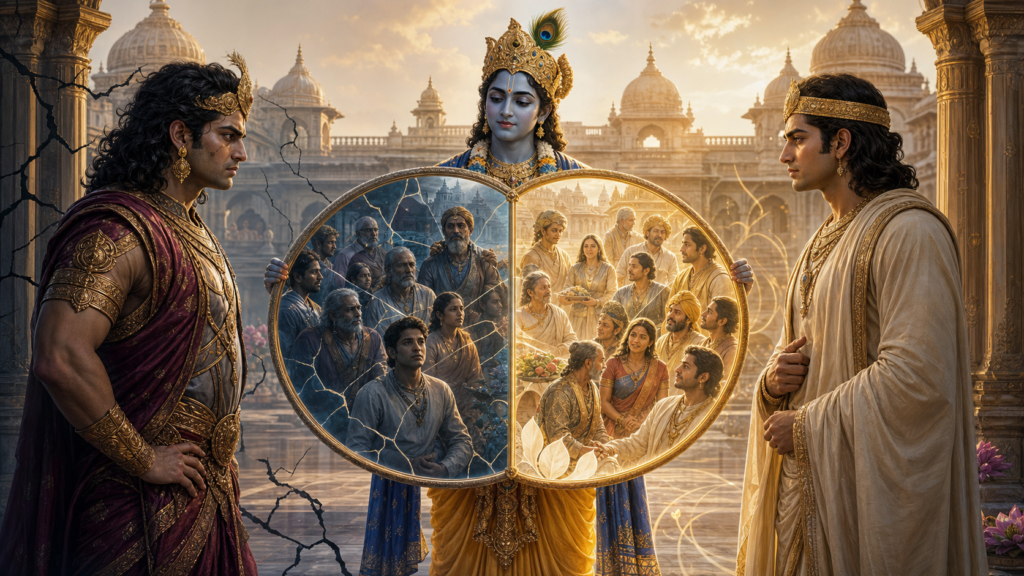
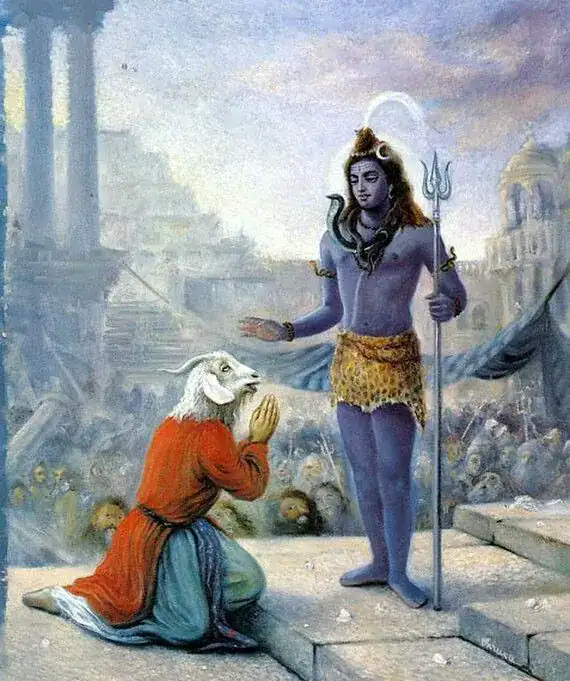
In many narrative variants, Makaradhwaja is discovered at the gates of Pātāla while guarding the realm of Ahiravana (also called Mahiravana), a subterranean adversary who abducts Rama and Lakshmana. Unaware of their kinship, Hanuman and the youthful sentinel meet in combat. Only later, through tokens, omens, or the very logic of dharma, does recognition dawn: the two are father and son, bound by a paradox that tests vows, ethics, and the fabric of familial duty.
These episodes typically culminate in Hanuman’s victory over Ahiravana and the restoration of Rama and Lakshmana, with Makaradhwaja’s role transformed from obstacle to ally. Some tellings even invest him with rulership or custodianship in Pātāla, suggesting that karmaphalafar from being only punitivecan ripen into stewardship, responsibility, and right order once illuminated by discernment (viveka) and anchored in dharma.
The doctrine of karmaphala in Hindu thought is not merely retributive; it is formative and pedagogical. Actions (karma) leave impressions (samskaras), mature into fruits (phalāni), and curve back into one’s moral horizonsometimes as relationships and duties rather than as obvious reward or reproof. Read this way, Makaradhwaja becomes karma made flesh: the embodied echo of Hanuman’s tapas, courage, and catalytic agency in Lanka.
Importantly, the tradition does not compromise Hanuman’s brahmacharya. The birth “from sweat” communicates a metonymic truth: the heat of heroic service yields consequences, yet without violating the theological profile of Hanuman as an exemplar of devotion (bhakti), self-mastery, and single-pointed loyalty to Sri Rama. In symbolic grammar, sweat signifies exertion and tapas, the ocean connotes the boundless substratum (apas), and the makara embodies liminal depthstogether generating a life that must be acknowledged and guided into dharmic purpose.
This hermeneutic is strengthened by elemental symbolism. Agni (fire) purifies and reveals; Vayu (wind, Hanuman’s own lineage) carries and enlivens; Apas (water) receives, transforms, and births. The Lankā Dahana is Agni’s revelation of adharma. The ocean’s reception of heat and sweat is Apas’ transformative matrix. The meeting at Pātāla unfolds where hidden forces, choices, and identities await discernment. Hanuman’s ensuing actions are Vayu’s decisive, life-restoring movement.
Across the wider Dharmic family, cognate insights resonate. Buddhism emphasizes intentionality (cetana) and the conditioned arising of consequences; Jainism details karma’s material subtlety binding to the jīva; Sikhism stresses action aligned with Naam and truthful living. While doctrinal vocabularies differ, a shared intuition emerges: deeds echo, and ethical clarity must subsequently convert echoes into responsibility. In this spirit, Makaradhwaja’s tale invites unity in reflection among Hindu, Buddhist, Jain, and Sikh readers on the responsibility that follows from transformative, even righteous, action.
Philologically, the evolution of the narrative illustrates how Puranic and regional Ramayanas interrogate and extend the ethics of the Valmiki storyline. By staging a father–son duel unknown to the earlier text, later poets dramatize the collision of abstract principle with concrete duty. The plot’s emotional intelligence lies in allowing astonishment, resistance, and finally integrationthe very steps communities and individuals often traverse when confronted by the fruits of their own endeavors.
Iconographic and ritual footprints of Makaradhwaja persist in several regions. Devotees point, for example, to Hanuman Dandi at Beyt Dwarka in Gujarat and to shrines in parts of Odisha and Rajasthan where Makaradhwaja is venerated. These sites extend the Ramayana’s moral geography beyond Ayodhya and Lanka into littoral and subterranean imaginaries, where water, depth, and guardianship become central tropes.
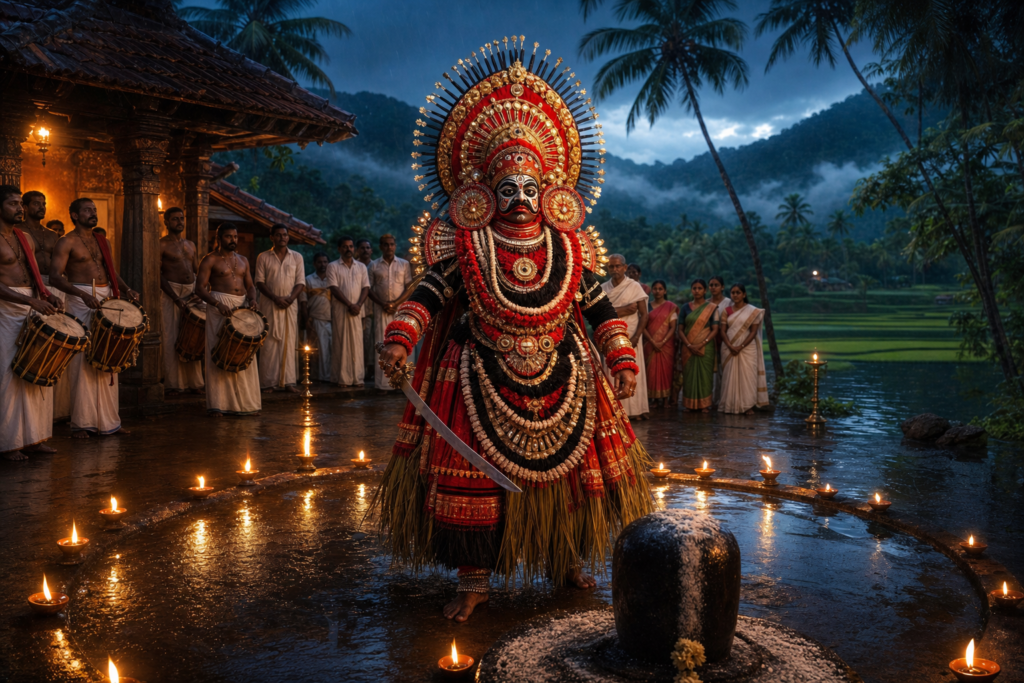
Performance traditions have preserved and popularized the Ahiravana cycle and the encounter with Makaradhwaja. Rām Līlā troupes in North India, as well as Yakshagana and Chhau in parts of the peninsula and east, have dramatized these episodes, using martial choreography and dialogic exposition to make the philosophical point vivid: valor without the humility to accept karmaphala will miss its own fuller measure of dharma.
Ethically, the tale pivots on two decisions: first, Hanuman’s conversion of humiliation into just action during the Lankā Dahanaa paradigm of Dharma-Yuddha; second, the acceptance and redirection of karmaphala when faced in the person of Makaradhwaja. Power is here tempered by guardianship; victory by mentorship; triumph by the establishment of order.
From a leadership perspective, the narrative suggests an enduring lesson. Successful interventionswhether in family, community, or public lifebeget new obligations. The “sweat” shed in crises may crystallize later as dependent relationships, institutional commitments, or moral debts. Recognizing them is not failure but fidelity to the arc of responsibility set in motion by earlier choices.
At the same time, the encounter underlines a principle central to Ramayana ethics: identity is not exhausted by origin. Although Makaradhwaja’s birth is wondrous, the crux is not biological descent but the cultivation of rightful disposition (samskara) and role (svadharma). Hence variants that invest him as a guardian articulate the transformation of mere origin into office, secured by dharmic sanction.
For many devotees and readers, the emotional force of the tale lies in the shock of recognition: the hero meets a consequence he did not anticipate, and the heart must widen to include it. That recognition births tenderness, instruction, and structurethe affective and institutional supports without which victory remains brittle. The story thus aligns valour with care, and conquest with community.
This integrative reading coheres with the broader Puranic method, wherein allegory and event co-operate. The oceanic birthing of Makaradhwaja places karmaphala in the realm of the subtle and the liminal, suggesting that not all consequences are immediately visible. The subterranean theatre of Pātāla teaches that some reckonings unfold in depth, demanding patience, skill, and sustained ethical attention.
Within the comparative Ramayana archive, such expansions are not anomalies but expected pathways through which communities shape memory toward pedagogy. The Krittivasi Ramayan and cognate sources press moral questions that the core Valmiki narrative leaves tacit, affirming a civilizational preference for plurality, dialogue, and layered meaning rather than rigid singularity.
In a world wrestling with conflict and polarization, the episode’s relevance is clear. Actions taken in the heat of strugglehowever necessarygenerate long shadows. Dharma is fulfilled not only in decisive intervention but in the wise tending of what those interventions set into motion. By elevating Makaradhwaja from antagonist to entrusted guardian, the tradition models this fullness.
Thus, “Makaradhwaja, Son of Hanuman from His Sweat” is best understood as an ethical theophany: the karmaphala of righteous fire returning as a relational call. To accept, dignify, and guide that call toward order is to honor both the courage that lit the fire and the compassion that completes its work.
Read alongside the core themes of the Ramayanadevotion to Sri Rama, fidelity in friendship, discernment in crisisthe Makaradhwaja motif enriches rather than competes with the canonical arc. It extends Sundara Kanda’s luminous energy into a meditation on aftermath, responsibility, and the guardianship that sustains justice once achieved.
In sum, the narrative invites a unified Dharmic reflection: right action must be joined to right aftermath. Hindu, Buddhist, Jain, and Sikh wisdom converge here on a simple but exacting truthkarma ripens, and the ripened fruit calls for courageous, compassionate stewardship. Makaradhwaja stands at that threshold as the banner from the deep, asking that the fire of victory be completed by the water of care.
Inspired by this post on Hindu Blog.