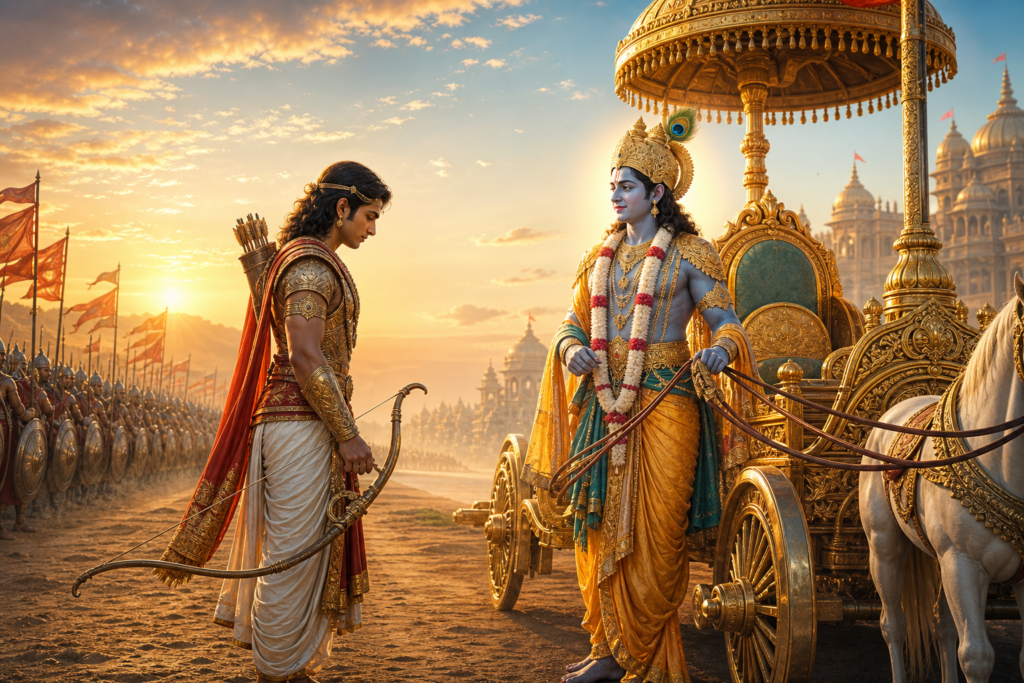
On the third day of the Ramayana war, remembered in many recitational traditions as the moment when divine composure met demonic rage, Rama and Ravana stood face-to-face for the first time. The scene has endured as a powerful emblem of dharma confronting adharma, not through bluster, but through restrained strength, ethical clarity, and mastery of statecraft and warcraft.
Placing this encounter within the textual landscape is essential. The Valmiki Ramayana’s Yuddha Kanda distributes the Lanka campaign over several days and duels, with the decisive battles between Rama and Ravana occurring later. Yet, a number of narrative lineages and oral tellings frame an earlier, briefer confrontation around the third day as the first direct meeting on the battlefield. This study adopts that lens while acknowledging variation across regional retellings such as the Kamba Ramayanam and the Ramcharitmanas, as well as later commentarial traditions.
The setting was the theatre of war outside Lanka’s ramparts. Vanara formations pressed in waves, testing the fortifications, while Lanka’s crack units sallied forth in sorties. The air carried the clang of steel and the hum of arrows, punctuated by conch-blasts and war drums. In that charged environment, the impending meeting of Rama and Ravana drew the attention of allies and adversaries alike.
The confrontation did not begin as a scheduled or sacralized duel. Ravana, enraged by early setbacks and the erosion of his psychological advantage, surged out to assert dominance and to dismantle the morale of the vanara coalition. Rama did not advance from vanity or wrath; he moved to the fore because kshatra dharma obliges a ruler to protect allies, stabilize the field, and uphold order even amid chaos. In this, his maryada and measured agency contrasted sharply with Ravana’s ahamkara.
The opening exchanges were an education in archery, chariot maneuver, and battlefield assessment. A storm of shafts tested armor, reflexes, and attention. Rama’s arrows flew with economy and precision, guided by mantra and mind, each shot chosen for function rather than spectacle. Ravana’s counters were powerful, sometimes flamboyant, manifesting strengths in speed, volume, and intimidation.
Even in a brief engagement, the grammar of astra-vidya surfaced. Agneyastra called forth flame; Varunastra quenched it. Vayavyastra scattered volleys; Parjanyastra thickened the air. The duel revealed not only personal prowess but a layered science: selection, sequencing, and neutralization of astras according to circumstance, terrain, and timing. In each exchange, Rama favored calibrated responses that tamed the crisis without needless escalation; Ravana often sought to overwhelm by force and fear.
Ethics governed the encounter as much as skill. The Ramayana’s war is a dharma-yuddha, animated by rules that disdain strikes on the unarmed, prohibit assaults at certain hours, and respect the intrinsic dignity of a worthy foe. Those protocols shaped both the tempo and the limit of violence. The encounter on day three, like many in the Yuddha Kanda, unfolded within those boundaries, reminding that means matter as much as ends in dharmic statecraft.
This early face-off also clarified leadership styles. Rama’s core was composure: situation awareness, non-reactivity, and protection of noncombatants behind the lines. Ravana’s center of gravity was fury accelerated by pride, a leadership posture that can produce short bursts of dominance yet often erodes coalition cohesion and strategic foresight. Read as political theory in motion, the exchange illustrates that kshatra dharma prioritizes restraint yoked to capability, not bravado untethered from prudence.
From the perspective of martial technique, the scene recalled the classical literature of Dhanurveda preserved across Purana and Smriti layers: stance and breath, sighting and release, anticipating an opponent’s pattern, and knowing when not to shoot. Chariot craft mattered too: wheel-arc calculations, pivot windows, and the dialogue between warrior and charioteer. In such details, the Ramayana treats war as a composite disciplinetactical dexterity anchored in ethical axioms.
The rhetoric of the fieldtaunts, cautions, and moral argumentformed a parallel skirmish. Ravana proclaimed sovereignty resting on conquest and fear; Rama consistently held that sovereignty rests on justice and consent, and that adharma corrodes the very throne it seeks to guard. In this sense, arrows and arguments flew together: one contested bodies and space; the other contested legitimacy and memory.
As the sun declined, war protocol required a pause. Chariots drew back, archers lowered bows, and commanders recalibrated dispositions for the next phase. The encounter ended without a final resolution, but not without consequence: both sides had measured each other. In many tellings, this day-three meeting seeded the tactical adjustments and spiritual resolve that would define the climactic duels when Indra’s charioteer Matali later guided Rama’s chariot and the final balance tipped.
Interpreted through the lens of guna theory, Rama’s conduct embodied sattvaclarity, balance, and benevolence expressed through strengthwhile Ravana’s rage reflected a rajas-tamas complex of agitation mingled with ethical obscuration. The encounter thus operates on two planes at once: a historical-mythic battlefield and an inner battlefield where clarity must master compulsion, and discernment must domesticate appetite.
Across dharmic traditions, the scene resonates in complementary ways that invite unity rather than rivalry. The Hindu Ramayana places dharma at the heart of victorious kingship; Buddhist retellings often elevate the primacy of self-mastery and compassion; Jain narratives such as the Paumacariya explore ahiṃsā and karmic law with distinctive emphases, sometimes reassigning who strikes the final blow, yet aligning with the conviction that pride invites downfall. Read together, these traditions offer a harmonized reflection: true power is ethical, self-governed, and accountable to cosmic order.
For practitioners and readers today, the encounter serves as leadership meditation. Composure under fire, a refusal to be baited, and loyalty to allies are not only battlefield virtues but civic ones. Many recall hearing this episode during temple recitations or festival gatheringsRam Navami, Deepavali lectureswhere the pause at sunset is felt as a pause within the heart, a reminder that strength without restraint is not strength at all.
Strategically, the day-three face-off underscores a timeless principle of conflict: early engagements shape the vocabulary of later victory. Rama’s measured responses forced Ravana to expend energy and reveal tendencies; such revelation would inform subsequent counters and, finally, a conclusive, code-bound triumph. The war thus models a sequence: contain, comprehend, and only then conclude.
In the end, this first encounter is memorable less for who ‘won the day’ than for what it revealed: two archetypal approaches to power meeting in the open. One held that order arises from dharma; the other, that order can be commanded by force alone. The Ramayana’s enduring verdict, shared across Hindu, Buddhist, Jain, and Sikh ethical sensibilities, is that order without virtue is fracture in waiting.
Read as scripture, as statecraft manual, or as an inner guide, the day-three confrontation distills the Ramayana’s central promise: when dharma stands firm and skill serves conscience, fury cannot finally prevail. That is why this momentwhen divine composure met demonic ragestill instructs, consoles, and unites seekers across the dharmic family today.
Inspired by this post on Hindu Blog.