
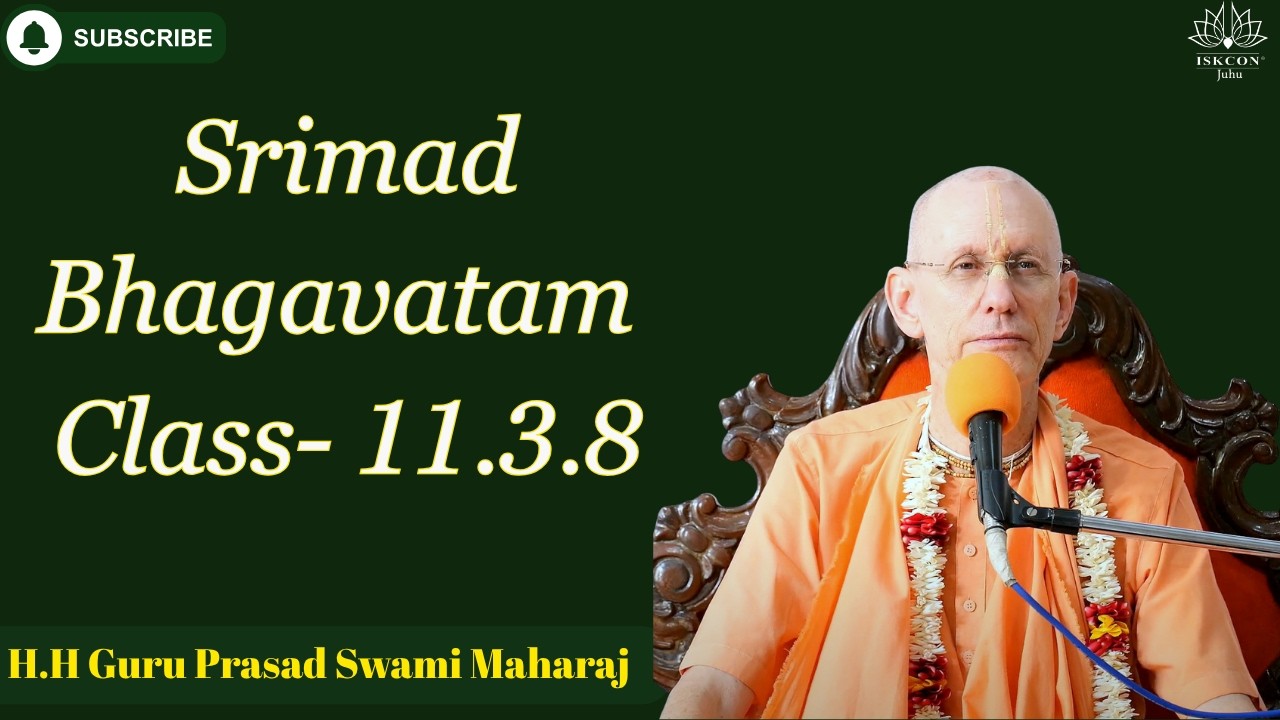
Srimad Bhagavatam 11.3.8 came into sharp focus in a class delivered by H.H. Guru Prasad Swami on 31 March 2026, where two expressions of the unlimited were juxtaposed with precision: rasathe ever-fresh devotional experience of Krishnaand tattvathe equally boundless architecture of philosophical truth that elucidates the material and spiritual worlds. Rather than opposing poles, these are mutually intensifying dimensions of reality, each deepening the other, while in the material domain kāla (time) underwrites all change, decay, and sequence.
Within the Eleventh Canto of the Bhagavata Purana, the dialogue of the Navayogendras with King Nimi provides an ideal setting for this analysis. The canto integrates ontology, cosmology, and praxis; verse 11.3.8, in particular, orients the listener toward bhakti’s lived experience even as it presupposes a robust grasp of tattva. The result is a pedagogical method that moves from accurate seeing (tattva-darśana) to transformative tasting (rasa-āsvāda).
The term rasa, in the bhakti tradition, signifies a relational savoring of the Divine. Rooted in Bharata Muni’s aesthetic theory and refashioned theologically by Śrī Rūpa Gosvāmi, rasa in Gaudiya Vaishnavism denotes the distilled essence of love between the jīva and Bhagavān. It is not sentimentality; it is structured, cumulative, and precise, arising when a stabilized disposition (sthāyī-bhāva) is energized by stimuli (vibhāva), expressed in signs (anubhāva), and elevated through transitory states (vyabhicārī-bhāva). In the case of Krishna-bhakti, this synthesis yields a devotional relish that practitioners consistently describe as inexhaustibly new (nava-navāyamāna).
Five primary rasasśānta (reverential quietude), dāsya (servitorship), sakhya (friendship), vātsalya (parental affection), and mādhurya (conjugal love)frame the spectrum of enduring relationships with Krishna, while secondary rasas such as hāsya (comedy), adbhuta (wonder), vīra (heroism), karuṇa (compassion), raudra (wrath), bhayānaka (fear), and bībhatsa (disgust) provide tonal color. In the transcendental realm (Vaikuṇṭha and Goloka), these exchanges are aprākṛtabeyond the three guṇas and untouched by the diminishing influence of timeso their variety and sweetness expand without satiety or entropy.
By contrast, tattva addresses what reality is and how it coheres. In the Bhagavata Purana and allied Vedic philosophy, the primary explanatory set often includes īśvara-tattva (the Supreme Person), jīva-tattva (the conscious selves), prakṛti-tattva (material nature), kāla-tattva (time), and karma (causal moral law). This integrates with the Sāṅkhya map of the 24 principles (tattvas) that arise from prakṛti, while distinguishing the unique status of īśvara and jīva. Gaudiya Vaishnava theology gathers these strands within the doctrine of acintya-bhedābhedaan inconceivable simultaneity of oneness and difference that preserves both divine immanence and transcendence.
Both rasa and tattva are unlimited, but in different registers. Tattva is unlimited because truth about the Absolute and its energies unfolds without exhaustion: every categoryīśvara, jīva, śakti, māyā, and kālaadmits finer distinctions and deeper synthesis. Rasa is unlimited because love of Krishna, once awakened, generates endlessly novel permutations of intimacy, service, and remembrance. In practice, tattva stabilizes and safeguards rasa from sentimentality, while rasa prevents tattva from remaining sterile or merely conceptual.
Srimad Bhagavatam 11.3.8 gestures toward the centrality of bhakti as the telos of philosophical inquiry, echoing the canonical axiom, “sa vai puṁsāṁ paro dharmo yato bhaktir adhokṣaje; ahaituky apratihatā yayātmā suprasīdati,” wherein devotion to the Transcendent Person, causeless and unobstructed, alone satisfies the self. In this hermeneutic, correct understanding (sambandha-jñāna) leads to effective practice (abhidheya), whose fruit (prayojana) is realized as rasa.
Time (kāla) is the crucial mediator in the material world. The Bhagavata Purana consistently presents kāla as a distinct potency of Bhagavān that governs sequence and transformation, while the Bhagavad-Gītā’s revelatory “kālo ’smi loka-kṣaya-kṛt” underscores time’s inexorable role as the devourer of all compounded forms. Kāla impels manifestation from subtle to gross, accelerates change through the guṇas, and draws all embodied beings toward periodic dissolution.
Vedic cosmology specifies time scales both intimate and vast. At the macro level, the four yugasSatya (1.728 million years), Tretā (1.296 million), Dvāpara (864,000), and Kali (432,000)compose a mahāyuga of 4.32 million years. One thousand such mahāyugas constitute a day of Brahmā (4.32 billion years), followed by an equally long night. These cycles scaffold creation, maintenance, and dissolution, ensuring that in the material world nothing escapes the choreography of kāla.
In the spiritual domain, by contrast, time does not corrode or constrain; it serves līlā rather than terminating it. Vaikuṇṭha is described as free from fear and decay, a realm where “no anxiety” characterizes existence precisely because time’s destructive function is absent. There, remembrance of Krishna intensifies without the fatigue, forgetfulness, or loss that mark material memory. Thus the expansion of rasa is unthreatened by entropy.
These distinct modalities of time explain why the same spiritual discipline feels different across planes. In the material realm, practitioners experience fluctuationenthusiasm and fatigue, clarity and fogbecause kāla, guṇas, and karma braid together to shape perception. In the spiritual realm, the same actsśravaṇa (hearing), kīrtana (chanting), and smaraṇa (remembering)unfold as unending freshness, the signature of liberated love.
H.H. Guru Prasad Swami’s emphasis on the “two unlimiteds” helps clarify a frequent confusion: knowledge is not a terminus, nor is experience a substitute for truth. Tattva identifies the subject, object, and means of knowing; rasa reveals why knowing culminates in loving. When a listener grasps this complementarity, the study of Srimad Bhagavatam 11.3.8 becomes not only intelligible but irresistible in its promise of integration.
Technically, rasa maturation follows a disciplined pathway. Regulated devotion (vaidhī-bhakti) purifies the heart; taste (ruci) and attachment (āsakti) arise; stable emotion (sthāyī-bhāva) consolidates; and, through Krishna’s grace and saintly association (sādhu-saṅga), bhāva flowers into prema. At each stage, tattva protects from projection and misattributionensuring, for instance, that aesthetic thrill is not mistaken for spiritual progress, and that humility (amanitva) rather than pride marks advancement.
Tattva-study itself is multi-layered. Beyond the Sāṅkhya enumeration and the fivefold explanatory set (īśvara, jīva, prakṛti, kāla, karma), the Bhagavata elaborates śakti-tattva (internal, external, and marginal energies), avatāra-tattva (modes of divine descent), and bhakti-tattva (the epistemic priority of devotion). Acintya-bhedābheda offers a meta-framework in which paradox is neither denied nor irrationalized but affirmed as integral to divinity’s freedom.
For contemporary practitioners, this architecture yields practical counsel. Immersion in śāstra (Bhagavad-Gītā, Upanishads, the Sandarbhas, and the Bhagavata Purana) steadily aligns understanding; daily nāma-saṅkīrtana kindles rasa; and service imbues knowledge with tenderness. What listeners often reportgreater inner quiet, refined moral intuition, and a deepening sense of Krishna’s presencecorresponds exactly to the tradition’s forecast when tattva and rasa mature together.
Importantly, the complementarity of experiential and philosophical truth resonates across dharmic traditions. Buddhism articulates conventional and ultimate truths (saṁvṛti-satya and paramārtha-satya), inviting both disciplined analysis and meditative realization. Jainism’s tattva-saptaka (seven tattvas) offers a meticulous map of bondage and liberation that balances insight and practice. Sikh thought extols the Timeless OneAkalwhile evoking spiritual savor (ras) in the remembrance of the Divine Name. Although theological content differs, the shared commitment to uniting clear seeing with transformative experience fosters authentic pluralism and strengthens unity among Hinduism, Buddhism, Jainism, and Sikhism.
Such unity is not a flattening of distinctions but a celebration of convergent aspirations: truth sought without dogmatism, devotion offered without exclusion, and time understood as the context, not the tyrant, of spiritual growth. This vision aligns seamlessly with the Bhagavata’s own inclusivist spirit, where wisdom and love are presented as universally human possibilities.
Kāla’s role, finally, is pedagogical. In the material sphere, it exposes the fragility of all provisional sheltershealth, status, even cherished ideasthereby redirecting the heart toward what is deathless. In the spiritual sphere, it becomes the gentle rhythm of līlā, organizing but never eroding devotion’s sweetness. Recognizing this double valence of time helps a reader of Srimad Bhagavatam 11.3.8 locate courage in impermanence and constancy in the imperishable.
From H.H. Guru Prasad Swami’s presentation emerge three durable insights. First, pursue tattva with rigor; clear categories prevent confusion and stabilize practice. Second, seek rasa with humility; love matures gradually and blossoms by grace. Third, interpret time rightly; in the world it disciplines and disillusions, in the spiritual realm it serves joy. When these insights animate study and sādhanā, the verse ceases to be an object of analysis and becomes a doorway to realization.
Thus, Srimad Bhagavatam 11.3.8 stands as a masterclass in integration. It teaches that ultimate truth (tattva) and ultimate love (rasa) are not parallel tracks but a single, spiraling ascent toward Krishna, in whom knowledge becomes intimate and intimacy becomes luminous with knowledge. Understood this way, the contrast between the two “unlimiteds” is not resolved by choosing one over the other, but by allowing both to expand togetherbeyond the reach of kāla’s decay, within the radiance of eternal consciousness and bliss.
Inspired by this post on Dandavats.
