Srimad-Bhagavatam (SB) 2.7.17 distills a moment of profound theological significance: upon hearing an elephant’s desperate plea, the Personality of Godhead responds immediately, arriving on the wings of the king of birds, Garuḍa, bearing the divine wheel (cakra). With that very wheel He “cut to pieces” the peril that bound the supplicant, epitomizing swift, compassionate intervention in response to sincere surrender.
Considered within the narrative arc of SB 2.7, this verse belongs to a sweeping overview of the Lord’s saving acts recounted to King Parīkṣit. Its terse, vivid phrasing emphasizes responsiveness: distress voiced in trust meets a decisive, protective descent. This is not merely narrative; it functions as a doctrinal affirmation that the divine remains accessible to beings in crisis, answering the language of need with the grammar of grace.
The episode alludes to the famed Gajendra-mokṣa narrative presented at length in SB 8.3–8.4, where the Lord liberates the elephant king Gajendra from a crocodile’s grip. Canto 2 offers the compressed theological essence, while Canto 8 unfolds the experiential fullnessprayer, surrender, and deliverance. Read together, they present a coherent doctrine of śaraṇāgati (refuge-taking) and divine reciprocation that anchors the Bhakti Tradition across centuries.
The phrase “after hearing the elephant’s plea” invites close attention. It asserts divine attentiveness, a premise foundational to devotional practice. In canonical and commentarial treatments alike, this attentiveness becomes a promise: authentic appeal, free from pretense, catalyzes help. The Lord’s descent is thus not arbitrary but correlated with the quality of the supplicant’s surrender and the intensity of distress.
Iconographically, Garuḍa signals speed, sovereignty, and safe conveyance. Theologically, his presence signifies that compassion does not dawdle; it takes wing. Devotional literature frequently links Garuḍa to the safeguarding of dharma’s pathways, a reminder that protection and guidance are intrinsic to divine kingship. In lived practice, this imagery strengthens the intuition that help can arrive far more swiftly than the mind anticipates.
The cakra, often understood as Sudarśana, represents luminous discernment, the cutting edge of dharma that cleaves through bondage. Purāṇic symbolism associates the cakra with time (kāla), order (ṛta), and protective wisdom. In SB 2.7.17, the wheel’s action dramatizes how lucid insight and compassionate intent can sever the specific fetter that submerges a being in suffering.
A traditional allegorical readingoffered by many teachers in the bhakti lineageunderstands the elephant as the embodied self (jīva), the river as the currents of worldly engagement (saṁsāra), and the crocodile as constricting karma or time-bound entanglement. On this view, Garuḍa figures as the momentum of revealed knowledge, while the cakra signifies the incisive clarity that ends captivity. The narrative thus becomes a contemplative map of liberation.
Crucially, none of this foregrounds sectarian superiority. Rather, SB 2.7.17 communicates an ethic of compassion and reciprocity that resonates across dharmic traditions. In Buddhism, the motif of karuṇā“hearing the cries of the world”frames compassionate responsiveness; in Jainism, the disciplined path of ahiṁsā and kṣamā (forbearance) addresses suffering at its roots; in Sikhism, ardās (supplication) and trust in hukam (divine ordinance) cultivate resilient reliance. Each path, in its vocabulary and discipline, honors the possibility that sincere appeal meets meaningful aid.
Listeners frequently report that this verse evokes a recognizably human moment: the cry for help that breaks through self-sufficiency. That recognition softens defensiveness and invites a practical reorientationtoward remembrance, prayer, and ethical steadiness. Many practitioners across Hinduism, Buddhism, Jainism, and Sikhism describe having felt unexpectedly “carried” through crises, a lived echo of compassion arriving “on wings.”
From a philological angle, the concise syntax“after hearing … at once … with the wheel He cut to pieces”compresses causation, decision, and act. The sequence is instructive for contemplative life: perception of suffering (hearing), resolve grounded in compassion (appearing at once), and transformative intervention (cutting the fetter). Meditatively rehearsed, this triad becomes an internal ethic for responding to the pain of others with clarity and speed.
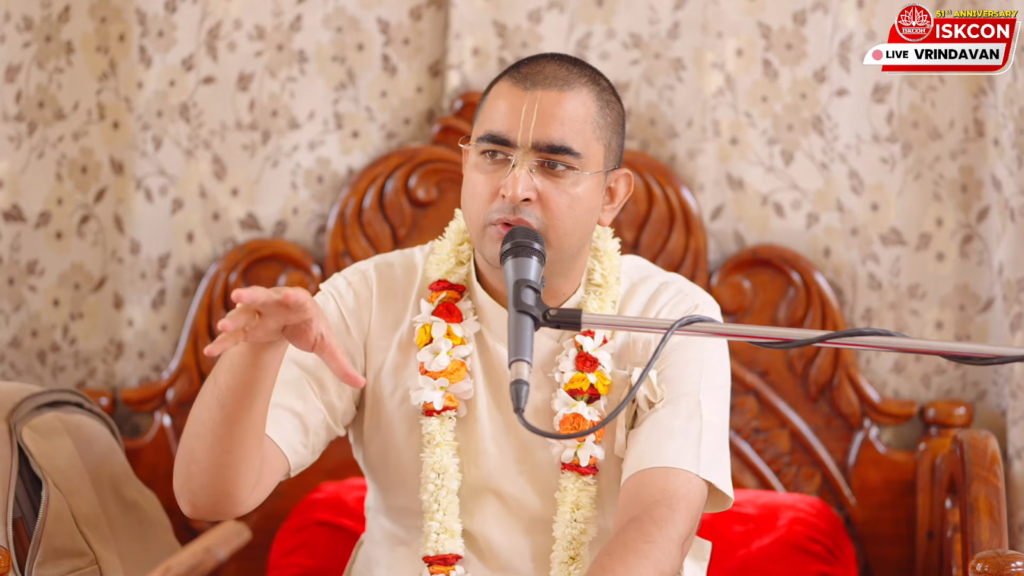
In an exegetical classroom settingsuch as teachings attributed to HH Chandramauli Swami on SB 2.7.17discussion often emphasizes both historical context and practical sādhanā. The verse’s economy models a discipline of remembrance: when worry proliferates, return to a single, wholehearted appeal. When agency seems insufficient, stabilize intention in dharmic conduct and community, and let the “wheel” of discernment do the severing work that willpower alone cannot accomplish.
Ethically, “cutting to pieces” is not a mandate for outer aggression but a metaphor for incisive relief: dismantling patterns that perpetuate harm, dissolving ignorance, and ending predationwithin and without. In this interpretive light, SB 2.7.17 supports nonviolence aligned with protection, a stance congruent with ahimsa and with the Sikh virtue of nirmal shakti (pure strength) guided by compassion.
Practically, readers can draw three steadying applications from the verse’s architecture. First, voice the plea: honest articulation of distress is itself a sacred act. Second, make room for swifter-than-expected help: compassion rarely arrives on one’s timetable, yet it often arrives on “wings.” Third, cultivate the cakra within: through study of Scriptures, reflective journaling, and disciplined ethics, sharpen the discernment that severs inner bondage.
Comparative study highlights a shared dharmic through-line: suffering invites clarity, clarity invites refuge, and refuge elicits transformation. Whether framed as taking shelter in Viṣṇu, taking refuge in the Buddha, honoring the Jina’s path of nonharm, or standing in the humility of Sikh ardās, the structure of liberation is cooperativedevotion and discipline meeting grace and guidance.
SB 2.7.17 thus reads as a compact soteriological vow folded into narrative form: no authentic cry for help goes unheard, and no sincere turn toward dharma is left without support. By honoring this insight as common ground, communities across Hinduism, Buddhism, Jainism, and Sikhism strengthen mutual regard and shared purposeunity rooted not in uniformity, but in compassion’s unerring response to suffering.
Inspired by this post on Dandavats.