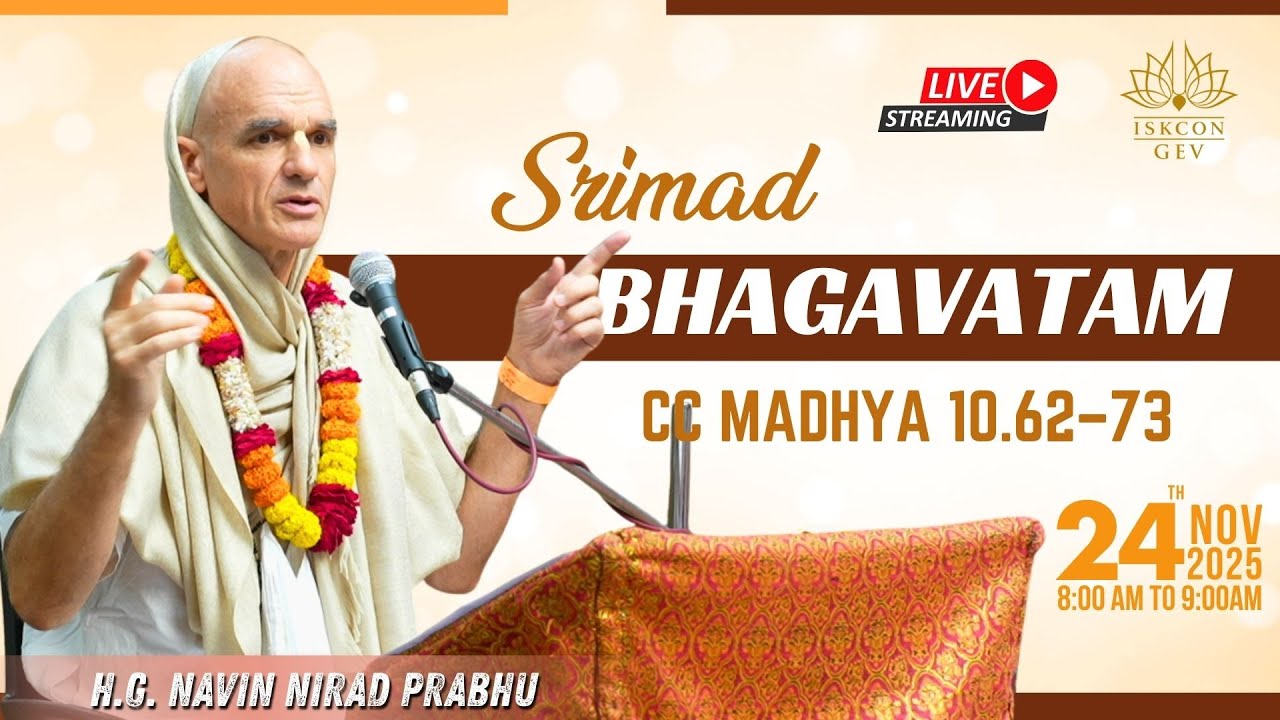
This morning discourse focused on Sri Caitanya-caritāmṛta, Madhya-līlā 10.62–73, presented by H.G. Navin Nirad Prabhu at ISKCON Govardhan Eco Village. The session situated these verses within the broader Gaudiya Vaishnava tradition, highlighting Lord Chaitanya Mahaprabhu’s paradigm of devotion, service, and humility as timeless guides for contemporary spiritual life.
CC Madhya 10.62–73 offers a succinct window into the living practice of bhakti. The teaching emphasized how these passages illuminate the dynamics of Lord Chaitanya’s interactions with devotees and the community, underscoring central tenets of sādhana-bhakti—steadiness, compassion, attentive hearing, and refined conduct—without losing sight of the text’s historical and theological context.
Methodologically, the class modeled careful reading and applied hermeneutics, connecting scriptural insight to daily practice. Key themes included the ethical power of humility, the transformative potency of nāma-saṅkīrtana, and the stabilizing role of seva in cultivating inner clarity. By aligning scriptural principles with practical routines, the presentation demonstrated how devotion matures through consistent, mindful engagement.
Practical applications were outlined in accessible steps: regular study of Sri Caitanya-caritāmṛta, reflective japa, thoughtful service to community, and cultivating a compassionate disposition in speech and action. These habits were framed as mutually reinforcing disciplines that help integrate Srimad Bhagavatam wisdom and the teachings of Lord Chaitanya Mahaprabhu into everyday decisions.
In keeping with a dharmic ethos of unity, the session drew resonances across traditions. The empathy and non-harm central to Jainism (ahimsa), the cultivated compassion of Buddhism (karuṇā), and the service-centered spirituality of Sikhism (seva and kirtan) converge with Gaudiya Vaishnavism’s devotion-focused practice. Such inter-dharmic alignment affirms shared moral commitments and strengthens social harmony without diluting distinct identities.
The ISKCON Govardhan Eco Village context was noted for its contemplative atmosphere, where disciplined study and sustainable living cohere. This environment supports a reflective rhythm, encouraging participants to internalize scriptural teachings and translate them into ethical action consistent with a mindful, community-oriented life.
For continued study, the class recommended reading Sri Caitanya-caritāmṛta alongside foundational texts such as the Bhagavad-gita and Srimad Bhagavatam, allowing core concepts—devotion, duty, compassion, and self-restraint—to be seen in complementary light. Cross-referencing themes clarifies how principles of bhakti are simultaneously personal, communal, and civilizational.
Overall, the exploration of CC Madhya 10.62–73 presented a balanced synthesis: academically grounded, devotionally rooted, and socially relevant. The teachings invite steady practice, respectful dialogue across dharmic pathways, and a commitment to inner transformation that naturally radiates outward as empathy, responsibility, and unity.
Inspired by this post on Dandavats.