Within the Purāṇic tradition, the episode of Brahma’s transformation from Creator to Warrior stands out with singular force: the defeat of the asura Vajranabha and the consecration of Pushkar’s three sacred lakes. While Brahma is ordinarily associated with creation (sṛṣṭi), knowledge, and the maintenance of cosmic order (ṛta), this legend frames a rare intervention undertaken to preserve dharma when ritual life and social equilibrium were under threat.
Primary references to the Pushkar cycle appear in Padma Purana and Skanda Purana (Pushkara-Māhātmya), alongside later tirtha-māhātmyas and regional retellings. Across these sources, the antagonist is named Vajranābha (also rendered Vajranāśa in certain recensions), an asura whose violence disrupted yajña, tapas, and the settled rhythms of sages and householders around the Aravalli tract.
Theologically, the episode exemplifies Dharma-Yuddha: the use of force as a deliberate, circumscribed, and proportionate strategy in defense of life-sustaining rites and ethical order. It sharply distinguishes ‘Righteous War’ from conquest or cruelty, underscoring that the office of creation sometimes requires protection from adharma, much as a physician may excise disease to restore health.
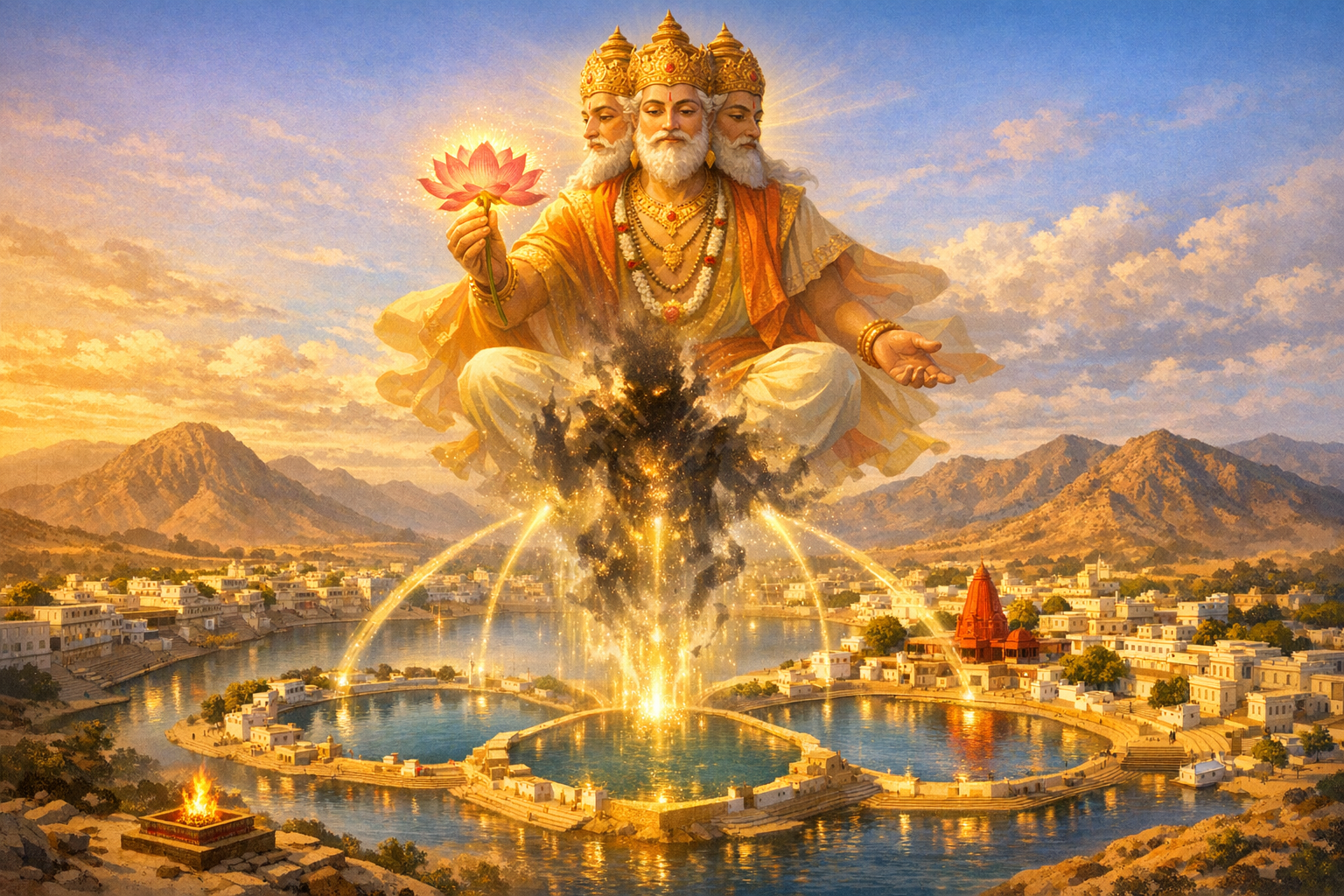
As the narrative unfolds, reports of devastation reach the divine court. Rishis and devas seek redress, and Brahma descends to the contested ground. He does not wield a blade or thunderbolt; instead, he raises the lotushis emblem of sattva, knowledge, and emergence from primordial watersthus transforming a symbol of creation into a nonlethal yet irresistible instrument of justice.
Vajranabha is subdued and slain, and in the gesture of casting the lotus, three petals separate and fall to earth. Where each petal lands, a lake manifests: Jyeṣṭha Pushkar (the Great), Madhya Pushkar (the Middle), and Kaniṣṭha Pushkar (the Lesser). This etiological moment binds language, landscape, and liturgy: pushpa (flower) and kara (hand) yielding Pushkar, while pushkara also denotes the blue lotus itself.
These lakes configure a distinctive sacred geography. Situated on the margins of the Thar, Pushkar’s hydrological ensemble became a pilgrim oasis and ritual center whose ghats, kunds, and circumambulatory paths (parikramā) organize space for purification, vow-taking, and study. Over centuries, the tirtha has attracted ascetics, householders, and merchants, knitting devotional practice to regional commerce and seasonal fairs.
Following the asura’s defeat, Brahma institutes a yajña at Pushkar to re-harmonize the elements and consecrate the site. Purāṇic protocol requires the sahadharma-cāriṇīhis consortas co-officiant. Sarasvatī is delayed, and to maintain the ritually ordained hour, Brahma solemnizes the rite with Gayatrī, personification of the Vedic meter and, in many tellings, a local pastoral maiden sanctified for sacrifice.
When Sarasvatī arrives, she censures the breach of propriety and, in a dramatic turn that shapes later ritual history, pronounces that Brahma will be scarcely worshipped on earthsave at Pushkar. This etiological curse explains a striking feature of Indian temple geography: the rarity of Brahma shrines in contrast to temples for Vishnu and Shiva, and the unique eminence of the Brahma Temple at Pushkar.
Reconciling variants across Padma Purana, Skanda Purana, and regional narratives reveals a consistent ethical core: punctual adherence to sacrificial time (kāla), respect for marital and ritual dharma, and the primacy of intention (saṅkalpa) over mere form. The emphasis on consequence even for deities teaches accountability without undermining compassion.
Historically, the Pushkar tirtha is attested in Purāṇic literature and in itineraries of pilgrims across early and medieval India. The present Brahma Templerebuilt and renovated multiple timesbears architectural features and records that point to late-medieval foundations with subsequent additions, while the sanctity of the site itself is far older, embedded in tirtha-māhātmya and oral transmission.
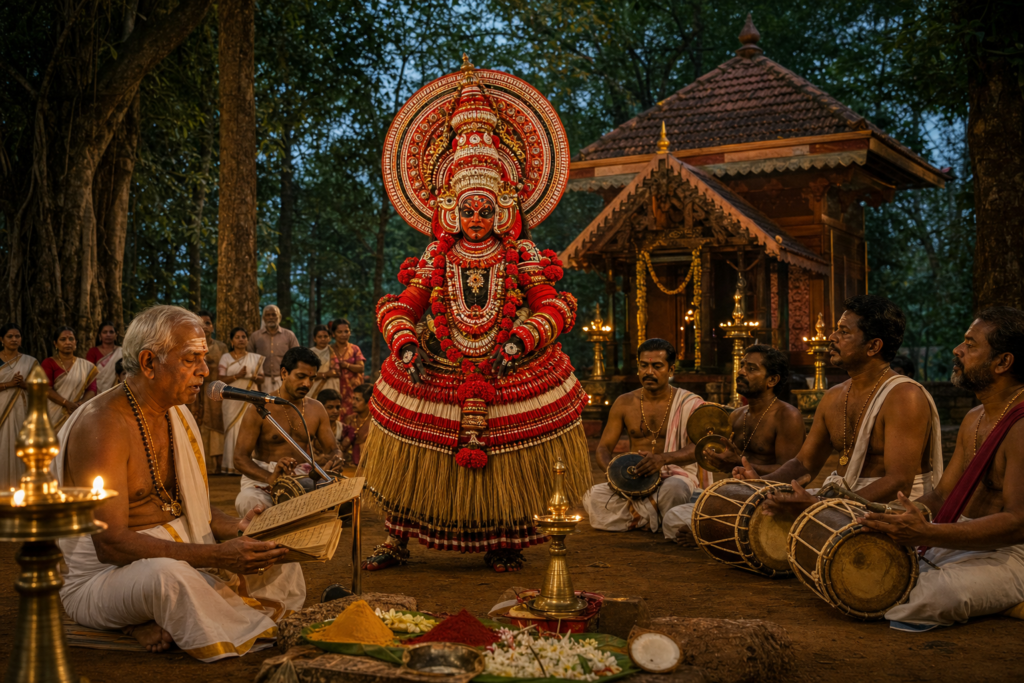
Ritual life at Pushkar crescendos during Kartik Purnima, when pilgrims gather for snāna (sacred bathing), pradakṣiṇā, and dāna. The famed Pushkar Fair that coincides with this lunar climax embodies a multilayered continuityagrarian cycles, trade in livestock, community feasting, and the renewal of vows. For many visitors, lamps mirrored on the lake at dusk render the Purāṇic past palpably present.
Symbolically, Brahma’s lotus as an instrument of Dharma-Yuddha communicates a precise ethic: knowledge, restraint, and creative energy can be mobilized to neutralize violence without glorifying it. Exegetes often align the three lakes with tri-guṇa theory (sattva–rajas–tamas) or with the three bodies (sthūla–sūkṣma–kāraṇa), suggesting that purification at Pushkar touches gross, subtle, and causal strata of being.
The episode also speaks across dharmic traditions. The lotus that redeems disorder resonates with Buddhist imagery of purity arising unsullied from mud; the primacy of ahiṃsā and proportionate response echoes Jain ethics; and the yajña’s communal orientation parallels Sikh sewa and sangat, where collective intent sustains moral life. Read together, these lineages affirm that the defense of order is ultimately service to life, not license for domination.
Linguistically, Pushkara signifies both a floral icon and a hydrological node, reflecting how Sanskrit morphology frequently encodes ecological insight. In an arid fringe zone, three interlinked water bodies became not only ritual reservoirs but also engines of settlement and hospitality. Safeguarding them todaythrough responsible pilgrimage, waste reduction, and groundwater stewardshipextends the original consecration into environmental dharma.
Temple History at Pushkar mirrors broader patterns of Cultural Heritage in India: cycles of patronage, repair, and revival shaped by local guilds, ascetic orders, and household donors. Inscriptions and hagiographies refer to festivals, endowments, and moments of crisis and renewal; yet beneath these vicissitudes, the tirtha’s narrative spinethe defeat of Vajranabha and the sanctifying yajñaremains intact.
From a philosophical vantage, Brahma’s brief adoption of kṣatra does not contradict his sṛṣṭi-function; rather, it completes it. Creation demands continuity, and continuity sometimes demands measured courage. In this light, the legend models ‘Righteous War’ as an exceptional instrument wielded by one whose default stance is generative, teaching that power earns legitimacy only when yoked to dharma.
For contemporary readers and pilgrims, the Pushkar cycle offers a disciplined template for ethical action: diagnose harm accurately; exhaust conciliatory avenues; apply the least force necessary; and restore balance through shared rites, gifts, and remembrance. In organizational life, civic responsibility, or interfaith dialogue, this arcdisruption, proportionate response, reconsecrationretains remarkable practical utility.
Ultimately, Brahma’s Warrior Deed binds story to soil. A mythic lotus cast in righteous intent yields real waters that have nurtured communities for centuries. To walk the ghats of Pushkar is to witness a living Purāṇic page where creation, protection, and pilgrimage converge in a single, enduring act of Sacred Tradition.
Inspired by this post on Hindu Blog.