The birth of Garuda is one of the most instructive narratives in ancient Hindu texts, presenting a precise moral geometry in which divine pride confronts the quiet, immovable force of tapas. Anchored in the Mahabharata (Adi Parva, Sambhava Parva) and echoed in later Puranic retellings, the episode of Indra and the Balakhilya rishis reveals how sacred resolve, rightly directed, becomes a generative power that restores balance (dharma) without dismantling the cosmic order of the devas. It also explains why Garuda, the pakshi-indra (king of birds), attains a stature comparable to Indra while becoming inseparably associated with Vishnu as vahana and standard-bearer.
Textual witnesses place the core of this account in the Mahabharata’s Sambhava Parva, where Sauti recounts the genealogies of beings born from Prajapati Kashyapa. While the Bhagavata Purana elaborates the genealogical context of Kashyapa, Vinata, and Kadru, the Mahabharata supplies the theological thread that links Indra’s hubris, the Balakhilyas’ ascetic potency, and Kashyapa’s mediation through yajna. Across these layers, the narrative functions as an ethical case study: power unguided by humility destabilizes order, whereas resolute austerity tempered by wise counsel generates a non-rivalrous solution aligned with dharma.
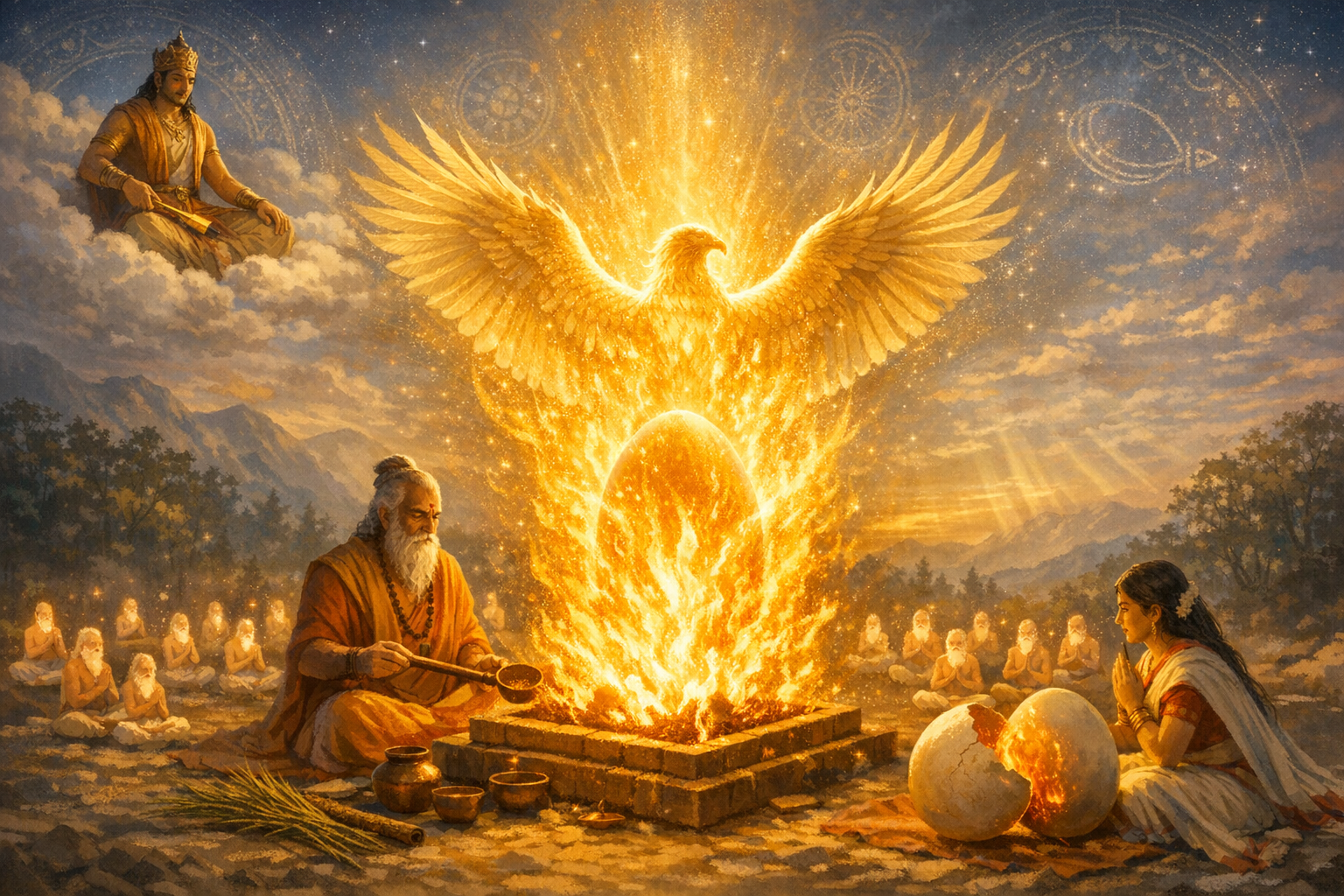
The scene opens upon Kashyapa’s sacred undertaking. Revered as a progenitor (Prajapati) and a central figure in Vedic and Puranic cosmology, Kashyapa conducts a yajna not as a mere ritual, but as a precise technology of intention, offering, and mantraan instrument designed to shape outcomes in accordance with rta (cosmic order). In this sacrificial context, his assistants include the Balakhilya rishissixty thousand thumb-sized ascetics whose physical minuteness conceals unimaginable spiritual voltage amassed by tapas.
Indra, sovereign among the devas and guardian of cosmic equilibrium, enters this setting carrying the legacy of previous victories and the latent peril of pride. Several Mahabharata recensions describe a moment of derision or neglectIndra underestimating the Balakhilyas on account of their size and seeming insignificance. The sages, aggrieved not for themselves but for the principle slighted, resolve to conduct a sacrifice whose fruit would yield a “second Indra,” thereby subjecting the king of gods to the discipline he had forgotten.
Alarmed by the prospect of existential rivalry among devasa scenario inimical to cosmic stabilityIndra seeks resolution through Kashyapa. The Prajapati recognizes both the just cause of the sages and the necessity of preserving functional hierarchy. He counsels a redirection of the sacrifice’s intended fruit. The Balakhilyas, anchored in principle rather than retribution, agree to retune their sankalpa so that the embodied result of their tapas becomes not a rival Indra, but pakshi-indrathe supreme among birds. Thus, by Kashyapa’s mediation, the yajna becomes the seedbed for Garuda, one whose prowess would equal Indra’s yet remain harmonized with the devas’ domain.
From this spiritual vector, the narrative shifts to lineage. Kashyapa’s wife Vinata lays two eggs destined to mature over an extended, ascetic timescalean intrinsic motif suggesting that extraordinary beings require extraordinary gestation. In impatience, Vinata prematurely breaks the first, giving birth to Aruna, radiant and incomplete, who becomes the charioteer of the Sun (Surya). Aruna counsels Vinata to patience regarding the second egg, foretelling that the son to emergeGarudawill surpass imagination in might and wisdom.
In a parallel arc, Vinata’s sister Kadru and the fateful wager over the color of Uccaiḥśravasthe celestial horse born of the Samudra Manthanaresults in Vinata’s bondage when Kadru contrives to win by deceit. This enslavement does not merely create narrative tension; it supplies the ethical spur for Garuda’s later quest. His mission to obtain amrita is framed not as acquisitive ambition but as filial dharmaa righteous endeavor undertaken to liberate his mother from injustice.
When Garuda is finally born, the texts describe a being of aweSuparna, “fair-winged,” whose very flight disturbs the elements. The Mahabharata emphasizes that Garuda does not move impetuously; his actions are guided by counsel and law. Kashyapa enjoins him to observe ethical constraints even during acts of staggering power, a motif that recurs throughout Hindu scriptures: strength is truly sovereign only when yoked to self-restraint.
Garuda’s ascent toward the deva realms to secure the amrita is narrated as a traversal through concentric fortificationsrings of flame, wind, and illusory veilsguarded by devas and serpents (nagas). His victories are never framed as mere force; they emerge from clarity of purpose and sanctioned righteousness. This is an applied demonstration of dharma as both path and method: even when challenging the devas’ custody of amrita, Garuda’s intent remains aligned with justice rather than domination.
Indra’s confrontation with Garudaculminating in the hurling of the vajrabecomes the dramatic fulcrum of the tale. The texts emphasize mutual recognition. Garuda, honoring the rishi Dadhichi from whose bones the vajra was fashioned, accepts the strike without malice and without injury, while Indra recognizes in Garuda not an enemy but a being of comparable stature, born of tapas and sanctioned by dharma. The ensuing exchange of boons crystallizes this mutuality: Vishnu grants Garuda immortality without partaking of amrita and installs him as vahana and banner; Indra accords him the right to prey upon serpents while safeguarding the cosmic trust of the nectar itself.
Fidelity to the moral architecture of the story is preserved in the denouement. Garuda delivers the amrita to the nagas not as a transferral of sovereignty but as a contractual fulfillment to free Vinata. Indra, by prior understanding, reclaims the amrita, leaving only its dew upon darbha grasswhose sharpness the serpents taste, splitting their tongues. The devas retain their elixir, the nagas secure the terms that free Vinata, and Garuda’s renown expands without diminishing any legitimate domain. This is dharma as a conservation of rightful order achieved through wise redirection, not annihilation.
Philosophically, this narrative advances three tightly coupled theses. First, tapas is a primary source of power in the Hindu worldview; it can recalibrate cosmic hierarchies when those entrusted with guardianship lapse into pride. Second, yajna is not mere rite but a vector of intention; by reorienting the fruit of sacrifice, Kashyapa transforms potential rivalry into a complementary sovereignty (pakshi-indra) that sustains harmony. Third, humility is not timidity but the condition for sustainable leadership; Indra’s willingness to seek counsel and share boons is as important as the Balakhilyas’ willingness to accept redirection.
The roles of the protagonists clarify further. Indra personifies executive powerswift, martial, and protectivesusceptible to the entropy of arrogance when divorced from reflection. The Balakhilya rishis embody concentrated spiritual capitalseemingly minor in outward form yet decisive in effect. Kashyapa, the archetypal mediator, aligns these forces through yajna and counsel, becoming the template for statesmanship grounded in dharma. Garuda, born of this alignment, exemplifies sovereign strength under ethical disciplinean enduring symbol in temple iconography where the Garuda-stambha faces Vishnu’s sanctum.
For students of the Mahabharata and Puranas, the story offers a rigorous case study in “non-zero” resolution: the devas retain the amrita; the sages vindicate the invincibility of tapas; the nagas gain their contractual relief; Garuda attains an immortal role without precipitating a cosmic coup. This integrative outcome distinguishes dharmic statecraft from zero-sum strategies; it prioritizes stability and justice over punitive spectacle.
Symbolically, Garuda’s kingship over birds (pakshi-indra) articulates a layered cosmology in which “Indra” is a function rather than a personal monopoly: the term denotes sovereign excellence in a domaindeva, pakshi, or otherwise. This fluid semantics invites a broader reflection: leadership across domains ought to be earned by character and competence, sustained by humility, and answerable to dharma. The Balakhilyas’ success, despite their diminutive frames, encodes a second lesson: in dharmic thought, the scale of cause is measured by purity of intent, not by visible magnitude.
Comparative dharmic perspectives reinforce these insights. Buddhism’s emphasis on humility and right intention, Jainism’s profound valorization of tapas and ahiṁsā, and Sikhism’s celebration of nimrata (humility) and seva (service) converge with the Garuda narrative in affirming that power must be internally regulated by ethics. Far from compartmentalizing traditions, the episode exemplifies a shared civilizational grammar: pride is self-defeating; disciplined resolve, guided by wisdom, elevates the whole.
From a historical-literary vantage, the Mahabharata’s Sambhava Parva situates this account within a broader matrix of origin stories, linking divine genealogies to ethical propositions. Puranic works subsequently echo the frameworksometimes emphasizing the Vinata–Kadru wager, sometimes foregrounding Garuda’s journey for amritabut the core causal circuit remains: Indra’s lapse, Balakhilya resolve, Kashyapa’s redirection, and Garuda’s birth as a non-rivalrous sovereign.
The etymological and conceptual notes are also instructive. “Balakhilya” signals the paradox of smallness and strength; “Suparna” highlights radiance and auspicious wings; “pakshi-indra” encodes functional sovereignty; and “yajna” extends beyond oblation to include intelligent design of consequences through sankalpa. The narrative thereby functions as both theology and pedagogy, teaching how intention, ritual, and ethical counsel can be aligned to avert conflict and generate lasting order.
In temple practice and iconography, Garuda’s presence before Vishnu’s sanctum is not decorative; it is doctrinal. The Garuda-stambha faces the deity as a sentinel of bhakti and as an affirmation of the vows that established his rolecourage devoted to service, might tethered to restraint, immortality accepted as responsibility. Vaishnava traditions retain this alignment, honoring Garuda not as a competitor to the devas but as a co-guardian of dharma.
For contemporary readers, the narrative has clear analytic force. Organizational power (Indra) needs ethical ballast; quiet expertise (Balakhilyas) deserves due regard; leadership (Kashyapa) must reframe potential collisions into complementary strengths; and execution (Garuda) should be maximally effective yet minimally disruptive to legitimate orders. This “dharmic systems” reading shows why the story endures as guidance for governance, community stewardship, and personal conduct.
Ultimately, the birth of Garuda is the fruition of reoriented intention: a would-be rival to Indra becomes instead the exemplar of non-rivalrous excellence. By turning the fruit of sacrifice toward a domain that required guardianship rather than supremacy, Kashyapa and the Balakhilyas demonstrate how tapas and yajna, guided by wisdom, can elevate the fabric of the world. The devas are not diminished; dharma is not compromised; sovereignty is not hoardedrather, it is diversified and harmonized.
This is why the tale retains canonical relevance in Hindu thought and, by extension, in the broader dharmic family. It models a civilizational preference for integrative solutions grounded in humility and disciplined resolvevalues equally honored in Hinduism, Buddhism, Jainism, and Sikhism. In every retelling, the same insight shines: when pride yields to principle and austerity serves wisdom, creation itself breathes easier.
Inspired by this post on Hindu Blog.