
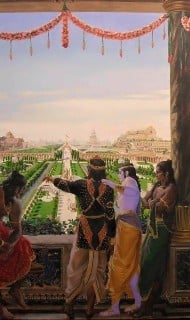
In Puranic cosmology, the seven subterranean planetsAtala, Vitala, Sutala, Talātala, Mahātala, Rasātala and Pātāla (SB 5.24.7)form a radiant and culturally sophisticated expanse beneath the earthly plane, not to be confused with the physical globe. Known collectively as bila-svarga, these regions are described in Srimad Bhagvatam as astonishingly prosperous, in certain ways even more opulent than the Heavenly planets (svarga-loka). This striking claim reframes common assumptions about “heaven,” urging careful reflection on how beauty, abundance, and influence can coexist with spiritual limitation.
Srimad Bhagvatam (SB 5.24.8–10) offers vivid depictions of bila-svarga: splendid residential architecture; assembly halls, walls, and gateways; purpose-built compounds and guest residences; and waterways teeming with transparent currents, resplendent with lilies, kuvalayas, kahlāras, and blue and red lotuses. The imagery evokes communities of refined material culturewell-ordered, aesthetically cultivated, and sensually gratifying. Rather than conjuring a realm of gloom, these passages foreground a scintillating “heaven below,” where the arts of living are advanced and worldly pleasures are expertly curated.
Within this framework, the statement that such regions are “more opulent” than higher worlds does not diminish the status of the devas; it clarifies the domain of material excellence. In these strata, prosperity, sensual refinement, and political influence can reach peak intensity. Textual traditions sometimes attribute this to lineages that pursue elevated standards of enjoyment, governance, and craft. The emphasis, however, is not on caricatured moral judgment but on the distinction between technical mastery over matter and the metaphysical freedom sought by spiritual disciplines.
Sutala offers an especially instructive case. SB 5.24 relates Sutala with Bali Mahārāja, whose devotion and integrity transform this realm into a model of ordered abundance. Commentaries often highlight Vāmana’s benevolence toward Bali as a theological fulcrum: opulence itself is not an adversary of dharma; its ethical valence depends on consciousness, humility, and service. The narrative situates Sutala as a sphere where wealth and virtue can cohabit under divine guardianshipyet still within the circumference of time, karma, and rebirth.
From a cosmographical perspective, the seven lower planetary systems expand the inhabited layers of the universe beyond a single “heaven–earth–hell” triad. Puranic sources maintain clear distinctions: bila-svarga is not synonymous with naraka (punitive realms). Instead, these worlds are cosmopolitans of the material cosmos, with advanced arts, waterways, horticulture, and civic design. They exemplify how the Puranas map experience across multiple planeseach with its own ethos, capabilities, and constraints.
The philosophical implication is subtle but decisive: prosperity and pleasure, even at superhuman scales, do not resolve the existential question posed by all dharmic traditionshow to transcend suffering, limitation, and death. In Bhagavatam’s language, all such realms remain under the jurisdiction of kāla (time) and the cyclic mechanics of karma. Thus, the phrase “illusion of heavenly planets” does not deny their reality; it underscores the tendency of opulence to be mistaken for ultimate fulfillment. Material excellence can veil metaphysical aspiration when the heart equates comfort with completion.
This insight resonates across the dharmic spectrum. Buddhism describes multiple deva realms of the kāma-loka and rūpa-loka where beings enjoy refined pleasures or subtler absorptions, yet remain subject to impermanence and rebirth. Jain cosmology distinguishes numerous deva-lokas, meticulously classifying conditions of life and merit, while holding that liberation (kevala-jñāna) requires non-violence, restraint, and insight beyond any celestial station. Sikh teachings, too, counsel vigilance against māyāworld-appearance that can enthrall through possessions, honor, and sensory appealemphasizing remembrance (simran), humility, and selfless service (seva) as antidotes to spiritual complacency. Across Hinduism, Buddhism, Jainism, and Sikhism, the shared conclusion is clear: however exquisite a world may be, freedom lies not in the landscape but in liberated awareness.
For readers tracing the textual logic of SB 5.24.7–10, the descriptive luxuriance serves a pedagogical function. By presenting bila-svarga in luminous detailmansions, compounds, gates, assembly spaces, guest residences, and lotus-lakesthe text compels a heartfelt question: if grandeur itself is available in many layers of the cosmos, what finally satisfies? The narrative invites discernment between two trajectories: pravṛtti (skillful engagement with the world) and nivṛtti (progressive inward turning toward transcendence). Both have their place in dharmic life; neither, by itself, guarantees liberation. The synthesis is ethical excellence animated by abiding realization.
A comparative lens helps clarify this synthesis. Where Buddhist analysis emphasizes the unsatisfactory (dukkha) character of all conditioned states, Jain practice prescribes vows (vratas) and austerities (tapas) to refine and finally liberate consciousness, and Sikh wisdom continually redirects attention from the glitter of māyā to the timbre of the Divine Name. Hindu texts like Srimad Bhagvatam, while honoring sacred order and worldly duties, consistently elevate bhakti, jñāna, and yoga as vehicles that convert prosperity into instrument rather than aim. In each case, the counsel is convergent: refine conduct, steady attention, and open the heart to what neither rises nor falls with fortune.
Technically, the seven subterranean lokas broaden spiritual anthropology by showing that cultures can flourish with sophistication at multiple scales of existence. They demonstrate that aesthetics, architecture, and governance are not exclusive to a single “heaven.” The presence of lakes adorned with lilies and lotuses, assembly halls, and gateways suggests rule of law, hospitality, and public culturefeatures of civilization recognizable to any careful observer. Yet the very recognizability of these achievements is the caution: what is admirable is not automatically ultimate.
Interpreters have long noted that Puranic cosmography can be read along at least two axes: as a metaphysical cartography of realms and as a phenomenology of consciousness. On the latter reading, the “lower” and “higher” worlds mirror tendencies in the psyche. Bila-svarga then becomes a symbol of skillful enjoyment refined to its zenithculture, beauty, and influence harmonious to the senseswhile still bounded by the causes and conditions that generate craving. The text’s didactic power lies in honoring that refinement without conceding the final goal to it.
Ethically, this perspective invites gratitude without attachment. A practitioner may cultivate prosperity through dharma, steward resources, beautify spaces, and govern justlyall celebrated in bila-svarga’s civic imagerywhile maintaining inner freedom. Dharmic life thereby becomes integrated: worldly excellence is not renounced as “evil,” but purified of the conceit that it can complete the soul. The locus of transcendence is re-situated from the outer scene to the inner seeing.
Practically speaking, the shared counsel of the dharmic traditions is accessible to contemporary readers. Steady ethical discipline (yama–niyama in Yoga; śīla in Buddhism; anuvrata in Jainism; and the Sikh ethos of seva and remembrance) curbs the centrifugal pull of distraction. Daily meditation or japa stabilizes attention; scriptural study refines understanding; gratitude and generosity loosen the grip of possessiveness. In this way, one can savor beauty and contribute to collective well-being without becoming psychologically domiciled in it.
It is worth noting how the Bhagavatam’s account avoids reductionism. By ensuring that realms like Sutala can be exquisitely prosperous yet ethically reformed under Bali Mahārāja’s humility and unwavering devotion, the text affirms that transformation is always near. Divine reciprocity, not deprivation, is the axis around which reorientation occurs. The “illusion” therefore is not the existence of opulence but its mistaken enthronement as life’s crown.
Historically and culturally, such passages preserve memory of sophisticated urban and environmental design, encoded not merely as nostalgia but as spiritual pedagogy. The imagery of gates, halls, and reservoirs inscribes a vision of society in which public architecture, hospitality, and water management are sacral tasks. When read with the complementary ethics of non-violence, self-restraint, compassion, and devotion, the description becomes a mirror: civilizations are strongest when their technical genius bows to moral and spiritual genius.
For many seekers, this reading is emotionally resonant. The allure of comfort, recognition, and influence is as alive today as in any mythic past. Just as lotus-filled waters can reflect the sun yet be stirred by a passing breeze, a life can gleam with accomplishment yet be unsettled by the slightest change in circumstance. The Puranic reminder is gentle but firm: cultivate what endures. Let beauty serve truth; let achievement serve compassion; let order serve love.
In sum, the bila-svarga of Srimad Bhagvatamfar from being caricatured as “underworlds”are portrayed as dazzling theaters of material excellence. Their very splendor is the lesson. Whether in Atala or in the highest svarga, the same law applies: time moves, karma ripens, and desire begets further becoming. The solution proposed across Hinduism, Buddhism, Jainism, and Sikhism is consonantdisentangle awareness from the glamour of gain, deepen practice, and anchor life in virtues that neither rise nor fall with fortune. In that anchoring, the soul recognizes a dignity beyond opulence, and a freedom beyond even the most immaculate “heaven.
Inspired by this post on Dandavats.
