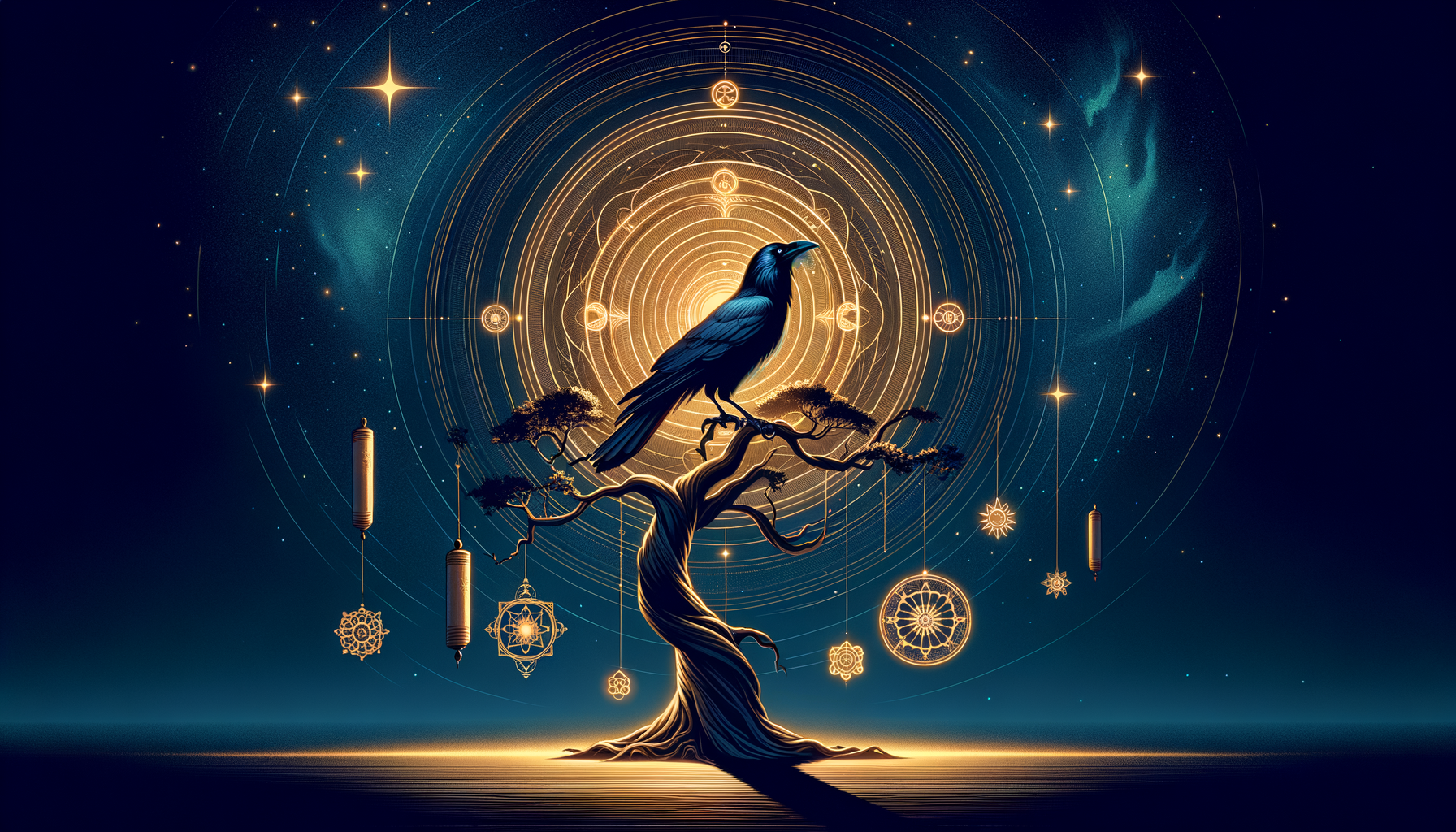
Within the vast tapestry of Hindu scriptures, Bhusundi (often identified as Kākabhūśuṇḍi) stands out as the enlightened crow whose consciousness spans yugas and kalpas. In traditions associated with the Bhusundi Ramayana, this immortal witness observes the eternal drama of dharma unfolding across infinite cosmic cycles, revealing that there are countless Ramayanas shaped by time, place, and the souls who receive them. The theme resonates deeply with Sanatana Dharma and affirms a broader unity across Hinduism, Buddhism, Jainism, and Sikhism: truth is one, its expressions many.
Traditions describe Bhusundi as a sage blessed with a divine boon of near-eternal life and lucidity, allowing the traversal of cosmic time and witnessing of creation’s recurring rhythms. As the “crow saint,” he embodies humility and vigilance, perching on the thresholds between worlds while seeing beyond the confines of a single chronology. This portrayal emphasizes a central insight of Hindu cosmology: what recurs does not repeat mechanically; it renews meaningfully.
The Bhusundi Ramayana highlights an arresting idea: in every kalpa, the life and leela of Sri Rama manifest according to the needs of beings living then. Dharma’s essence remains, yet its narrative contours adjust to circumstances. This perspective reframes multiplicity not as contradiction but as contextual illumination—each telling discloses a facet of the inexhaustible.
That insight harmonizes with the plural Ramayana tradition itself. Alongside the Valmiki Ramayana and Tulsidas’s Ramcharitmanas, readers encounter the Adhyatma Ramayana, Kamba Ramayanam, and regional retellings such as Thailand’s Ramakien and Cambodia’s Reamker, as well as related narratives like the Buddhist Dasaratha Jataka and the Jain Paumachariya. Rather than competing, these texts deepen one another, demonstrating how dharma takes form within diverse languages, cultures, and spiritual sensibilities. For many contemporary readers, this plurality feels both emotionally reassuring and intellectually liberating: the beloved story lives wherever hearts are ready.
Philosophically, Bhusundi’s vision aligns with key dharmic insights. The Hindu understanding of cyclical time situates Ramayana within an infinite canvas. Jain anekāntavāda underscores many-sided truth, complementing the plurality of narratives. Buddhist dependent origination (pratītyasamutpāda) highlights relational unfolding, echoing how epic meaning arises through context. Sikh remembrance of the Divine Name affirms an inner axis around which all narratives turn. Together, these perspectives converge on unity in spiritual diversity without erasing distinctive paths.
The figure of Bhusundi also models a path of practice. Devotion to Sri Rama anchors perception beyond egoic limits; humility safeguards against dogmatism; and contemplative inquiry allows readers to appreciate multiple Ramayanas without anxiety about “the one” definitive version. In an age of polarized certainties, this stance nurtures mutual respect among seekers and encourages a shared ethical center: compassion, courage, and truthfulness in action.
Traditional sources allude to Bhusundi’s dialogues and transmissions within the wider Ramayana literature, especially in the devotional frame of the Ramcharitmanas. Puranic cosmology provides the backdrop for cyclic time (yugas and kalpas), while the pan-Indic spread of Ramayana traditions illustrates living continuity rather than textual fixity. The scholarly and spiritual takeaway is sober and inspiring: a canon is not a cage; it is a garden with many flowering paths.
By guiding attention beyond a single text to the living field of dharma, the Bhusundi Ramayana offers both rigor and tenderness—rigor in honoring sources and contexts, tenderness in recognizing how people grow through the stories they can receive. The immortal crow’s testimony ultimately invites a collective vow: to hold fast to the heart of dharma while celebrating its countless forms, fostering harmony among the dharmic traditions and affirming unity in spiritual diversity.
Inspired by this post on Hindu Blog.