
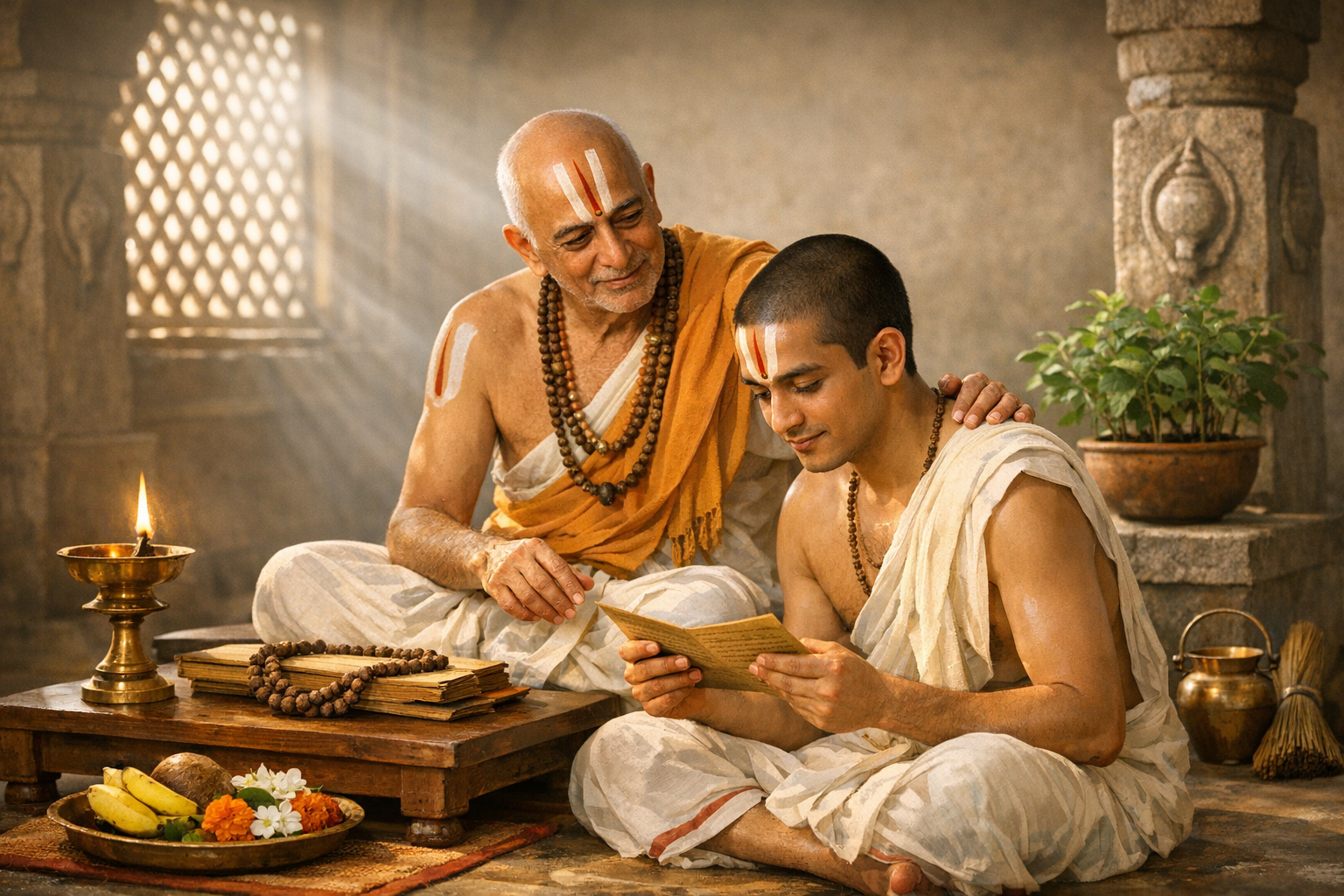
Across the dharmic traditions of Hinduism, Buddhism, Jainism, and Sikhism, the Guru–Shishya Relationship is revered as a living conduit for wisdom, ethical formation, and inner transformation. Within Hinduism in particular, the Guru is not merely a teacher but an enlightened guide whose presence and insight catalyze progress where effort alone appears to falter. The episode associated with Acharya Periyavachanpillai and a so-called “dull-headed” devotee has long served as a compelling Hindu story illustrating the subtle yet decisive force of Guru’s Blessings in spiritual and intellectual growth.
Acharya Periyavachanpillai (often also rendered as Periyavāccān Piḷḷai) is remembered in the Sri Vaishnava lineage for lucid expositions on the Tamil Divya Prabandham and for nurturing a culture of rigorous study anchored in devotion (bhakti) and humility (vinaya). Situated in the broad Ramanujacharya sampradaya, his pedagogy reflects the Sri Vaishnava synthesis: disciplined learning, service (seva), mantra-centered contemplation, and surrender (prapatti) to Bhagavan, all mediated through the living continuity of the acharya-parampara.
Traditional hagiographies recount that a devotee once approached Periyavachanpillai lamenting an inability to grasp even basic lessons. Classmates progressed; memory failed; texts seemed opaque. Rather than dismiss the seeker, the acharya diagnosed the impediment as a conjunction of restlessness, self-judgment, and a mind unprepared (an-adhikara) for concentrated study. The remedy he prescribed was multifold and compassionate: steady seva in the matha, regulated lifestyle, simple daily japa of Om Namo Narayanaya and the Dvaya Mantra, and a return to foundational verses in the Divya Prabandham recited with attentive listening.
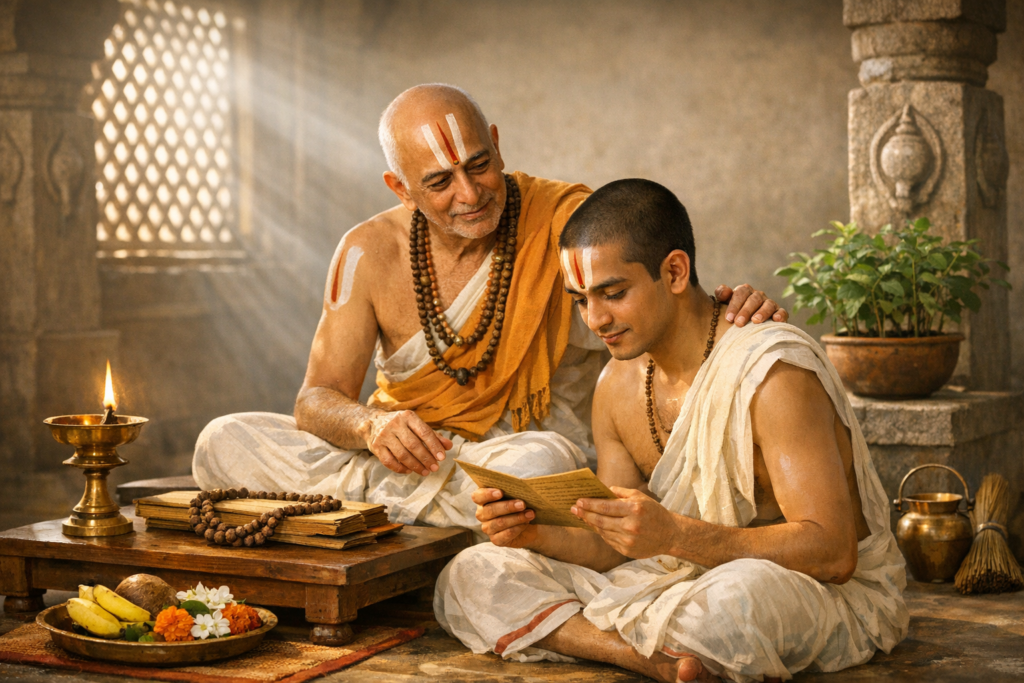
Months passed in quiet discipline. The devotee’s routine—cleaning, assisting elders, hearing and repeating short passages, and offering naivedya—gradually stilled the inner turbulence. When Periyavachanpillai finally asked him to read aloud a passage he had long struggled with, the words flowed with unexpected clarity. The acharya’s benediction, a gentle touch and a few words of encouragement, did not “magically bestow” literacy; rather, it released the constriction of doubt, aligned practice with purpose, and revealed the fruit of cumulative effort under right guidance. The transformation—once attributed to a “dull head”—was recognized for what it truly was: the awakening of capacity through Guru’s grace acting upon sustained, honest striving.
From a Sri Vaishnava doctrinal lens, this episode illuminates several pillars. First, śabda-pramāṇa (authoritative testimony) requires a prepared mind; the Guru embodies the living śāstra, situating text within practice. Second, bhakti and prapatti are not opposed: devotion matures into utter reliance on Bhagavan’s compassion, often mediated through the acharya as a visible embodiment of divine kindness. Third, mantra—especially the aṣṭākṣarī (Om Namo Narayanaya) and the Dvaya—purifies the antaḥkaraṇa (inner instrument), making knowledge resilient rather than brittle. In this way, Guru’s Blessings do not override natural processes; they harmonize them, aligning effort, eligibility (adhikāra), and insight.
The unity of this insight extends across dharmic families. In Buddhism, the kalyāṇa-mitra (noble friend) guides with compassionate precision, helping the disciple integrate sīla, samādhi, and paññā. In Jainism, the ācārya and upādhyāya shape disciplined study and right conduct (samyag-cāritra) while guarding against harsh self-judgment. In Sikhism, the Guru’s wisdom—enshrined in the Guru Granth Sahib—refines the heart through shabad and simran, dissolving the knots of haumai (ego). These traditions differ in metaphysical framing, yet converge on an ethical-spiritual grammar: humility, truthful living, and the transformative presence of an illumined guide. The story of Periyavachanpillai is thus not sectarian; it exemplifies a shared dharmic conviction that guidance and grace can unlock latent excellence in every seeker.
Pedagogically, the acharya’s method prefigures contemporary learning science. By lowering cognitive load (short, repeated verses), adding context and meaning (seva and ritual embed memory in lived experience), and fostering a growth mindset (reframing “dull-headed” as “not yet prepared”), he built durable neural pathways. Seva inculcated prosocial motivation; mantra entrained attention; routine stabilized circadian rhythms and affect; respectful challenge plus timely encouragement invited mastery. What devotional culture terms “grace,” educational psychology might describe as the catalysis of neuroplasticity within a nurturing, high-trust mentorship—two languages for the same unfolding.
The theological heart of the episode is not intellectual prowess but ethical refinement. “Genius” here denotes steadiness, compassion, and clarity rather than mere agility with texts. In practical terms, Guru’s Blessings operate as a subtle calibration: they soften self-condemnation, channel aspiration into disciplined steps, and turn comparison into service. The former “dull-headed” devotee becomes a contributor to collective learning—reciting, assisting, and eventually supporting others who begin where he once stood.
Readers may recognize analogues in daily life: confusion yielding to understanding after a mentor reframes a problem; anxiety loosening its grip when trusted counsel affirms a path; a complex practice becoming natural through patient repetition. In each case, an external presence helps reinterpret struggle, transforming it from a verdict on ability into a vehicle for growth. This is the living relevance of the Guru-Shishya Relationship—an ethics of accompaniment as much as a transmission of knowledge.
Cultivating such transformation can be approached through simple, tradition-grounded measures: regular svādhyāya (self-study) with short, meaningful passages; light seva that benefits the learning community; a stable daily window for japa or contemplative reading; reflective journaling to track what clarifies and what confuses; and periodic guidance from a qualified teacher embedded in a recognized paramparā. Across Hindu, Buddhist, Jain, and Sikh settings, these elements recur with different accents yet a shared intention—sustained, compassionate formation of the whole person.
Equally vital are ethical guardrails. Authentic guidance resists domination, centers the welfare of the disciple, and remains accountable to śāstra, saṅgha, and community norms. The acharya’s kindness toward the struggling seeker was matched by pedagogical rigor—no shortcuts, no theatrics, no transactional promises. The grace he exemplified dignified effort and restored agency, exemplifying why the Role of Guru in dharmic traditions is transformative without becoming authoritarian.
In sum, the narrative of Acharya Periyavachanpillai and the “dull-headed” disciple is an enduring meditation on how Guru’s Blessings harmonize with human effort. Where humility, routine, and service prepare the ground, grace blossoms as clarity, confidence, and care for others. This is the shared promise of the dharmic path: diverse in methods—mantra, meditation, study, seva—yet unified in its conviction that wise companionship can awaken the genius latent in every heart.
Inspired by this post on Hindu Blog.







Leave a Reply
You must be logged in to post a comment.