
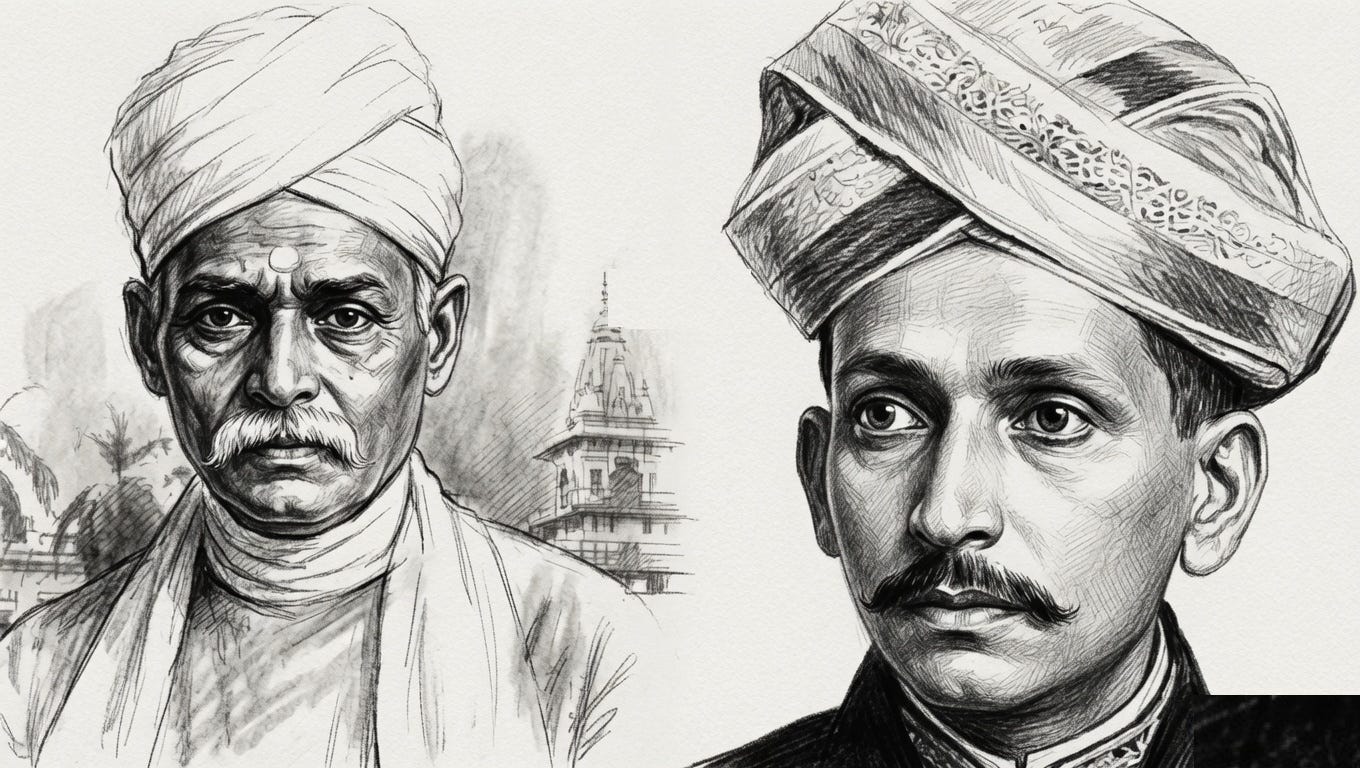
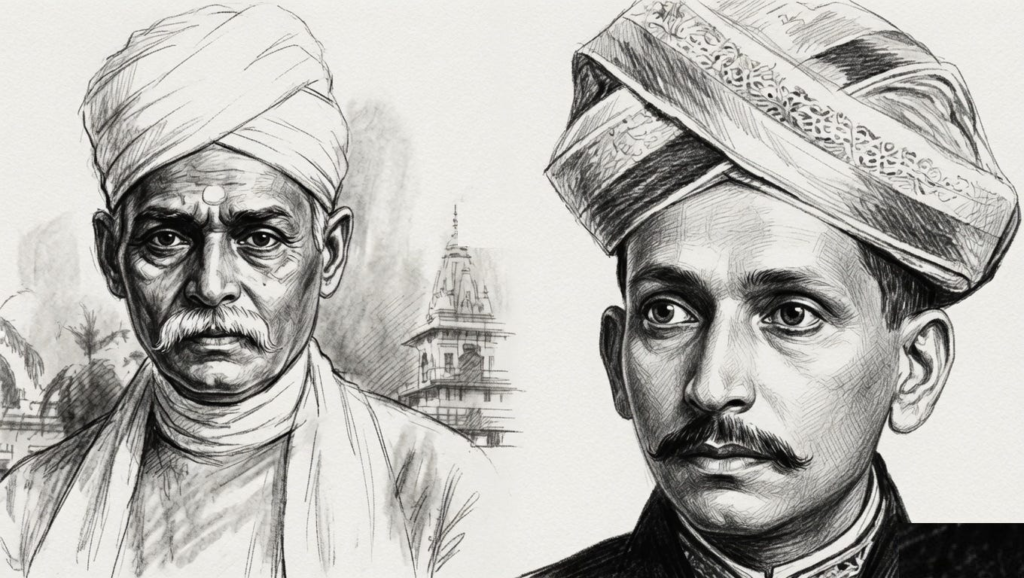
Sir M. Visvesvaraya’s longhand essay, titled Some Personal Reminiscences, offers a rare, first-hand portrait of Pandit Madan Mohan Malaviya as statesman, educationist, and nation-builder. Composed by an engineer-administrator of unimpeachable stature, the text functions as both tribute and primary source, illuminating the ethical grammar of public life in early 20th-century India—marked by respect, magnanimity, recognition of virtue, and principled restraint. Read in historical context, it stands as a model of dharmic leadership: resolutely modern in problem-solving, yet deeply anchored in Indic civilizational values shared across Hindu, Buddhist, Jain, and Sikh traditions.
Visvesvaraya located Malaviya’s public vocation within three interrelated domains—education, politics, and economics—where policy imagination and institution-building drove societal progress. What emerges is a rigorous appraisal of character as destiny: a leader whose cultural depth enabled political courage, and whose moral authority translated into organizational outcomes of national consequence.
In political life, the first notable encounter recorded is the December 1910 session of the Indian National Congress at Allahabad. Malaviya, in characteristically plain white attire, led deliberations with assurance and eloquence, quickly becoming the focal figure on the floor. His interventions balanced conviction with constitutional propriety, an approach that would define his public career for decades.
Another defining moment came in December 1921 when Malaviya led a cross-party deputation to the Viceroy in Calcutta, alongside Dr. Annie Besant and other prominent leaders. The group urged measures to allay social unrest, voiced dissatisfaction with the limited reforms under the Government of India Act (1919), and pressed for an immediate advance to enable constructive public work and peaceful progress. The emphasis was on constitutional dialogue, calibrated pressure, and tangible outcomes.
On January 10, 1922, Malaviya catalyzed a representative All-Parties Conference in Bombay, bringing together leaders of sharply differing persuasions—including M. A. Jinnah and M. R. Jayakar—into a working committee entrusted with practical follow-up. Although the committee’s work ended abruptly due to circumstances well known to historians, its formation revealed Malaviya’s hallmark method: consensual coalition-building to unlock national capacity.
From 1886 onward, Malaviya stood at the forefront of India’s political struggles—first on the Congress platform and later in the Imperial Legislative Council and the Indian Legislative Assembly from 1910. For much of his life he pursued the exacting path of constitutional agitation. When, in 1931, civil resistance and incarceration became unavoidable for leading national figures including Mahatma Gandhi, Malaviya joined the Working Committee of a proscribed Congress and accepted imprisonment. For an orthodox Hindu, as Visvesvaraya notes, prison life was particularly abhorrent; his decision thus carried the weight of ethical sacrifice, a dharmic tapas performed for a higher civic duty.
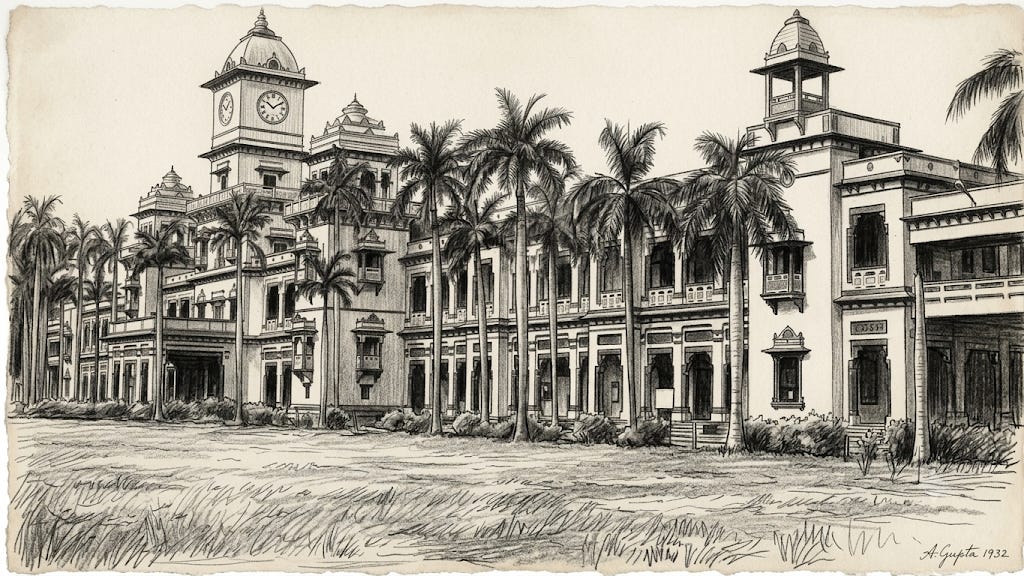
Malaviya’s most transformative achievement in constructive work was the establishment of the Benares Hindu University (BHU)—an institutional design that fused civilizational memory with modern disciplines. Uniquely, this was not a state-built university, nor merely the legacy of a single magnate; rather, it arose through public trust in one citizen’s integrity, dedication, and moral purpose. Malaviya’s blueprint was clear: preserve the highest thought of Hindu religion and philosophy, and simultaneously train experts in science, engineering, agriculture, and business to expand India’s productive capacities and economic self-reliance.
Benares (Varanasi) was a deliberate choice: an ancient, revered center of learning that symbolized continuity of knowledge and practice for millions. The first Chancellor, His Highness the Maharaja of Mysore, was selected for his piety, love of Sanskrit literature, and devotion to dharmic learning—reinforcing the university’s standing as a pan-Indian institution rooted in culture and oriented toward national development.
Malaviya’s institution-building method combined strategic vision with meticulous consultation. He sought input from engineers, architects, educationists, and industrial leaders about campus planning, academic design, and long-term sustainability. While receptive to advice, he preserved the essential architecture of his original plan, ensuring that classical studies and modern sciences would reinforce rather than dilute each other.
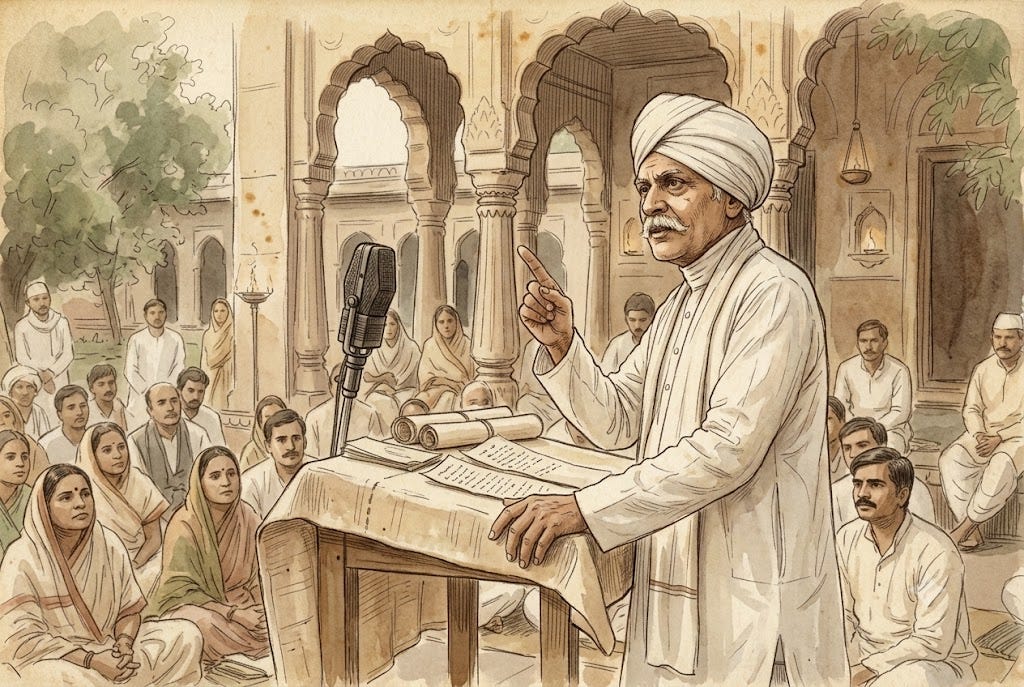
Fundraising demonstrated the power of ethical credibility to mobilize resources. Addressing large assemblies across major cities, Malaviya appealed to the patriotism of merchants and zamindars, and to the dharmic duty of philanthropy. A Calcutta meeting in January 1912—delivered in forceful Hindi—became emblematic: donations arrived both as large pledges and as currency bundles on the spot, a testament to how oratory can convert moral capital into institutional capital.
By January 1923, BHU had acquired visible scale and academic rhythm. A noble complex of buildings housed programs in the arts and sciences, Sanskrit classics, and a high-caliber engineering college; a college of agriculture was in preparation. Though still expanding, the university already functioned as an all-India center of learning, attracting students from every region and generating a cadre committed to national reconstruction.
Politics occasionally aided the university—by elevating Malaviya’s standing as a principled, non-partisan builder—and at times threatened it, when official displeasure imperiled grants. During his imprisonment, rumors even suggested staff might face half-pay. Such episodes highlighted a structural reality for citizen-led institutions under colonial constraint: financial diversification, endowment-building, and community solidarity were essential to buffer political shocks.
In statutory terms, the Benares Hindu University Act (1915) provided an enabling framework, and the university commenced operations in 1916. Conceived as a residential and teaching university, BHU integrated classical knowledge systems with applied sciences, creating a pipeline for professional expertise while honoring the broader Indic canon. In spirit and aspiration, it fostered a civilizational commons where dharmic traditions—Hindu, Buddhist, Jain, and Sikh—could find scholarly voice in a modern research environment.
Malaviya’s interests extended beyond higher education. He championed compulsory primary education as an instrument of social justice and human capability. He supported community organizations dedicated to uplift and cooperative action, consistently articulating a vision in which Hindu society’s renewal contributed to the shared flourishing of all Indic communities. This approach aligns with the dharmic ethic of strengthening society’s moral and material sinews while affirming mutual respect among diverse traditions.
He also advocated civic preparedness, including basic military training, to ensure communities could protect hearths and homes if required—an expression of kshatra yoked to self-discipline and responsibility rather than aggression. In economic thought, his contribution to the Industrial Commission (1916–18) is well remembered. His note advanced a characteristically Indian approach to industrial policy—emphasizing indigenous capacity, balanced growth, and the synergy of technical education with enterprise—anticipating the role universities like BHU would play in building human capital for industry.
As an orator, Malaviya possessed a mellow, persuasive voice and a method of exposition illuminated by many disciplines: Sanskrit classics, English history and literature, grassroots realities, and contemporary finance and economics. He could speak for hours without notes, and his addresses in Hindi held distinctive power with orthodox audiences in North India. Across decades, his messages displayed continuity of aim and consistency of principle—made credible by simplicity of living and conspicuous disinterest in personal gain.

Visvesvaraya’s estimate of Malaviya’s public standing is striking for its breadth. He enjoyed the confidence of high dignitaries even as he consistently softened the rigors of bureaucratic rule for ordinary people. Adversaries respected him as a clean fighter. Indian princes regarded him as a friend. Orthodox constituencies revered him, yet he remained acceptable to reformers. His most enduring claim on the nation’s gratitude lay in his unwavering concern for people’s welfare, his ability to spark enthusiasm for national projects, and his impetus to institution-building—qualities that knit together the moral and the practical.
Read as a whole, Some Personal Reminiscences doubles as a leadership manual. It documents a calibrated progression from constitutional advocacy to willing self-sacrifice when the public interest demanded it. It shows how character—anchored in dharma—scales into effective organization, and how ethical authority can convert trust into institutions that outlive their founders.
The BHU story, in particular, offers a replicable blueprint for citizen-led universities: articulate a civilizationally rooted but forward-looking academic vision; consult widely while preserving core design; mobilize philanthropy by appealing to duty and national purpose; diversify funding to mitigate political risk; and integrate classical learning with modern science to serve both culture and economy. Each element remains salient for contemporary India and the wider Indic world.
For dharmic unity, Malaviya’s example is instructive. His approach to education honored the shared Indic inheritance across Hindu, Buddhist, Jain, and Sikh traditions while preparing students for the scientific and economic tasks of modernity. That synthesis—cultural depth with technical competence—continues to be the surest path to nation-building grounded in pluralism, mutual respect, and collective progress.
Ultimately, Visvesvaraya’s portrait reveals a noble, lovable, and indefatigable leader—staunchly dharmic and unmistakably Indian—who devoted every waking moment to community and country. The tribute is thus more than remembrance; it is an invitation to renew the same ethical seriousness in present tasks of education, public policy, and economic development.
|| Om Tat Sat ||
Inspired by this post on Dharma Dispatch.






Leave a Reply
You must be logged in to post a comment.