
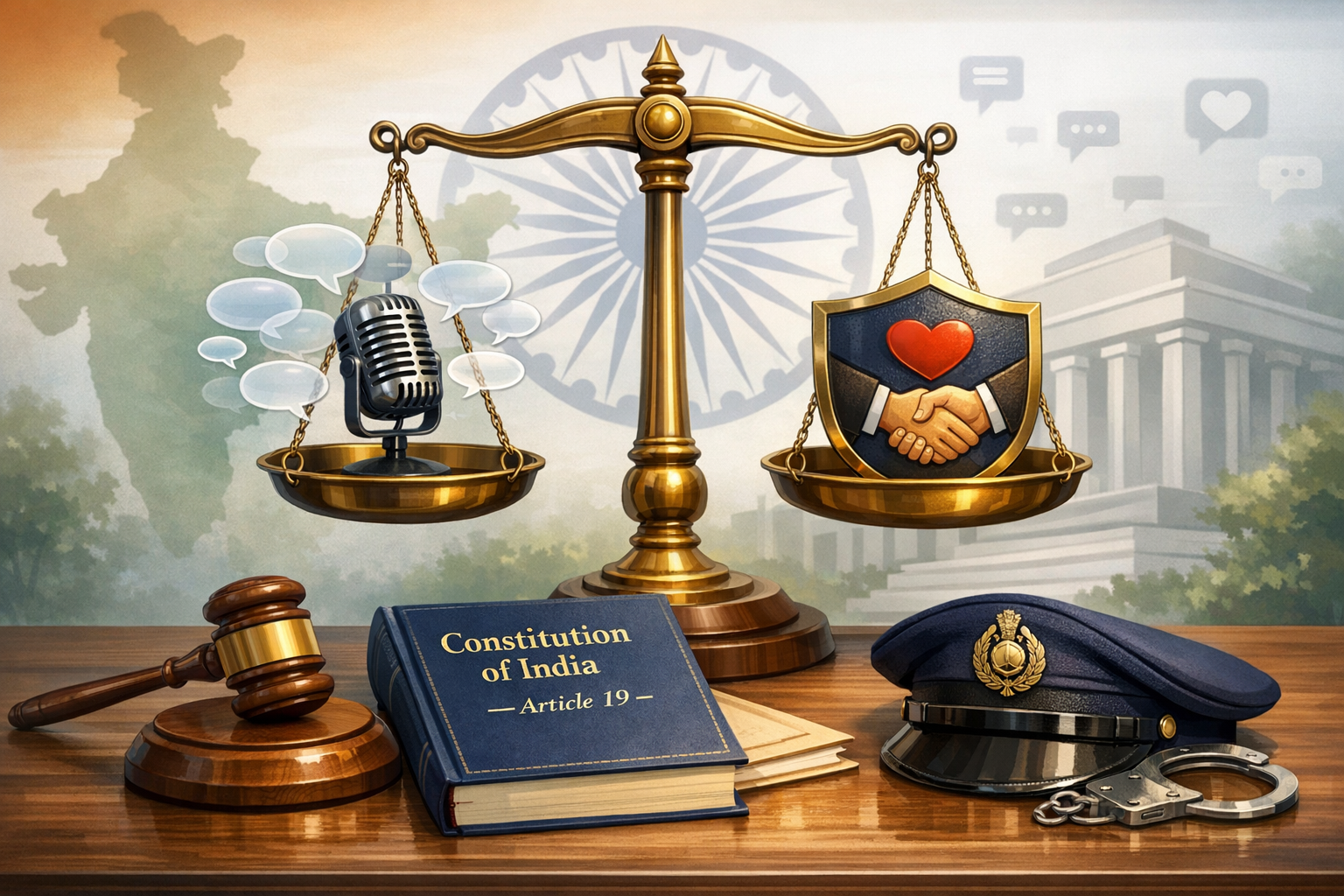
On March 31, 2026, a Bihar-based Muslim cleric was arrested after making disparaging remarks directed at the mother of Uttar Pradesh Chief Minister Yogi Adityanath. The individual subsequently issued a public apology even as legal proceedings moved forward. Beyond the immediate facts, the episode has reopened a recurring national debate: how India’s constitutional protections for free expression interface with legal duties to preserve dignity, communal harmony, and public order.
In a plural democracy, rigorous criticism of policies and public decisions is both legitimate and necessary. Yet personal attacksespecially those that target family members of public officialserode the civility that sustains democratic discourse. Such conduct also acquires a sharper edge in a society as diverse as India’s, where words can echo across community lines and produce unintended social consequences.
The apology, while a welcome step toward de-escalation, does not automatically extinguish potential legal liability. Indian criminal law evaluates not only the content and context of speech but also its intent, reach, and likely impact on public order. Courts typically consider expressions of remorse during bail and sentencing, but contrition is assessed alongside the evidence and the applicable statutory thresholds.
The constitutional framework is clear. Article 19(1)(a) protects freedom of speech and expression, while Article 19(2) allows narrowly tailored restrictions in the interests of public order, decency or morality, defamation, and the prevention of incitement to an offence, among other grounds. The question in cases like this is whether the impugned words, taken in their full context, cross the line from protected critique to unlawful provocation or insult with a tangible risk to public tranquility.
Depending on the facts as determined by investigators and prosecutors, cases involving insulting or inflammatory speech often examine provisions such as Sections 153A (promoting enmity), 295A (outraging religious feelings), 504 (intentional insult likely to provoke breach of the peace), 505(2) (statements conducing to public mischief) and 499–500 (defamation) of the Indian Penal Code, and, where relevant, provisions of the Information Technology Act, 2000 (for instance, if the content was disseminated online). The precise charges, if any, are a matter of ongoing investigation and prosecutorial discretion.
Procedurally, such matters commonly begin with a complaint and the registration of a First Information Report (FIR) under Section 154 of the Code of Criminal Procedure (CrPC), followed by evidence preservation (including authenticated copies of audio/video, social media posts, and metadata), and statements from witnesses. Ensuring chain of custody and, where applicable, digital forensics is critical to evidentiary integrity.
Arrest decisions engage Sections 41 and 41A of the CrPC and the Supreme Court’s guidelines in Arnesh Kumar v. State of Bihar, which require the police to justify custody in cognizable offences rather than resort to arrest by default. Once arrested, an accused must be produced before a magistrate within 24 hours (Section 57 CrPC, excluding travel time). Bail is then considered on statutory criteria, including the gravity of the offence, risk of tampering with evidence, and likelihood of reoffending.
Because speech can be published or heard across jurisdictions, questions of territorial jurisdiction may arise. Investigators coordinate through transit remand and inter-state procedures so that the person is presented promptly before the competent magistrate. Where multiple complaints are filed over the same utterance, courts have, in different contexts, encouraged consolidation to reduce duplication and prevent abuse, while ensuring that aggrieved parties are heard.
Judicial precedents help delineate the boundary between offensive but lawful expression and punishable hate speech. In Shreya Singhal v. Union of India (2015), the Supreme Court protected online speech by striking down Section 66A of the IT Act yet affirmed that incitement remains sanctionable. In Amish Devgan v. Union of India (2020), the Court emphasized context, intent, and target group in evaluating allegations of hate speech. In Pravasi Bhalai Sangathan v. Union of India (2014), it urged robust enforcement of existing laws rather than new prohibitions, highlighting implementation as the central challenge.
Equally important is the ethical dimension of speech across India’s dharmic traditions. Hindu thought valorizes satya (truth) and ahimsa (non-violence) in word and deed; Buddhism’s Right Speech (samyak vāk) counsels against slander and harshness; Jainism’s vows elevate truthful, non-injurious expression; and Sikh teachings encourage nirmal bani (pure, uplifting speech). These shared values, grounded in compassion and restraint, offer a practical compass for civic dialogueespecially when emotions run high.
Public figures and religious leaders occupy influential positions in shaping sentiment. When commentary targets family members rather than public actions, it distracts from substantive debate and risks widening social fissures. A norm of issue-focused critique, articulated firmly but respectfully, strengthens both accountability and social cohesion.
A practical path forward includes responsible speech protocols for community leaders and preachers: training on legal thresholds; fact-verification before public remarks; clear disclaimers when sharing opinion; and rapid, unambiguous corrections or apologies if a line is crossed. Such steps, applied consistently across Hindu, Buddhist, Jain, Sikh, and Muslim communities, build resilience against polarization.
Digital platforms and newsrooms also play a pivotal role. The Information Technology (Intermediary Guidelines and Digital Media Ethics Code) Rules, 2021, require timely action on lawful takedown requests and adherence to due diligence. Responsible amplificationeschewing sensationalism, providing context, and foregrounding verified factshelps prevent isolated incidents from cascading into wider unrest.
Restorative practices can complement the rule of law. Where appropriate, facilitated dialogues, community statements reaffirming mutual respect, and public education initiatives can channel outrage into constructive learning. A prompt, unequivocal apologyas in the present casecan be a first step in rebuilding trust, though courts will ultimately assess its legal weight.
From a process standpoint, observers might watch for the nature of charges (if any), the outcome of bail applications, and the investigative timeline under Section 173(2) CrPC for filing a police report. If the speech was disseminated online, expect digital forensics and platform-origin records to inform the evidentiary picture. The overarching objective remains consistent: uphold constitutional freedoms while deterring speech acts that predictably imperil public order and dignity.
Ultimately, the incident underscores a simple civic ethic: robust disagreement must coexist with respect. Personal invective aimed at family members corrodes democratic culture and social trust; issue-based critique, anchored in facts and restraint, advances accountability without inflaming tensions. Reaffirming the shared ethical ground of India’s dharmic traditionsalongside the constitutional rule of lawoffers the most durable route to unity in diversity.
Inspired by this post on Struggle for Hindu Existence.







