

Vedanta places detachment at the center of spiritual understanding because the human mind cannot clearly perceive truth while it is governed by possession, craving, fear, and egoic identification. In this tradition, detachment, known as “vairagya”, is not a rejection of life but a disciplined reorientation of attention. It teaches that lasting knowledge of the Self cannot arise from a mind that is constantly pulled outward by the senses, social approval, personal ambition, or emotional dependence on changing circumstances.
The statement that no progress is possible in Vedanta without detachment may sound severe at first, but it reflects a precise psychological and philosophical insight. Vedanta does not ask seekers to hate the world, abandon responsibility, or become indifferent to human suffering. It asks them to understand the difference between the real and the transient, between the Self and the non-Self, between what is eternally present and what appears briefly in experience before passing away.
In classical Vedantic language, this discrimination is called viveka. It is the ability to distinguish the permanent from the impermanent. Detachment naturally follows when this distinction becomes clear. A person does not need to be forced to loosen the grip on passing pleasures; the grip weakens when their limited nature is understood. Just as a child eventually outgrows fascination with toys that once seemed all-important, the mature spiritual intellect begins to see that wealth, praise, status, sensory pleasure, and even intellectual achievement cannot provide final fulfillment.
This does not mean worldly life is meaningless. Vedanta is subtler than pessimism. It recognizes that family, work, service, learning, art, and community can all become meaningful fields of dharma. The problem begins when these become the foundation of identity. When a person thinks, “I am my success,” “I am my body,” “I am my reputation,” or “I am my relationships,” anxiety becomes inevitable because all such conditions are unstable. Detachment protects the seeker from building a permanent self-image upon impermanent supports.
The Upanishadic vision of the Self, or atman, is not an abstract theory meant only for scholars. It is a radical claim about human identity. Vedanta teaches that the deepest Self is not the body, not the mind, not the emotions, and not the stream of social roles that appear across a lifetime. The Self is the witnessing consciousness because of which all experiences are known. To recognize this, the mind must become quiet, subtle, and free from compulsive attachment.
Attachment agitates the mind because it creates dependency. The mind attached to pleasure fears loss. The mind attached to status fears criticism. The mind attached to control fears uncertainty. The mind attached to identity fears contradiction. Such a mind may read the Upanishads, discuss Brahman, quote the Bhagavad Gita, and admire Hindu saints, but it will struggle to internalize the truth because its emotional energy remains bound to the external world.
For this reason, Hindu sages repeatedly emphasized that scriptural knowledge alone is insufficient. Vedanta requires śravaṇa, manana, and nididhyāsana: listening to the teaching, reflecting upon it through reason, and deeply contemplating it until it becomes assimilated. Detachment supports all three stages. Without detachment, listening becomes selective, reflection becomes defensive, and contemplation becomes restless. With detachment, the seeker becomes capable of receiving truth without constantly filtering it through personal preference.
In the Bhagavad Gita, this principle appears through the discipline of karma yoga. Sri Krishna does not teach Arjuna to avoid action. He teaches him to act without selfish attachment to the fruits of action. This is a crucial distinction. Vedantic detachment is not passivity; it is freedom from inner bondage while performing one’s duty. A person may work diligently, protect dharma, serve society, care for family, and pursue excellence, yet remain inwardly free from the feverish demand that outcomes must satisfy the ego.
This teaching is especially relevant in modern life. Much of contemporary culture rewards constant comparison, self-display, consumption, and anxiety about achievement. The mind is trained to measure worth through visibility, productivity, and approval. Vedanta challenges this habit at its root. It asks whether the person who is praised becomes more real, whether the person who is criticized becomes less real, and whether any external condition can truly define consciousness itself.
Detachment therefore has a technical meaning as well as a practical one. Technically, it is the reduction of identification with anātman, the non-Self. Practically, it is the ability to remain steady when pleasant and unpleasant experiences arise. The spiritually mature person does not become numb. Rather, such a person feels deeply without being enslaved by feeling. Compassion remains, but possessiveness declines. Responsibility remains, but egoism weakens. Love remains, but dependency is purified.
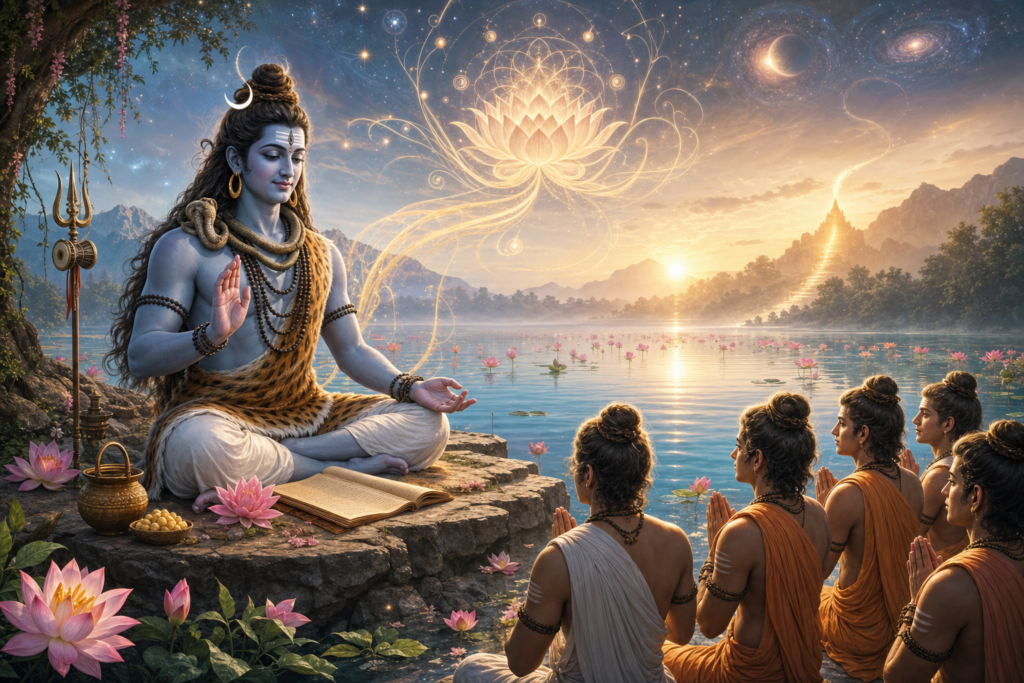
The Hindu saintly tradition often describes this inner freedom through simple images. A lotus grows in water but remains unwetted by it. A person living in the world can similarly remain untouched by inner clinging. This image is not merely poetic; it captures the Vedantic ideal of engagement without bondage. The world is not denied. It is understood. Action is not abandoned. It is sanctified through clarity.
Without detachment, the study of Vedanta can become another possession of the ego. A person may become proud of philosophical vocabulary, sectarian identity, debate skill, or ritual knowledge. This is a subtle danger because spiritual learning can easily become spiritual vanity. Detachment guards against this distortion. It reminds the seeker that the goal is not to appear knowledgeable but to be free from ignorance, not to win arguments but to realize truth.
Vedanta identifies ignorance, or avidya, as the root of bondage. This ignorance is not mere absence of information. It is misidentification: taking the impermanent body-mind complex to be the true Self. Detachment weakens the force of this error. When desires are examined, they reveal the assumption that happiness lies elsewhere. When fears are examined, they reveal the assumption that the Self can be diminished by events. Vedantic inquiry exposes both assumptions as incomplete.
This is why detachment and knowledge are mutually reinforcing. Detachment prepares the mind for knowledge, and knowledge deepens detachment. At first, the seeker may practice detachment deliberately by moderating desires, simplifying habits, and observing reactions. Later, detachment becomes more natural because the seeker sees that the objects once pursued cannot deliver permanent peace. The movement is not from life to emptiness, but from dependence to freedom.
The discipline also has ethical consequences. A detached person is less likely to exploit others for personal gain because the hunger for domination is reduced. Such a person can practice generosity without anxiety, leadership without arrogance, and scholarship without contempt. In this sense, Vedantic detachment supports social harmony. It does not produce withdrawal from dharma; it produces cleaner participation in dharma.
This point is important for understanding the unity of dharmic traditions. Hinduism, Buddhism, Jainism, and Sikhism use different metaphysical frameworks, but all give serious attention to the problem of attachment. Buddhism analyzes craving as a cause of suffering. Jainism emphasizes aparigraha, or non-possessiveness, as a central ethical and spiritual discipline. Sikh teachings warn against haumai, ego-centeredness, and encourage remembrance of the Divine while living responsibly in the world. Vedantic “vairagya” belongs to this larger dharmic concern for inner freedom.
Such comparisons should be made carefully, without flattening real doctrinal differences. Vedanta’s language of atman and Brahman is not identical to every other dharmic vocabulary. Yet the shared civilizational insight is unmistakable: bondage begins when consciousness is captured by craving, ego, and possessiveness. Liberation begins when the grip loosens and the mind becomes capable of truth, compassion, discipline, and direct spiritual insight.
In Advaita Vedānta, detachment is traditionally listed among the qualifications of the seeker. These include discrimination between the eternal and the non-eternal, dispassion toward transient enjoyments, mastery over the mind and senses, endurance, faith in the teaching and the guru, concentration, and a burning desire for liberation. These qualifications are not ornamental. They describe the psychological fitness required for subtle knowledge. A distracted, reactive, pleasure-bound mind cannot easily recognize the witnessing Self.
This is comparable to scientific discipline in a limited sense. A researcher must control bias, observe carefully, and avoid premature conclusions. Similarly, the Vedantic seeker must observe the mind, detect false identification, and refuse to confuse emotional preference with truth. Detachment is therefore not anti-intellectual. It is a condition for rigorous inquiry into consciousness. It makes philosophical reflection more exact, not less.
Many misunderstand detachment as emotional coldness. Vedanta rejects that misunderstanding. Attachment and love are not the same. Attachment says, “You must complete me.” Love says, “May you flourish in dharma.” Attachment seeks possession. Love seeks welfare. Attachment is anxious because it depends on control. Love is steady because it rests on a deeper recognition of shared being. As detachment matures, relationships can become less manipulative and more compassionate.
Another misunderstanding is that detachment requires poverty or external renunciation in every case. Hindu traditions have honored both householders and renunciates. The central question is not whether one owns objects, but whether one is owned by them. A householder may practice profound detachment while fulfilling family and social duties. A monk may still be inwardly attached to reputation, comfort, or doctrine. Vedanta evaluates the inner condition of the mind, not merely the outer form of life.
The practical cultivation of detachment begins with observation. When desire arises, the seeker asks what is being promised by the desired object. Is it pleasure, security, recognition, distraction, or a sense of identity? When aversion arises, the seeker asks what image of the self is being protected. This kind of inquiry does not suppress emotion. It illuminates emotion. The mind gradually learns that not every impulse deserves obedience.
Daily spiritual practice strengthens this process. Japa steadies attention. Meditation reveals the difference between awareness and thought. Study of the Bhagavad Gita and Upanishads provides conceptual clarity. Seva reduces self-centeredness. Ethical restraint disciplines the senses. Satsanga protects the mind from isolation and confusion. Together, these practices create an inner atmosphere in which detachment becomes livable rather than merely admirable.
Detachment also requires honesty about suffering. Most people begin spiritual inquiry not because life has failed entirely, but because its successes have proved insufficient. Achievement may bring satisfaction, but not final rest. Pleasure may bring delight, but not permanence. Relationships may bring meaning, but also vulnerability. The Vedantic tradition does not mock these experiences. It interprets them as signs that the human heart seeks something deeper than temporary fulfillment.
This deeper seeking is called mumukshutva, the desire for liberation. Without it, Vedanta remains an intellectual system. With it, Vedanta becomes a transformative path. Detachment nourishes this longing because it redirects energy from endless external pursuit toward Self-Realization. The seeker begins to understand that freedom is not produced by acquiring one more object, experience, title, or relationship. Freedom is discovered by knowing the nature of the one who experiences all of them.
The emotional beauty of this teaching lies in its promise of inner dignity. A person need not wait for the world to become perfectly favorable before discovering peace. Praise and blame, gain and loss, pleasure and pain may continue to arise, but they need not define the Self. This insight gives courage. It allows human beings to live in the world with tenderness and strength, participating fully while remembering that their deepest identity is not exhausted by worldly events.
In this sense, detachment is not a negative discipline. It is a positive freedom. It frees intelligence from prejudice, devotion from possessiveness, action from anxiety, and love from fear. It allows the teachings of Vedanta to move from memory into realization. The mind becomes less noisy, the heart less dependent, and the intellect more capable of subtle truth.
The wisdom of Hindu saints is therefore not that the world must be despised, but that it must be seen correctly. The world is a field of experience, duty, learning, and worship; it is not the final source of identity. When this distinction is forgotten, bondage begins. When it is remembered, spiritual progress becomes possible. Detachment is the bridge between scriptural knowledge and lived realization.
To understand Vedanta deeply, one must become inwardly available to truth. This availability requires humility, discipline, and freedom from compulsive clinging. Without detachment, the mind remains occupied with protecting its preferences. With detachment, it becomes transparent enough to recognize the Self. That is why the saintly teaching remains enduringly relevant: no genuine progress in Vedanta is possible until the seeker learns to loosen the hold of the transient and turn toward the real.
Inspired by this post on Hindu Blog.










Leave a Reply
You must be logged in to post a comment.