
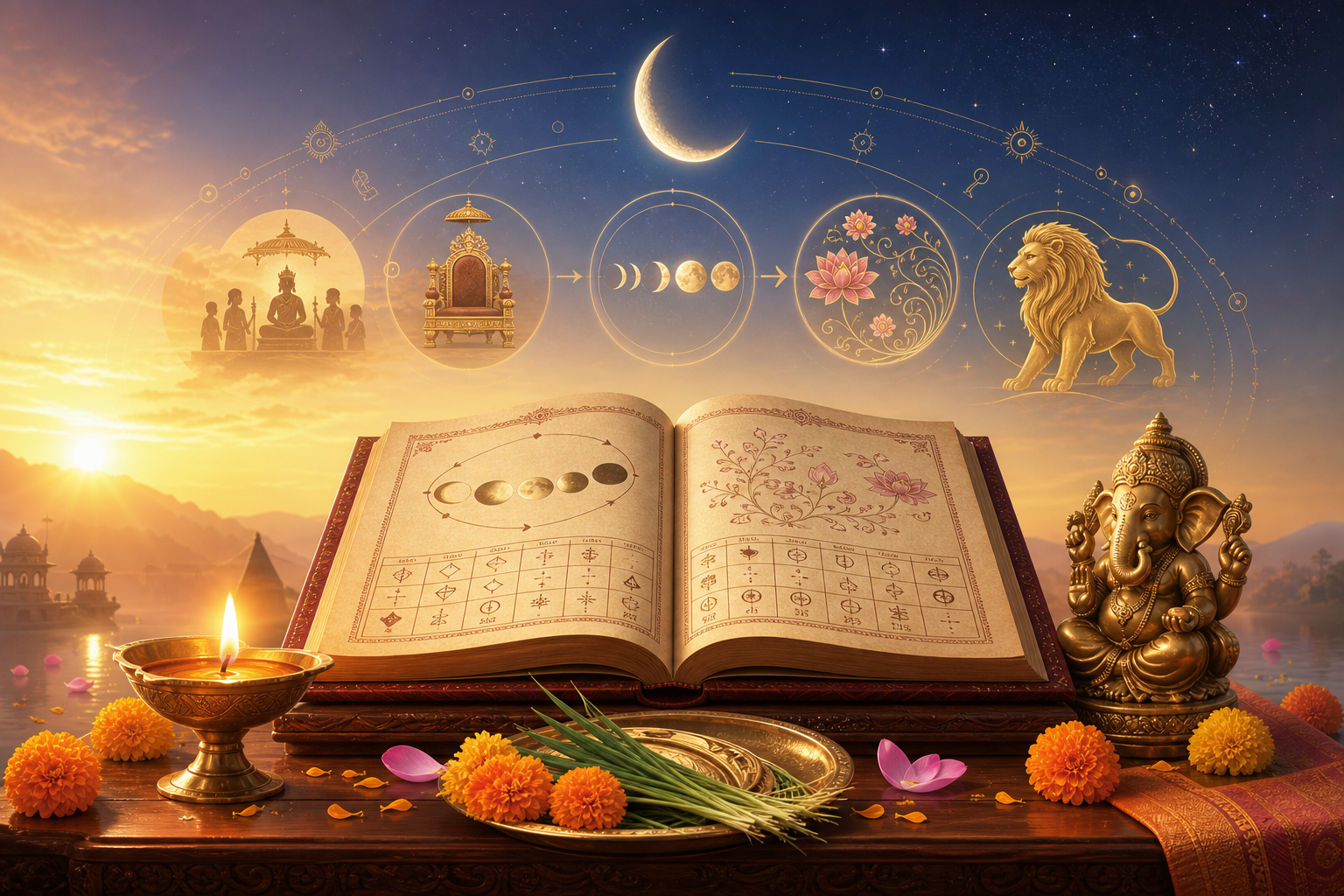
Friday, July 17, 2026, is an important date in the Hindu calendar because it falls in Shukla Paksha, the waxing or bright fortnight of the lunar month. In most regional Panchang traditions, the day begins under Shukla Paksha Tritiya, the third tithi after Amavasya, and then moves into Shukla Paksha Chaturthi. The supplied Panchang note records Tritiya until 9:39 AM on July 17, after which Chaturthi begins. Since Panchang timings are calculated from the relative movement of the Sun and Moon and are adjusted by location, local sunrise and regional calculation methods should always be checked before fixing a vrata, puja, journey, samskara, or other time-sensitive observance.
The core identity of the day is shaped by Shukla Paksha. This is the fortnight in which the Moon grows in brightness, symbolically associated with expansion, renewal, and the gradual unfolding of intention. In Hindu ritual culture, the waxing phase is often treated as supportive for devotional discipline, study, worship, charity, and beginnings that require clarity and growth. For households that follow the daily Panchang, this is not merely a calendar entry; it is a way of reading time as sacred, rhythmic, and connected to dharma.
Shukla Paksha Tritiya, the tithi active in the morning, is traditionally understood as a Jaya tithi, associated in many muhurta traditions with effort, resolve, and success after disciplined action. Tritiya is not interpreted in isolation; its practical value depends on the weekday, nakshatra, yoga, karana, sunrise, and the purpose of the work being considered. Even so, the morning presence of Tritiya gives the day a constructive tone for worship, learning, reflection, and moderate new undertakings, especially when supported by a suitable local muhurta.
After Tritiya ends, Shukla Paksha Chaturthi begins. Chaturthi is closely associated with Bhagavan Ganesha, the remover of obstacles and the deity invoked before auspicious beginnings. At the same time, traditional muhurta texts often treat Chaturthi with care because it belongs to the Rikta group of tithis, which may be avoided for certain major worldly ceremonies unless supported by specific ritual intent or a qualified priestly recommendation. This is why the change from Tritiya to Chaturthi is significant: the same civil day can carry two different lunar qualities.
For practical observance, the most reliable method is to identify which tithi prevails at sunrise and which tithi is active at the time of the intended ritual. Many festivals and vratas are determined by the tithi at sunrise, while others depend on the tithi prevailing during a particular part of the day or night. This technical detail explains why two families in different cities may sometimes observe a vrat on different civil dates while both are following valid Panchang rules. The Hindu calendar is therefore not a rigid date list; it is a location-sensitive system of sacred astronomy.
The Panchang is built around five limbs: tithi, vara, nakshatra, yoga, and karana. Tithi measures the angular distance between the Sun and Moon and changes roughly once a day, though not at the same clock time. Vara is the weekday, and July 17, 2026, is Friday, traditionally called Shukrawara. Nakshatra records the lunar mansion occupied by the Moon. Yoga is calculated from the combined longitudes of the Sun and Moon, while karana is half of a tithi. These five elements together create the technical foundation for assessing daily religious timing.
Friday carries its own cultural and devotional associations. Shukrawara is linked with Shukra, with refinement, beauty, learning, prosperity, and devotional worship of Devi, Lakshmi, and other forms of the Divine Mother in many households. In different Hindu sampradayas, Friday worship may include lighting a lamp, offering flowers, reciting stotras, maintaining a vrata, or performing simple acts of charity. Such practices are not merely transactional; they cultivate steadiness, gratitude, and reverence within ordinary domestic life.
Nakshatra and Rashi add another layer of meaning to the day. Location-based Panchang calculations for New Delhi show the Moon in Simha Rashi, with Magha Nakshatra prevailing until the evening and Purva Phalguni following thereafter. Magha is traditionally connected with ancestors, lineage, authority, and inherited responsibility. Purva Phalguni is associated with rest, sociability, creativity, and enjoyment. This transition is culturally meaningful because it moves the emotional tone of the day from ancestral dignity toward relational ease and creative expression.
Simha Rashi, or Leo, as the Moon sign for the day in many North Indian calculations, gives the lunar mood a royal, expressive, and self-respecting quality. In devotional interpretation, Simha can be read as a reminder that dignity should be held together with humility. A person may feel drawn toward recognition, leadership, or decisive action, yet the dharmic use of such energy is not egoistic display. It is disciplined responsibility, protection of what is sacred, and service performed with inner steadiness.
The good time, or shubh muhurat, on July 17, 2026, should be selected with attention to local Panchang data. General daily periods such as Brahma Muhurta, Abhijit Muhurta, Vijaya Muhurta, Godhuli Muhurta, and Amrit Kalam are often consulted for prayer, study, travel, or important decisions. A New Delhi reference calculation places Brahma Muhurta before sunrise, Abhijit Muhurta around midday, Vijaya Muhurta in the afternoon, Godhuli near sunset, and Amrit Kalam in the late afternoon. These periods may shift by city, so local verification remains essential.
Rahu Kaal, Yamaganda, Gulikai Kalam, Dur Muhurtam, Varjyam, and Bhadra are traditionally treated with caution. Rahu Kaal is especially observed in many regions as a time when new auspicious undertakings are avoided. This does not mean ordinary life stops; routine work, previously begun duties, study, service, and necessary responsibilities continue. The point is more precise: major initiations such as marriage talks, housewarming, business openings, or ceremonial beginnings are usually postponed outside these intervals when possible.
The spiritual value of the day lies in disciplined awareness. Tritiya in the morning can be used for prayer, study, mantra japa, and planning. Chaturthi later in the day can be approached through Ganesha worship, especially for removing mental hesitation, practical obstacles, and confusion before beginning necessary work. A simple offering of durva, flowers, a lamp, and sincere remembrance of Ganesha can give the day a grounded devotional center without requiring elaborate ritual arrangements.
From a dharmic perspective, the Panchang also supports unity across Hindu, Buddhist, Jain, and Sikh cultural worlds by reminding communities that sacred time can be honored through discipline, compassion, reflection, and ethical conduct. Different traditions may interpret lunar days differently, yet the shared reverence for mindful living remains powerful. A calendar becomes meaningful only when it leads to better conduct: patience in speech, restraint in consumption, gratitude toward ancestors, respect for teachers, and kindness toward family and society.
For those using the July 17, 2026 Panchang in daily life, the most practical approach is to note three things: the tithi transition from Shukla Paksha Tritiya to Shukla Paksha Chaturthi, the Moon’s nakshatra and rashi for the local region, and the day’s favorable and unfavorable time windows. This allows the Panchang to function as it was intended: not as superstition, but as a disciplined framework for aligning human action with cosmic rhythm, inherited wisdom, and thoughtful decision-making.
In summary, July 17, 2026, is a Shukla Paksha day marked by the morning influence of Tritiya and the later movement into Chaturthi. It is suitable for worship, reflection, study, devotional discipline, and careful planning, while major undertakings should be checked against the local shubh muhurat and avoided during traditionally inauspicious periods. A location-specific Panchang reference for New Delhi is available from Drik Panchang, and regional calendars should be consulted for precise local observance.
Inspired by this post on Hindu Blog.
