
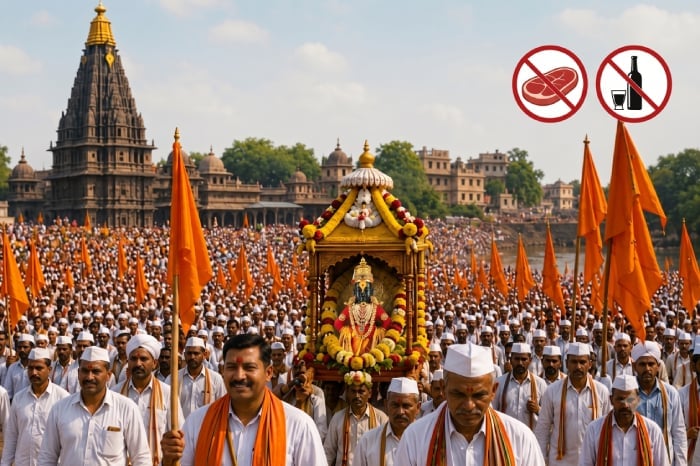
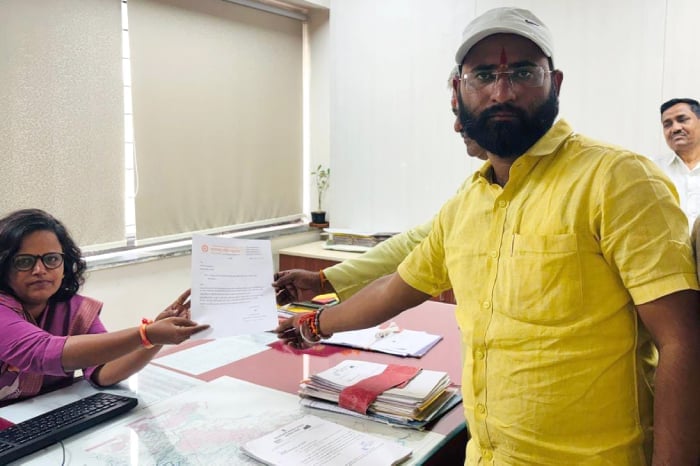
The Maharashtra Mandir Mahasangh has urged the administration to prohibit the sale of meat and liquor in Pandharpur from 22 to 29 July, presenting the demand as a measure to preserve the sanctity, devotional atmosphere, and religious traditions associated with the Ashadhi Yatra. The appeal is centered on one of Maharashtra’s most emotionally significant pilgrimage traditions, where lakhs of devotees converge on Pandharpur in reverence for Bhagwan Vitthal and Rakhumai.
The demand must be understood in the specific cultural context of Pandharpur. During Ashadhi Yatra, the town is not merely a geographical destination; it becomes a living sacred space shaped by bhakti, discipline, collective walking, kirtan, abhang, fasting, seva, and shared devotional memory. For Varkari devotees, the journey to Pandharpur is not only a religious event but also a moral and spiritual practice that emphasizes humility, restraint, equality, and surrender before Vithoba.
The proposed temporary restriction on meat and liquor sales is therefore being framed as a protective measure for the pilgrimage environment rather than as a permanent commercial prohibition. Such demands often arise during major religious gatherings because sacred towns experience a dramatic change in population density, social rhythm, public behavior, sanitation needs, crowd movement, and emotional sensitivity. In this setting, administrators are expected to balance religious sentiment, public order, local livelihood, legal norms, and the practical requirements of managing a high-density pilgrimage.
Ashadhi Yatra, also known through the larger devotional tradition of Ashadhi Wari, holds a unique place in Maharashtra’s cultural history. The Wari is closely associated with the legacy of saints such as Sant Dnyaneshwar, Sant Tukaram, Sant Namdev, Sant Chokhamela, Sant Savata Mali, Sant Janabai, and many others who helped shape a bhakti movement rooted in spiritual accessibility. Its devotional universe is marked by the idea that the path to the Divine is open to all sincere seekers, irrespective of social standing.
This is why Pandharpur’s pilgrimage culture carries significance beyond ritual observance. It functions as a social institution where devotion, discipline, music, memory, and community service converge. The sight of devotees walking in dindis, carrying saffron flags, singing abhangs, and taking the name of Vitthal reflects a civilizational continuity that is both deeply local and widely recognizable across the Hindu religious landscape.

The Maharashtra Mandir Mahasangh’s request also reflects a broader principle commonly seen in sacred geography: certain spaces are treated differently during periods of intensified worship. Around temples, pilgrimage routes, and festival zones, communities often expect a heightened standard of conduct. Restrictions on intoxicants, slaughter, or activities considered incompatible with sacred observance are frequently defended on the grounds of public discipline, religious sensitivity, and respect for devotees undertaking vows or austerities.

From an administrative perspective, the question is not only devotional but operational. Large pilgrimage gatherings require preventive planning. Temporary curbs on alcohol sales may be considered by authorities in many contexts to reduce the risk of disorder, accidents, harassment, crowd friction, and policing burdens. A meat-sale restriction, where demanded by religious bodies, is usually argued from the standpoint of maintaining the sattvic character of the pilgrimage town during the most sacred days of the yatra.

At the same time, any such decision requires clarity, proportionality, and timely communication. Shopkeepers, small food vendors, hotels, transporters, local residents, and visiting pilgrims all need predictable rules. If the administration accepts such a demand, the order must define the exact area, dates, commodities, enforcement mechanism, and exemptions, if any. Clear administrative language helps prevent confusion, selective enforcement, and unnecessary tension between residents, traders, and devotees.

The period mentioned in the demand, 22 to 29 July, indicates a time-bound appeal rather than an open-ended restriction. This distinction is important. Temporary festival regulations are often justified differently from permanent bans because they are tied to specific religious observances, crowd-management needs, and the preservation of a defined sacred atmosphere. The narrower the restriction, the stronger the administrative case usually becomes, provided it is implemented fairly and transparently.
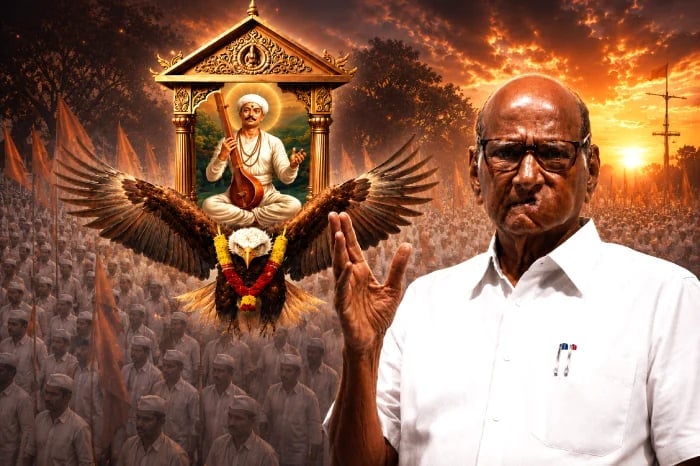
The emotional dimension of the issue is also significant. Many devotees who reach Pandharpur during Ashadhi Yatra have walked for days or weeks, often in difficult weather, with minimal personal comfort. Their journey is not a tourist itinerary but an act of devotion. For such pilgrims, the environment around the temple town becomes part of the vrata itself. A marketplace that reflects restraint, cleanliness, and reverence can strengthen the devotional experience for families, elderly pilgrims, children, and first-time visitors.

There is also a wider cultural lesson in the Wari tradition. The Varkari movement has historically emphasized devotion without arrogance, simplicity without exclusion, and community without hostility. Any discussion around restrictions during Ashadhi Yatra is therefore best approached through the language of mutual respect. The objective should be to protect the sacred character of Pandharpur while avoiding social bitterness or unnecessary polarization.
Dharmic traditions have long recognized that food, conduct, speech, and environment influence the mind. In Hindu practice, especially during pilgrimage and fasting periods, sattvic discipline is not treated as merely symbolic. It is understood as a support for inner steadiness, concentration, and devotion. Within that framework, the call to restrict meat and liquor sales during the yatra is seen by supporters as an attempt to align the public environment with the spiritual mood of the festival.
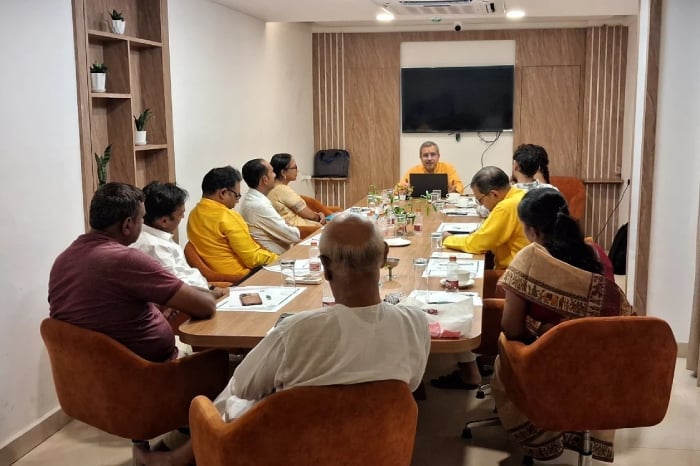
However, the administrative response must also consider civic fairness. A pilgrimage town is a sacred space, but it is also home to permanent residents and local businesses. Responsible governance must recognize both realities. The most constructive approach would be consultation among temple representatives, local traders, police, municipal authorities, food-safety officials, and community leaders so that religious expectations and economic concerns are handled through dialogue rather than confrontation.
The demand by the Maharashtra Mandir Mahasangh therefore opens a larger conversation about how India manages sacred public spaces during major festivals. The issue is not limited to Pandharpur alone. Across Bharat, from Kashi to Tirumala, from Puri to Haridwar, from Palitana to Amritsar, sacred geographies require distinct administrative sensitivity. Each place has its own traditions, but the underlying challenge is similar: how to maintain sanctity while ensuring orderly, lawful, and inclusive civic management.
Pandharpur’s special place in Maharashtra’s religious life makes this question particularly important. The town is associated with a form of devotion that is tender, musical, disciplined, and socially expansive. The name of Vitthal carries memories of saints, farmers, workers, families, and ordinary devotees who found dignity through bhakti. For many Maharashtrian households, Ashadhi Ekadashi is not simply a date on the Hindu calendar; it is an inherited emotional rhythm.
In that sense, the appeal for a meat and liquor ban should be read as part of a broader desire to preserve the moral atmosphere of the yatra. Whether the administration accepts the demand fully, partially, or with modifications, the decision will need to demonstrate respect for the pilgrimage’s spiritual importance and awareness of the practical realities of a functioning town.
The most constructive outcome would be a carefully drafted, time-bound, and fairly enforced policy that maintains peace, supports pilgrims, and minimizes hardship for residents and traders. Such an approach would honor the sanctity of Ashadhi Yatra without turning a devotional concern into a divisive civic dispute.
Ultimately, Pandharpur’s strength lies in the unity of devotion. The Ashadhi Yatra continues to remind society that sacred traditions are sustained not only by temple rituals but also by public conduct, community cooperation, and shared reverence. The Maharashtra Mandir Mahasangh’s demand has brought attention to these questions at a moment when the protection of pilgrimage culture, religious discipline, and civic harmony all require thoughtful engagement.
Inspired by this post on Hindu Jagruti Samiti.








Leave a Reply
You must be logged in to post a comment.