
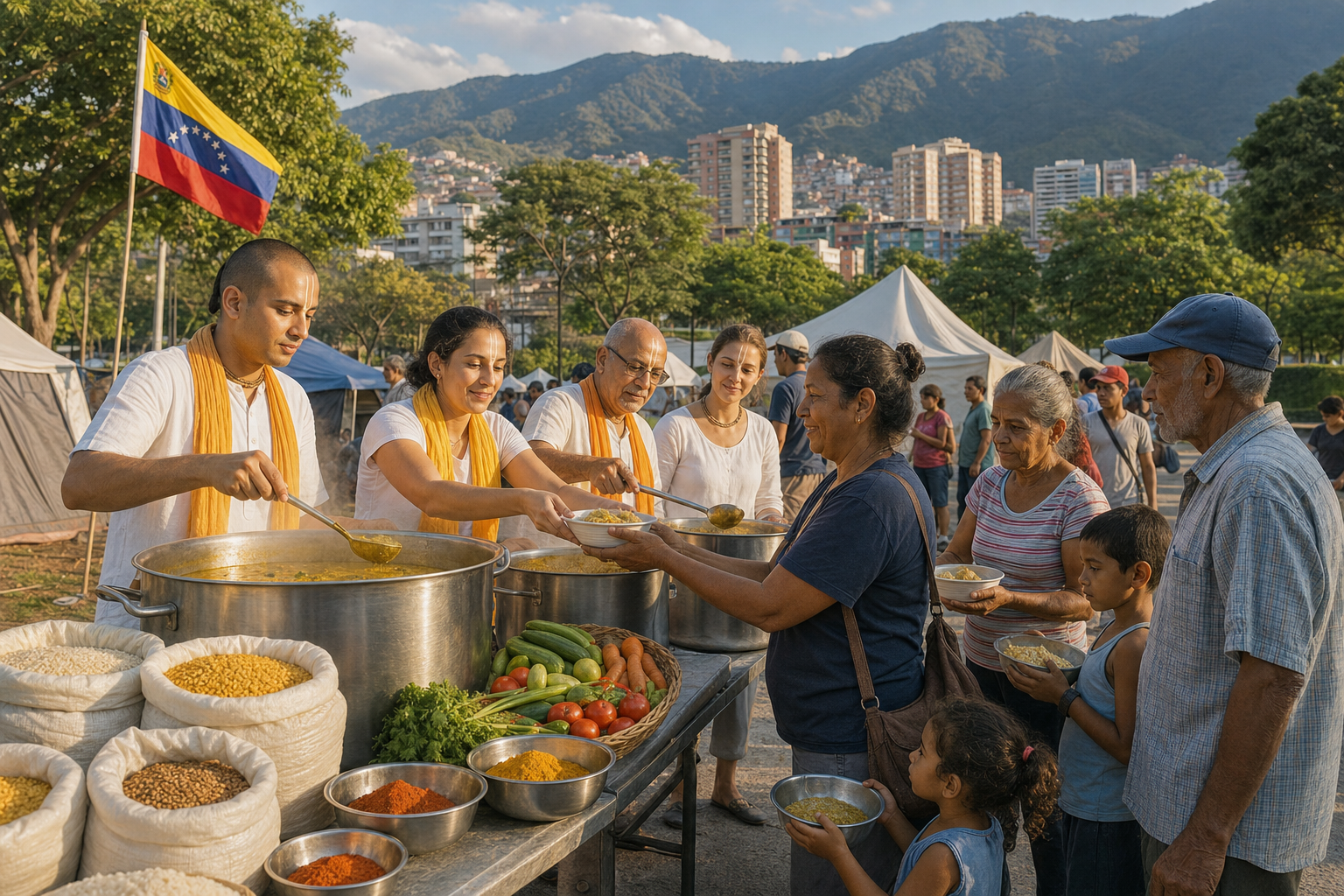
In Caracas, Venezuela, disaster relief became visible in one of its most direct and humane forms: warm cooked meals served to families who had been forced out of ordinary domestic life and into tents, streets, and public parks. The original account of Food For All’s response describes a modest but meaningful intervention by Loka Saranga Das, Parasuram Das, Food For All HQ, and the local ISKCON Caracas Food for Life program after an earthquake affected the community. The scene is not merely a charitable episode; it is a case study in how faith-based community kitchens can move quickly when formal systems are strained.
The response centered on a practical and time-tested principle: when people lose shelter, stability, and access to cooking facilities, prepared food becomes an urgent form of protection. A bag of ingredients may help a household with a functioning kitchen, fuel supply, clean water, and storage space. In a disaster zone, however, many of those assumptions collapse. Warm meals, served consistently and respectfully, can reduce hunger, preserve dignity, and create a rhythm of care amid uncertainty.
The UK delegation arrived in Caracas at the initiative of Parasuram Das and Food For All HQ to support the existing ISKCON Caracas Food for Life effort. This detail matters because effective humanitarian aid rarely begins with outsiders taking over local work. It begins by strengthening those already present, already trusted, and already familiar with the social, cultural, and logistical realities of the affected community. In this case, the local Food for Life team had already begun cooking and distributing meals soon after the earthquake struck.
From a disaster-management perspective, the intervention had three important features: speed, local partnership, and cultural continuity. Speed is essential because the first days after a disaster often determine whether vulnerable people receive basic nutrition and reassurance. Local partnership is essential because residents usually know where the need is greatest, which families are displaced, and which streets or parks have become temporary shelters. Cultural continuity is essential because food is never just calories; it carries memory, identity, and emotional stability.
The report that many families were sleeping in tents on streets and in parks conveys the deeper social effect of the earthquake. Displacement changes every aspect of daily life. Parents must find food while watching children in unsafe or crowded conditions. Elderly residents may be cut off from normal support. Children lose routines, privacy, and a sense of safety. In such settings, a community kitchen becomes more than a feeding operation. It becomes a point of contact, a place where people are seen, counted, and treated as members of a shared human family.
The 30 kilograms of spices brought from the UK may appear, at first glance, to be a small logistical detail. In reality, it reveals a sophisticated understanding of community feeding. Spices affect nutrition, taste, morale, and consistency. Large-scale vegetarian cooking depends on flavor architecture: grains, legumes, vegetables, oils, salt, and spices must be balanced so that meals are nourishing, digestible, and acceptable to those receiving them. In emergency settings, acceptability is not a luxury. People under stress are more likely to eat food that feels familiar, warm, and carefully prepared.
ISKCON’s Food for Life tradition has long emphasized the distribution of sanctified vegetarian meals, often known within Vaishnava communities as prasadam. In a broader public context, prasadam can also be understood as food prepared and served with spiritual intention, discipline, and care. This is where seva, or selfless service, becomes a practical social ethic. The kitchen is not separate from spirituality. It is one of the places where spirituality becomes measurable: in meals cooked, people fed, suffering reduced, and dignity protected.
The Venezuela effort also illustrates the wider relevance of dharmic traditions in humanitarian work. Hindu, Buddhist, Jain, and Sikh communities have each preserved strong models of food-centered service. Hindu seva, Sikh langar, Jain compassion toward living beings, and Buddhist karuna all point toward the same civilizational insight: nourishment is a moral responsibility, especially when suffering is public and immediate. The Caracas response fits within this wider dharmic grammar of compassion, where service is not performed for status but offered as a duty toward life itself.
Food security in Venezuela has been a serious public concern for years, shaped by economic crisis, inflationary pressure, shortages, and uneven access to essential goods. A natural disaster adds another layer of stress to people already navigating fragile conditions. In such an environment, a warm meal can carry disproportionate value. It saves money for a displaced family, reduces the burden of finding safe food, and gives volunteers a structured way to identify additional needs such as water, shelter, medical care, or support for children.
Community kitchens are technically demanding operations. They require procurement, storage, cooking capacity, fuel, water, hygiene controls, serving systems, waste management, volunteer coordination, and crowd flow. They also require judgment. Food must be prepared in quantities large enough to matter, but not so large that it spoils. Distribution must be orderly, but not cold or bureaucratic. Volunteers must move with urgency, but also with patience, because people who have lost stability may arrive anxious, tired, or grieving.
The Caracas Food for Life program appears to have acted on the principle that relief should be immediate and embodied. Rather than waiting for perfect conditions, the local team began cooking. This is a recurring strength of decentralized faith-based relief. Temples, community centers, and volunteer networks often possess kitchens, supply relationships, devotional discipline, and a ready culture of service. When coordinated responsibly, these assets can become a rapid-response system for humanitarian aid.
There is also an emotional dimension that formal relief language can miss. For a family sleeping in a tent, a cooked meal can communicate that their suffering has not become invisible. For a child, it may be the first normal moment in a frightening day. For volunteers, the act of serving can transform helplessness into purposeful work. This is why disaster relief should not be evaluated only by volume, though volume matters. It should also be evaluated by the quality of human contact it restores.
The involvement of Food For All from the UK shows how diaspora-linked networks can support local humanitarian action without erasing local leadership. Diaspora communities often have access to resources, transport channels, fundraising capacity, media attention, and specialized volunteers. Local communities have trust, cultural knowledge, language, and direct visibility of need. When these strengths are combined carefully, relief can become both efficient and respectful.
At the same time, responsible reporting on such efforts must avoid turning suffering into promotion. The most important subject is not the organization itself, but the people affected by the disaster and the model of service that responded to them. The Venezuela episode should therefore be read as an example of applied compassion: a small team, a local kitchen, essential supplies, and a disciplined commitment to feeding people during a period of displacement.
Local media coverage, including the Watford Observer report on the Hare Krishna-inspired charity’s deployment to Venezuela, helped document the connection between a UK-based support network and the Caracas relief effort. Such documentation is useful because humanitarian work often disappears quickly from public memory once the immediate emergency fades. Records, photographs, and local reporting preserve lessons for future responses: prepare community kitchens before disasters occur, build international partnerships before they are needed, and treat food relief as a core part of resilience rather than an afterthought.
The most compelling lesson from Food For All in Venezuela is that disaster relief does not always begin with large institutions or complex declarations. Sometimes it begins with a pot, a stove, spices, volunteers, and the decision to serve immediately. In the dharmic understanding of seva, that decision carries spiritual and social weight. Feeding the hungry is not symbolic compassion; it is compassion made tangible. In Caracas, that principle found expression in warm meals offered to families facing fear, displacement, and uncertainty.
Viewed academically, the episode demonstrates how religiously inspired humanitarian aid can contribute to disaster resilience when it remains inclusive, locally grounded, and focused on human dignity. Viewed personally, it reminds many communities that service becomes most meaningful when it reaches people at the point of need. The Venezuela response was modest in scale when compared with the enormity of national hardship, yet its significance lies precisely there: even limited resources, when organized through compassion and discipline, can become a lifeline.
Inspired by this post on Dandavats.
